


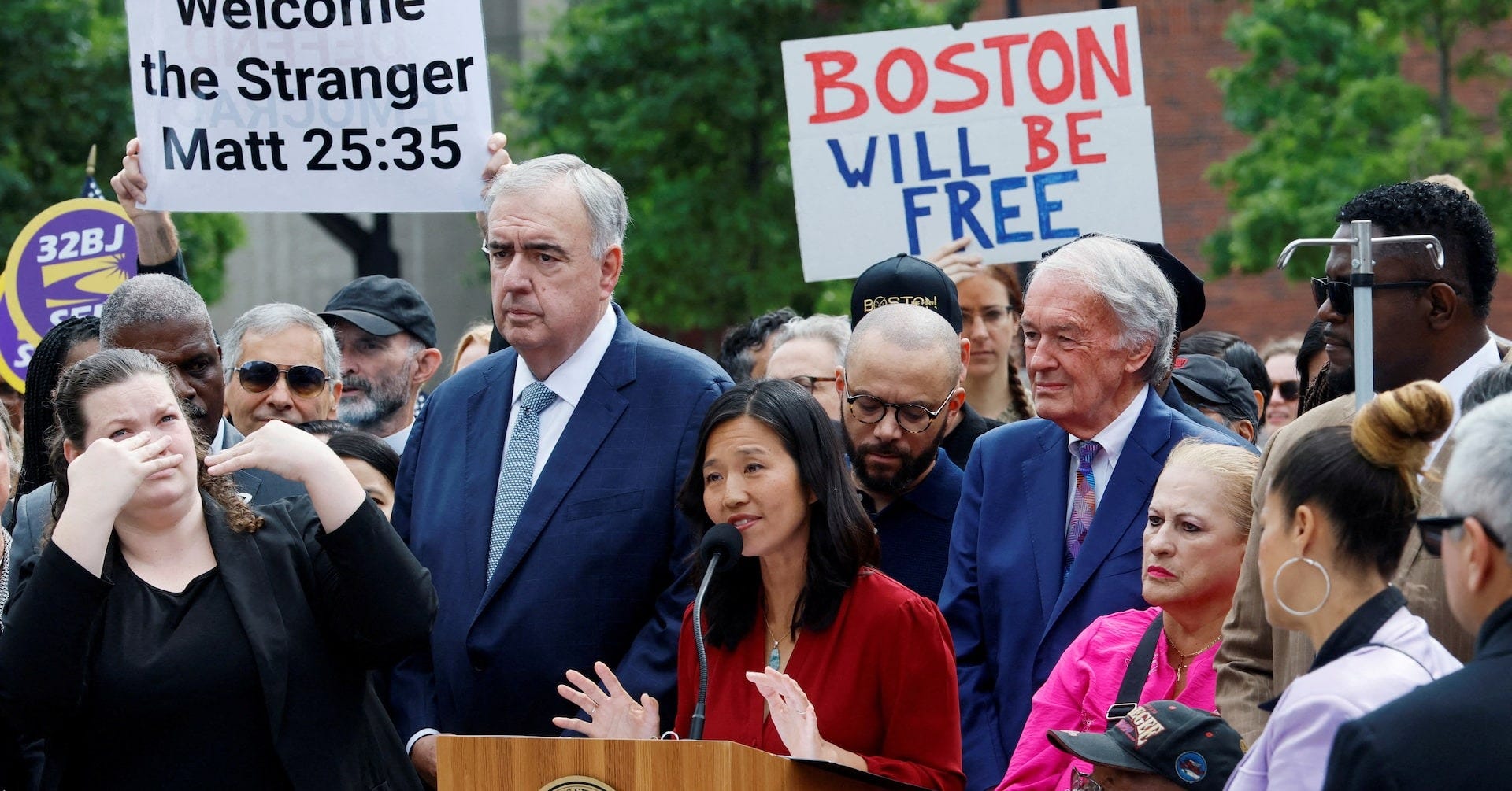
A federal judge has dismissed the Trump administration’s lawsuit challenging Boston’s immigration enforcement policies, handing the administration another legal setback in its growing campaign against sanctuary jurisdictions across the country.
U.S. District Judge Leo Sorokin ruled that the Department of Justice could not move forward with its challenge to Boston’s Trust Act, a local law that limits cooperation between city police and federal immigration authorities in civil immigration matters.
The court found that even if Boston’s ordinance were invalidated, Massachusetts law would continue to prohibit local officers from detaining individuals solely on federal immigration detainers. Because of that, the judge concluded the federal government failed to show how striking down the city policy would remedy the harm it alleged.
The ruling centers on a longstanding legal dispute over the role state and local governments play in federal immigration enforcement.
The Trump administration has argued that sanctuary-city policies interfere with federal immigration operations and make it more difficult for Immigration and Customs Enforcement to detain and remove people who are in the country illegally. Local governments and immigrant-rights advocates have countered that federal law does not require local police departments to carry out federal immigration duties.
The decision generated swift reaction from city officials and advocacy groups.
Boston Mayor Michelle Wu described the ruling as another legal victory for cities challenging federal immigration policies and said the city would continue enforcing the Trust Act.
The American Civil Liberties Union of Massachusetts also praised the decision, arguing that the Constitution does not allow the federal government to force local governments to administer federal immigration programs.
Coverage of the ruling quickly spread across national and local media outlets, with discussion extending across social media platforms and immigration-policy communities as the decision became part of the broader debate over sanctuary-city policies.
Subscribe free for daily political analysis they won’t broadcast. Join 110K+ readers →
The Boston case is only one front in a much larger legal battle.
Since returning to office, the Trump administration has pursued multiple lawsuits against states and cities that limit cooperation with federal immigration authorities. Several of those cases have targeted jurisdictions in Massachusetts, New York, Connecticut, Illinois, and other Democratic-led areas.
Supporters of the administration argue that local restrictions undermine federal immigration enforcement and public safety efforts.
Opponents argue that immigration enforcement is primarily a federal responsibility and that local governments cannot be compelled to dedicate resources to carrying out federal objectives.
The significance of the ruling extends beyond Boston.
Judge Sorokin’s decision focused heavily on standing and on the existence of independent Massachusetts legal restrictions. That reasoning could complicate similar lawsuits in other states where local immigration policies are reinforced by state law.
For the Trump administration, the ruling narrows one possible path toward increasing local cooperation with federal immigration enforcement.
For sanctuary jurisdictions, the decision provides another legal precedent supporting local discretion over how police agencies interact with federal immigration authorities.
With additional lawsuits still pending around the country, the battle over immigration enforcement authority is expected to remain one of the administration’s most closely watched legal and political fights heading into 2026.
Subscribe free for daily political analysis they won’t broadcast. Join 110K+ readers →