


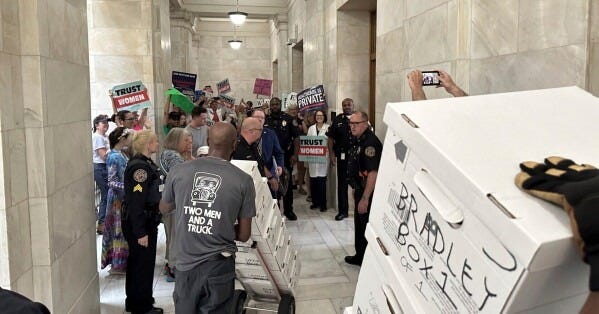
A federal judge has struck down several Arkansas laws restricting how citizen-led ballot petitions are circulated, ruling that major parts of the state’s petition-signature system violate the First Amendment.
U.S. District Judge Timothy Brooks issued the June 30 order in League of Women Voters of Arkansas et al. v. Jester, a federal case challenging Arkansas rules governing ballot initiatives and referendums. The plaintiffs include the League of Women Voters of Arkansas, Save AR Democracy, Protect AR Rights and For AR Kids. The defendant is Arkansas Secretary of State Cole Jester.
Brooks granted summary judgment to challengers on First Amendment claims involving several provisions. The court found unconstitutional the pre-collection disclosure rule for paid canvassers, the crime-notification rule, the photo ID verification requirement, the ballot-title reading requirement, the post-collection affidavit and “cool-off” period, and the requirement that petition sponsors reimburse the state for publication costs.
The court said those provisions burdened core political speech. In one section, Brooks wrote that Arkansas could not justify adding speech restrictions while failing to enforce existing laws against alleged petition fraud.
Subscribe free for daily political analysis they won’t broadcast. Join 110K+ readers →
The ruling does not fully resolve the case. Brooks dismissed some challenges, including claims against the 50-county requirement and Act 273’s signature-exclusion provision. Other issues will proceed to trial, including challenges to residency and domicile requirements for canvassers, the commission ban, and vagueness claims tied to the ID and reading requirements.
The legal consequence is significant for Arkansas petition campaigns. Several restrictions remain blocked while the case moves forward, and the court said final judgment and a permanent injunction will wait until remaining claims are resolved.
Jester, who defended the laws in court, said his office plans to appeal the ruling and continue defending voter ID-style safeguards.
Subscribe free for daily political analysis they won’t broadcast. Join 110K+ readers →