


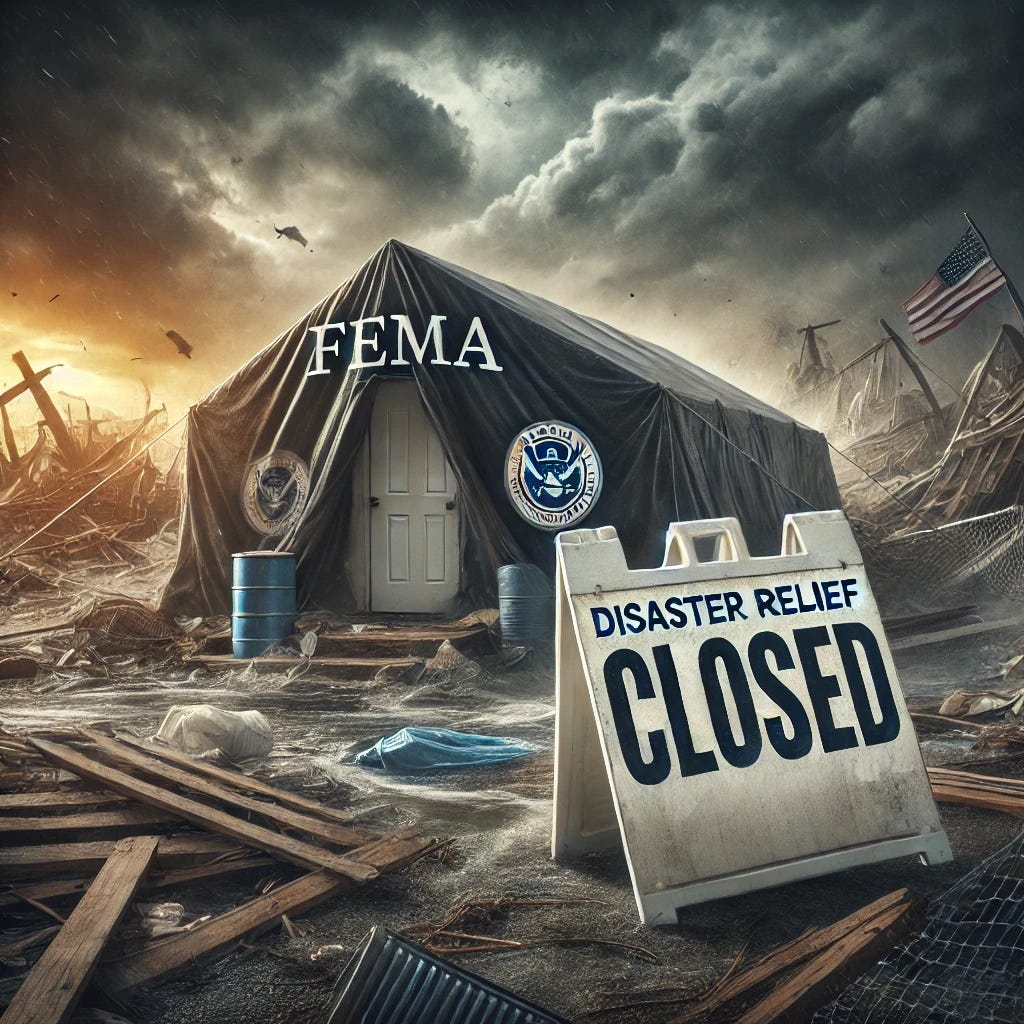
The Federal Emergency Management Agency (FEMA) has long been the backbone of America’s disaster response system, stepping in when communities are most vulnerable. FEMA provides critical funding, emergency relief, and long-term rebuilding assistance for hurricanes, tornadoes, wildfires, and floods. Now, in a politically charged move, President Donald Trump’s administration is freezing FEMA funding and purging officials over their handling of migrant-related aid. The consequences could be catastrophic, especially with tornado and hurricane seasons looming.
The Coffman Chronicle is powered by YOU—no billionaires, no corporate overlords. Help us keep exposing the BS, delivering sharp insights, and keeping you informed.
For just $8 a month or $80 a year, you can fuel the fight and be part of the movement.
Not ready to subscribe? No worries, chaos loves company, and you're always welcome. But if you’re fired up to keep us loud, proud, and unfiltered, smash that subscribe button now!
A Brief History of FEMA: A Lifeline in Times of Crisis
FEMA was established in 1979 under President Jimmy Carter, consolidating multiple federal disaster relief agencies into one central organization. Over the decades, FEMA has responded to thousands of disasters.
The agency is crucial in providing financial aid, coordinating rescue efforts, and helping communities rebuild. It is often the first and last line of defense for disaster-stricken areas, especially those without the local resources to handle large-scale emergencies.
However, FEMA has also been a political punching bag. Under Trump’s first term, he repeatedly threatened to withhold FEMA funding from states like California over wildfires, even though California contributes the most federal tax dollars that then fund FEMA in the first place. With Trump back in office, FEMA is again in the crosshairs—this time with far more sweeping consequences.
The Trump Administration’s Freeze on FEMA Funding
On February 11, 2025, Trump’s Department of Homeland Security (DHS) fired four top FEMA officials over their role in distributing aid for migrant housing in New York City. Trump officials claimed the firings were due to "egregious" spending on hotel accommodations for migrants. Critics argue this is a politically motivated purge designed to weaken FEMA and redirect funds away from humanitarian assistance.
The Real Story Behind the "Fraud" Allegation
The so-called “fraud” involved payments through FEMA’s Shelter and Services Program (SSP), an initiative designed to help local governments house and assist noncitizens released by federal immigration authorities. New York City legally received $80.5 million from this program to pay for temporary migrant housing, security, and food.
The allegations of “luxury hotel spending” have been widely mischaracterized. The average cost per night was $152, well within standard hotel rates for emergency housing in NYC. DHS leadership, appointed by Trump, framed this as reckless spending to justify a crackdown on FEMA and broader migrant assistance programs.
Making matters worse, FEMA officials have reportedly ignored a federal judge’s order to unfreeze certain disaster relief funds, an unprecedented defiance of judicial authority. The administration's message is clear: FEMA will now be a political tool, not a neutral disaster relief agency.
Why This Is a National Emergency
This assault on FEMA couldn’t come at a worse time. The U.S. is just weeks away from peak tornado season (March-May), and hurricane season begins June 1. Early forecasts suggest an above-average hurricane season, with warm Atlantic waters fueling potentially devastating storms. Freezing FEMA funds or defunding the agency entirely would leave millions of Americans vulnerable just as the most dangerous weather of the year approaches.
If FEMA funding is frozen, who will step in? State and local governments lack the resources to handle large-scale disasters independently.
Who Will Be Hurt Most by Freezing or Defunding FEMA?
1️⃣ Low-Income Communities & Rural Areas
These communities often lack insurance and savings to rebuild after disasters.
Many rely entirely on FEMA for relief and recovery.
2️⃣ Southern & Republican-Led States
Red states like Florida, Texas, Mississippi, and Alabama rely most heavily on FEMA.
These states experience frequent hurricanes and tornadoes. Without FEMA, recovery would take years.
3️⃣ Small Businesses & Farmers
FEMA provides disaster loans and crop loss assistance to small business owners and farmers.
Without this aid, businesses close, and rural economies collapse.
4️⃣ Seniors, Disabled People & Those with Medical Needs
Many rely on FEMA-funded shelters and emergency power for life-saving equipment.
Winter storms, wildfires, and hurricanes disproportionately affect elderly and disabled populations.
5️⃣ Democratic-Led Cities & States
Trump has a history of threatening to withhold FEMA funds from blue states, especially California.
New York, Illinois, and California face increasing floods, wildfires, and winter storms. Defunding FEMA would be catastrophic.
Final Thoughts: Playing Politics with Disaster Relief Is Reckless
FEMA is not just another government agency but a lifeline for millions of Americans. Whether you live in a blue or red state, a rural town or a big city, natural disasters don’t care about politics.
Trump’s decision to freeze FEMA funds and purge officials for political reasons is dangerous. It puts American lives at risk just as tornadoes, hurricanes, wildfires, and floods intensify. The real question is: Will Congress push back, or will Republicans allow their constituents to suffer just to score political points?
The clock is ticking, and for many Americans, this isn’t a political debate. It’s a matter of survival.
This is the end of the editorial. Keep reading or listening for the complete source list.
Bibliography:
Associated Press. (2025, February 11). Appeals court rejects Trump administration push to reinstate spending freezes on grants and loans. AP News. Retrieved from https://apnews.com/article/df756135aa9015457b6d14d59435cb89
Durkin, E. (2025, January 23). 'Setting us up for catastrophe': alarm at Trump attack on federal disaster agency. The Guardian. Retrieved from https://www.theguardian.com/us-news/2025/jan/23/trump-fema-natural-disasters
Federal Emergency Management Agency. (n.d.). Disaster Declarations Summaries - v2. OpenFEMA. Retrieved from https://www.fema.gov/openfema-data-page/disaster-declarations-summaries-v2
Federal Emergency Management Agency. (n.d.). Disasters and Other Declarations. FEMA.gov. Retrieved from https://www.fema.gov/disaster/declarations
Federal Emergency Management Agency. (2023, December 31). 2023 By the Numbers. FEMA.gov. Retrieved from https://www.fema.gov/blog/2023-numbers
Hawkins, A. (2025, February 12). 'Highway robbery': New York City hits back over FEMA funds seized by Trump administration. Politico. Retrieved from https://www.politico.com/news/2025/02/12/fema-new-york-city-migrant-hotel-funds-017015
Kaufman, A. (2025, February 12). Musk Inspires FEMA to Revoke $80 Million Intended for NYC. New York Magazine. Retrieved from https://nymag.com/intelligencer/article/musk-inspires-fema-to-revoke-80-million-intended-for-nyc.html
Vincent, I. (2025, February 11). Inside FEMA's sickening history of misspending billions of taxpayers' dollars - and going largely unchecked. New York Post. Retrieved from https://nypost.com/2025/02/11/us-news/femas-troubling-history-of-misspending-taxpayers-cash/
WDSU Digital Team. (2025, February 12). FEMA Reclaims NYC Migrant Shelter Funds. WDSU. Retrieved from https://www.wdsu.com/article/fema-reclaims-funds-nyc-migrant-shelters/63776481
Williams, T. (2025, February 12). Trump Administration Sues New York Officials, Revokes Funding Over Immigration. The Wall Street Journal. Retrieved from https://www.wsj.com/politics/policy/fema-nyc-migrant-centers-funding-claw-back-255aeae8