


On March 16, 2026, President Donald Trump signed an executive order establishing a national task force to combat fraud in federal social welfare programs. The initiative, to be led by Vice President J.D. Vance, arrives with familiar political urgency. It promises to root out abuse, restore integrity, and ensure taxpayer dollars reach their intended recipients.
Those are goals few would dispute. Fraud in public programs erodes trust and diverts resources from people who need them. Any serious government should invest in preventing it. Yet the way this order is framed raises an immediate and consequential question. Can an anti-fraud effort maintain credibility if it appears to identify its targets before defining how they are measured?
This Community Is Powered by You
What started as a small circle has grown into something much bigger, and it’s all because of readers like you.
Every time you forward this email, post it on socials, or bring someone new into the fold, you’re helping build one of the most passionate, independent political communities out there.
Want to keep the momentum going?
Share this newsletter with someone who should be part of this conversation.
Thank you for being here. It means everything.
What the Executive Order Actually Does
A Structured, Agency-Driven Process
The executive order is more substantive than some of its political messaging suggests. It lays out a three-stage process over 90 days that relies heavily on federal agencies themselves, rather than on political appointees, to identify weaknesses.
Within 30 days, agencies are directed to review their programs and identify transactions most vulnerable to fraud. These include eligibility determinations, benefit redeterminations, provider enrollment, and payment changes. The emphasis is on understanding where systems fail in practice rather than imposing assumptions from the top down.
Within 60 days, the task force is instructed to coordinate across agencies to establish minimum anti-fraud standards. These may include identity verification procedures, pre-payment checks, data sharing across programs, and enforcement mechanisms such as suspensions or repayment requirements.
By 90 days, agencies must submit implementation plans that outline how these controls will be applied in practice. The structure reflects a familiar approach in large systems. Identify risk points, standardize controls, and then enforce them.
This is, at least on paper, a reasonable administrative framework. It recognizes that the people who run these programs are often best positioned to identify vulnerabilities.
Leadership and Oversight
The decision to place Vice President Vance at the head of the task force signals that the administration intends to treat this as a high-level priority. The selection also echoes previous efforts by the administration targeting fraud allegations in Minnesota. The selection also centralizes authority within the White House, which may allow for faster coordination across agencies.
Yet centralization also raises the stakes for decision-making. When enforcement authority is concentrated, the legitimacy of the underlying methodology becomes even more important. To ensure decisions are not politically motivated, care should be taken to avoid preconceived conclusions, and enforcement must be uniform.
Unsurprisingly, this is where the Executive Order shows its true colors.
Where the Order Undermines Its Own Premise
Naming States Before Defining Metrics
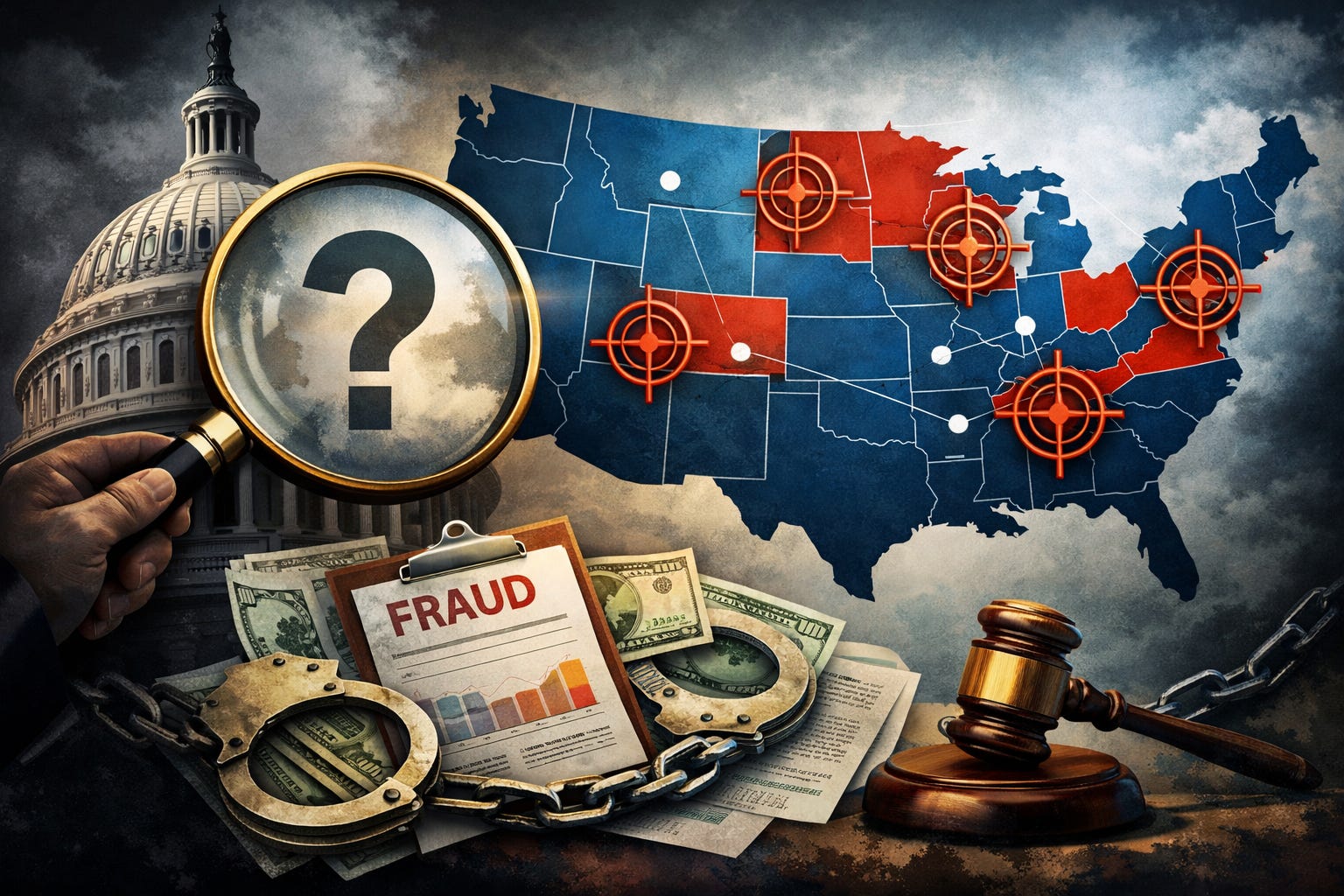
The executive order and accompanying statements do not stop at describing a process. They also single out several states, including Minnesota, California, New York, Illinois, Maine, and Colorado, as examples of weak oversight.
That choice is where the tension begins.
A credible anti-fraud system typically works in the opposite direction. It establishes metrics, applies them consistently, and then identifies which jurisdictions fall short. Here, the order gestures toward a methodology to be developed over time, while simultaneously naming jurisdictions already deemed problematic.
This suggests that the conclusions may precede the analysis and tie directly to the administration's rhetoric for months.
The Problem of Opaque Selection
The administration has not publicly presented a uniform metric explaining why these particular states were singled out. Federal programs measure performance in different ways, and those measures are not always comparable.
For example, the Supplemental Nutrition Assistance Program, or SNAP, publishes a “payment error rate” that reflects inaccuracies in benefit amounts or eligibility determinations. The U.S. Department of Agriculture is explicit that this rate is not a direct measure of fraud. Many errors stem from paperwork issues or administrative complexity rather than intentional abuse. It reflects both overpayments, fraud, and underpayments.
Medicaid, the joint federal and state health program, uses a different concept called the improper payment rate. The Centers for Medicare and Medicaid Services has warned that these rates are not designed for direct state-to-state comparisons and often reflect documentation issues rather than confirmed fraud.
When an administration cites states as examples of weak oversight without specifying which metric it uses, whether that metric measures fraud or error, and whether it is comparable across states, the selection begins to look less like analysis and more like assertion.
Minnesota and the Limits of Political Examples
Minnesota has been a central reference point in the administration’s rhetoric, largely due to high-profile fraud cases in recent years. Those cases were serious and exposed real weaknesses in program oversight.
Yet using Minnesota as a symbol of systemic failure becomes more complicated when examined through available national data.
In fiscal year 2024, Minnesota’s SNAP payment error rate was 8.98%. The national average was 10.93%. At least nineteen states and the District of Columbia recorded higher rates, placing Minnesota well outside the top tier of error rates on that measure.
This does not mean Minnesota has no oversight challenges. It does mean that a single or a handful of high-profile scandals do not necessarily reflect a state’s overall standing relative to others. A major fraud case can reveal a specific breakdown without indicating that a state is among the worst performers across the system.
The distinction is important. When political messaging elevates one state as emblematic of a broader problem, it risks conflating anecdote with comparative evidence. It is, to put it lightly, governing based on vibes rather than evidence.
A Broader Pattern Across States
Minnesota is not the only case where the logic appears uneven. Some states named by the administration may show elevated rates in certain programs, while others do not. At the same time, unnamed states may have comparable or worse performance on specific measures.
Alaska, for example, recorded one of the highest SNAP payment error rates in fiscal year 2024, at roughly 2%. At first glance, that figure is striking. Yet even here, the number reflects overall payment accuracy, not proven fraud, and can be influenced by factors such as small sample sizes and administrative complexity. The presence of such high outliers in states that are not politically highlighted underscores a larger issue. Without a consistent, clearly explained metric, it is difficult to understand why some states are singled out while others with comparable or even higher error rates are not.
A fair system would not require every state to perform perfectly. It would require that every state be judged by the same standards. Anything less is clearly partisan.
The Numbers May Point to a National Administrative Problem
The USDA data tell a more complicated story than the White House rhetoric does. In fiscal year 2024, 44 states were required to submit corrective action plans for SNAP payment errors, and 5 were in multi-year liability status and subject to fiscal sanctions. Those are serious numbers. They suggest the federal government is right to pay attention to program integrity, yet they also raise a different question, and perhaps a more important one. If so many states crossed the corrective action threshold in the same year, what changed?
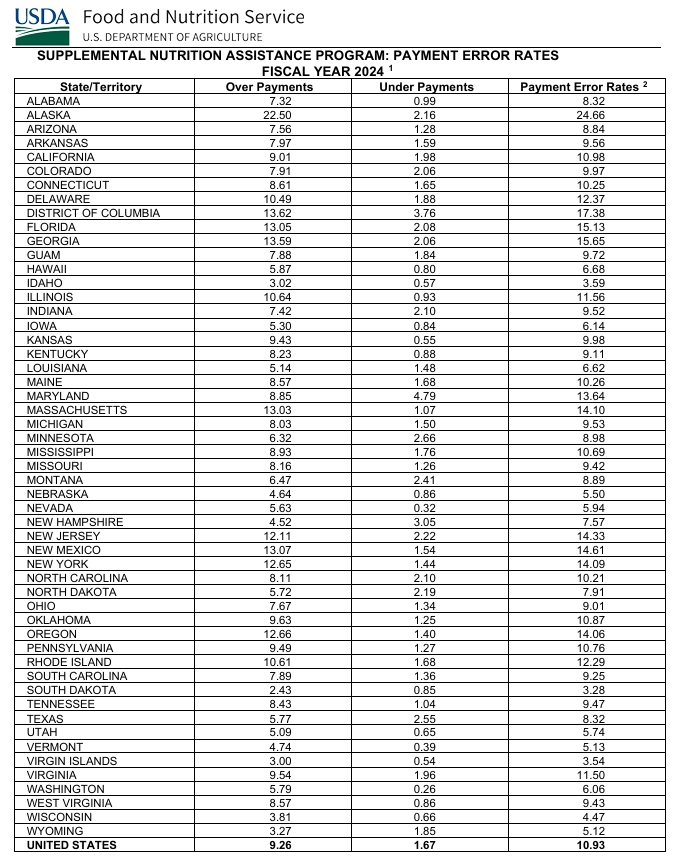
The USDA numbers do justify concern. They do not, however, justify the White House’s selective storytelling. When 44 states need corrective action plans in the same year, the obvious question is not only who failed, but also why. It is what changed. A pattern that widespread may point to staffing shortages, outdated systems, shifting guidance, or other structural pressures that cut across state lines. If that is the case, then the administration is describing a national administrative problem as though it were mainly a story about a few politically convenient states.
What a Credible Anti-Fraud Model Would Look Like
Letting the Data Lead
A more defensible approach would begin with anonymity. Jurisdictions could be assigned identifiers, and analysts could evaluate performance without knowing which state corresponds to which identifier. This kind of blinded review is common in other fields where bias is a concern.
The next step would involve comparing each jurisdiction to itself over time and to its peers to determine which states show consistent improvement, which ones show persistent problems, and which demonstrate stability across multiple programs.
From there, analysts could identify high performers and study what they are doing differently. If several states with strong outcomes use similar controls, that pattern becomes a candidate for broader adoption. If weaker performers lack those controls, the gap becomes clearer.
Only after that analysis would identities be revealed, allowing for targeted implementation and support.
Defining Metrics and Limiting Discretion
Equally important is the need for clear, standardized metrics. Fraud and error must be distinguished. Time periods must be consistent. Thresholds for action must be defined in advance.
The order also raises a more practical question. In at least some major programs, the federal government already has compliance systems in place. USDA already requires states with high SNAP payment error rates to submit corrective action plans, and repeat poor performance can trigger fiscal sanctions. Medicaid and CHIP likewise operate with corrective action processes for improper payments. That does not make new anti-fraud coordination unnecessary. Yet it does make it harder to tell whether the White House is building a new enforcement regime or repackaging powers the agencies already have.
The executive order gestures toward enforcement, including the possibility of withholding funds from jurisdictions that fail to meet anti-fraud standards, a measure that echoes current enforcement tools within these agencies. Yet it does not clearly define the thresholds that would trigger those consequences or how consistently they will be applied.
That introduces discretion at the most sensitive stage of the process.
Some degree of discretion is inevitable in complex systems. However, when it comes to systemic enforcement across states, too much flexibility can undermine the entire framework. If two jurisdictions with similar performance are treated differently, the system begins to look arbitrary rather than rules-based.
A credible model would limit that risk by tying enforcement to predefined triggers. If a state exceeds a certain threshold for a defined period, specific consequences follow. If performance improves, those consequences are reduced or removed.
This kind of structure does not eliminate judgment entirely, but it constrains it. It makes clear that enforcement flows from measurable outcomes rather than shifting interpretations.
The Stakes for Credibility
Fraud prevention is a legitimate and necessary function of government. Public confidence in social programs depends in part on the belief that they are administered fairly and responsibly.
Yet credibility is not built through intention alone. It depends on process. The process outlined by this Executive Order does little to inspire confidence in nonpartisanship.
When an administration names jurisdictions before establishing a neutral framework for evaluating them, and reserves broad discretion in how enforcement will be applied, it invites skepticism about whether the system will operate evenly. Even well-designed policies can lose public trust if they appear to be enforced selectively.
If the goal is to restore confidence, the most effective step would be a simple one. Let the data identify the problems, define the rules in advance, and apply them consistently in every case. As released, this system is primed for weaponization.
Subscribe for thoughtful, fact-driven commentary that respects your intelligence and your time.
Sources:
The White House — “Establishing the Task Force to Eliminate Fraud”, March 16, 2026
The White House — “Fact Sheet: President Donald J. Trump Establishes the Task Force to Eliminate Fraud”, March 16, 2026
Reuters — “Trump launches anti-fraud task force to be led by Vance”, March 16, 2026
Reuters — “What is the Minnesota social welfare scandal that has drawn Trump’s ire?”, January 14, 2026
Reuters — “Trump administration tightens US childcare reporting requirements, no funds frozen in Minnesota”, December 31, 2025
U.S. Department of Agriculture, Food and Nutrition Service — “Fiscal Year 2024 SNAP Quality Control Payment Error Rates”, June 30, 2025
U.S. Department of Agriculture, Food and Nutrition Service — “USDA Releases Annual SNAP Payment Error Rates for FY 2024”, June 30, 2025
U.S. Department of Agriculture, Food and Nutrition Service — “SNAP Payment Error Rates”, June 30, 2025
Centers for Medicare and Medicaid Services — “Fiscal Year 2025 Improper Payments Fact Sheet”, January 15, 2026
Centers for Medicare and Medicaid Services — “2025 Medicaid & CHIP Supplemental Improper Payment Data”, January 2, 2026
Sounds like a way to go after the blue states again. I’m sure there is fraud and abuse in every state. For example: Rick Scott, I have read that he abused a government entity. Was it medicaid or Medicare? Go after those who have truly no matter their party. But they won’t and that is a shame. 🤬
Exactly like the comment above the pig wants to throw crap onto blue states. If piggy doesn’t back down soft succession is the answer.