


Elon Musk wants you to believe he’s the misunderstood genius of our age, a sci-fi savior, a rocket man with a conscience, and a billionaire burdened with the responsibility of saving the planet from itself.
He sees himself as Iron Man, if Iron Man posted anime memes, tanked the global discourse, and sold cars that explode into lawsuits.
But here’s the real story: He’s not a hero. He’s not even a rebel. He’s a midlife crisis with a launchpad, a grudge list, and a badge that says “The DOGEFather” with the number 69420 printed on it.
He could’ve been Batman.
Instead, he’s LARPing as a meme savior while quietly dismantling the systems that keep people alive.
Independent News. Just $1/Week.
We just hit 12,000 subscribers—thank you! We’re offering full access to The Coffman Chronicle for just $1 a week ($52/year) to celebrate.
Get exclusive analysis and fearless reporting you won’t find in corporate media.
Support truth. Stay informed.
The Green Savior—Or Just a Really Loud Greenwasher?
Musk says he’s saving Earth. He tweets about “the mission” and sustainable energy like he’s on loan from Asimov. And yes, Tesla did shove the auto industry into the EV era.
But don’t let the branding distract you from the actual record.
Tesla builds luxury cars for the comfortably employed, not the climate-stricken masses. Its “Autopilot” feature is under federal investigation for multiple crashes and fatalities, and “Full Self-Driving” is neither full nor, in many cases, self-driving. Musk's factories have become ground zero for anti-union crackdowns, racial harassment lawsuits, and reported injury cover-ups.
And let’s talk about the money. For years, Tesla’s profits were buoyed not by building a greener world, but by selling carbon credits to more polluting companies—a little climate indulgence scheme that let other corporations keep pumping out emissions while Musk cashed in.
Meanwhile, his personal carbon footprint is nothing short of elite-tier hypocrisy. He takes so many short-hop private jet flights you could probably offset a small country just by grounding him during lunch.
Then there's SpaceX: Musk’s rocket-powered legacy project and planetary exit plan—if the ozone survives the launch schedule.
Every Starship launch emits over 1,000 metric tons of CO₂, the same as 10,000 cars yearly. The rockets also spew black soot into the stratosphere, which lingers longer and traps more heat than emissions released closer to Earth. When SpaceX tests go wrong—and they often do—concrete and debris rain down on surrounding wildlife refuges and coastal communities in Texas. It seems Twitter wasn’t the first bird he decimated.
This isn’t “accelerating the green revolution.”
It’s climate arson in brushed aluminum, set to an orchestral swell and a rocket emoji.
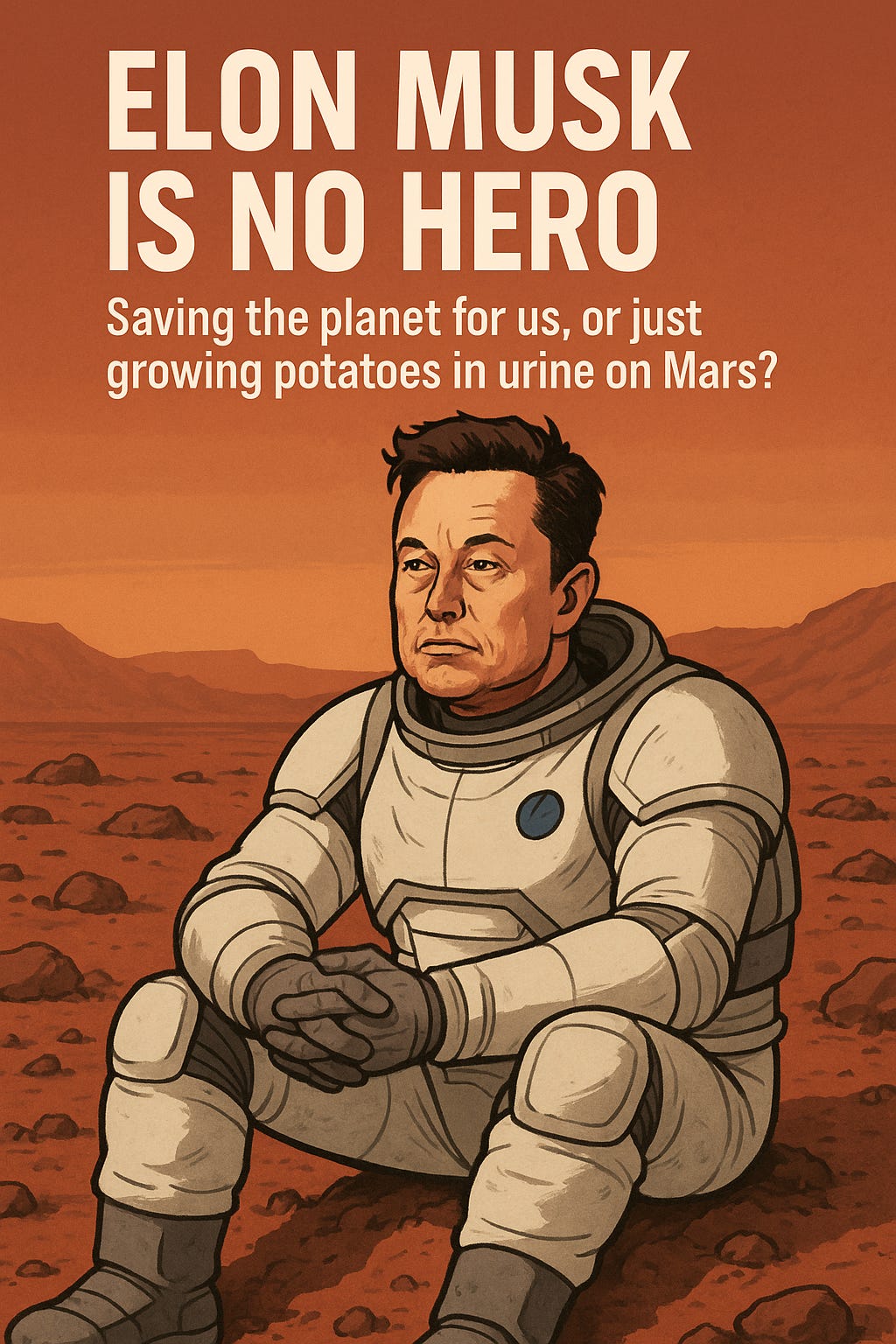
Mars as the Exit Plan
Because nothing says “I believe in Earth” like building a lifeboat on a dead rock 140 million miles away.
Elon Musk wants to be the man who saved humanity. Just not here.
His plan for our survival? Flee to Mars—a planet with no air, no water, no magnetic field, and enough radiation to make your bones ring. It’s framed as bold futurism, but in practice, it’s billionaire fatalism wrapped in a high-gloss launch video. And while he’s pitching this red-planet rescue fantasy, SpaceX continues to torch the blue one.
Each Starship launch emits over 1,000 metric tons of CO₂, releases black carbon into the stratosphere, and frequently blows chunks of steel and concrete across the Gulf coast. The launches aren’t rare either: SpaceX now accounts for over half of all orbital launches worldwide, and Musk wants hundreds more per year.
Scientists warn that if scaled, these emissions could raise stratospheric temperatures by 1–2°C, accelerating the same climate collapse Musk says he’s trying to outfly.
If we get there, the Martian survival plan involves living in radiation-shielded bunkers, wearing suits that cannot be removed, and growing potatoes in recycled urine.
Mars isn’t for the billions. It’s for the billionaires, and maybe not even most of them.
This isn’t progress. It’s just rich-man escapism launched on a plume of carbon and justified with anime memes.
He’s not saving Earth; he’s lighting it on fire, planting a flag on Mars, and tweeting “🔥🚀💎🙌” as the oceans rise.
The Musk Foundation – Charity in the Mirror
Because giving away billions isn’t hard when you give it to yourself.
In 2021, Elon Musk went viral for offering to donate $6 billion to end world hunger if the United Nations could show him a plan. The World Food Programme did just that, outlining how $6.6 billion could feed 42 million people on the brink of famine.
So what did Musk do?
Nothing.
Or, more precisely, he donated $5.7 billion worth of Tesla stock to his own Musk Foundation and never sent a dime to the UN. Just vibes, headlines, and a significant tax deduction.
What the Numbers Actually Say
The Musk Foundation held ~$9.5 billion in assets by the end of 2023.
IRS rules require private foundations to disburse at least 5% of their assets annually. In Musk’s case, that’s roughly $475 million.
He gave away... $54 million.
That’s $421 million short of the legal minimum.
For comparison:
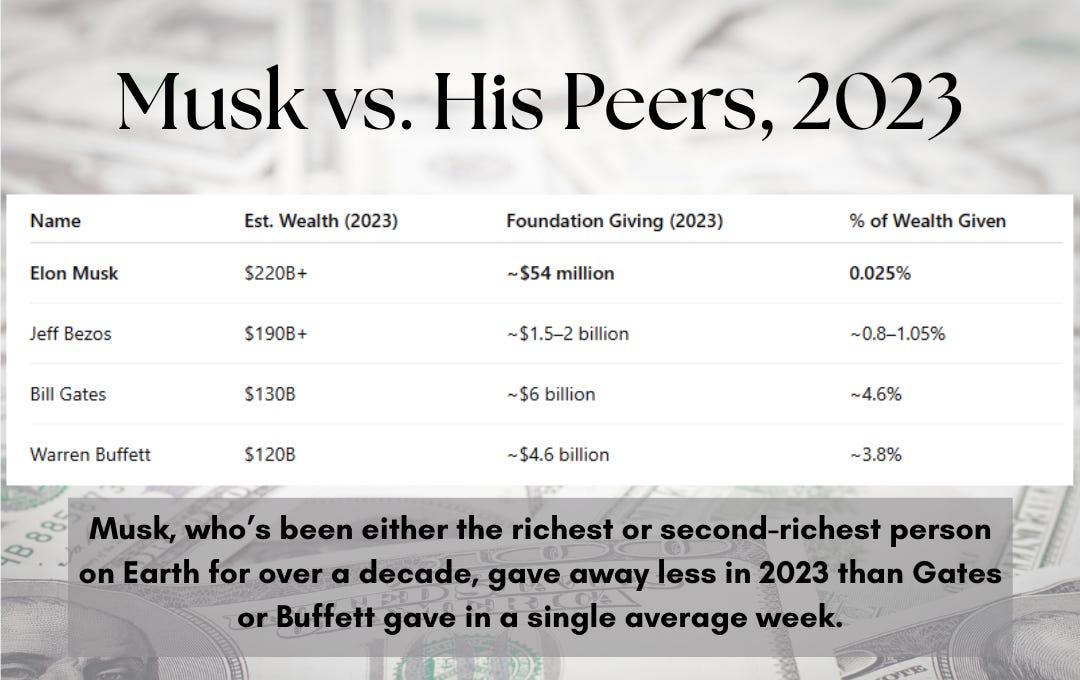
The world’s richest man gave away less than 0.03% of his wealth, mostly to himself.
This isn’t charity. It’s tax-advantaged brand maintenance.
X — The Memelord Monarchy
He didn’t buy Twitter to save democracy. He bought it to save his ego, and renamed it after his favorite letter.
When Musk bought Twitter in 2022, he said it was all about “free speech.” What followed was chaos with a rebrand: he gutted moderation, fired the safety teams, turned verification into a cash grab, and renamed the whole thing “X”, because what even is branding if it’s not cryptic, edgy, and vaguely pornographic?
The result? Extremists reinstated. Hate speech surged. Advertisers bailed. And Musk reportedly ordered his engineers to boost his own tweets to the top of everyone’s feeds, just in case the algorithm had the gall to prioritize someone else.
He didn't fix the platform. Instead, he made himself the main character and blamed everyone else when the house caught fire.
And here’s the kicker: X is now infrastructure. Not metaphorically—literally.
Agencies like NASA, FEMA, and the Social Security Administration now rely on Musk’s content platform to communicate with the public. Your grandma might need a burner account to find out if her benefits are delayed.
All while Musk controls Starlink, the satellite network powering everything from humanitarian relief to military ops. In a growing number of places, Elon Musk is the one you rely on for both internet access and the platform where your government talks to you.
He doesn’t just control the narrative. He controls the network.
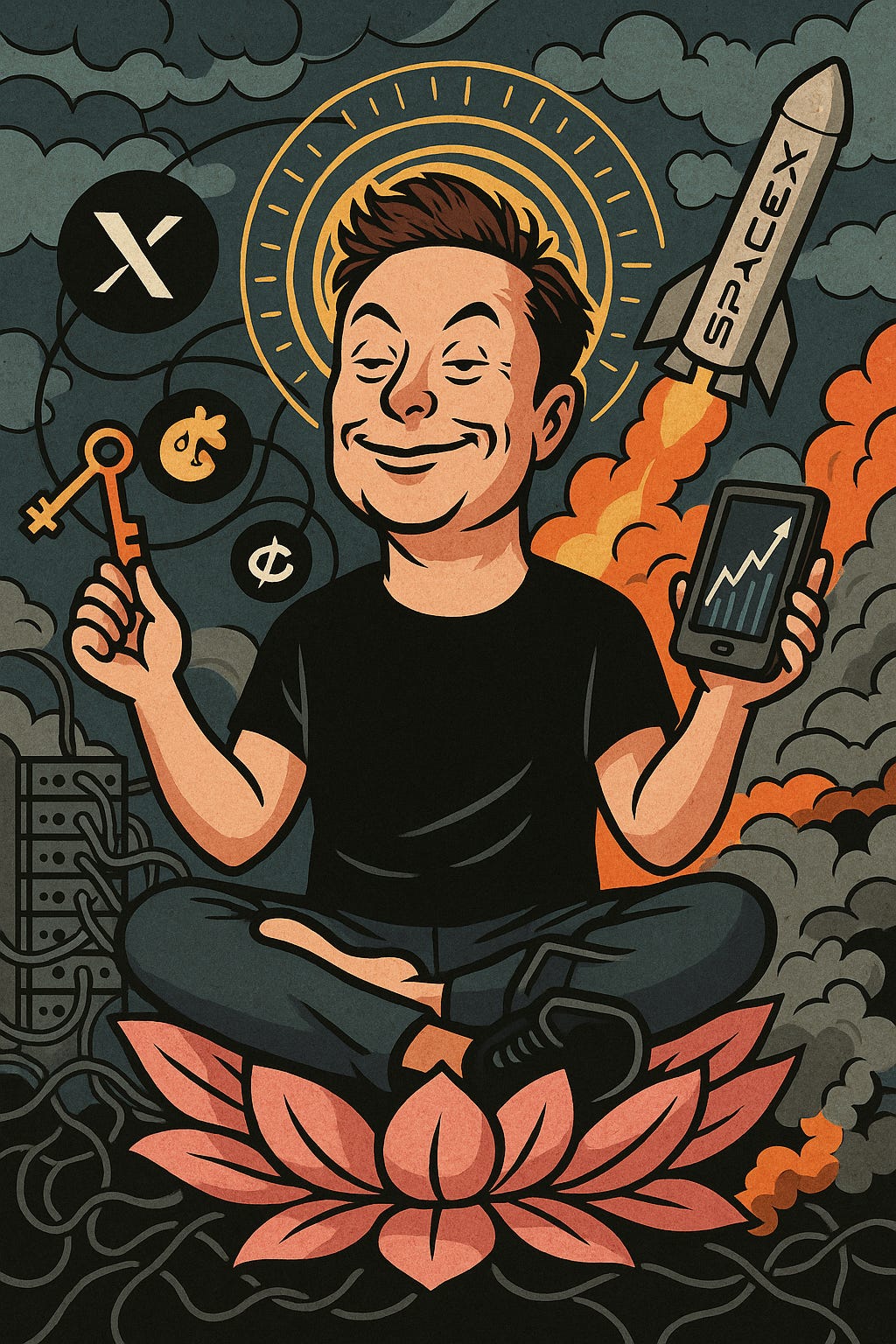
X isn’t a free speech utopia. It’s a stage he built for himself, and he’s the headliner, the spotlight, and the bouncer. He compared himself to Buddha. The only thing transcendent is his ego.
DOGE — Government by Meme and Grudge
Because nothing says “efficient government” like naming your federal agency after a joke coin and a dog meme.
When Musk was handed control of the Department of Government Efficiency (DOGE), he promised to save the U.S. government a trillion dollars by “cutting waste.” What he delivered instead was a glorified grudge tour in a novelty hat.
This wasn’t a thoughtful audit of bureaucratic bloat. It was a personal hit list, dressed up in meme logic and executed like a speed run through civil society.
He didn’t go after the actual money pits. The bloated defense budget? Left alone. Corporate subsidies? Still flowing. But the agencies that had investigated him, regulated him, or stood in the way of his companies? Suddenly, they were first in line for the guillotine.
The SEC, which fined him for misleading investors, was gutted. The EPA, which dared to question the ecological cost of SpaceX launches, was slashed. The FTC, the CFPB, and the NHTSA—all watchdogs tasked with protecting consumers from exactly the kind of behavior Musk engages in—found themselves defunded or dismantled.
And he didn’t stop at regulators. Entire service agencies—Education, Social Security, HUD, Health and Human Services—were downsized, privatized, or offloaded onto malfunctioning AI tools. School lunch programs stalled. Seniors waited hours on underfunded phone lines to access basic benefits. Critical agency communications moved to X, where access is spotty and accountability is nonexistent.
It was the Twitter playbook, scaled up: Fire the experts, break the systems, rebrand it all with a joke, and blame “the haters” when things fall apart.
He didn’t streamline anything. He gutted the infrastructure, destabilized public services, and posted through the fallout like it was a brand rollout.
And like all of his endeavors, he overpromised, underdelivered, and called it success. The promised $1 trillion? His own dodgy reporting suggests it is more like $160 billion at an estimated cost of $135 billion. Even Steve Bannon called out the bad math.
And the worst part? It wasn’t an accident. It was the plan.
We’ve been covering the carnage. These articles may be of interest:
Note: These articles are over 45 days old and now live in the archive. Consider becoming a paid subscriber for the full 500+ article archive, exclusive content, and occasional early access.


The Myth of the Inventor-King
He didn’t build the future. He bought it, branded it, and made you believe he soldered it himself.
Somewhere along the way, Elon Musk became a myth: the coding prodigy, the lone genius, the man who sleeps on factory floors and personally revolutionizes every industry he touches. Your cousin believes he invented Tesla. Your coworker thinks he codes rocket software. Your libertarian ex says he will upload humanity to the cloud between meme posts.
The truth? He’s not an inventor. He’s not a builder. He’s a wealthy man who buys impressive things other people started, and then aggressively rebrands them as his personal genius.
Tesla? He didn’t found it. He invested after the fact, forced the original founders out, sued to be called a co-founder, and won—because when you're that rich, you can rewrite origin stories like Wikipedia pages.
SpaceX? Musk didn’t design the rockets. He hired the best aerospace engineers in the business, pushed them to the brink, and took center stage every time a launch succeeded. When they failed, he blamed the team.
Neuralink and Starlink? He’s not in a lab soldering chips or calculating orbital velocity. He signs checks, stages demos, and tells the press it’s world-changing. Then he logs onto X and posts an anime meme about brainwaves.
And no, he doesn’t write code anymore. What he writes are tweets. Unfiltered. At all hours, flipping the market with a meme.
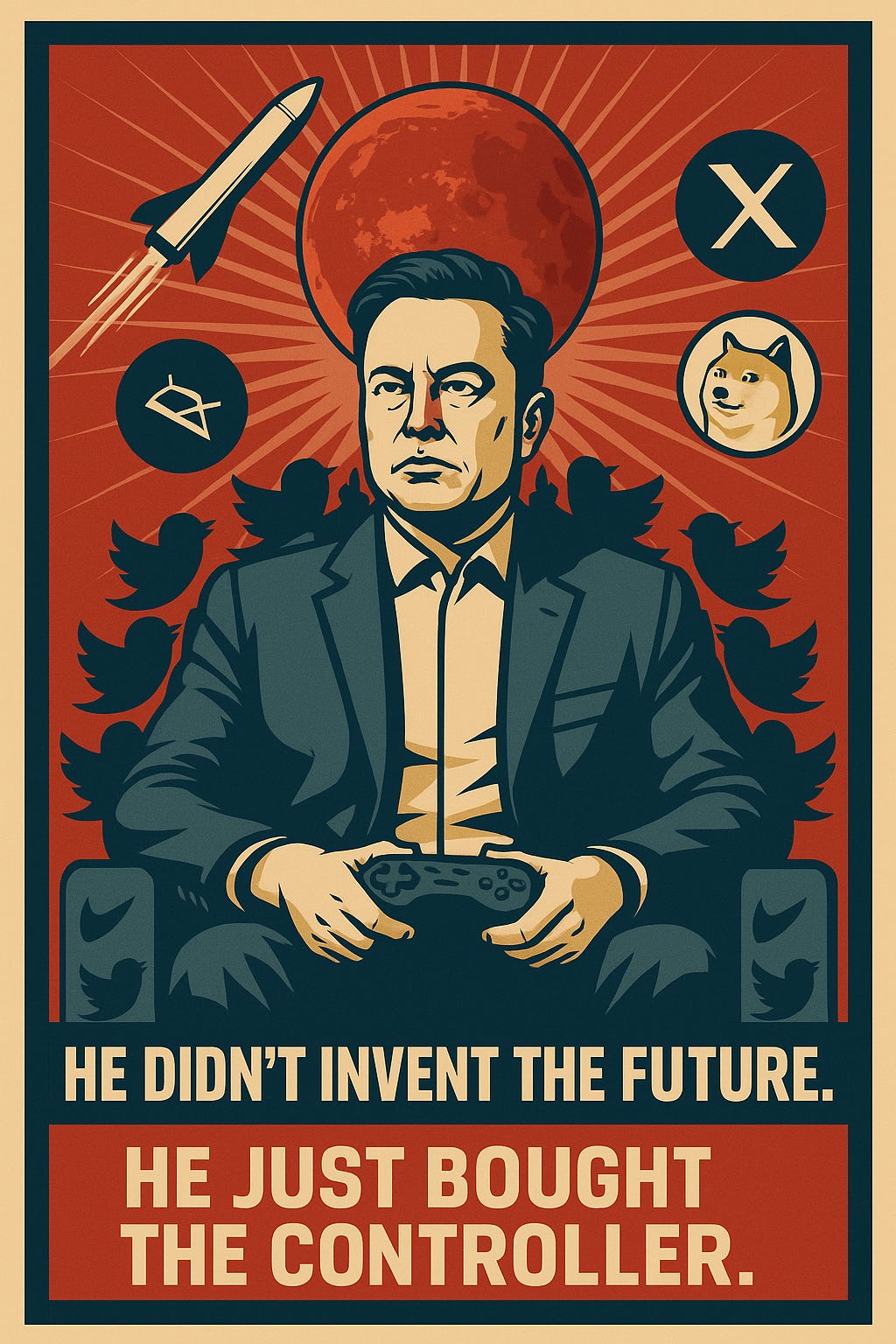
He’s not a fraud. The genius is real, but it’s not the kind that builds. It’s the kind that brands, performs, and conquers. He’s not the architect of the future. He’s a hype-industrial complex wearing a zip-up hoodie and sitting on a rocket someone else built.
Musk doesn’t invent. He colonizes innovation, narrates it as personal sacrifice, and demands a standing ovation for the empire he annexed.
He didn’t give us progress. He gave us a storyline and cast himself as the protagonist.
Lex Luthor in a Batsuit
Elon Musk wants to be Batman—the brooding billionaire, the misunderstood genius, the one man brave enough to stand between humanity and the void.
But he’s not Batman. He’s not even Iron Man. He’s Lex Luthor with a meme folder, a fleet of lawyers, and a main character complex. He funds rockets he doesn’t design, posts through disasters he causes, and insists he’s the savior while cutting the safety net out from under everyone else.
He’s the final boss of late-stage tech worship: a man who consolidates power, destabilizes systems, and calls it “disruption.”
He dismantles government like it’s a puzzle he got bored with.
He rewires democracy like it’s his smart home.
And when anything goes wrong, he rageposts at 3 a.m. and blames “activists” or “legacy media.”
This is the guy who controls your internet, moderates your town square, and may soon decide how your health data is stored or how your kid's school gets funded.
And yet, when he lost to a tutorial-level boss in a video game, he threw a fit and logged off. Because it was never about saving anything, it was always about winning, and being seen as the smartest one in the room while doing it.
He bought the console.
Renamed the game “X.”
Still blamed lag when he lost.
Elon Musk doesn’t want to save the world. He wants to own whatever’s left of it and meme from the throne while the rest of us burn, and the billionaires garden in filtered piss.
We just hit 12,000 subscribers—thank you! We’re offering full access to The Coffman Chronicle for just $1 a week ($52/year) to celebrate.
Get exclusive analysis and fearless reporting you won’t find in corporate media.
Bibliography:
Wilson, Andrew. "How Environmentally Friendly Is SpaceX's Starship?" Space.com, March 10, 2023.
"Billionauts' Space Tourism and Mars Fantasies Need to Be Pulled Back to Earth." Carbon Market Watch, August 30, 2024.
"SpaceX's Impacts to Boca Chica, Texas." Defenders of Wildlife, October 2024.
"SpaceX Damages Bird Habitat, Environment Around Texas Starbase." Business Insider, July 2024.
"Elon Musk's Charitable Foundation Ballooned to $9.5 Billion in Assets Last Year While Handing Out $237 Million in Gifts." Bloomberg, December 13, 2024.
"Musk Foundation." Wikipedia.
"Elon Musk's Foundation Gave Away Less Money Than Required in 2023." The Salt Lake Tribune, December 14, 2024.
"Elon Musk Created a Special System for Showing You All His Tweets First." The Verge, February 14, 2023.
"Elon Musk Reportedly Forced Twitter Algorithm to Boost His Tweets." The Guardian, February 15, 2023.
"Twitter Under Elon Musk." Wikipedia.
"Elon Musk Does Not Regret Work at DOGE, Support for Trump: 'Essential' for America to 'Reach Greater Heights'." New York Post, May 4, 2025.
"Federal Workers in Limbo Amid Whiplash White House Firings and Court-Ordered Rehirings." The Guardian, May 4, 2025.
"DOGE Says It Has Saved $160 Billion. Those Cuts Have Cost $135 Billion, Analysis Finds." CBS News, May 4, 2025.
"Elon Musk Says DOGE Needs to Endure Amid Hints That He'll Step Away." Politico, May 1, 2025.
"Musk Defends His Work as He Prepares to Wind Down at DOGE." Associated Press, May 1, 2025.
"DOGE Cuts Are in Doubt as Trump Shows Musk the Door in Cabinet-Meeting Sendoff." MarketWatch, May 1, 2025.
"Most Americans Don't Think DOGE Has Actually Cut Government Waste, Poll Says." Business Insider, April 2025.
