


President Donald Trump fired Homeland Security Secretary Kristi Noem on March 5, 2026, after a brutal week of hearings on Capitol Hill and mounting outrage over deaths in DHS operations and a $220 million no-bid ad contract that mostly starred… Kristi Noem. He announced, on Truth Social and then everywhere else, that he would nominate Senator Markwayne Mullin of Oklahoma to replace her, with Mullin expected to take over the department at the end of March.
Noem is being kicked upstairs into a newly invented diplomatic role as “Special Envoy for the Shield of the Americas,” complete with a Florida rollout event and a mandate to work with right-wing governments in Latin America. Mullin, by contrast, is being handed one of the largest, most complicated departments in the federal government.
See our earlier reporting on the Shield of the Americas here:

The temptation is to treat all of this as casting news in a never-ending political reality show— Noem, the ad-campaign star with the private jet and the congressional brawls, Mullin, the MMA fighter turned senator, who once challenged the head of the Teamsters to settle a dispute with their fists in the hallway.
However, this is not a casting decision. It is about who runs the Department of Homeland Security. That matters far more than any meme.
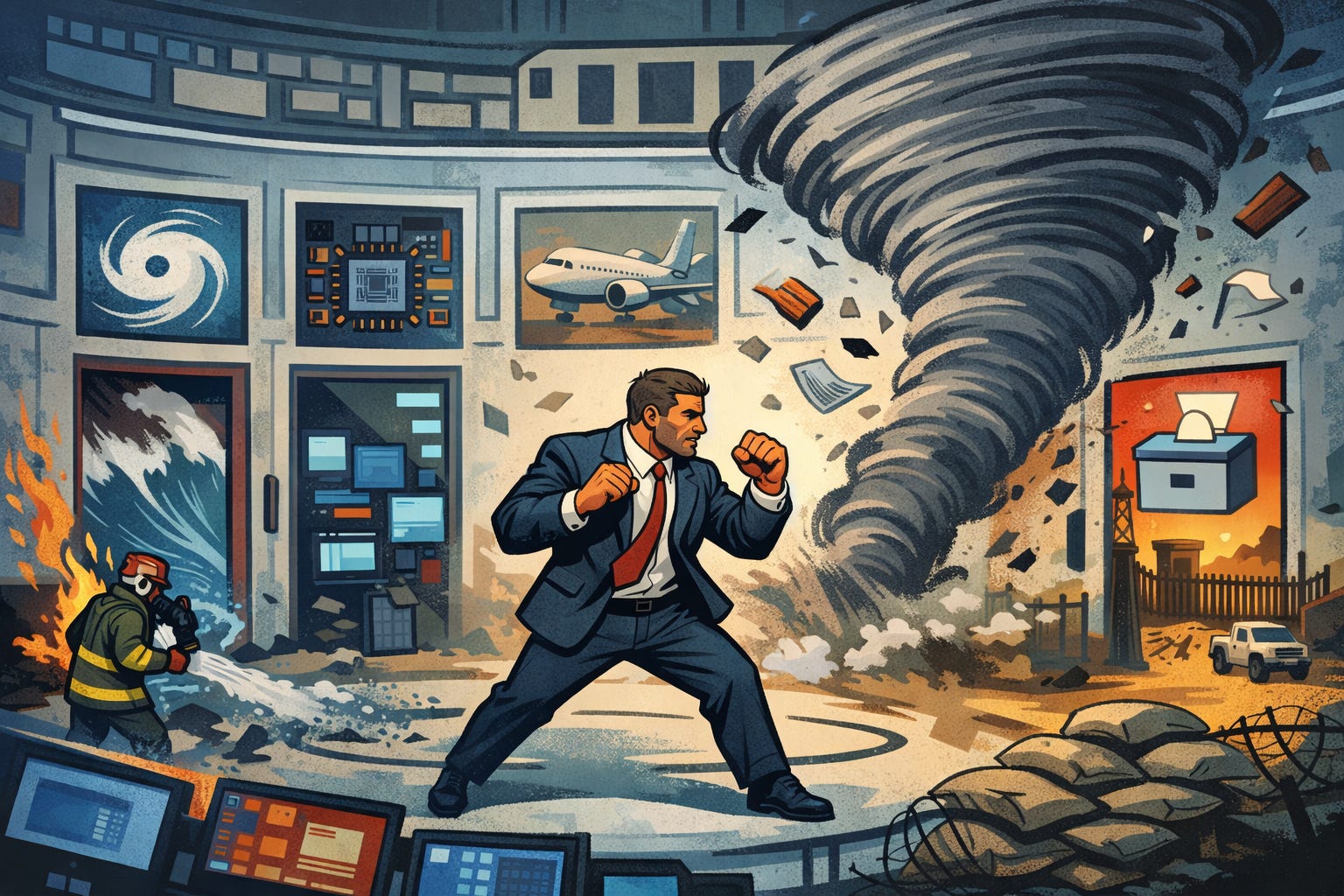
This is not a personal indictment of Kristi Noem or Markwayne Mullin. This is about their public behavior and résumés, and the job description of the position. The concern is simple. The Trump administration keeps treating the DHS secretary as a mascot for border politics, when the job is supposed to be an administrator and steward for a sprawling, high-stakes department that also includes disaster response, cybersecurity, aviation, ports, and the security of our elections.
This Community Is Powered by You
What started as a small circle has grown into something much bigger, and it’s all because of readers like you.
Every time you forward this email, post it on socials, or bring someone new into the fold, you’re helping build one of the most passionate, independent political communities out there.
Want to keep the momentum going?
Share this newsletter with someone who should be part of this conversation.
Thank you for being here. It means everything.
DHS Is Bigger Than The Border
When people hear “DHS,” they usually think of immigration, ICE, Border Patrol, and walls. That is a big part of the story, especially under Trump. However, it is not the whole story, or even most of it.
By statute, the Department of Homeland Security is the federal executive department responsible for “public security,” created after the September 11 attacks. It is now the third-largest Cabinet department, with more than 240,000 employees.
The major DHS components include:
FEMA (Federal Emergency Management Agency), which coordinates federal disaster response and recovery
TSA (Transportation Security Administration), which handles aviation and other transportation security
CISA (Cybersecurity and Infrastructure Security Agency), which helps protect critical infrastructure, including election systems
U.S. Coast Guard, which manages maritime safety and security
U.S. Secret Service, which protects presidents, candidates, and investigates certain financial crimes
CBP (U.S. Customs and Border Protection) and ICE (U.S. Immigration and Customs Enforcement), which handle border and interior immigration enforcement
USCIS (U.S. Citizenship and Immigration Services), which runs the legal immigration and benefits system
That list is not trivia. It is a reminder that the DHS secretary is not just the boss of ICE. The secretary is the person who should be calm and credible on television after a hurricane, reassuring after a cyberattack, clear after an airport security failure, and steady when the country is worried about elections being hacked or disrupted.
Yet when you look at how Trump has used the office in his second term, the public face of DHS has shrunk down to a single mission: immigration enforcement as theater.
What The DHS Secretary Is Actually Supposed To Be
No one is going to walk into the secretary’s office knowing every detail of border operations, disaster logistics, cyber defense, aviation regulations, maritime law, and presidential protection. That person does not exist. Fortunately, that is not what the job actually requires.
The DHS secretary’s role is closer to that of an administrator of a large hospital system or university than to that of a star surgeon or star professor. The secretary oversees a huge, fragmented structure, coordinates between very different internal cultures, manages budgets, priorities, and turf wars, communicates with governors, mayors, and tribal governments, and answers to Congress and the public when things go wrong
In other words, the job is to clear obstacles so the experts at FEMA, CISA, TSA, Coast Guard, Secret Service, CBP, ICE, and USCIS can do the work they are trained to do. It is to manage the messy, boring, behind-the-scenes infrastructure of competence.
In healthy institutions, you can see this pattern. In a good nonprofit, the administrator is not the one running the food bank or teaching the literacy class. The administrator is the one grinding through grant reports, resolving internal conflicts, setting up shared systems, and making sure the lights stay on. The work is spreadsheets and meetings, not photo shoots. When that person speaks for the organization, it is usually after listening to frontline workers and crafting a message with them.
Previous DHS secretaries have often come from that kind of background. Tom Ridge and Janet Napolitano came to DHS after serving as governors, where they had already overseen emergency management, National Guard deployments, statewide law enforcement, and complex budgets. Their biographies read like instructions for how to be an institutional grown-up.
Kristi Noem, for all the damage of her tenure, at least arrived with executive experience from running South Dakota and dealing with disasters and state agencies.
The point is not that governors are perfect. The point is that the DHS secretary is supposed to be a steward of a broad system, not the face of a single policy lane.
Markwayne Mullin’s Résumé And Reputation
That brings us to Markwayne Mullin.
On paper, Mullin is a businessman and rancher who inherited and grew a family plumbing and construction company, then served a decade in the House before moving to the Senate in January 2023. As of his nomination, he has about three years of Senate experience.
His official biography lists his business ventures and family life. It does not list any experience running an emergency management agency, commanding a law enforcement body, overseeing aviation or maritime safety, working in cybersecurity, or managing a large federal bureaucracy. The closest thing he has to that world is sitting on committees and voting on legislation.
His public persona is something else entirely. In November 2023, during a Senate HELP Committee hearing, Mullin read a mocking tweet from Teamsters President Sean O’Brien, pushed back from the dais, and invited O’Brien to “stand your butt up,” clearly proposing that the two men settle their dispute with a physical fight. Bernie Sanders, who was chairing, had to shut it down. The exchange went viral because it looked like a half-serious bar fight had broken out in a Senate hearing room.
Mullin has also built a brand as a “fighter” for Trump, with aggressive rhetoric toward the press and political opponents, and a clear alignment with Trump’s hardline immigration stance. That is a political choice. It is also a deliberate style.
See our previous reporting on Mullin’s beef with the press here:
Note: Articles move in our archive over time. Become a paid subscriber for full access to the our extensive catalog.

None of this makes him a uniquely bad person. It does make him an odd fit for a job that is supposed to be about de-escalation, coordination, and institutional trust.
There is also timing. Trump announced Mullin’s nomination on March 5, the same day he fired Noem after days of punishing hearings where Democrats and some Republicans grilled her over DHS shootings of U.S. citizens in Minneapolis, FEMA staffing cuts, and that enormous ad campaign that looked suspiciously like a presidential run-up reel.
Noem’s removal is happening in the shadow of a lawsuit over deep cuts at FEMA, where a federal judge just ordered that she be deposed about who decided to stop renewing disaster workers' appointments. It is happening after she cancelled key contracts that supported election-security work at CISA and pushed mass layoffs and reassignment of CISA staff, including specialists who supported state election officials.
Into that chaos walks Mullin.
An Immigration Czar For A Department That Also Runs FEMA And CISA
To understand why this is so troubling, it helps to notice the pattern.
Kristi Noem’s tenure at DHS was framed around immigration. She became the public face of Trump’s “crackdown” on migrants, appearing at border operations, starring in a $220 million DHS ad campaign portraying her as the tough face of immigration enforcement, and turning ICE and CBP into stage partners. Meanwhile, use-of-force incidents and fatal shootings piled up, and FEMA and CISA were being cut, redirected, or rhetorically pushed back toward the states.
The emphasis was clear. Immigration was the story. Everything else was background.
Mullin fits that story. He is a loyalist, a border hawk, and a political fighter who can go on television and defend Trump’s immigration priorities with gusto. That is exactly how Reuters and other outlets have described his selection.
Yet DHS is not just the border.
While Trump and Noem were talking about “election integrity,” the department was cutting or suspending CISA staff who worked on election security, cancelling contracts that supported election threat-sharing, and reducing federal support to the very state and local officials who are actually in charge of running elections. State election officials and secretaries of state publicly warned that they were losing federal eyes and hands at exactly the wrong time.
If election integrity were being treated as an operational priority rather than a talking point, CISA would be hiring, not firing. Its election programs would expand, not shrink.
See our earlier reporting on the gutting of CISA here:
Note: Articles roll into our archive over time. Become a paid subscriber for full access to our extensive catalog.

The same is true of FEMA, where staffing cuts and an apparent push to offload more responsibility to states have collided with a lawsuit and a judge’s order requiring Noem and other DHS officials to appear for depositions.
DHS under Trump 2.0 has not become “too broad” to manage. Instead, its leadership has behaved as if the department is much narrower than it really is, treating it primarily as a border-politics vehicle while the rest of the portfolio is neglected, thinned out, or rhetorically minimized.
Mullin’s nomination suggests that it will continue.
Spectacle Versus Administration
There is a difference between a leader and a mascot. Recent DHS leadership has leaned heavily toward the second.
Kristi Noem turned DHS into a stage. She fronted a multi-million-dollar national ad campaign built around her face, tangled the department in a no-bid contract scandal, flew on a luxury government jet while telling local officials to tighten their belts, and fought with lawmakers in hearings that looked more like reality TV than oversight.
Markwayne Mullin is now the sequel. He arrives trailing highlight reels of him trying to square up with a union leader during a hearing. He has a brand as an MMA fighter who says he will go toe-to-toe with anyone who disrespects him or Donald Trump. It is not hard to picture him at a disaster site, staring down a tornado and telling it to “come at me, bro.” It is a funny image. It is also not what disaster survivors need.
Spectacle leadership is built for clips, not continuity. It rewards people for going viral, not for sitting through eight straight hours of interagency coordination calls. It prizes visible toughness over the unglamorous discipline of reading staffing reports, fixing procurement bottlenecks, and hammering out boring agreements with governors and state emergency managers.
Administrative leadership is the opposite. It is quiet and tedious. It looks like spreadsheets, regulatory agendas, risk matrices, and oversight prep. It involves telling the White House “no” sometimes, because that photo op will make the work harder for FEMA, CISA, or TSA. It involves accepting that when something goes right, the public may never know your name.
DHS does not need a mascot. It needs a manager.
When people are angry about deaths in immigration operations, they do not need a secretary who thinks the way to handle a confrontation is to ask if someone wants to step outside. When people are anxious about election hacking, they do not need a secretary who is barely visible while CISA is hollowed out behind the scenes. When a hurricane is bearing down on the Gulf Coast, they do not need a secretary who sees the storm as a backdrop for a tough-guy ad.
They need someone who can look at the whole DHS map and say: FEMA is ready. TSA is tightening procedures. CISA is in close contact with state officials. Coast Guard cutters are in position. The Secret Service has what it needs. CBP and ICE know their limits.
That is administration. It is not glamorous. It is the job.
The Real Problem: There Are No Standards
The uncomfortable truth is that none of this is illegal. The statute that created DHS says the secretary is appointed by the president “by and with the advice and consent of the Senate.” It gives the secretary “direction, authority, and control” over the department. It does not require a single day of relevant experience.
If a president wants to nominate a respected former governor with deep emergency-management experience, this law allows that. If a president wants to nominate a hardline immigration hawk with little administrative background beyond a few years in Congress, this law allows that, too. He can nominate his gardener if he thinks he has the senate vote.
That is the real scandal.
There are reasonable, neutral standards Congress could write into law tomorrow without turning DHS into some technocratic priesthood. For example, it could require that a DHS secretary have:
significant senior executive experience in government, emergency management, national security, or a similarly complex public institution, and
a demonstrated record of managing large organizations and working across agencies and levels of government, and
no record that is plainly antagonistic to DHS’s core, statutory missions
That would still leave any president with a long list of potential allies to choose from. It would not stop a conservative president from picking a conservative or a liberal president from picking a liberal. It would, however, make it harder to treat one of the most powerful domestic security posts in the country as a loyalty prize for whoever looks toughest on television.
Rules and guardrails are not there to restrain the best of us. They exist to restrain the worst of us, or at least the most short-sighted. We accept limits on ourselves because we do not want others to be able to do whatever they like with our lives, our homes, and our institutions. That is the social contract.
If the only real qualification for running DHS is that the president likes you and your party controls 51 Senate seats, then we have chosen to live without guardrails. We should not act surprised when we end up with mascots instead of managers.
Markwayne Mullin may well be confirmed. He may even grow into parts of the job. The point of raising these concerns is not to pretend that one senator from Oklahoma is uniquely dangerous. The point is to ask why, in 2026, after everything we have learned about how fragile our systems are, Congress still has not decided that the person who runs FEMA, CISA, TSA, Coast Guard, Secret Service, CBP, ICE, and USCIS should meet any minimum standard beyond vibes and a willingness to fight.
If this deep dive into DHS, mascots, and missing guardrails hit something in your brain that cable news doesn’t quite reach, consider subscribing. You’ll get more pieces like this one: narrative-driven, receipts in hand, and unapologetically progressive about how power actually works, not just how it’s marketed. No spam, no doomscroll firehose, just thoughtful analysis and the occasional well-earned “come at me, bro” aimed where it belongs.
Sources:
“United States Department of Homeland Security,” Wikipedia
“Operational and Support Components,” U.S. Department of Homeland Security, January 28, 2026.
“DHS Component Websites,” U.S. Department of Homeland Security / USCIS. April 22, 2025.
“Markwayne Mullin,” Wikipedia
“Biography – U.S. Senator Markwayne Mullin of Oklahoma,” Office of Senator Markwayne Mullin.
“Oklahoma senator challenges Teamsters president to fight at U.S. Senate hearing,” The Missouri Independent, November 14, 2023.
“Sen. Markwayne Mullin challenges Teamsters head to a fight,” Associated Press, November 14, 2023.
“Markwayne Mullin, Maga ‘warrior’ and ICE defender, to replace Kristi Noem,” The Guardian, March 5, 2026.
“From fighter to senator: Five facts about Trump’s new homeland security pick,” Reuters, March 6, 2026.
“Meet Markwayne Mullin, the new multimillionaire head of DHS, who owns a cattle ranch in Oklahoma,” Fortune, March 5, 2026.
“A $220 million ad blitz and a public split with Trump mark the end of Kristi Noem’s DHS tenure,” Associated Press, March 6, 2026.
“Sen. John Kennedy reveals why Kristi Noem was ‘dead as fried chicken’ after disastrous congressional hearing,” New York Post, March 7, 2026.
“Unions, nonprofits challenge FEMA staffing cuts in court,” Federal News Network, January 28, 2026.
“Unions sue to block thousands of staffing cuts at FEMA,” Reuters, January 28, 2026.
“AFGE Leads Coalition Lawsuit Challenging FEMA Staffing Cuts,” American Federation of Government Employees, February 2, 2026.
“Noem, top DHS officials to be deposed in FEMA staffing cut lawsuit,” Federal News Network, March 4, 2026.
“Trump administration halts funding for two cybersecurity initiatives, including election security program,” Associated Press, March 10, 2025.
“CISA halts support for states on election security, U.S. tells officials,” Votebeat, March 11, 2025.
“Federal cuts to election security concern secretaries of state,” StateScoop, February 20, 2025.
“Changes to the agency that helps secure elections lead to concerns ahead of 2026,” Associated Press, November 23, 2025.
“As feds pull back, states look inward for election security support,” CyberScoop, February 2, 2026.
“How the Federal Government Is Undermining Election Security,” Brennan Center for Justice, April 14, 2025.
“Timeline of the Trump Administration’s Efforts to Undermine Elections,” Brennan Center for Justice, October 7, 2025.
Mullin is just a different variety of bad.
Eventually, the Lyin' King wants all of his appointees to be former Fox, UFC, or WWE members.