


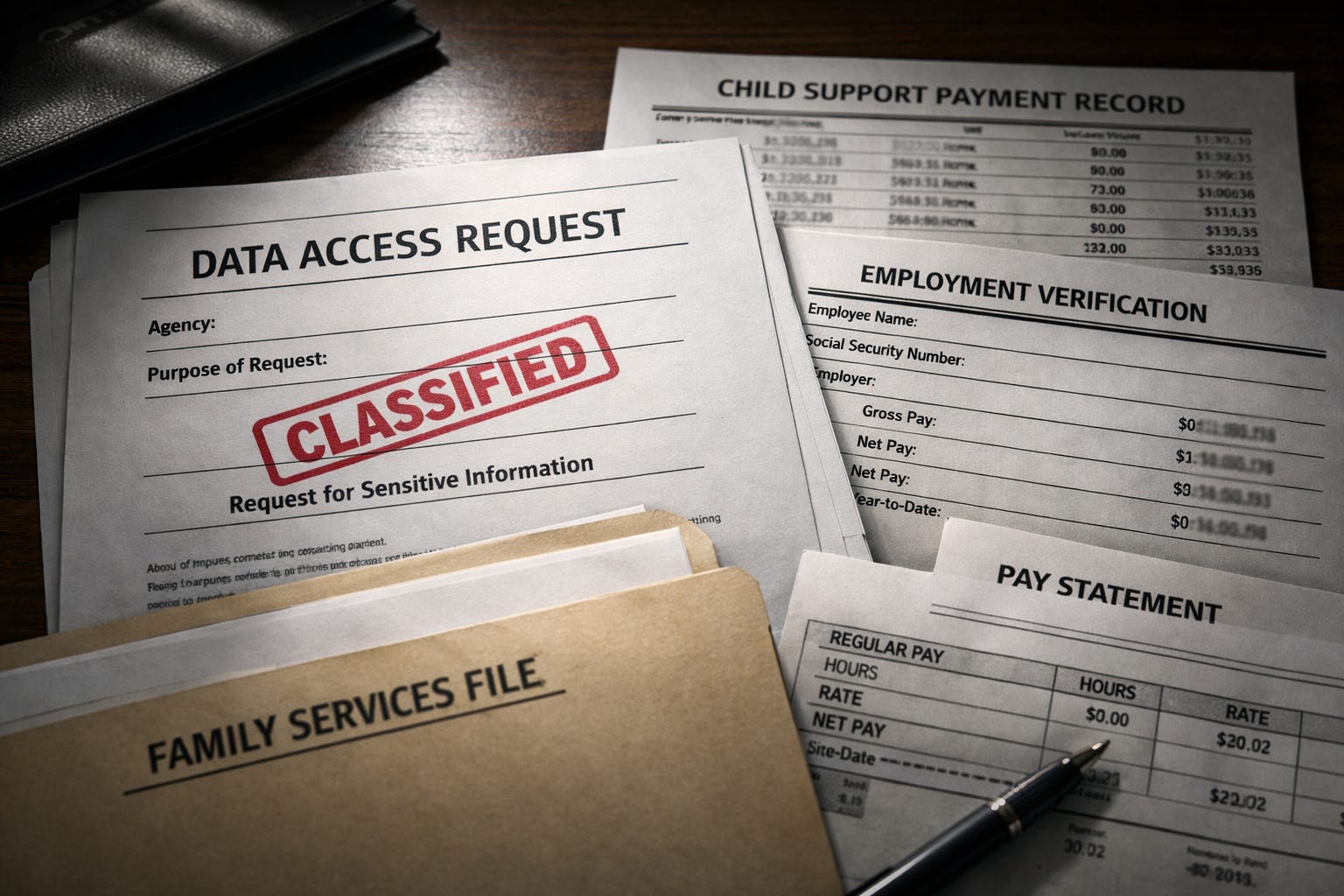
This database was built to help children. It was built to enforce child support, support family-law cases, and handle some of the most sensitive records the federal government holds. Now, according to ProPublica, officials inside the Department of Homeland Security are seeking access to the Federal Parent Locator Service for immigration enforcement. That should alarm people immediately, because this is not a fight over some generic government file. It is a fight over whether a system created for family support can be turned into a tool for tracking people down.
Federal law sharply limits how this system’s information can be used, and it includes special protections in cases involving domestic violence and child safety. That is what makes the story so disturbing. A database people would reasonably assume exists to protect families is now reportedly being eyed for a very different purpose.
The question is bigger than whether DHS has access to a single database. The question is what happens when the government starts treating records collected for care, support, and protection as raw material for enforcement. Once that line is crossed, no safeguard feels permanent, and no promise about limited use feels fully real.
This Community Is Powered by You
What started as a small circle has grown into something much bigger, and it’s all because of readers like you.
Every time you forward this email, post it on socials, or bring someone new into the fold, you’re helping build one of the most passionate, independent political communities out there.
Want to keep the momentum going?
Share this newsletter with someone who should be part of this conversation.
Thank you for being here. It means everything.
What the Federal Parent Locator Service actually is
The Federal Parent Locator Service is not some obscure federal spreadsheet. It is a system created under federal law to help establish parentage, locate parents and children, set and enforce child-support obligations, and support certain custody and visitation matters. In plain English, it was built for one of the most sensitive functions in government: helping families and courts handle cases involving children, support payments, and parental responsibility. Federal law lays out those purposes directly, and that narrow purpose is the reason the system exists at all.
A major part of that system is the National Directory of New Hires, which is part of the broader FPLS structure. According to HHS and the Congressional Research Service, it contains employment, unemployment-insurance, and quarterly wage information drawn from state reports, federal agencies, and workforce systems. CRS says it holds personal and financial data on nearly every working American and on people receiving unemployment benefits. That does not make it a general surveillance tool by design, but it does make it a powerful locator and wage-matching system built for a narrow child-support mission.
That sensitivity is exactly why the legal guardrails matter. The statute says FPLS information cannot be used or disclosed except as expressly authorized, and Congress included special protections for cases involving domestic violence or child abuse where disclosure could put a custodial parent or child at risk. Readers need to understand that before anything else in this story makes sense. The controversy is not simply that DHS wants data. It is that the data sits inside a system designed for family protection and child-support enforcement, not a broad mission far outside that original purpose.
What DHS reportedly wants and why that changes the meaning of the database
The scandal here is not just access in the abstract. It is transformation. A system created for a narrow family-law and child-support mission is reportedly being pursued for a very different government objective: locating people for enforcement.
That shift changes the meaning of the database itself. When the government asks for information or compels employers and states to provide it, the public is told there is a reason for that collection. In this case, the reason was tied to child support, parentage, custody, and related family protections. Once an enforcement agency tries to turn that same system into an immigration tool, the original public promise starts to erode. The issue is no longer just what the database contains. The issue is whether any record system built for a limited and socially accepted purpose can stay limited once a more aggressive arm of the state decides it wants in.
That is why this story should be understood as more than an immigration story. It is a government power story. It is about administrative systems being quietly converted into enforcement infrastructure and about the public learning too late that “limited use” may only mean “limited until someone powerful asks for more.” The law’s restrictions matter precisely because they reflect an older understanding that not every federal record system should be treated as fair game. If that line weakens, the damage does not stop with one agency request. It reaches the basic trust that allows government systems to function in the first place.
Why the domestic violence and child safety angle make this more alarming
The domestic-violence and child-safety dimension is what turns this from a troubling database dispute into something much more serious. These are not just ordinary government records. Federal law specifically recognizes that some information inside this system can become dangerous if it is disclosed in the wrong context, especially in cases involving domestic violence or child abuse. That is why the statute includes protections when releasing information could put a custodial parent or child at risk. Congress understood that the wrong person getting the wrong data at the wrong time could do real harm.
That point matters because it reminds readers what kind of system this actually is. The Federal Parent Locator Service is tied to cases involving children, custody, support payments, and family relationships that are often already under strain. In some of those cases, the issue is not simply finding someone. The issue is protecting someone. A database built to help courts and child-support authorities function in that environment carries a different moral and legal weight than a general enforcement file. That is why the reported push for access feels like more than bureaucratic overreach. It feels like pressure against a set of guardrails built around some of the most vulnerable people in the system.
That is the betrayal at the center of this story. A system designed to support children and protect families from financial abandonment was never supposed to become part of a broader machinery of pursuit. Once the government starts pressing against even these limits, it sends a chilling message about what protections still mean. If records related to child safety and abuse protections can be treated as another enforcement opportunity, then the public is right to ask whether any boundary within the administrative state is still a real boundary at all.
The bigger pattern: when systems built for care become systems of control
This is why the story cannot be dismissed as a narrow fight over one sensitive database. The larger issue is the pattern it reveals. Modern government collects enormous amounts of personal information for reasons the public is told are limited, practical, and socially necessary. In this case, the Federal Parent Locator Service and the National Directory of New Hires were built to support child-support enforcement and related family-law functions, not to serve as a general enforcement dragnet. Federal law reflects that limited purpose by stating that information in the FPLS cannot be used or disclosed except as expressly authorized.
What changes a system like this is not only who can access it, but how the government begins to think about it. Once officials start treating administrative records as simply another reservoir of useful data, the original purpose matters less than the convenience of new uses. That is how systems built for care, benefits, and family support begin to slide toward systems of tracking and control. It happens quietly. It happens through requests, exceptions, reinterpretations, and bureaucratic arguments that sound technical enough to avoid public outrage. By the time most people notice, the underlying principle has already shifted: data gathered for one narrow reason is now being treated as fair game for a broader enforcement mission.
That is the warning inside this story. If a database built around child support, custody, wages, and family protection can be recast as an immigration-enforcement tool, then the lesson for government is clear. No administrative system has to stay in its lane if enough power is brought to bear. No promise of limited use is fully secure if agencies can keep pressing for access until old boundaries give way. That is why this should concern more than immigration advocates. It is about whether Americans are watching the slow conversion of public-administration infrastructure into enforcement infrastructure, one exception at a time.
Why Americans should care even if immigration is not their issue
Even people who do not follow immigration politics closely should care about this story, because the principle at stake reaches far beyond immigration enforcement. ProPublica reported on March 11 that DHS is seeking access to the Federal Parent Locator Service, a legally restricted system maintained by HHS for child support and related family law purposes. Federal law limits disclosure and use of that information to expressly authorized purposes, and it includes protections when disclosure could endanger a custodial parent or child in domestic-violence or child-abuse cases.
That means the real question is not only who gets targeted first. The real question is whether Americans can trust that information collected for one narrow purpose will stay tied to that purpose. If a database built around child support, custody, wages, and family protection can be redirected to a different enforcement mission, then every promise about “limited use” starts to feel less like a safeguard and more like a temporary condition. That is not just an immigration concern. It is a public trust concern.
This is also why the story belongs in a broader conversation about the architecture of government power. Once agencies begin treating highly sensitive administrative systems as resources to tap whenever useful, the line between administration and surveillance starts to erode. People do not need to agree on immigration policy to understand that danger. They only need to understand what it means when the government keeps trying to turn specialized record systems into general enforcement tools. If that logic holds here, it will not stay confined here for long.
A country that turns family records into tracking tools is crossing a line
The most revealing thing about this story is how bureaucratic it sounds. An access request. An internal debate. A dispute over statutory authority. Those phrases are tidy enough to make the whole matter seem technical. It is not technical in any ordinary sense.
Purpose matters. This system was built to help children, support families, and manage records that can involve abuse, custody, wages, and parental responsibility. Once a government starts treating a system like that as an opportunity to expand its enforcement reach, it is doing more than requesting data. It is changing the system's meaning itself. It is telling the public that even records gathered for protection and support may be only one policy fight away from becoming tools of pursuit.
That is a line Americans should not let the government cross quietly. A country that turns family-support infrastructure into enforcement infrastructure is not merely stretching a statute. It is eroding the basic trust that allows people to live with an administrative state at all. If records connected to child support and family protection can be used this way, then every promise about limited use deserves a harder look. And every future request for access should be met with the same blunt question: if even this database is no longer off-limits, what exactly is left of the line between public service and state power?
Support Independent Media
If you believe stories like this deserve more than a passing headline, support The Coffman Chronicle with a paid subscription. We dig into the quiet abuses of power, the buried systems stories, and the policies that reshape everyday life long before most people realize what is happening. Your support helps keep this work independent, relentless, and focused where it belongs: on the people living with the consequences.
Sources:
“DHS Seeks Access to Massive Employment, Salary and Family Database Legally Restricted to Use in Child Support Cases.” ProPublica, March 11, 2026.
Legal Information Institute. “42 U.S. Code § 653 - Federal Parent Locator Service.” Cornell Law School.
Administration for Children and Families. “The Federal Parent Locator Service.” U.S. Department of Health and Human Services.
Administration for Children and Families. “A Guide to the National Directory of New Hires.” U.S. Department of Health and Human Services, January 13, 2023.
Administration for Children and Families. “Overview of Federal Parent Locator Service.” U.S. Department of Health and Human Services, December 29, 2011.
Chilling. And it needs immediate and stalwart pushback both from the public and from Congress.
A country that turns family records
into tracking tools is unconscionable.
Immediate action should be taken to
compel this administration to stop
this illegal grab for personal information.