


Every government sends a message with its ambassadors.
Trump’s message is simple: qualifications are optional, as long as you kneel.
Stay Informed. Stay Loud.
Subscribe to The Coffman Chronicle for no-BS political analysis, action guides, and daily truth bombs you won’t get from corporate media.
The New Face of Diplomacy
Fifteen years. That’s how long the United States went without a Senate-confirmed ambassador to the Bahamas. Fifteen years of acting envoys, empty offices, and half-staffed missions in one of the most strategically important corners of the Caribbean, a region where China has quietly built ports, courted politicians, and poured in money while America hit the diplomatic snooze button.
And then, at long last, the U.S. finally sends someone— a man who once said he was “not that smart,” a man who confused evolution with apes, who pitched vampire movies as political metaphors, and who couldn’t win his own Senate race.
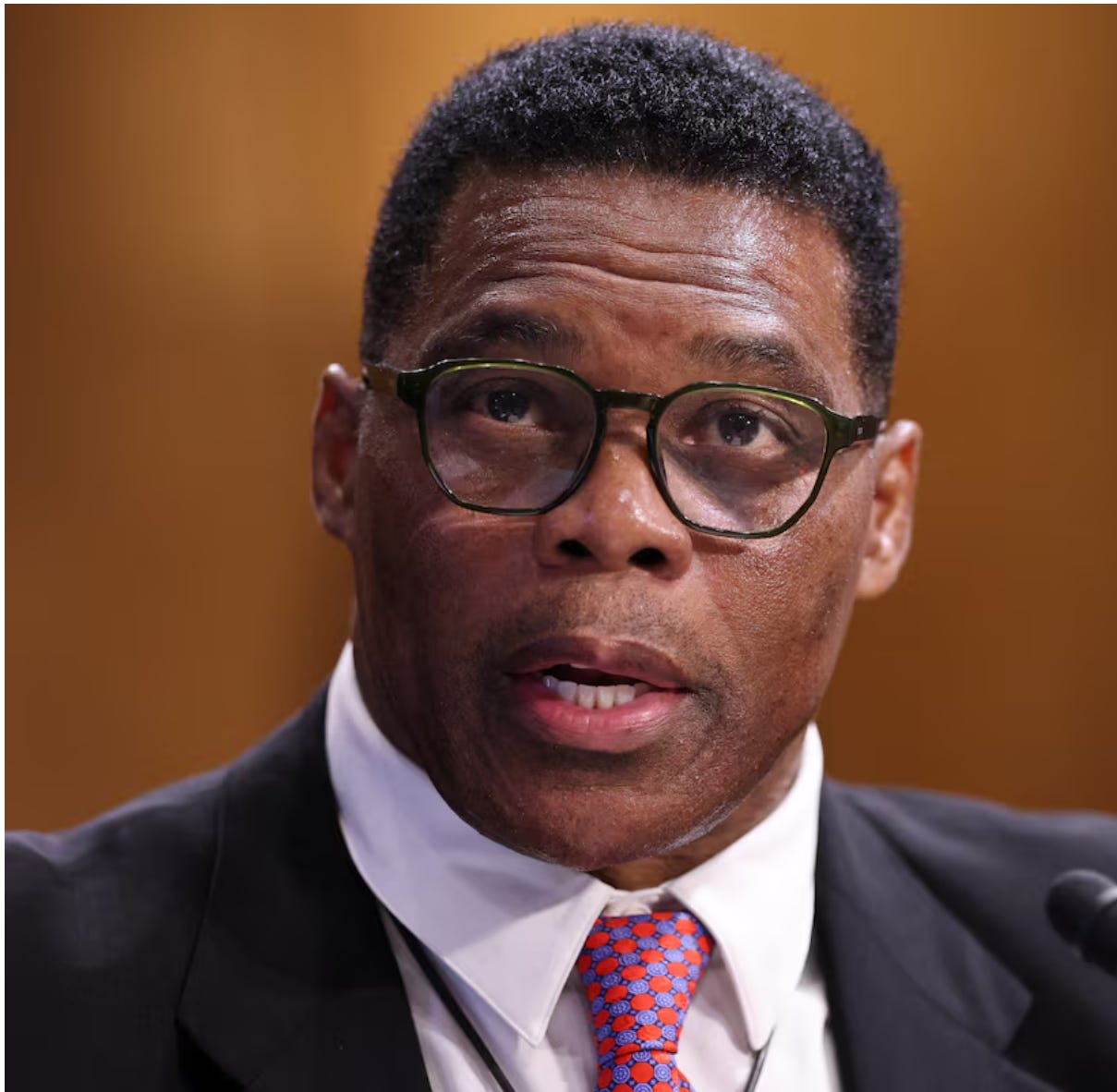
Herschel Walker — former NFL star, reality-TV regular, and Trump loyalist — is now Ambassador Extraordinary and Plenipotentiary of the United States to the Commonwealth of the Bahamas, a job title longer than his foreign-policy résumé.
Walker’s confirmation on October 7 wasn’t just a headline; it was a mirror held up to the second Trump administration’s governing philosophy. It’s not that Walker was chosen in spite of his lack of experience. He was chosen because of it.
In Trump’s world, unqualified isn’t a bug, but the feature.
When the Senate voted 51–47 to make him America’s top diplomat to the Bahamas, they weren’t confirming a statesman. They were confirming a brand: Trump’s brand, a culture where loyalty beats competence, optics beat policy, and every public post is a casting call for the next episode of Government by Grievance.
The Bahamas is no minor assignment. It sits just 50 miles off Florida’s coast, a key partner in maritime security, anti-drug operations, and climate resilience. It’s also a front line in the battle for regional influence between Washington and Beijing. But Trump’s pick isn’t a diplomat, a policy expert, or even a seasoned administrator. He sent a football legend with a MAGA jersey.
To understand the Trump doctrine, you don’t need a classified memo. You just need to look at who he hires. Every appointment tells the same story: professional experience is a liability, critical thinking is suspect, and the only credential that matters is devotion to him.
Walker’s new post isn’t an accident. It’s an emblem, a symbol of what happens when governing becomes performance art.
Walker’s confirmation isn’t a one-off absurdity; it’s the purest distillation of Trump’s entire governing philosophy. Once you see Herschel Walker in an ambassador’s chair, you start to see the pattern everywhere else. the faces change, but the logic never does.
The Pattern, Not the Exception
Herschel Walker’s ambassadorship isn’t an isolated absurdity. It’s part of a long, deliberate pattern, one that defines Trump’s relationship with government itself. He doesn’t appoint people to make the system work; he appoints people to prove that the system doesn’t work.
Walker is just the latest face in a long line of loyalty hires, a parade of unqualified, unvetted, and often openly hostile figures placed in charge of the very institutions they barely understand.
Take Thomas Fugate, the 22-year-old wunderkind Trump installed to lead the Department of Homeland Security’s counterterrorism office earlier this year. His résumé reads more like a college internship than a national-security credential. Yet there he sits, running an office tasked with coordinating against domestic extremism, a threat that Trump’s own rhetoric continues to inflame.
Or look back at Trump’s first term, when Rick Perry, a man who once vowed to abolish the Department of Energy, was put in charge of it, only to later admit he didn’t realize the agency managed America’s nuclear arsenal.
Ben Carson, a neurosurgeon, was tapped to run Housing and Urban Development.
Betsy DeVos, an heiress with no public-education experience, ran the Department of Education. And Linda McMahon, a professional-wrestling executive, became head of the Small Business Administration.
Now in his second term, Trump isn’t even pretending. The new wave of appointments looks less like a cabinet and more like a loyalty club — influencers, podcasters, and donors elevated not for what they know, but for how loudly they’ll say “yes.”
Marjorie Taylor Greene is rumored to be shaping civics curriculum under the Department of Education’s “Patriotic Learning Initiative.”
Sebastian Gorka, who falsely claimed to hold a Ph.D. in counterterrorism, is back advising on intelligence coordination.
Linda McMahon is now in charge of the Department of Education.
And Kari Lake, still awaiting confirmation, is being floated for a diplomatic post in Latin America, despite her total lack of foreign-policy experience beyond appearing on Fox News.
These aren’t random picks. They’re the logical outcome of Trump’s ideology: government as spectacle, institutions as props, loyalty as law. Competence is the enemy. Expertise is suspicious. And public service is replaced by personal servitude.
Every president rewards allies, but Trump has turned it into an organizing principle, a loyalty test that defines who gets near power and who gets destroyed by it. The question isn’t “Can they do the job?” It’s “Will they ever say no?”
And in that sense, Herschel Walker was the perfect choice. He’s famous, he’s loyal, and he owes everything to Trump. He’s not expected to run an embassy. Rather, he’s expected to embody the brand: a government that worships image over impact, devotion over duty.
The sad truth is, Walker fits right in, because in the modern MAGA hierarchy, the less you know, the higher you go.
And for all the headlines these appointments generate, the real story is what gets buried under them, the quiet wreckage that follows when loyalty replaces competence.
The Cost of Unqualification
Every time Trump rewards loyalty over competence, the rest of us foot the bill.
It’s easy to laugh at Herschel Walker’s ambassadorship, to treat it as another absurd footnote in the ongoing MAGA reality show, but the consequences are not funny. They are measurable, global, and lasting.
Diplomacy by Spectacle
The Bahamas is more than a vacation postcard. It’s a key ally for U.S. maritime security, disaster response, and regional diplomacy. It’s a strategic listening post, sitting at the crossroads of the Caribbean and the Atlantic. China knows this. That’s why Beijing has poured billions into Bahamian ports and infrastructure over the past decade.
For 15 years, the U.S. left that playing field open, with no confirmed ambassador since 2011. Now, finally, Washington sends someone, and it’s a celebrity whose only qualification is Trump’s endorsement. That doesn’t just signal neglect; it broadcasts unseriousness to the entire world.
When the U.S. treats diplomacy like a casting call, adversaries take notes. Beijing, Moscow, and Tehran don’t have to lift a finger to make America look unstable.
We’re doing it ourselves.
National Security on Autopilot
This rot isn’t limited to embassies. When you put a 22-year-old influencer in charge of counterterrorism, or a football player in charge of foreign policy, or a political firebrand in charge of education, you’re not just trolling the establishment. You’re dismantling it.
Inside agencies, morale plummets. Career staff retreat, whistleblowers are punished, and institutional memory erodes. The veterans of government — the quiet professionals who keep the country running — are replaced by loyalists who think governance is performance art. The result is paralysis. Agencies stop producing coherent policy because the people at the top don’t understand the work, and those who do are too afraid to correct them.
The Trust Deficit
There’s another, slower kind of damage — the corrosion of public trust.
When Americans see political appointees who couldn’t pass a basic background check in any other era, they stop believing in the system altogether. “Government” becomes a punchline. “Expert” becomes an insult. And that cynicism is exactly what authoritarian movements need to thrive.
Trump’s appointments don’t just weaken America’s competence. They weaken its confidence. When the public stops expecting the government to be capable, corruption becomes easier to justify. Failure becomes normal. Chaos becomes strategy.
The Price Tag
All of this comes with a cost. It’s not measured in headlines; it’s measured in missed opportunities, broken alliances, and lost influence.
Every unqualified appointment turns a functioning department into a hollow shell, one more agency that doesn’t serve the public, one more gap that someone else (usually China or Russia) is happy to fill.
Diplomacy without expertise. Security without accountability. Governance without skill. That’s not public service. That’s public sabotage.
But chaos like this doesn’t happen by mistake. It’s not clumsiness. It’s choreography.
A System That Rewards Chaos
There’s a reason Trump keeps surrounding himself with people who can’t do the jobs he gives them. It’s not laziness. It’s strategy. In Trump’s world, chaos isn’t a failure. It’s control.
A seasoned diplomat, a trained administrator, or a career expert has something Trump can’t stand: independence. They have standards. They have ethics. They might even have the nerve to say no. But a loyalist with no qualifications? That’s someone who won’t question an order, no matter how reckless, illegal, or absurd it is.
When every office is run by someone in over their head, the only person who looks powerful is the one barking orders. That’s the point. Trump doesn’t need effective governance. He needs dependency. He wants appointees who rely on him for validation, protection, and purpose. Their weakness becomes his strength.
This is why the MAGA machine runs on a steady diet of chaos. Every scandal, every implosion, every “you can’t make this up” headline serves a purpose: it teaches the public that the government is broken. That “the deep state” can’t be trusted. That the only person who can fix it is Trump himself.
Sabotage as a Governance Model
In his first term, Trump tested this idea. He gutted the State Department, sidelined scientists at the CDC, fired inspectors general who exposed corruption, and replaced watchdogs with lapdogs. The chaos was the message: government doesn’t work, so why not let Trump run it like a family business?
Now, in his second term, the experiment has become policy. The goal is no longer to reform government, but to erase it as a functioning check on power. When agencies stop producing expertise, they stop producing accountability. When the public stops expecting professionalism, it stops noticing corruption. And when everyone in the chain of command owes their career to one man, democracy quietly dies of neglect.
The Reality TV Presidency
Trump doesn’t see appointments as governance; he sees them as casting decisions.
Who plays the diplomat? The football star. Who runs the counterterrorism desk? The kid influencer. Who teaches civics? The conspiracy theorist.
Every role is filled by someone whose loyalty guarantees spectacle, not results. And just like a reality show, the chaos isn’t an accident. It’s the product.
It’s the same formula that made Trump famous: surround yourself with incompetence, provoke the meltdown, and stand back looking “presidential” while the audience gasps. Except this time, the stakes aren’t ratings. They’re republics.
The Authoritarian Dividend
The true payoff of this chaos is power without resistance. A functioning bureaucracy enforces rules; a broken one obeys whims. By populating the government with the unqualified, Trump creates a state incapable of saying no.
Every disaster becomes an excuse for more central control — “See, they failed, so I have to step in.” It’s the oldest trick in the authoritarian playbook: manufacture the fire, then sell yourself as the firefighter.
What looks like disorder is really the design. The chaos serves a blueprint, one where only the unqualified survive, and only the loyal endure.
Unqualified by Design
The Trump administration doesn’t stumble into unqualified appointments. It engineers them. It’s not that competent people don’t exist. It’s that competence is the enemy.
In Trump’s America, the ideal public servant isn’t a career diplomat, a policy scholar, or a seasoned administrator. It’s someone who owes everything to him. Herschel Walker didn’t get the ambassadorship because he’s ready for the job. He got it because he’s safe, politically, personally, and emotionally dependent on Trump’s approval. And that dependency is the entire point.
Every unqualified appointment serves two purposes:
It weakens the institution, making it harder to resist executive overreach.
It strengthens the dependency loop, ensuring that Trump remains the only source of direction, power, and permission.
When you hollow out expertise, you hollow out accountability. Inspectors general, scientists, diplomats, intelligence officers, all replaced or sidelined by loyalists whose first question is not “What’s right?” but “What does Trump want?” The result is a government that looks like it’s functioning, but underneath, it’s just scaffolding, a hollow state, wrapped in a flag and branded as patriotism.
That’s why the administration’s choices so often seem absurd on their face. They’re meant to be. Putting Herschel Walker in the Bahamas isn’t about foreign policy. It’s about signaling that the rules no longer apply. Appointing Thomas Fugate to DHS isn’t about youth empowerment. It’s about mocking the very idea of expertise.
It’s political performance art, and the cruelty is in the indifference: they’re not even pretending to care if it works.
The Message Beneath the Mockery
For decades, America measured success by competence, by what worked. Trump replaced that metric with loyalty and grievance. And now, under his second term, that philosophy has metastasized: the less you know, the more you belong.
Because when no one is qualified to do their job, the only qualification left is obedience. That’s not mismanagement — that’s monarchy.
This is how autocracies are built: not in one grand coup, but in a thousand small humiliations of competence. Every expert fired. Every loyalist promoted. Every norm bent until it breaks. Until one day, “the government” isn’t a collection of institutions anymore. It’s just one man, surrounded by flattery.
So yes, Herschel Walker is the ambassador to the Bahamas. But the story isn’t about him. It’s about the regime that made him possible, a government that rewards ignorance, punishes expertise, and calls it patriotism.
And if you think this can’t touch you, it already has. Every hollowed agency, every vanished expert, every loyalist who takes their place brings the country one step closer to collapse by design.
The Cost of a Hollow State
There’s a certain kind of silence that follows when a nation forgets how to govern itself. You don’t hear it all at once — it creeps in slowly, between headlines and hearings, in the spaces where expertise used to live. The scientists stop testifying. The diplomats stop negotiating. The watchdogs stop barking. And all that’s left are loyalists with microphones and photo ops.
That’s the cost of a hollow state. It doesn’t collapse with a bang. It decays with applause.
Herschel Walker’s appointment isn’t just an embarrassment. It’s a symptom of a deeper rot: a government that’s no longer built to serve, only to obey. When you strip away the qualified and replace them with the devoted, you don’t get patriotism — you get paralysis. And paralysis, in a world this dangerous, kills.
When the Lights Go Out
Imagine the next hurricane season in the Bahamas — a Category 5 storm, American tourists stranded, lives on the line. Do we really believe a man who struggled to explain basic science on the campaign trail is ready to coordinate with the Coast Guard, FEMA, and Bahamian leadership in a crisis? Do we think he’ll know who to call, what to authorize, what chain of command to activate? The tragedy isn’t that he’ll fail. The tragedy is that he was set up to.
Multiply that across every department filled with the unprepared. Homeland Security run by the inexperienced. Health policy dictated by talk-show pundits. Foreign relations managed by influencers with no diplomacy beyond a selfie. That’s not a government — that’s a hazard.
The Vacuum of Competence
Authoritarian movements thrive on vacuums. The less capable the government, the more power collects in one pair of hands. And when every disaster becomes an opportunity to “step in” and seize control, democracy slowly turns into dependency.
That’s where we’re heading: a nation too broken to function, and too exhausted to resist.
The danger isn’t just that Trump’s appointees will fail at their jobs. It’s that they’ll succeed at their purpose — making the government itself fail.
Who Pays the Price
It won’t be the billionaires or the donors or the party insiders who suffer the fallout.
It’ll be working families who depend on functioning systems — veterans waiting on benefits, farmers needing disaster aid, parents counting on schools that teach truth.
They’ll feel the cost when the unqualified can’t deliver and the competent have been driven out.
And while the cameras focus on the next absurd headline, the machinery of democracy will keep rusting in the background — until it doesn’t move at all.
The Final Warning
America doesn’t die in chaos; it dies in appointment memos. One unqualified loyalist at a time, one hollowed agency after another, until the system exists only to serve the man at the top.
We can’t laugh this off anymore. We can’t treat Herschel Walker’s ambassadorship as just another late-night punchline. Because behind the absurdity lies intent, and behind that intent lies a regime that sees your disbelief as its shield.
The pain that’s coming isn’t symbolic. It’s real. It’s the loss of a functioning state, the erosion of expertise, and the silence that follows when truth no longer has a desk to sit at.
If democracy still means anything, it’s on us to demand more than loyalty from those who serve. Because once a nation forgets how to govern, it doesn’t need to be overthrown — it simply collapses under the weight of its own applause.
Stay Informed. Stay Loud.
Subscribe to The Coffman Chronicle for no-BS political analysis, action guides, and daily truth bombs you won’t get from corporate media.
Bibliography:
“Trump Chooses Herschel Walker as US Ambassador to Bahamas.” AP News, December 17, 2024.
“PN54-1 — Herschel Walker — Department of State.” United States Congress, 119th Congress (2025-2026).
“Ex-NFL Star Herschel Walker Confirmed as First U.S. Bahamas Ambassador in Nearly 15 Years.” Reuters, October 7, 2025.
“Senate Confirms Herschel Walker as Ambassador to the Bahamas.” Washington Post, October 7, 2025.
“Herschel Walker.” Wikipedia
“List of Ambassadors of the United States to the Bahamas.” Wikipedia
“List of Ambassadors Appointed in the Second Trump Presidency.” Wikipedia
On entry USA, you should see "You are not welcome, unless you bring lots of money for bribery and willing to bend the knee to the Rotten Orange King". Why should our embassies be any different?