


The clock is winding down again. On Monday afternoon, congressional leaders and President Trump met at the White House in a final effort to avert a shutdown. They emerged with nothing. Democrats lingered on health care and Medicaid cuts; Republicans clung to their version of a “clean” continuing resolution (CR). The impasse remains. The nation waits.
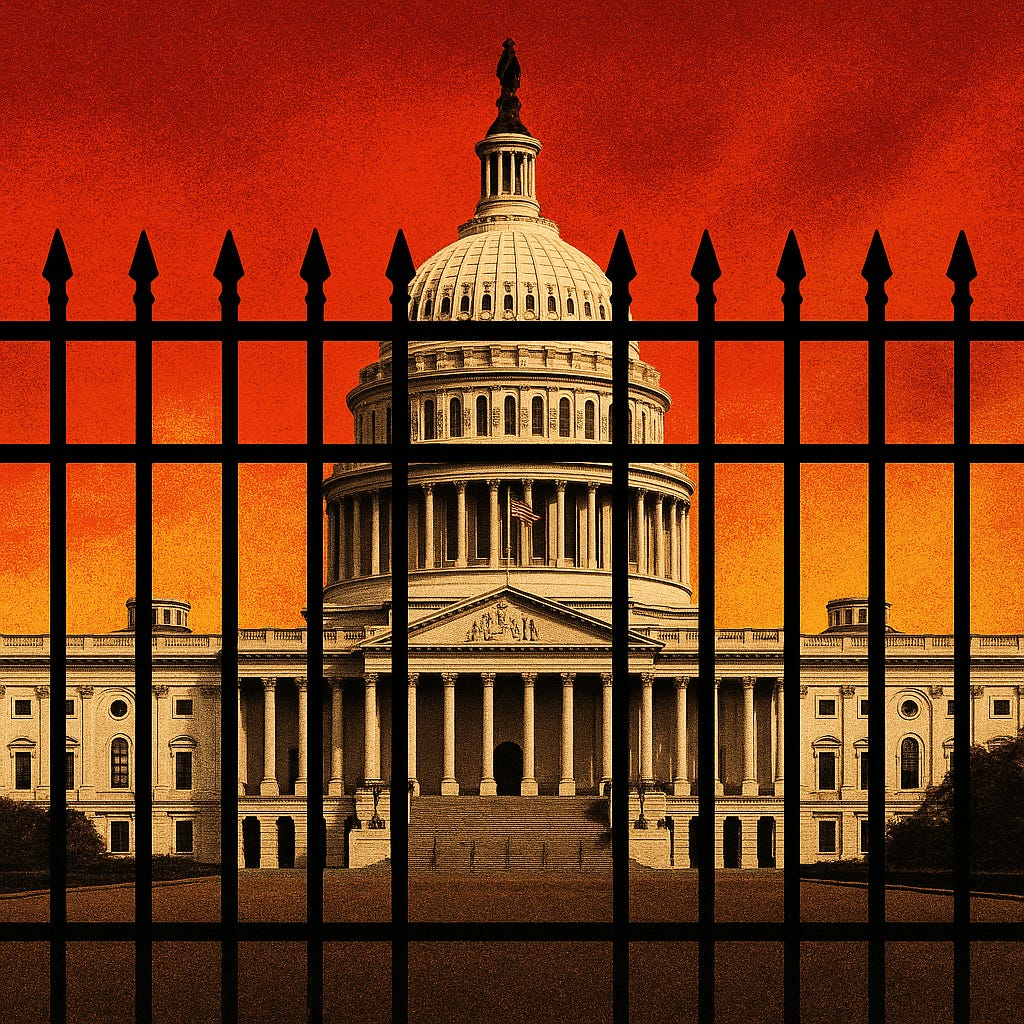
It wasn’t always like this. Congress used to pass budget bills on time. Now, however, a CR doesn’t just delay a fight. It helps cement the status quo. Worse still, in the midst of this standoff, a rider has been tacked on: $88 million for expanded security for members of Congress and justices. No one outside Capitol Hill receives that protection— not the schools in high-crime neighborhoods, not health clinics stretched thin, not children terrified to walk home after sunset.
The rider is being justified — publicly — by the killing of conservative media figure Charlie Kirk. However, Kirk was not an elected official. He wasn’t attacked at the Capitol. The incident occurred in a public space on a college campus, and no clear political motive has been confirmed. And yet this tragedy is being used to justify even greater protection for those already surrounded by layers of security, while the rest of the country is told there’s not enough money to serve their needs.
You helped us reach 20,000 readers. Now take the next step: for two weeks, go paid at 20% off—just $64/year.
How a Budget Tool Became a Weapon
Continuing resolutions weren’t meant to be business as usual. They were born out of necessity, emergency tools for rare instances when Congress couldn’t finalize appropriations before the start of the new fiscal year. For decades, CRs were infrequent, used cautiously, and seen as signs of legislative failure.
But that restraint is gone. Since the late 1970s, when modern budgeting rules were codified, Congress has failed to pass full funding on time in nearly every year. Between 1998 and 2025, lawmakers passed an average of five continuing resolutions annually. In 2001, they passed twenty-one in one year alone.
What was once an exception is now the norm. The result is paralysis. Instead of making hard choices or reaching across the aisle to negotiate serious, long-term solutions, Congress lurches from deadline to deadline, crisis to crisis, each time keeping government on life support while failing to do the work of governing.
And that dysfunction has consequences: delays in critical funding, uncertainty for agencies, fear for federal workers, and disruption to programs that real people depend on.
A Temporary Fix That Never Fixes
A Congress that governs only to avoid collapse is not governing at all. Weeks — even months — are consumed crafting, negotiating, defending, attacking, and reworking stopgap bills that keep key parts of government barely limping along. Those lost weeks are time not spent debating climate policy, housing, Medicare modernization, or gun violence prevention.
What makes this year’s version even more dangerous is the backdrop of the One Big Beautiful Bill (OBBB) passed in July 2025. That sprawling package is more than a tax cut for the ultrawealthy. It also slashed Medicaid, imposed stricter SNAP eligibility requirements, and imposed domestic spending caps under the guise of fiscal discipline. In other words, critical programs are already weakened, many are in danger of collapse, and the CR fight now threatens to make those cuts permanent. The GOP demands a clean CR that leaves those wounds open, while inserting a new rider to protect themselves.
And once the CR expires? This fight returns in November with fresh pressure and new demands. Will they ask for more security then? Another rider? Another “emergency”? The question isn’t hypothetical. It’s how they maintain the system.
Why the Rider Speaks Louder Than the Shutdown
The rider is the map to the charade. The GOP majority refuses to allow any rider that restores social programs, but inserts one for their own safety. Congress already secured $2.1 billion after January 6 to fortify the Capitol and protect lawmakers. Yet here they are, asking for more, not to help vulnerable communities, not to stop violence in neighborhoods, but to bunker themselves further.
Democratic leadership, to their credit, is focusing their messaging on kitchen-table issues, including healthcare, housing, and food. However, they’ve been careful not to expose the hypocrisy of the security rider. Perhaps this is to avoid scrutiny. Maybe it is to keep the focus on working-class pain. However, in doing so, they may be missing an opportunity not only to expose GOP self-dealing, but also to pivot the conversation toward real investments in public safety that extend beyond razor wire and metal detectors.
They could acknowledge what we all know to be true: violence is real. People are scared. But safety doesn’t come from armoring the Capitol, federalizing the National Guard, or militarizing the police. It stems from job creation, access to mental health services, violence intervention programs, youth services, housing, and trauma-informed education. The same $88 million Congress wants to use to wall itself off could instead reduce the root causes of violence in the communities that feel it most.
Then there is the timing. In the past 72 hours alone, multiple mass shootings took place, all in public spaces, in cities, in neighborhoods far from the halls of power. More people were killed in those random attacks than on January 6. None of those happened at the Capitol, nor in the cities Trump has threatened with National Guard intervention. None of them involved elected officials. Yet no matching federal emergency response, no surge funding, and no crisis meeting was called. Meanwhile, $88 million is proposed—not for us, but for them.
The contrast is stark: when Congress feels a threat, the funds flow quickly; when the people suffer, they’re told to wait.
This Isn’t Public Safety. It’s Self‑Preservation
No other job in this country comes close: as a Congressperson, you get $174,000 per year (starting), access to lifelong benefits, the ability to pension out after only five years, and the luxury of spending half your time fundraising or posturing. You don’t lose a paycheck during a shutdown. And now to demand extra security, on top of billions already spent, because you claim danger still looms?
If they’re so worried about their safety, Congress can hire bodyguards. But more importantly, they could act in good faith. They could legislate. They could govern. They could pass bipartisan deals that reduce social despair, shrink the gap between haves and have-nots, invest in mental health, infrastructure, and community safety — and with it, reduce the reasons people feel desperate enough to act out.
Instead, they abdicate their duty to the people who elected them, demand tax dollars to shield themselves from “us,” and let millions wait for services they desperately need.
When a government stops defending its people and starts defending itself, the social contract is broken.
What You Can Do and Why It Matters
If you’re tired of watching your tax dollars protect the powerful while your community goes without, don’t stay quiet. Call your representative. Ask them where they stand on the continuing resolution. Ask them why they support a rider that funds security for themselves, but not safety for the people who elected them.
If this made you angry — good. Anger means you’re still paying attention. Share this. Talk about it. Help others connect the dots between the gridlock in Washington and the struggles in their own lives. The more people see through the fog, the harder it becomes to hide behind it.
This isn’t just about another CR. It’s about who this government serves and who it fears. We don’t need another delay. We need a reckoning. We need a reset. Because if they’re spending millions to build walls around themselves, it’s time to ask what they’re so afraid we’ll see when those walls finally come down.
Stay Informed. Stay Loud.
Subscribe to The Coffman Chronicle for no-BS political analysis, action guides, and daily truth bombs you won’t get from corporate media.
Sources:
Congressional leaders leave White House meeting without deal to avoid government shutdown — AP News
Trump, Democrats leave meeting without deal to avoid government shutdown — Axios
Medicaid Cuts in the One Big Beautiful Bill Act Leave 3‑10 Young Adults Vulnerable — Urban Institute
The Truth About the One Big Beautiful Bill Act’s Cuts to Medicaid and Medicare — Center for American Progress
One Big Beautiful Bill Act (text & summary) — Congress.gov
Impact of the “Big Bill” on Medicare — Medicare Advocacy
One Big Beautiful Bill Act: Winners and Losers in the Medicaid Provisions — Center for Children and Families, Georgetown
How Medicaid, SNAP Cutbacks Would Trigger Job Losses — The Commonwealth Fund
Democrats Leave White House With No Deal — Time
government-shutdown live updates: leaders make little headway — CBS News
Marie, I suppose it’s the bleeding obvious, but, Congress doesn’t do a damn thing anymore. The pedophile is running the country on Executive Orders and congress is literally doing nothing. I’m very discouraged to be honest.