


On January 24, 2026, federal immigration agents in Minneapolis fatally shot 37‑year‑old ICU nurse Alex Jeffrey Pretti during an enforcement operation. Video footage and witness accounts contradicted early federal claims that Pretti posed a threat; instead, the images showed him holding a phone and attempting to shield a pepper‑sprayed woman when agents opened fire. Protest vigils and calls for transparency and justice quickly spread across Minnesota.
Nearly immediately, the Department of Homeland Security claimed that Pretti had been armed, with Trump contributing a social media post claiming on criminals carry guns on the street. The National Rifle Association and other pro‑gun groups called for a full investigation, sharply criticizing assertions from Justice Department officials that approaching law enforcement with a firearm could justify deadly force. Even some Republican lawmakers defended lawful gun ownership and condemned inflammatory remarks by a Trump‑appointed federal prosecutor suggesting that legal gun possession at protests is “a death sentence.”
This rupture between the administration and its usual allies underscores a deeper, more disturbing trend in American governance. It puts into sharp relief what has been unfolding for years: an executive strategy that no longer claims to defend constitutional freedoms but actively reshapes or suppresses them.
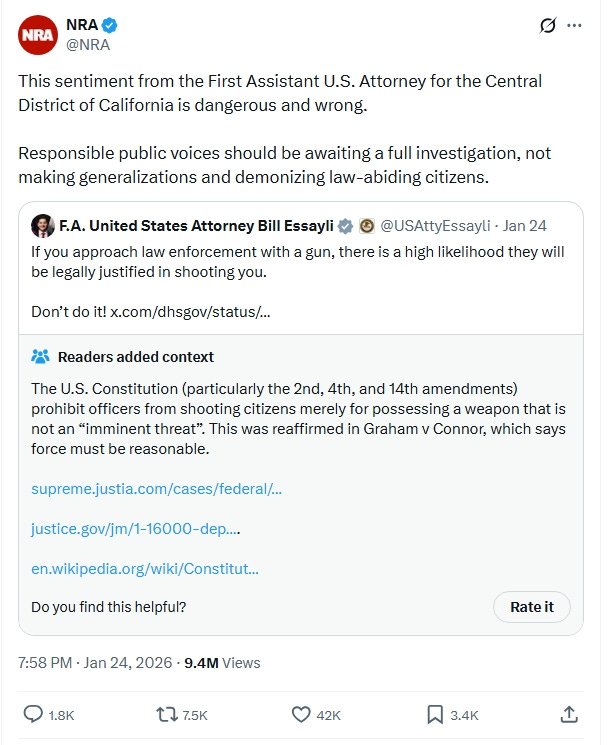
NRA on X
This Community Is Powered by You
What started as a small circle has grown into something much bigger, and it’s all because of readers like you.
Every time you forward this email, post it on socials, or bring someone new into the fold, you’re helping build one of the most passionate, independent political communities out there.
Want to keep the momentum going?
Share this newsletter with someone who should be part of this conversation.
Thank you for being here. It means everything.
Turning the Constitution on Its Head
The United States Constitution enshrines fundamental liberties, including freedom of speech, freedom of the press, freedom of assembly, the right to bear arms, protection against arbitrary detention, and the right to petition the government for redress of grievances. These rights are not incidental. They are the foundation of representative democracy.
Yet across multiple fronts, the current administration’s actions treat these core liberties as obstacles rather than protections.
NSPM‑7, a National Security Presidential Memorandum issued in September 2025, was billed by the White House as a strategy for “countering domestic terrorism and organized political violence.” Critics, including the Brennan Center for Justice, the ACLU, and Human Rights Watch, argued that the directive lacked legal grounding, gave law enforcement latitude to target broad categories of dissent, and could encompass activists ranging from labor organizers and racial justice advocates to critics of immigration enforcement. There is evidence that implementation memos encouraged federal agencies to compile lists of Americans whose activities “may constitute domestic terrorism,” defining it so broadly that opposition to government policy or support for gender‑oriented civil rights could be swept in.
See our reporting from early October here:
Note: Articles roll into our archive over time. Become a paid subscriber for full access to our extensive archive and support our work.

This is not a narrow, targeted policy against violence. It is expansive, vague, and weaponizes national security against political speech itself. And unlike McCarthyism of the 1950s, which at least claimed to protect the foundational protections of the republic from the foreign ideological threat of communism, this framework treats Americans exercising constitutional freedoms as threats.
The Constitution, Target by Target
The erosion of American constitutional norms under the current administration is not theoretical. It is deliberate, systematic, and visible across multiple rights and freedoms that once defined American identity, each of them undercut through policy, rhetoric, or executive action.
Press Freedom Undermined by Legal and Political Intimidation
The Trump administration has weaponized both the legal system and regulatory bodies to pressure newsrooms, sue critical outlets, and delegitimize any source of independent accountability. Lawsuits against major networks like CNN and CBS, threats to block media mergers, and the systematic framing of journalism as “fake news” or “enemy propaganda” have created an atmosphere of fear and compliance. In the case of CBS, merger-related threats and lawsuits reportedly led to editorial shifts and leadership changes, softening coverage and compromising journalistic independence.
We’ve reported on the attacks on the press extensively. See some examples here:
Note: Articles move into the archive after 45 days. Become a paid subscriber for full access to our extensive archive.


What remains of the Fourth Estate is not entirely muzzled, but its role as a check on executive power has been diminished. The American press now operates under conditions closer to intimidation than freedom.
Voting Rights Rewritten in Real Time
Under the guise of “election security,” federal and state-level efforts aligned with the administration have advanced a new generation of voter suppression laws. The most prominent, the SAVE Act, passed the House in late 2025, would require voters to present documentary proof of citizenship to register. While framed as a safeguard, the bill would disproportionately disenfranchise married women, naturalized citizens, low-income voters, and those whose documents don’t match state records despite virtually no evidence of widespread noncitizen voting.
See our reporting here:
Note: Articles move into our archive over time. Become a paid subscriber for full access.


Meanwhile, partisan gerrymandering continues to reshape district maps across key states, allowing minority-rule governance under the pretense of constitutional federalism. Simultaneously, public statements from conservative lawmakers and commentators have floated ideas like restricting women’s suffrage or reintroducing “household voting” — where only the head of the family, traditionally the man, casts a ballot. Once fringe, these notions are creeping toward normalization in certain legislative circles.
See some of our reporting here:
Note: Articles move into our archive after 45 days. Consider becoming a paid subscriber for full access.

Due Process Dismantled in Immigration Enforcement
The Trump administration’s immigration policy has expanded beyond border enforcement into a quasi-domestic policing operation. Raids by ICE and Homeland Security agents now occur in deep-blue cities, at workplaces, hospitals, and even homes. Detainees are often held without access to legal counsel, sometimes transferred to distant facilities without notification, and face prolonged detention without meaningful review.
The Criminalization of Protest
Perhaps most chilling is the redefinition of protest itself. Under NSPM‑7, peaceful assembly and political opposition can be framed as components of “organized political violence.” The memo doesn’t define thresholds or offer transparency about how threats are assessed. What it does do is direct federal agencies to coordinate surveillance, funding disruption, and prosecutorial strategies to dismantle what it calls domestic extremist networks.
In practice, this means racial justice protests, pro‑Palestine marches, environmental blockades, and reproductive rights rallies may be categorized as national security threats, not based on actions, but on associations and messaging. Civil society groups report increasing FOIA requests, delayed permits, and financial account freezes tied to activism. The specter of domestic terrorism hangs over ordinary political dissent like a preemptive criminal charge.
Not Just McCarthyism 2.0. McCarthyism Inverted
Some observers liken these developments to McCarthyism of the 1950s, and while there are superficial similarities, especially in the use of state authority to marginalize dissent, this comparison obscures a critical distinction.
McCarthyism, despite its excesses and injustices, claimed to protect the American constitution from ideological threats associated with the Soviet Union. It targeted alleged internal subversion tied to an external adversary. The broad public consensus, even among those opposed to McCarthy’s methods, still framed the Constitution and the system of checks and balances as ultimate reference points.
What we are seeing now is not an aggressive defense of constitutional order, but an active subversion of it. Instead of alleging that communists threaten democracy, the current rhetoric suggests that democracy itself is suspect and must be restrained according to ideological lines, whether through reshaping voting laws, deploying homeland security resources against protest, or delegitimizing institutions that hold power accountable. Indeed, parts of the administration and its allies have repeatedly proclaimed that the United States is not a “democracy” in the common parlance, but rather that it is a republic with limited popular rule, as if such definitions justify rolling back the very mechanisms that make representative governance meaningful.
In other words, this is not McCarthyism turned up to eleven. It is McCarthyism inverted: the state turning not outward, but inward, targeting constitutional liberties as problems to be managed rather than foundations to be upheld.
The Stakes Are Now
The backlash from the NRA over the Pretti shooting reveals how far the current trajectory has diverged from prior norms. When an organization that has long aligned with conservative power structures like the NRA feels compelled to demand accountability and defend lawful gun rights, it is a sign that more Americans are beginning to see the pattern. Constitutional freedoms are not secure because they are constantly being reinterpreted, narrowed, or weaponized against those who invoke them.
These are not abstract concerns. They are happening now, in real time, in courtrooms, in federal agencies, on protest lines, and on news networks. Every major corner of the Bill of Rights — speech, press, assembly, arms, due process, and political participation — is being contested in ways that reshape what it means to be an American citizen with recourse to constitutional protections.
This isn’t an academic debate. It is a battle for the future of American governance.
Stay Informed. Stay Engaged.
This is not a drill. Constitutional norms are being rewritten in real time, and if we don’t name it, we normalize it.
Subscribe to get clear-eyed analysis, historical context, and unflinching reporting as we track the erosion, and fight for what comes next.
No hysteria. No apathy. Just the truth, every week.
Sources:
“NRA and pro‑gun groups call for ‘full investigation’ into killing of Alex Pretti” — January 25, 2026, The Guardian
“Gun rights groups fiercely criticize top L.A. federal prosecutor for response to Minneapolis shooting” — January 24, 2026, Los Angelos Times via Yahoo News
“GOP Lawmaker Rips Trump‑Appointed Prosecutor’s Gun‑Related Warning” — January 25, 2026, Newsweek
“NRA slams federal prosecutor’s post about Minneapolis shooting: ‘Dangerous and wrong’” — January 25, 2026, CNN Newsource (via KBTX)
“Minneapolis mourns ICU nurse killed by a Border Patrol agent as a warmhearted neighbor and caregiver” — January 25, 2026, AP News
“Trump Says Administration Is ‘Reviewing Everything’ About Minneapolis Shooting” — January 25, 2026, The Wall Street Journal
“Outrage spreads after federal agents shoot and kill man in Minneapolis” — January 25, 2026, Los Angeles Times / AP
This is an outright ban on any political dissent and discussion. It erases all our 1st, 3rd, 4th and 14th and 19th Amendments in one fell swoop.
Yes, dammit! Enough of ICE; it was worthless from Day One!