


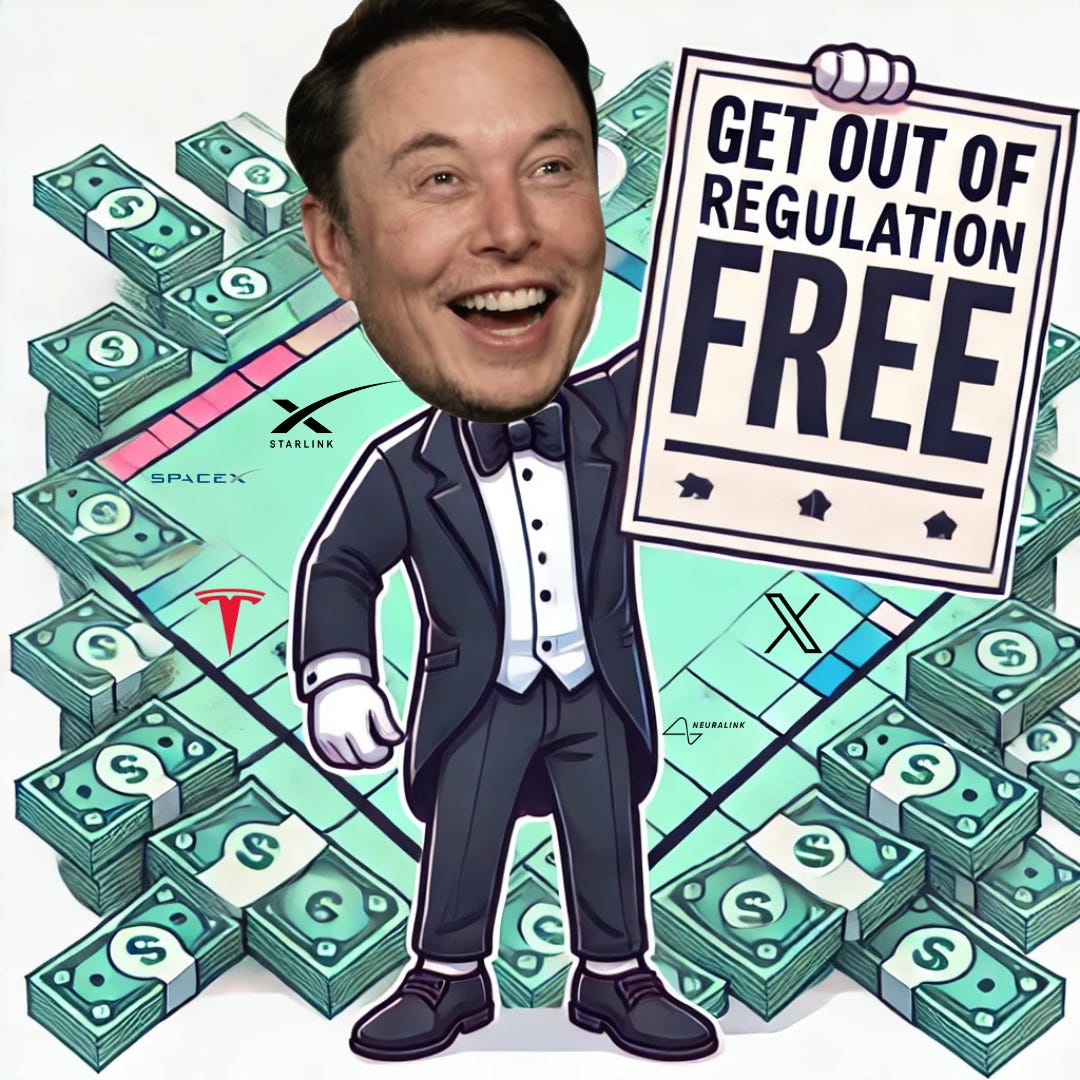
When Elon Musk announced that his AI company, xAI, was absorbing X (formerly Twitter) in a $33 billion all-stock transaction, the business press treated it as a bold innovation. But let’s be honest: This wasn’t just another tech pivot. It was a shell game.
With X bleeding revenue and carrying billions in debt, Musk needed a move. Fast. Folding the troubled company into xAI—a private firm he also controls—lets him obscure losses, shift liabilities, and insulate himself from the financial fallout. On paper, it’s corporate alchemy: turn failing assets into AI gold.
This isn’t speculation; it’s a pattern, one we’ve seen before. Just months earlier, Musk was hit with a lawsuit by the U.S. Securities and Exchange Commission (SEC) for quietly amassing Twitter stock in 2022 without timely disclosure, netting him $150 million. He broke the rules, delayed transparency, and counted on the system blinking. One SEC commissioner even did.
What links these stories is not just Musk. It’s the billionaire loophole he walks through repeatedly while regulators hesitate, rules bend, and ordinary investors pay the price.
Independent News. Just $1/Week.
We just hit 10,000 subscribers—thank you! We’re offering full access to The Coffman Chronicle for just $1 a week ($52/year) to celebrate.
Get exclusive analysis and fearless reporting you won’t find in corporate media.
Support truth. Stay informed.
The Musk Maneuver: Delay, Deceive, and Profit
According to the SEC, by March 14, 2022, Musk had quietly acquired over 5% of Twitter’s stock. Legally, he had until March 24 to file public disclosure. He didn’t. Instead, he kept buying, pushing his stake past 9%. Only on April 4 did he disclose his holdings after racking up millions in under-the-radar gains.
The result? A tidy $150 million in profits, pocketed while everyday investors like Diana R. and Marcus Greene were left in the dark. This isn’t just a paperwork issue; it’s a rigged market masquerading as fair play.
A Watchdog That Flinched
SEC enforcement votes are typically unanimous. This time, Acting Chair Mark Uyeda voted “no”—not because Musk was innocent, but because he feared political optics. Uyeda even asked staff to sign pledges affirming the case wasn’t political. They refused.
This wasn’t a question of law. It was a question of fear. And when regulators flinch in the face of a billionaire, it sends a message louder than any fine: some people are too powerful to hold accountable.
Justice for Some, Scrutiny for Others
Meanwhile, the SEC has quietly fined dozens of individuals for similar violations, people without tech empires, Twitter armies, or private equity shields. In September 2024, 23 individuals and firms were charged with late disclosures. No headlines. No dissent. Just penalties, up to $750,000.
Diana R., an Ohio accountant, sold Twitter stock just before Musk’s disclosure and lost hundreds she couldn't afford. Marcus Greene, a retail trader in Detroit, called it “a rigged game.” They're not wrong.
The Unequal Math of Accountability
The data backs up this disparity:
In FY2024, the SEC secured a record $8.2 billion in financial remedies, but over half of that came from a single case.
The SEC has written off nearly $10 billion in uncollected fines in the past decade.
Whistleblowers submitted 24,000 tips in FY2024, leading to $255 million in awards. They did the work that regulators often can’t or won’t.
It’s clear: the system is reactive, not proactive, and the rich have more ways to dodge, delay, or dilute consequences.
The Rigged Pattern
Let’s break it down:
Billionaires delay disclosures and profit.
Enforcement slows when the figure is rich and culturally influential.
Penalties come too late and rarely match the gain.
The public pays while elites game the system.
This isn’t failure. Its design. And it’s no coincidence that this design took shape in a political climate that celebrated deregulation and corporate dominance.
As detailed in Deregulation Nation: Trump’s Financial Sabotage, the past several years have seen agency teeth pulled individually to protect market predators.

A Two-Tiered System Endorsed from the Top
The SEC’s hesitancy to take on Musk is symptomatic of a more significant crisis: the erosion of independent regulatory power. The rules may be on the books, but if the agencies can’t enforce them—or are politically pressured not to—they become meaningless.
This crisis is no accident. As we explored in Trump Just Killed Independent Agencies, executive overreach and judicial indifference have gutted the autonomy of bodies like the SEC, turning watchdogs into lapdogs.
And it doesn’t stop at enforcement. As we showed in The Supreme Court Just Made It Legal to Mislead Federal Investigators the highest court in the land is now actively shielding elite misconduct. The rot runs from the boardroom to the bench.


Reform or Farce?
Here’s what real change would look like:
Automatic penalty multipliers for disclosure violations tied to gains, not income.
Strict enforcement deadlines, immune to political pressures.
Independent review panels to insulate regulators from billionaire influence.
Restitution funds for investors demonstrably harmed by hidden trades.
This isn’t about punishing wealth; it’s about restoring fairness to markets that claim to be free.
Who Are the Rules Really For?
Elon Musk didn’t just skip a form. He exploited the system, made millions, and trusted that regulators would blink. He was right.
And he’s still doing it. The xAI-X merger is not just another corporate reshuffle; it’s a strategic play to bury losses, shield debt, and keep the optics of failure off the books. No traditional disclosure. No clear transparency. Just another rebrand, backed by AI hype and billionaire audacity.
If justice is for sale, then disclosure is a joke, and markets are just mirrors reflecting who’s already winning. Until regulators, courts, and lawmakers close these billionaire loopholes, we don’t have a fair market. We have a gilded casino, with the house always winning.
We just hit 10,000 subscribers—thank you! We’re offering full access to The Coffman Chronicle for just $1 a week ($52/year) to celebrate.
Get exclusive analysis and fearless reporting you won’t find in corporate media.
Bibliography:
"SEC Charges Elon Musk for Failing to Timely Disclose Twitter Stake" U.S. Securities and Exchange Commission (SEC), January 14, 2025 https://www.sec.gov/enforcement-litigation/litigation-releases/lr-26219
"Interim SEC Chief Cast Sole Vote Against Suing Musk" Reuters, March 24, 2025
https://www.reuters.com/world/us/interim-sec-chief-cast-sole-vote-against-suing-musk-2025-03-24"SEC Charges 23 for Failing to Timely File Ownership Disclosures" U.S. Securities and Exchange Commission (SEC), September 13, 2024
https://www.sec.gov/news/press-release/2024-148"SEC Obtained Record Financial Remedies in Fiscal 2024, Agency Says"Reuters, November 22, 2024 https://www.reuters.com/markets/us/us-sec-obtained-record-financial-remedies-fiscal-2024-agency-says-2024-11-22
"SEC Has Written Off Nearly $10 Billion in Uncollected Fines" The Wall Street Journal, October 10, 2023 https://www.wsj.com/finance/regulation/sec-fines-penalties-collection-write-off-071cb768
"SEC Awards $255 Million to Whistleblowers in Fiscal Year 2024" U.S. Securities and Exchange Commission (SEC), October 18, 2024 https://www.sec.gov/newsroom/press-releases/2024-186
"Elon Musk’s Megadeal Between X and xAI Breaks Wall Street’s Rulebook"
The Wall Street Journal, March 27, 2025 https://www.wsj.com/business/deals/elon-musks-megadeal-between-x-and-xai-breaks-wall-streets-rulebook-191b2706"Elon Musk's xAI Acquires X in $33 Billion All-Stock Deal" Associated Press (AP News), March 28, 2025 https://apnews.com/article/b245f463076ac9b72c41f92160dc77eb
Without clear financial regulation of publicly traded stocks, the stock market in the USA will rapidly devolve into a jungle whereby oligarchs use it as a way of enriching themselves at the expense of 'retail investors' (you and me!). People like Musk are essentially stealing billions of dollars from ordinary people.
So he bought X for $44bn
☄️Transferred internally for $19bn
☄️Turning $25 bn tax
loss write off
☄️Revalued to $44bn
☄️Then transferred internally again for $33bn
presumably creating
☄️another $11bn tax loss write off
And paid $0 tax in 2024 - Google it