


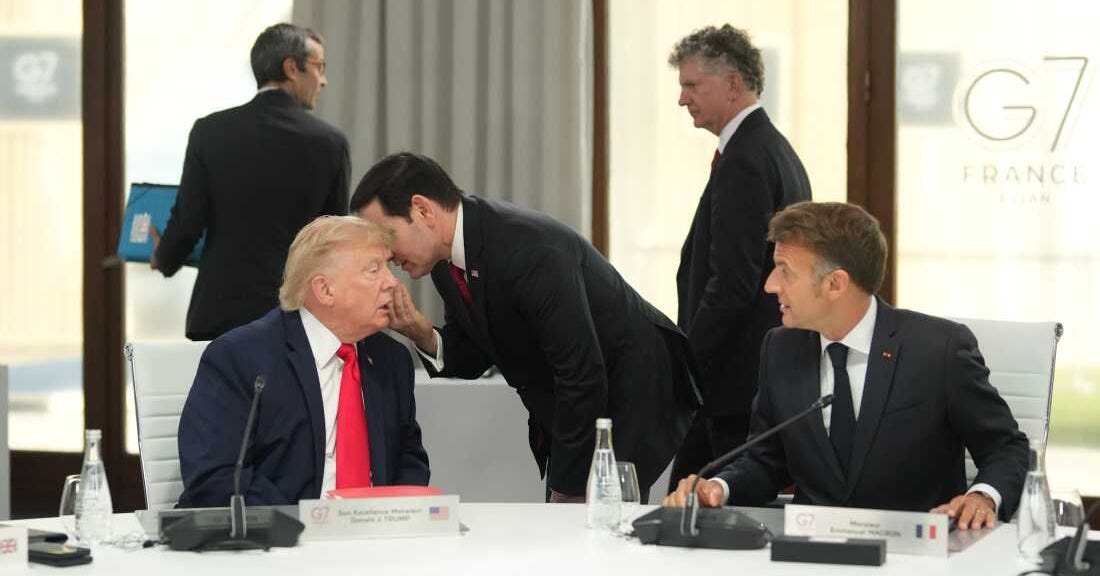
G7 leaders are navigating a delicate diplomatic challenge in France: how to work with President Donald Trump on major global crises while avoiding public clashes that could weaken summit unity.
The summit in Évian-les-Bains has been dominated by Iran, Ukraine, Russia sanctions and broader tensions between the United States and its allies. Reuters reported that Trump defended an interim Iran accord, saying the key issue was preventing Tehran from obtaining a nuclear weapon. He also said Russia “should make a deal” after talks involving Ukrainian President Volodymyr Zelenskiy.
That makes Trump both the central challenge and the central opportunity for the G7.
European leaders want stronger U.S. backing for Ukraine, tighter pressure on Russia and a stable approach to Iran. But AP reported that Trump arrived at the summit after repeated public friction with several G7 counterparts, including disputes and awkward exchanges involving leaders such as Keir Starmer, Emmanuel Macron and Mark Carney.
Subscribe free for daily political analysis they won’t broadcast. Join 110K+ readers →
The social and media reaction has focused on that tension. Reuters’ own summit preview noted Trump’s distaste for multilateral gatherings, while online discussion and political coverage have framed the meeting as a test of whether allies can keep Trump engaged without provoking a rupture.
The consequence is plain: G7 diplomacy now depends not only on shared policy goals, but on leaders’ ability to manage Trump’s personal style and political priorities.
The next test is whether careful summit diplomacy produces concrete movement on Russia sanctions, Ukraine’s defense needs and the unresolved details of the Iran framework.
Subscribe free for daily political analysis they won’t broadcast. Join 110K+ readers →