


In the first two parts of this series, we examined how the Genesis initiative emerged and the staggering physical cost it carries in electricity, water, and the air of real communities. We have reached the point where we must ask a deeper question. We’ve seen examples of rapid scientific advancement, from nuclear weapons to moon rockets, where ambition outstripped foresight, and cost was treated as an acceptable sacrifice. We’ve reviewed the environmental toll of AI infrastructure. Now we must confront the ethical core of it all.
Science does not happen in a vacuum. It is a human endeavor, embedded in culture, politics, power, and consequence. When society hands control of discovery to entities that operate outside democratic oversight, driven by speed and outcomes, the ethical ramifications ripple outward. We have seen these patterns before. The question now is not whether science works. It is whether how we are choosing to do it reflects our values, our responsibility to future generations, and our respect for human dignity.

Want to Know Your Rights?
Download a free digital copy of the U.S. Constitution, the same document Trump is trying to bulldoze. Learn exactly what he’s breaking, and how to fight back.
100,000+ strong — and counting.
This holiday, become a paid subscriber for just $1 a week and help us keep the truth alive.
Join The Coffman Chronicle — $1/Week
See the first in this series here:

Beyond Numbers: The Ethical Distance
Artificial intelligence is powerful. It can see patterns in data that elude human memory or intuition. It can flag anomalies, suggest correlations, and help scientists process mountains of results faster than ever before. However, data alone is not discovery. Data is a record of what was observed. Intelligence derives meaning from it, and meaning requires context that extends beyond the numbers.
Consider medicine. A physician confronted with a set of symptoms does not simply search for the statistically most likely diagnosis and stop. They consider the pattern, yes, but they also consider what doesn’t fit, what could be masked by overlapping conditions, what hidden variable might be at play. A rash, a fever, and a blood test out of range taken individually suggest common ailments. Taken together, they could mean something rare or overlooked. A human doctor moves beyond patterns. They ask why.
AI models are tools designed to produce predictions based on known data. They optimize, generalize, and estimate. When given a hypothesis, they test it within known parameters. If the output does not match expectations, many models stop or report a failure. They do not ask why, pivot in curiosity, or integrate new possibilities that fall outside the trends of their training sets.
Science is not just pattern recognition. It is inquiry into the unknown, the unexpected, and the uncomfortable. It is asking what might be true as much as what is most likely. That is why the scientific method exists. Its value is not in confirming the known, but in challenging it, and in systematically exploring when and why the known fails.
When Consensus Isn’t Immutable
AI relies on existing knowledge. Its predictions and analyses are drawn from the sum of what has already been observed and documented. In this way, AI is excellent at reinforcing consensus. However, consensus is not truth. Consensus is provisional. What we accept as scientific knowledge reflects the best understanding based on what we have tested, replicated, and interpreted. History shows that consensus can be overturned by new evidence. Doctors once treated stomach ulcers with surgery because H. pylori had not yet been identified. Physicists once believed the atom was indivisible.
AI cannot reflect the provisional nature of knowledge unless it is explicitly designed to do so. In its standard form, it operates on known datasets and well‑defined assumptions. It cannot spontaneously reframe the problem because something in the output feels “off.” It does not test variables that are not already encoded in its programming. It cannot explore beyond its training to discover what we have yet to observe.
Human scientists do. They revise hypotheses when experiments do not align with expectations. They adjust variables, rerun studies, question assumptions, and look for the unfamiliar signal in the noise. They do not treat failure as a dead end. They treat it as data.
This is why AI is a tool, not a replacement for scientific discovery. It accelerates part of the process. It does not embody the whole process of inquiry, interpretation, and iterative learning that has defined scientific progress.
Advance Without Reflection: Historical Precedents
Throughout history, there have been painful examples of science proceeding without due reflection on consequences and costs.
During the Nazi era, “research” on twins and other persecuted groups produced data sets. However, those datasets are fundamentally tainted. The conditions under which the “research” occurred — violence, coercion, stress, trauma — alter the very biology they purported to measure. The findings are neither ethically obtained nor scientifically robust. They cannot be replicated. They tell us more about the horror of their context than about genetics.
The Manhattan Project is often cited as a monumental scientific achievement. However, it was not pure science. It was engineering under political urgency. The goal was clear: build a bomb. The outcome was set before the process began. Scientists, engineers, and governments marshaled countless resources, and lives were upended and destroyed in the pursuit. The ethical costs were buried beneath secrecy and national pride.
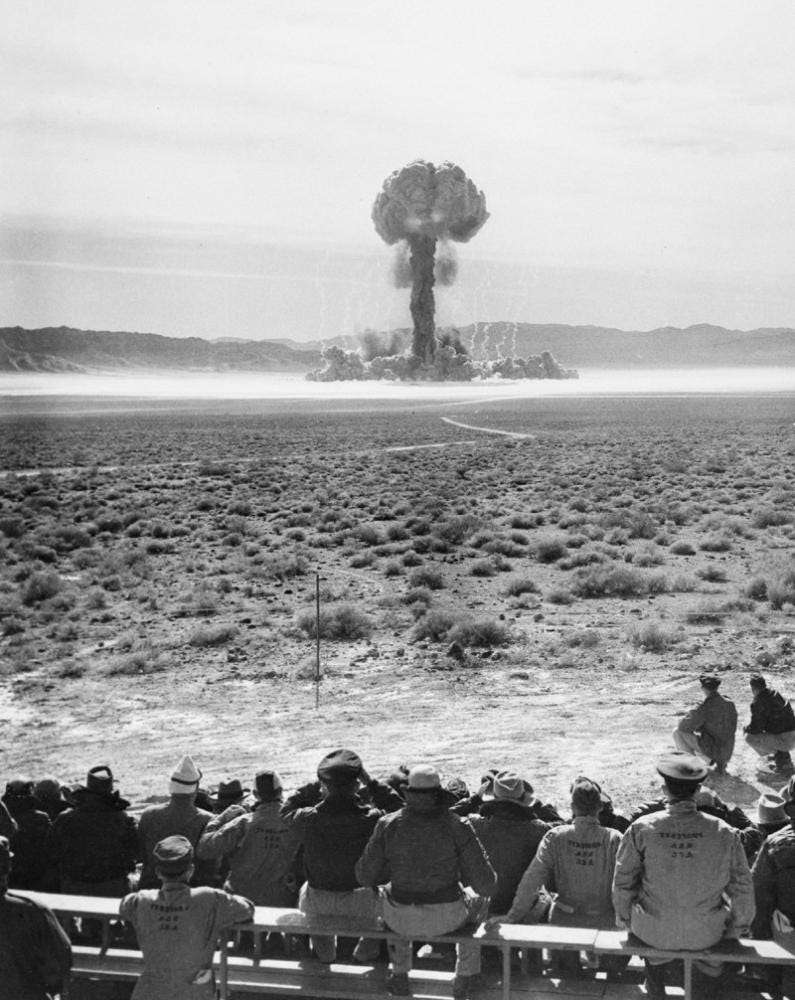
The space race was another outcome‑driven scientific surge. It achieved extraordinary milestones. Yet it compressed years of potential gradual scientific understanding into a politically charged sprint. Safety margins were narrower than ideal. Some missions ended in tragedy. In the rush to beat an opponent, exploration became a byproduct of competition rather than a careful unraveling of the unknown.
In each case, extraordinary investment yielded extraordinary knowledge. Yet the manner in which that knowledge was gained carried human and environmental costs that were seldom accounted for at the time, and we live with those costs still.
Collateral Damage: What We Leave Behind
The physical impacts of those historical efforts were not incidental. Nuclear testing and eventual deployment left entire regions contaminated for generations. Rocket launches scarred ecosystems. Waste materials from both programs leach into soil and water, long after the headlines faded.
In some cases, nature itself can remediate. Scientists have recently discovered a fungus capable of consuming toxic radioactive waste. However, our understanding remains cautious, precise, and slow. There is hesitation to release such organisms into the environment because of unknown ecological consequences. Yet history suggests that such caution is often abandoned in practice, replaced by the urgency to “solve” what was broken by past solutions.
The story of kudzu is emblematic. Imported to fix soil erosion, it grew with abandon. Then it became the problem. Small animals were introduced to control it, then bigger ones to control them. Each solution was meant to correct the last mistake. No one ever stopped to ask whether we should have brought kudzu here at all.
Humans are exceptional at realizing immediate benefits and terrible at considering long-term consequences. As populations grow and resource demands increase, ecosystems become more fragile. Land that once seemed expendable becomes essential. The sacrifices we make for short-term gain, whether in nuclear deserts or polluted neighborhoods, eventually demand repayment.
Memphis, Boxtown, and the Cost of Ignored Consequences
This pattern is visible right now in South Memphis. xAI built the “Colossus” supercomputer in a predominantly Black, low-income area already suffering from industrial pollution. Residents report rotten smells and worsening air quality. Methane‑powered gas turbines, installed initially without permits, have operated and emitted smog‑forming nitrogen oxides and other hazardous pollutants at levels that make the facility one of the most significant industrial sources in the region. The facility draws enormous amounts of electricity, enough to power tens of thousands of homes, and its sheer energy and emissions footprint has alarmed public health advocates. Community groups, including the NAACP and environmental justice organizations, have challenged permits, arguing that local health departments wrongly classified polluting turbines to avoid scrutiny and that the facility’s emissions burden unfairly falls on communities already facing respiratory illnesses and elevated cancer risks. This is not theory. It is happening now. More than sixty years after atomic and space projects reshaped landscapes thousands of miles away, we are again seeing powerful forces reshape a community’s environment without adequate consent, oversight, or accountability.
See our previous reporting in this series about the environmental impact of the Genesis program here:

When Science Is Reduced to Outputs
If science is used solely to achieve outcomes defined outside ethical considerations, it ceases to be a process of understanding. It becomes the machinery for producing results. When outcomes matter more than inquiry, when speed outweighs safety, and impact is subordinated to ambition, the enterprise is no longer science. It is a product.
AI, as proposed in Genesis, risks amplifying this tendency. Large models are trained to optimize for known patterns. They are less adept at exploring the unknown, and they cannot question the premises of their own training. If we let machines lead discovery while humans cede curiosity and interpretation, we risk transforming science into a series of predictions rather than an evolving body of understanding.
The Ethical Imperative
This brings us to a precise point. AI should be a tool in the scientific toolbox, a potent one perhaps, but one among many. Real breakthroughs have always come when technology amplifies human ingenuity, not replaces it. Funding scientists, laboratories, and the slow, imperfect work of experimentation and interpretation has historically yielded richer, more responsible knowledge. It is through this synergy of human creativity and computational power that we should pursue discovery, not by handing the reins to machines or to unaccountable power structures.
We must insist on ethical standards that keep pace with our tools. We need oversight bodies that answer to the public. We need transparency in how AI is deployed, whose interests it serves, and what external costs it imposes. We must build systems that reward not just efficiency but responsibility.
Toward Guardrails: What CRISPR Can Teach Us
We are not the first generation to face this challenge. When gene-editing technologies, such as CRISPR, emerged, they, too, carried staggering potential and terrifying risk. However, rather than pursue speed at all costs, the global scientific community paused, not just to reflect, but to invite public debate.
Ethicists, scientists, regulators, and communities came together. They asked not just what was possible, but what was acceptable. That conversation led to something rare: real guardrails, including international guidelines, research moratoriums, and a shared agreement that some lines, especially those involving inherited traits or race-based genetics, must not be crossed without complete understanding and consent. That clarity didn’t halt progress. It preserved its legitimacy.
We need the same kind of process now. Genesis should not operate as a closed system with executive-level authority and opaque oversight. It should be subject to global ethical review. It should include voices from sociology, medicine, environmental science, and bioethics, not just AI engineers and political appointees. It should build on the lessons of CRISPR, that science can move forward without discarding ethics. That guardrails are not burdens. They are proof of seriousness, because the risks are no longer theoretical.
Bias by Design: Who Teaches the Machine to See
Elon Musk’s Grok chatbot, promoted as a truth-seeking AI, has already demonstrated how easily systems can be shaped to reflect and amplify racial bias. Presented with questions about health disparities, crime statistics, or historical injustice, Grok has repeatedly offered answers that strip context and reinforce stereotypes, not because the technology failed, but because it followed its training.
Now imagine a similar model applied within Genesis, one tasked with analyzing medical data, biological markers, or social outcomes. What will it see in the higher rates of diabetes among Black Americans? Will it conclude systemic racism and unequal access to care? Or will it label the data as proof of genetic inferiority?
This is not speculation. This is what happens when AI is trained without ethical framing, and when governments remove the language necessary for that framing.
This administration has already removed key terms like “gender,” “female,” “race,” “diversity,” and “equity” from agency language and documentation. These aren’t just words. They are variables. They are context. When you remove them from the dataset, you strip away the human story behind the data. You teach the system to see disparity as destiny, not injustice. You remove the humanity.
Furthermore, this is the same administration that denies the science of climate change. What happens when Genesis, trained on centuries of atmospheric data, concludes — correctly — that human activity is accelerating global heating? Will the system be forced to conform? Will outputs be filtered, suppressed, or rephrased to suit political comfort? Or, depending on its training, will it propose alternative conclusions that support political narratives? That’s not science. That’s narrative-control.
When a machine is asked to discover, but only within approved ideological boundaries, it ceases to be a tool of science and becomes a weapon of power.
The Test We Keep Failing
The problem isn’t artificial intelligence. The problem is how we treat science.
When we elevate speed above deliberation, outcomes over inquiry, and power over accountability, we repeat the mistakes of the past. We build legacies we do not understand and cannot control. Again and again, we have seen science used to justify atrocities. We have witnessed progress propped up by power-seeking to achieve specific outcomes and narratives.
This time, we have a chance to do better. We have tools of unprecedented power and reach. However, those tools must remain in the hands of scientists, ethicists, and communities, not as replacements for human creativity and judgment, but as partners in the pursuit of knowledge that honors both discovery and consequence.
That is the responsibility we must insist upon, not because progress is optional, but because the cost of ignoring its ethical dimension is far too great. Science is not partisan. It represents our current empirical understanding of our world. It isn’t meant to be convenient, comforting, or controllable. It simply is, if we let it.
If you’ve made it this far, thank you. And if deep analysis like this matters to you, consider becoming a paid subscriber to support our work.
Sources:
NAACP launches lawsuit over pollution from Musk’s xAI — Politico (Jun 17, 2025)
Elon Musk’s xAI gets permit for methane gas generators — The Guardian (Jul 3, 2025)
Musk’s xAI increased Tennessee gas turbines without permits, community groups say — Reuters (Apr 10, 2025)
Resident Says She Can’t Open Windows Anymore Because of ‘Rotten’ Smell — People.com (Dec 16, 2025)
South Memphis residents skeptical of Musk’s xAI economic growth claims as pollution concerns grow — National CDFI Coalition (Oct 1, 2025)
Progress Shouldn’t Poison Black Communities — Tech Policy Press (Jun 25, 2025)
Ethical Challenges and Solutions of Generative AI: An Interdisciplinary Perspective — MDPI (Aug 9, 2024)
The New Ethical Implications of Gen AI — Institute for the Future of Education (Aug 29, 2025)
Ethics of artificial intelligence — Wikipedia
Artificial intelligence in healthcare — Wikipedia
Generative artificial intelligence — Wikipedia
Existential risk from artificial intelligence — Wikipedia
Artificial intelligence arms race — Wikipedia
Beyond principlism: Practical strategies for ethical AI use in research practices — arXiv
Does “AI” stand for augmenting inequality in the era of covid‑19 healthcare? — arXiv
Ethics and Governance of Artificial Intelligence: Evidence from a Survey of Machine Learning Researchers — arXiv
Human genome editing: a framework for governance — World Health Organization (Jul 12, 2021)
Human Genome Editing (HGE) Registry — World Health Organization
WHO issues new recommendations on human genome editing for the advancement of public health — World Health Organization (Jul 12, 2021)
What are the Ethical Concerns of Genome Editing? — Genome.gov
The impact of the three major human genome editing reports — Springer Nature Link (Jun 16, 2025)
Ethical Issues: Germline Gene Editing — ASGCT
The Ethics of Human Embryo Editing via CRISPR-Cas9 — Systematic bioethics review (2025) Springer Nature Link
This made me think of the acronym “GIGO” - garbage in, garbage out.