


For the last decade, one of the most enduring features of global geopolitics — the Arctic island of Greenland — has found itself at the center of an extraordinary diplomatic confrontation. Greenland, a vast, sparsely populated territory with strategic military value and significant natural resources, has long been a trusted partner of the United States in defense and scientific research. However, something about Greenland has changed. It is no longer just an ally’s neighbor, but an object of intense political drama.
For decades, the United States has maintained a robust security relationship with Greenland, dating back to the construction of Thule Air Base in 1951. Now known as Pituffik Space Base, it remains a key part of America’s early warning radar network and ballistic missile defense infrastructure. That cooperation has historically unfolded through treaties with the Kingdom of Denmark, under whose sovereignty Greenland remains.
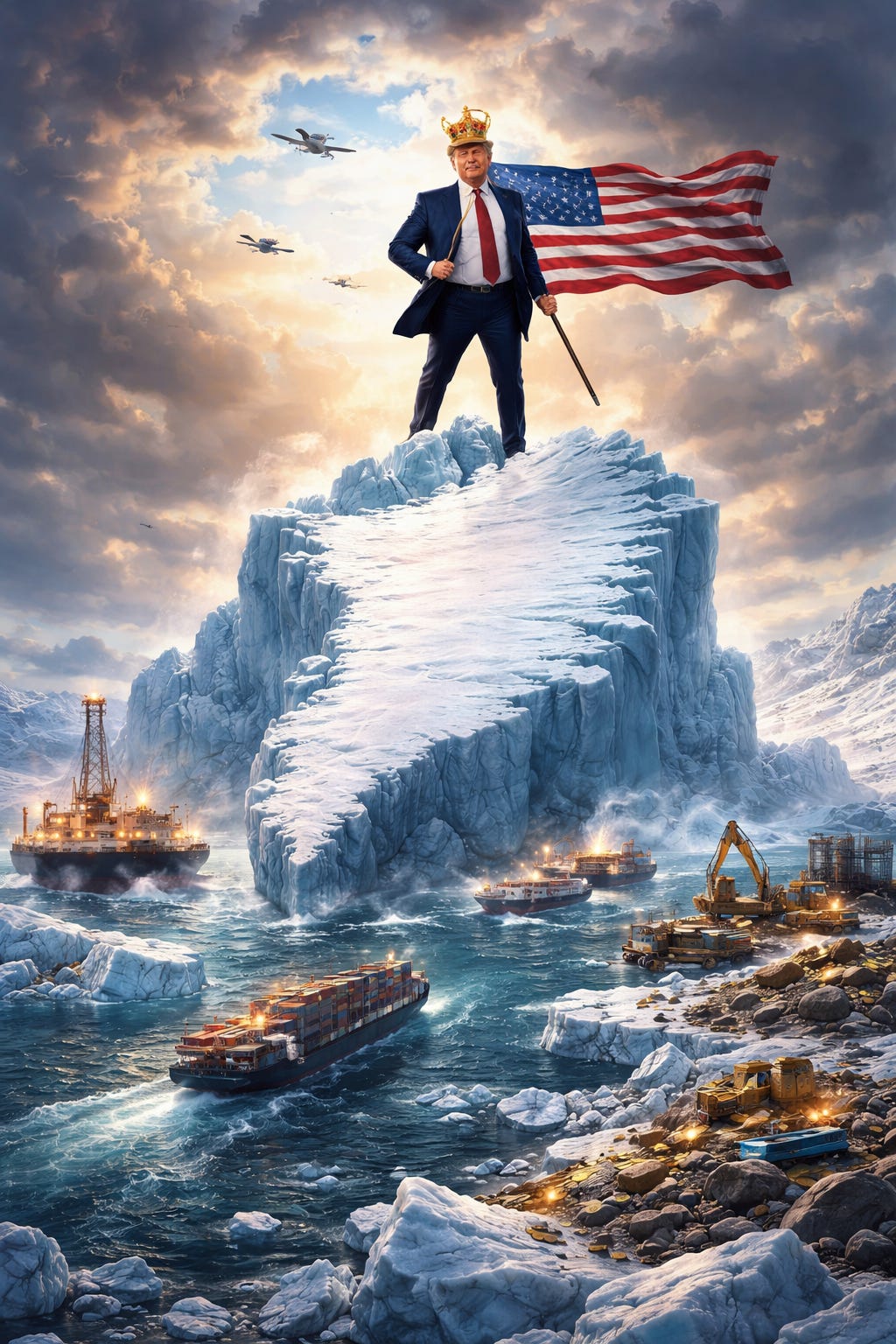
However, in 2019, an idea that once sounded like a diplomatic gaffe — buying Greenland — was publicly floated by then‑President Donald Trump, prompting public rebukes from Danish and Greenlandic leaders who insisted “Greenland is not for sale.” That notion receded from the international radar for a few years, until it roared back upon Trump's return to the Oval Office, with renewed force and a much more aggressive tone.
Want to Know Your Rights?
Download a free digital copy of the U.S. Constitution, the same document Trump is trying to bulldoze. Learn exactly what he’s breaking, and how to fight back.
100,000+ strong — and counting.
This winter of our discontent, become a paid subscriber for just $1 a week and help us keep the truth alive.
Join The Coffman Chronicle — $1/Week
How One Billionaire Put the Greenland Idea in Motion
Behind the scenes of this geopolitical drama is a figure who, until recently, hovered mostly on the fringes of public awareness: Ronald S. Lauder, heir to the Estée Lauder cosmetics fortune and a stalwart Republican donor. Multiple investigations and credible reporting have now traced the genesis of Trump’s Greenland fixation to a suggestion from Lauder himself. During Trump’s first term, Lauder proposed that the United States consider acquiring Greenland, not as an idle thought but as a strategic priority rooted in the island’s mineral wealth and its position as a gateway to the Arctic.
Lauder’s role is not merely anecdotal. Former National Security Adviser John Bolton has attested that Lauder planted the idea in discussions with Trump early in his presidency, and that the president took it seriously enough to explore policy avenues. Beyond merely suggesting the idea, Lauder has since invested his own money in Greenlandic ventures. He has acquired a stake in Greenland Water Bank, a boutique water company based in Nuuk, and he is connected to investment groups pursuing infrastructure projects such as hydroelectric development.
What Lauder does not appear to have publicly documented ownership of, despite broader narratives about Arctic resource wealth, is direct investment in rare‑earth mining enterprises in Greenland. Those resource plays have attracted other powerful technology and finance billionaires such as Bill Gates, Jeff Bezos, and Sam Altman, who are backing AI‑assisted mineral exploration ventures targeting nickel and rare‑earth deposits.
Nevertheless, Lauder’s vocal advocacy for U.S. acquisition of Greenland, combined with his business ties there, has raised legitimate questions about influence and the intertwining of private interests with national foreign policy. That overlap, rather than being concrete evidence of corruption, illustrates how personal relationships and wealth can shape strategic discourse in ways that bypass traditional diplomatic channels.
Diplomacy Under Biden: Partnership, Not Purchase
When Joe Biden assumed office in 2021, his administration pursued a markedly different approach to Arctic relations. In 2020, the United States reopened its consulate in Nuuk, Greenland’s capital, marking a renewed emphasis on close diplomatic and economic ties with the island’s government.
Biden’s strategy was grounded in respect for Greenlandic autonomy and the sovereignty of the Kingdom of Denmark. U.S. officials framed their engagements around economic development, science cooperation, and mutual security goals. This was not a bid for territorial control but rather a bid for partnership and stability in a region increasingly central to climate, defense, and supply‑chain considerations. European allies, too, welcomed this diplomatic outreach and joined NATO partners in Arctic planning.
Even U.S. economic engagement was intended to support Greenland’s government, rather than extract advantage. In previous years, the U.S. provided tens of millions in aid for development and resource exploration, especially in areas that could strengthen the island’s economic base and reduce its dependence on outside powers.
This diplomatic course reflected a broad, traditional U.S. approach to alliance management, one that leverages influence through cooperation rather than coercion.
An Old Strategy Returns With a New Edge
By contrast, as the United States entered 2025 under Trump’s leadership once again, the rhetoric around Greenland shifted from cooperation to assertion. On his personal social platform, Trump argued that the United States must gain ownership of Greenland for “national security” reasons, casting aside both Greenlandic opposition and Danish sovereignty.
Trump’s language escalated quickly. Rather than simply repeating that he wanted to buy Greenland, he threatened tariffs on European allies, including Denmark’s NATO partners, if they did not concede to U.S. demands. His administration suggested that, without direct U.S. control, Greenland would be vulnerable to Russian or Chinese influence, even though there is no credible evidence that either power is poised to seize the island militarily.
On January 17, 2026, Trump moved beyond rhetoric and took direct economic action. His administration imposed a 10 percent tariff beginning February 1st on imports from eight European nations, including Denmark, Germany, France, and the United Kingdom, all of which had publicly supported Greenland’s sovereignty or contributed troops to NATO Arctic exercises. Trump framed the tariffs as “temporary leverage” to force cooperation, warning they would escalate to 25 percent by June if Denmark did not enter negotiations over U.S. control of Greenland. The move stunned European leaders, who denounced the tariffs as “coercive,” “unprecedented among allies,” and “a clear abuse of economic power.” EU officials convened emergency meetings to consider retaliatory tariffs and described the situation as a potential trigger for a transatlantic trade war, all over an idea that began as a billionaire’s whispered suggestion in a golf clubhouse.
Citizens have taken to the streets in both Denmark and Greenland in protest, and public sentiment in Greenland strongly opposes any takeover. Around 85 % of Greenlanders surveyed have said they do not want U.S. annexation. European leaders, including Britain’s Prime Minister Keir Starmer, condemned economic threats and urged calm dialogue, warning that coercive tactics could spark a trade war among allies.
Meanwhile, discussions in Brussels and NATO circles have turned toward bolstering Arctic security with allies, including proposed joint missions in Greenland that affirm shared defense commitments rather than unilateral control. Troops from several nations have already hit the ground.
How We Got Here And Why It Matters
The contrast between diplomatic partnership and thinly veiled pressure over Greenland is stark. On one hand, a policy grounded in respect for self‑determination and multinational cooperation; on the other, an approach that threatens tariffs and hints at coercion when partners say no. That difference is not merely a stylistic debate. It is an illustration of how foreign policy can be warped when the levers of statecraft are influenced by outsized private interests and ego.
When a billionaire donor suggests a territorial acquisition and a sitting president runs with it — not as a metaphor but as a sincere policy objective — it raises uncomfortable questions about whose interests are being served. It is one thing for powerful nations to compete for influence in the Arctic. It is quite another for a democratic power to treat a partner’s sovereign territory as if it were a business transaction.
Climate Collapse as Business Model
While the public conversation around Greenland has focused on real estate metaphors and diplomatic insults, the deeper truth is far more sobering. For many of the players involved, from tech billionaires to national governments, the rush to Greenland is not despite climate change. It is because of it.
As the Arctic warms four times faster than the rest of the planet, the ice that once made Greenland nearly unreachable is disappearing. That retreat is opening up entirely new shipping lanes, including the Northern Sea Route along Russia’s coast and the future Transpolar Sea Route that will cut directly across the top of the world. These passages slash travel times between Asia, Europe, and North America, turning what was once a frozen barrier into a lucrative highway.
In addition to maritime access, the melt is uncovering vast stores of rare-earth minerals, hydrocarbons, and freshwater resources. For years, Chinese, Russian, and now American firms have maneuvered for access to these deposits. Greenland, sitting atop one of the world’s richest untapped caches of rare-earth elements, has become ground zero in the global race for energy independence, battery tech, and military-grade minerals.
This is not a secret. It’s a business model. Companies like KoBold Metals, backed by Bill Gates, Jeff Bezos, Sam Altman, and Michael Bloomberg, are explicitly targeting Greenland’s newly accessible mineral zones. They tout machine learning and satellite imaging as ways to predict where to drill, but none of this would be possible without the ongoing disintegration of the ice sheet.
Even Ronald Lauder, while not publicly tied to rare-earth mining, has invested in Greenland’s freshwater and hydroelectric potential, both resources that are gaining value precisely because of the climate crisis. The irony, of course, is that these ventures often rely on fossil fuel infrastructure to extract, process, and export the very materials that are driving climate change.
The result is a kind of strategic nihilism. Global warming, rather than being treated as an existential threat to be mitigated, is increasingly seen by powerful actors as an investment opportunity to be captured before the window closes. The question is no longer whether the world should stop the collapse, but who gets to own the spoils once the collapse arrives.
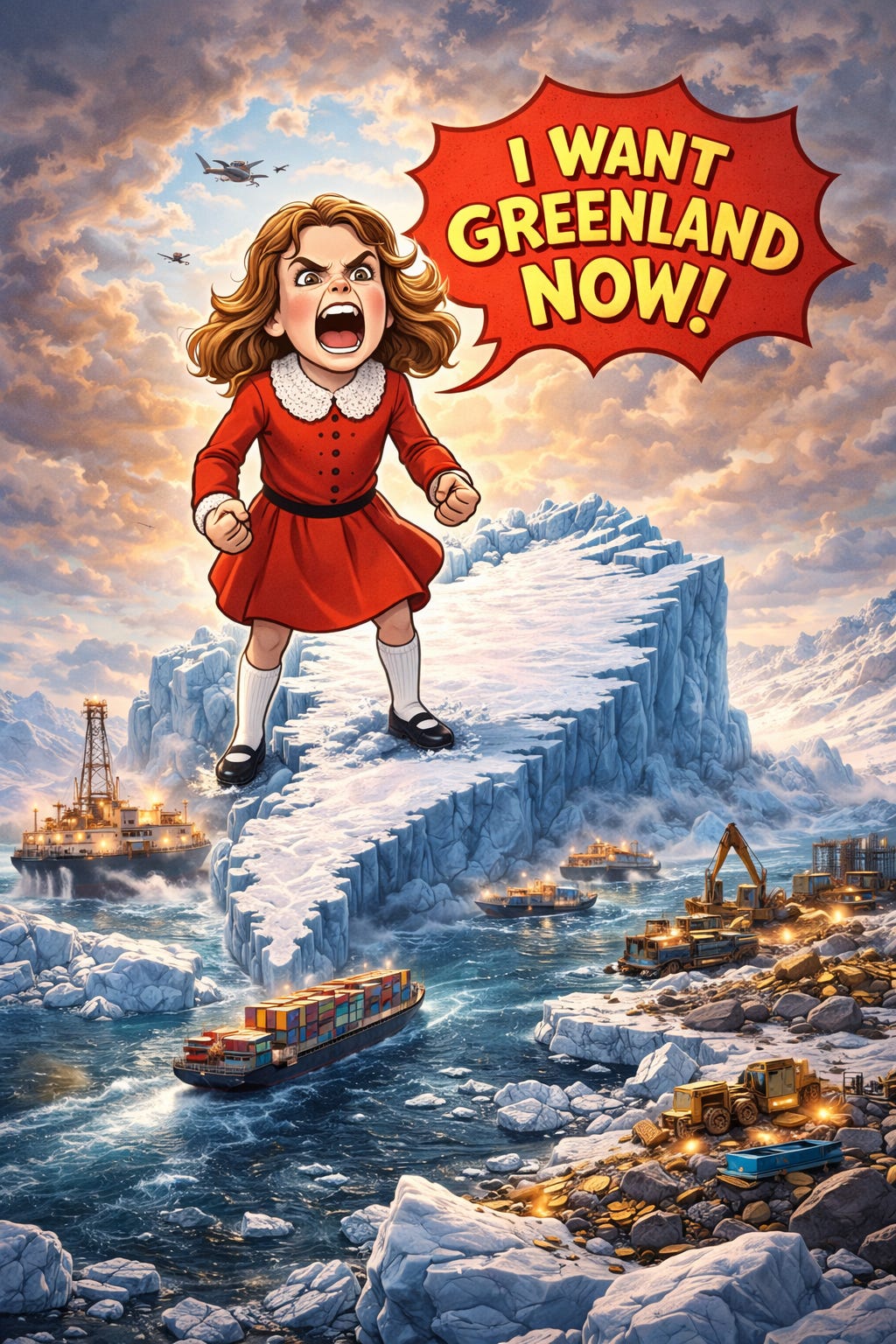
Donald Trump as Veruca Salt
To fully understand this moment, it helps to borrow a metaphor from popular culture. In Charlie and the Chocolate Factory, Veruca Salt is the quintessential spoiled child: entitled, demanding, and utterly convinced that the world owes her what she wants, now. She stamps her foot, screams for what she believes is hers, and throws tantrums when denied.
In the 2026 Greenland controversy, Donald Trump embodies the same dynamic. He does not negotiate for influence. He demands control. He does not respect alliances. Instead, he threatens penalties when he is rebuffed. He does not build through diplomacy, but bulldozes with economic and rhetorical force, as if Greenland were simply another property on the global Monopoly board.
What’s most striking in this situation is that Greenland was never unreachable through diplomacy or alliance. The United States already enjoys unfettered access to critical military facilities there, and Greenland’s leaders have shown a willingness to cooperate on mutual security goals. The dramatic shift toward threats and acquisitions is not a necessity of statecraft, but the theater of entitlement.
Like what you’re reading?
We connect the dots between power, politics, and the people pulling the strings with receipts, not rants. If you want more reporting that cuts through the noise (and calls out the Veruca Salts of democracy), hit subscribe and share this with someone who still thinks “Greenland” was just a punchline.
Stay informed. Stay sharp. Stay loud.
Sources:
“How a billionaire with interests in Greenland encouraged Trump to acquire the territory” — The Guardian, January 15, 2026
Ronald Lauder — Wikipedia
“Trump ally who inspired Greenland purchase idea quietly invests in Greenlandic companies” — Arctic Today, December 3, 2025
“These Billionaires Bet Big On Greenland—After Trump Took Interest” — Forbes, January 9, 2026
“Proposed United States acquisition of Greenland” — Wikipedia
“Trump says 8 European countries will face 10% tariff for opposing US control of Greenland” — AP News, January 17, 2026
“Europe ‘united’ in face of Trump’s Greenland threats, tariffs, EU chief says” — ABC News, January 17, 2026
“Trump’s Europe tariff threat over Greenland revives talk of ‘Sell America’ trade” — Reuters, January 19, 2026
“European leaders slam Trump’s tariff threats over Greenland” — Al Jazeera, January 19, 2026
“EU vows coordinated response to Trump’s tariffs threat over Greenland sale” — Euronews, January 17, 2026
“Starmer Breaks With Trump Over ‘Completely Wrong’ Greenland Tariff Threats” — TIME, January 19, 2026
“Hands off Greenland protests” — Wikipedia
“In Denmark, U.S. lawmakers contradict Trump on Greenland” — Washington Post, January 17, 2026
“Melting ice may raise Greenland’s value. Trump’s fight may be just the start.” — The Washington Post, January 18, 2026
“Greenland: new shipping routes, hidden minerals – and a frontline between the US and Russia?” — The Guardian, January 15, 2026
“2025 Arctic Vision and Strategy” — NOAA/Arctic.gov (2025)
Arctic shipping routes overview — Arctic Portal/Shippings Routes
All European countries have become comfortable allowing the US to dominate defense and economic issues in all of Europe. I served in the USMC and remember how willing Europeans were to allow Americans to serve while they remained safely at home to "thank me for my service". Trump is correct to upset this business as usual attitude. But, Trump the real estate pig is not interested in any participation without profit even when he creates chaos. The cooperative Danes and Icelanders will do nearly anything for or with US so why insult them? Trump is much too clumsy, coarse and ill mannered to broker any deals with ANYBODY friend or foe. That's what diplomats are for. While Trump boasts skill in managing the art of the deal he destroys any benefit of US military superiority by squandering common sense benefits visible to those of us who have actually served. Trump is incompetent, ignorant , immature and inexperienced and must be removed as POTUS ASAP.
It's time for the EU to ban comsumer products from US and import from other products.