


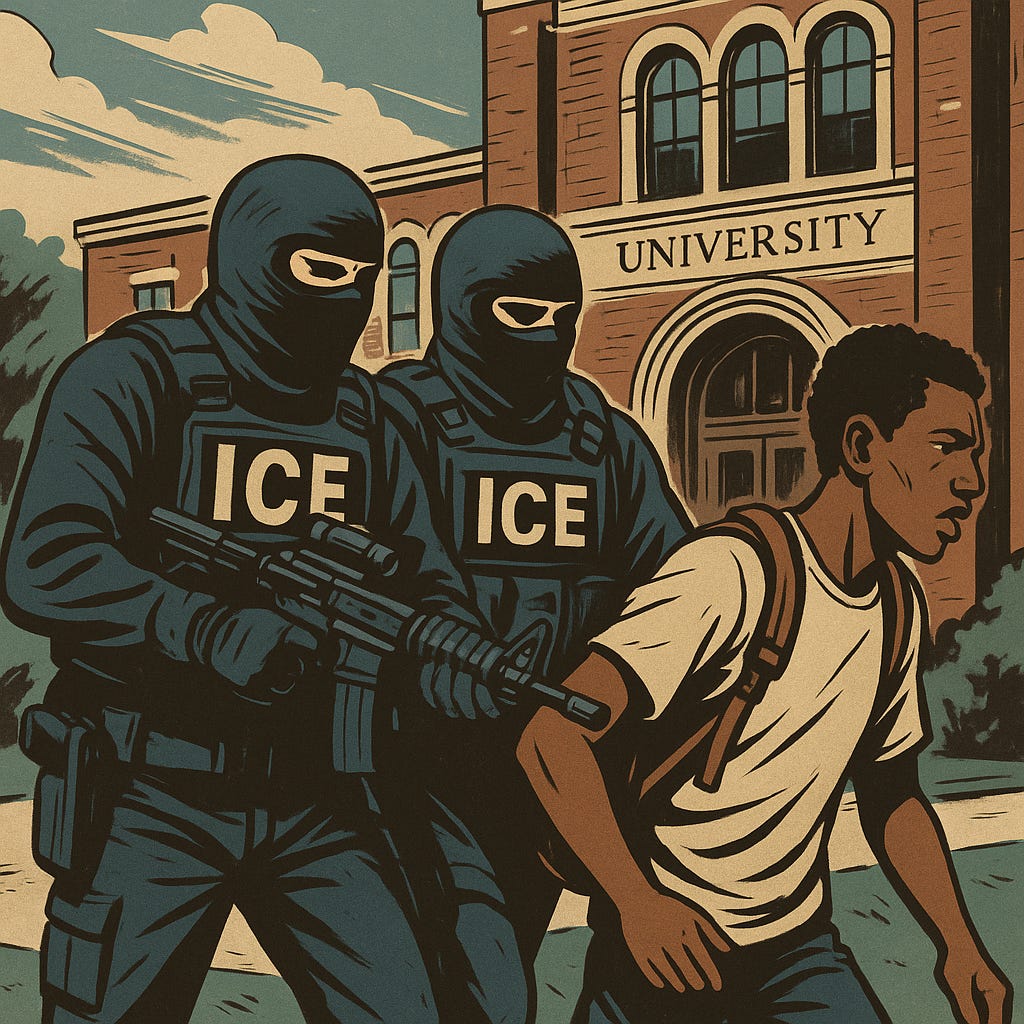
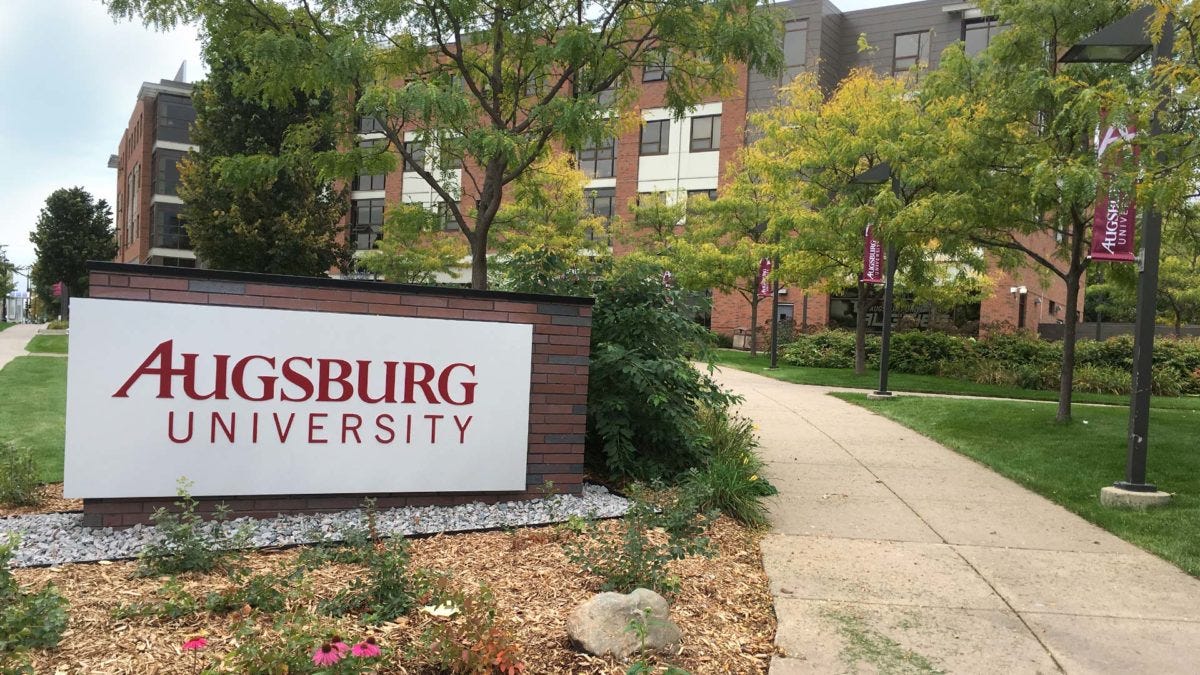
On the afternoon of Saturday, December 6, 2025, a group of masked men, later identified as agents of U.S. Immigration and Customs Enforcement (ICE), arrived in unmarked vehicles at Parking Lot B of Augsburg University in Minneapolis. Witnesses say the agents drew firearms, surrounded a student’s car, and attempted to detain him. According to the university, the agents refused to show a judicial warrant when campus security questioned them. One student filmed part of the encounter. In the footage, unmarked SUVs are parked near campus buildings, and bystanders appear uneasy, some peering out of a nearby dormitory. In some views, a rifle is visible among the masked men.
University administrators later described the incident as “unacceptable, dangerous, and profoundly disturbing”, calling it a violation of both law and the trust that campuses are supposed to offer.
Want to Know Your Rights?
Download a free digital copy of the U.S. Constitution—the same document Trump is trying to bulldoze. Learn exactly what he’s breaking… and how to fight back.
70,000+ strong — and counting.
This holiday, become a paid subscriber for just $1 a week and help us keep the truth alive.
Join The Coffman Chronicle — $1/Week
Why this feels different & why so many are alarmed
For many Americans, a campus is a place of learning, of belonging, and of hope. Even for immigrant and refugee students, it’s meant to be a sanctuary, not a dragnet.
This incident changes that calculus. Federal agents bringing weapons onto our campuses, refusing to show judicial oversight, and targeting students in broad daylight bites at the very idea of what “college” is.
What’s more, this isn’t happening in a vacuum. It comes at a moment when enforcement in Minnesota is aggressively stepping up.
If a private university — institutions many of us trusted to protect students — can be the site of a forced detention or arrest, what is safe anymore?
Why the backdrop matters
To understand the public alarm around the Augsburg raid, it’s important to consider recent history, both nationally and locally.
Across the United States, ICE has long focused its enforcement efforts disproportionately on Latinx and Hispanic populations. That pattern is deeply documented and continues today, particularly in southern states and border regions.
However, in Minnesota, a different pattern has emerged.
Over the past year, ICE enforcement in the state has increasingly targeted Somali and East African communities, even though the vast majority of Somali Minnesotans are either U.S. citizens or legal residents. These recent actions have included raids in Somali neighborhoods, confrontations at businesses and mosques, and, in at least one case, federal agents using pepper spray on a crowd during a chaotic incident in Minneapolis.
So while the student targeted in the Augsburg incident does not appear to be Somali, the broader context still matters. This action wasn’t taken in a vacuum. It landed in a city already on edge, in a state where immigrant communities are watching ICE move with increasing aggression and decreasing transparency.
Somali Communities in Minnesota
Minnesota is home to the largest Somali community in the United States. According to recent census‑based data, approximately 107,000 people of Somali descent live in the state, with about 84,000 in the Minneapolis–St. Paul area alone.
For many, the journey began more than 30 years ago after Somalia’s civil war forced waves of refugees to flee. Families were resettled through official refugee and asylum programs. Over decades, with help from nonprofit and community organizations, they built neighborhoods, mosques, small businesses, and cultural institutions. They became Minnesotans.
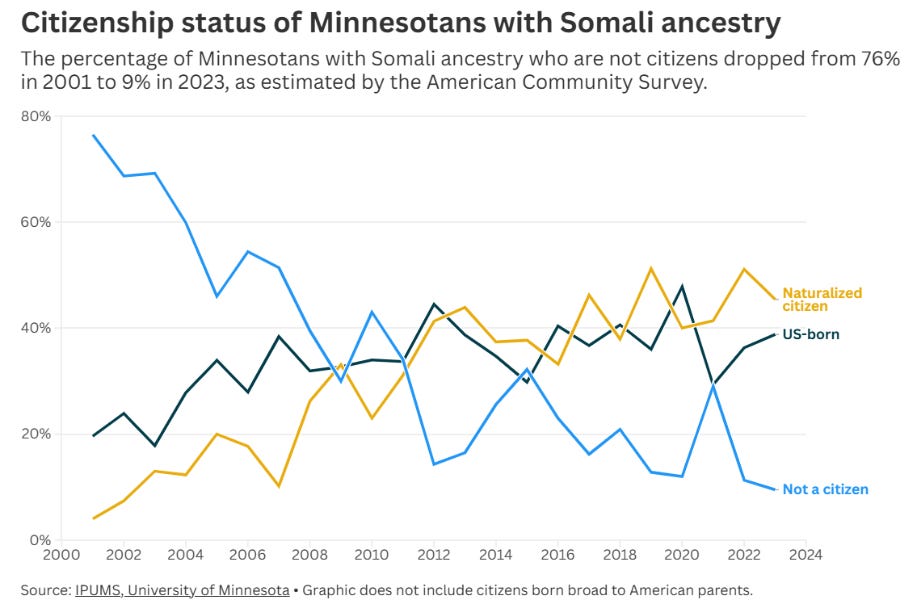
While some of these first arrivals still face economic challenges (poverty rates remain relatively high in parts of the community), younger generations are going to school, graduating, working, raising families, and integrating.
In short, this is not a transient population. This is an established American community. Many are U.S. citizens or legal residents, not “undocumented immigrants.”
So when ICE intensifies enforcement — especially targeting people of Somali descent — it’s not just chasing undocumented “outsiders.” It’s intimidating whole communities that built their lives here decades ago.
The logic doesn’t add up
ICE claims the student arrested at Augsburg was a “criminal illegal alien” and sex offender. However, public records don’t bear that out. That alone raises serious questions about whether this was a legitimate enforcement action or an act of profiling and intimidation.
Moreover, the kind of person who gets into a private university, stays enrolled, lives in dorms, and completes coursework is usually:
Academically qualified (strong high school record, English proficiency),
Financially stable or on scholarship,
Able to navigate U.S. institutions, bureaucracy, and cultural expectations.
A private college isn’t a backstop for unsafe or high‑risk individuals. It’s an institution built on evaluation, documentation, background checks, student support, and community integration.
It’s not reasonable to believe a student with a long criminal or sex‑offender history — one serious enough to warrant violent enforcement — would quietly make it through that system.
This suggests a more disturbing reality that the raid was not about law enforcement but about control, fear, and testing boundaries.
What happens when detainees are swept into ICE’s machine
If ICE had detained the student, especially after such a public display, chances are he wouldn’t have re-emerged any time soon. That’s because once someone is in ICE custody, they can be quickly transported across state or even international lines, often without their family or legal counsel knowing where they are.
Access to legal representation is frequently delayed or denied. This has been documented repeatedly.
As we’ve noted in previous reporting, the publicly available tracking systems within the Department of Homeland Security are notoriously opaque, making it hard to follow someone’s case or welfare. There are near-daily reports that family, lawyers, or human rights groups trying to locate someone within the system are being met with silence and stonewalling.
Deportation, often forced and rapid, can follow, sometimes to countries where the returnee faces violence, persecution, or death. If their nation of origin will not accept them, it has become standard practice for movement to third-party nations, many of which have been accused of human rights violations.
In practice, this makes wrongful deportation nearly irreversible. The person is lost. Their community and family often never see them again.
This raises a chilling question. If you can detain first and justify later — or not at all — then what consequences are there? How can justice be served?
If we don’t stop this now, who’s next?
This is not just about immigration. It’s about the expanding power of an agency that can act with weapons, anonymity, and minimal oversight.
Today, it was a college student. Tomorrow, it could be a protester, a journalist, a labor organizer, or someone whose only “crime” is being in the wrong place at the wrong time. The likelihood is that it has already occurred.
Unchecked federal enforcement power + racial or ethnic profiling + institutional apathy = a recipe for authoritarian control.
If this system is allowed to stand — if raids, arrests, and campus detentions become normalized — then law, trust, and safety become optional.
What needs to happen
The raid at Augsburg is too dangerous and too precedent‑setting to be ignored or dismissed as “just one case.”
Universities must act immediately. Institutions of learning, guardians of dissent and democracy, must not become accomplices in intimidation. They must:
Refuse to cooperate with ICE without judicial warrants.
Establish permanent protocols to protect students — immigrant or not — from unauthorized federal enforcement on campus.
Publicly commit to transparency, support for impacted students, legal defense, and accountability.
At the same time, this cannot remain a local fight. The federal system that allows such raids must be reformed.
Congress needs to close the loopholes that allow ICE to operate without judicial oversight, documentation, or public accountability. Enforcement should not be a matter of an internal memo. It must be a matter of constitutional standard.
If we don’t demand it now, we’ll regret not doing so when the next raid hits.
A warning and a call
When a university campus becomes the stage for an armed federal raid, we have to ask ourselves what kind of country do we want to live in?
Do we want fear masked as authority or justice rooted in law?
This isn’t just about one student, one campus, or one immigrant community. It’s about whether democratic norms still hold in America, or if the next generation will look back at this moment and wonder how it was allowed to happen.
We cannot look away. We cannot stay silent.
We must act now and build protections that linger long after the headlines fade.
Don’t let the bastards sneak anything past you. Subscribe and get your daily dose of rage and receipts delivered fresh, before the spin doctors can scrub it.
Sources:
“Augsburg University officials: ICE agents pointed weapons at students, staff during confrontation.” — FOX9
“Augsburg University president: ICE ‘illegally’ detained student, didn’t show warrant.” — MPR News
“ICE defends Augsburg campus arrest, says student was registered sex offender; school finds no record.” — Patch
“Minnesota’s Somali community marks 30 years of growth.” — FOX9 News
“By the numbers: Minnesota’s Somali population according to census data.” — KTTC
“Most Somali people in America — and Minnesota — are citizens.” — Minnesota Reformer
“ICE operations targeting Somali immigrants underway in Twin Cities | Live updates.” — CBS News Minnesota
“Federal agents use pepper spray on crowd in Somali neighborhood of Minneapolis amid Trump crackdown.” — Associated Press
“Minnesota, known for a warm welcome, turns icy for Somali immigrants” — The Washington Post
As a former Minnesotan, and as an American this disturbs me greatly. Who are the real criminals here, not some poor legal immigrant of color, but those masked men. This is not the Lone Ranger, these are cowards who pick on nonviolent people they know nothing about. I wonder how many of those bullies have records that were ignored? Because of the results of their actions, these people are closer to the KKK than they are to any true law enforcement. And how can any of us with a conscience justify the facilities they are kept in and the treatment they receive just for wanting a better life. Most criminals are treated better than these folks are. I believe in the principles this country was founded on, beating the crap out of innocent, productive people and then starving them wasn’t one of them.