


In the final weeks of 2025, Washington and Harrisburg delivered a flurry of headlines that, taken together, tell a stark story. In just a matter of days, we saw a House‑passed healthcare bill that cobbles together market tweaks while ignoring the looming coverage cliff, a federal bill to criminalize gender‑affirming care for minors amid broader attacks on gender identity, and a narrowly‑passed Pennsylvania constitutional amendment to protect reproductive liberty — itself unlikely to survive the next chamber. Meanwhile, Affordable Care Act subsidies vital to millions are set to expire on January 1 with no path forward, and both chambers of Congress have adjourned.
This is a moment where symbolism is everywhere, and real action is nowhere to be found.
Want to Know Your Rights?
Download a free digital copy of the U.S. Constitution, the same document Trump is trying to bulldoze. Learn exactly what he’s breaking, and how to fight back.
80,000+ strong — and counting.
This holiday, become a paid subscriber for just $1 a week and help us keep the truth alive.
Join The Coffman Chronicle — $1/Week
A Healthcare Bill That Doesn’t Heal
On December 17, the U.S. House of Representatives passed the so‑called Lower Health Care Premiums for All Americans Act, a GOP‑led effort pitched as a response to rising insurance costs. The legislation would expand association health plans — insurance arrangements that let small businesses or trade groups band together to buy coverage across state lines, often exempt from ACA requirements. These plans can offer lower premiums, but they often come with fewer essential benefits, higher out-of-pocket costs, and weaker protections for people with pre-existing conditions. It would also require more transparency from pharmacy benefit managers and restore funding for cost‑sharing reductions that lower out‑of‑pocket costs for some enrollees.
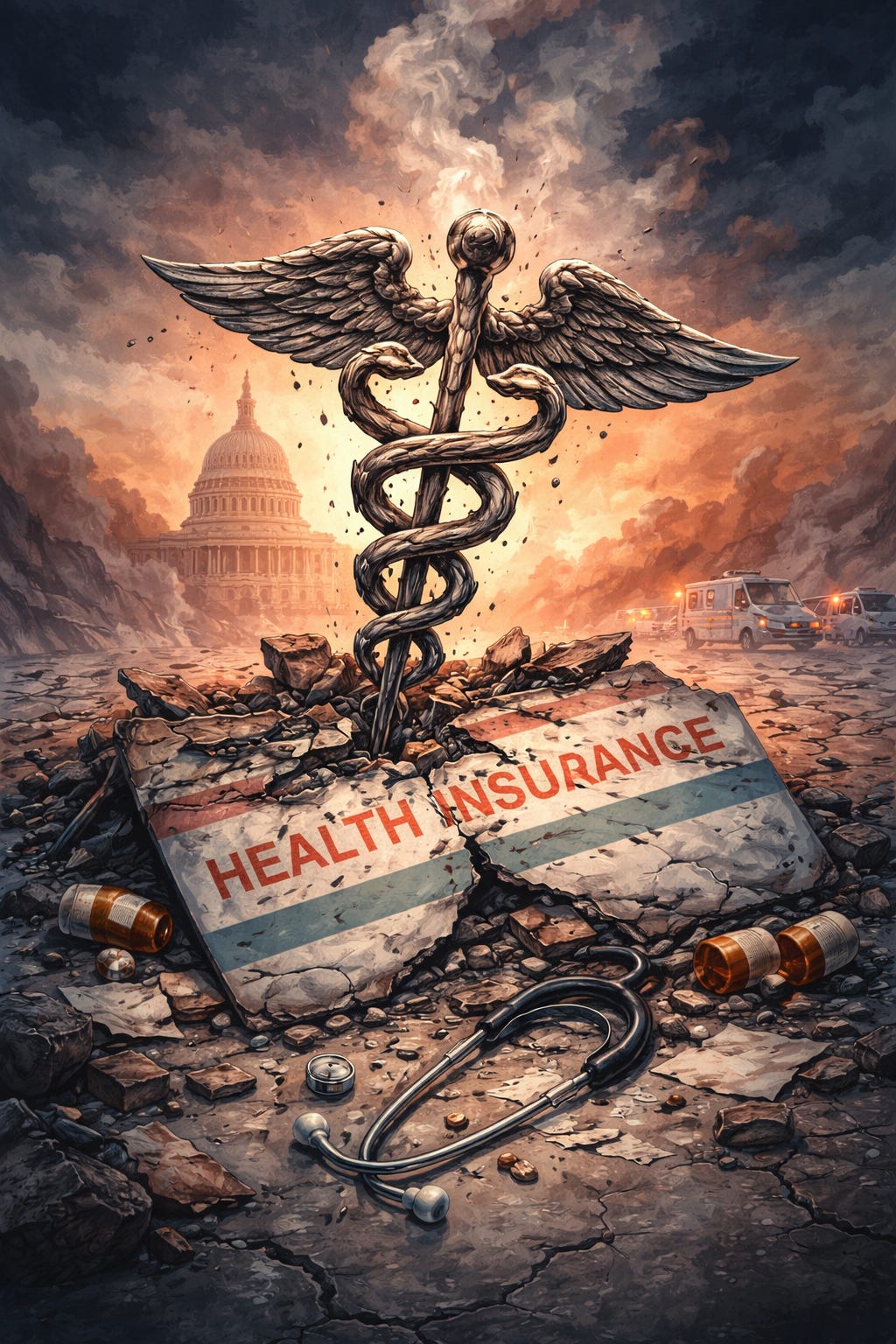
However, the bill’s more circumscribed reality quickly became clear. It does not extend the enhanced Affordable Care Act (ACA) premium tax credits that were expanded during the COVID‑19 pandemic and are set to expire on December 31, 2025. Without those subsidies, many who buy coverage on ACA marketplaces face premium hikes that experts warn could more than double costs in 2026, pushing people into skimpier plans or into uninsurance altogether.
Internal dissent among House Republicans, with four moderates joining Democrats on a discharge petition to force a vote on a three‑year extension of the subsidies, underscored how unpopular standing still has become. But GOP leadership under Speaker Mike Johnson ultimately pushed the party bill forward without any extension or stopgap and sent members home for the holidays.
The result is bill that talks about lowering costs in the distant future while doing nothing to avert a healthcare coverage crisis beginning January 1 or the insurance company greed bleeding everyone dry.
See our recent reporting on previous healthcare bills proposed by this House:


No Senate vote is expected before the end of the year, and both chambers have recessed.
The ACA Cliff: Leaving Millions Vulnerable
Even before the House vote, the U.S. Senate took up competing proposals to prevent a sharp rise in 2026 insurance costs, including a Democratic plan to extend the subsidies for three years and a Republican alternative offering Health Savings Account credits. Neither advanced past the filibuster threshold in early December, with each falling short of the 60 needed.
The failure to pass any extension in the Senate combined with the House’s refusal to take up the issue means that enhanced ACA subsidies will almost certainly expire at year’s end. Analysts warn this could trigger a “death spiral” in the individual market, with healthy enrollees dropping coverage due to cost, premiums rising sharply, and insurers exiting some markets entirely.
For millions of working families, seniors, and individuals with pre‑existing conditions, this isn’t abstract politics. It’s January 2026 bills they may not be able to afford. And Congress has adjourned before doing anything about it.
A Federal Assault on Gender‑Affirming Care & the DOJ
On the same day the House sent its lukewarm healthcare bill to the Senate, it also passed a radically punitive bill targeting transgender youth. Officially titled the Protect Children’s Innocence Act and championed by Rep. Marjorie Taylor Greene, the legislation would make it a federal crime — punishable by up to ten years in prison — for medical providers to offer puberty blockers, hormone therapy, or gender‑affirming surgeries to anyone under age 18.
This measure wraps itself in “protecting children” language, but its carve‑outs and contradictions reveal its ideological agenda. It allows non‑consensual surgeries on intersex infants while denying older youth and their doctors the ability to pursue medically supported treatment. A teenage intersex or transgender youth seeking care could be denied treatment that doctors currently view as evidence‑based, while procedures on infants — often performed without consent — remain untouched. Critics argue this is not medical policy but cultural coercion.
Further, there are no carveouts for gender-affirming adjacent care such as puberty blockers or hormone therapy for gynecological problems or surgery and hormones for gynecomastia.
In the midst of this legislative offensive, Attorney General Pam Bondi’s Department of Justice quietly issued a controversial internal directive on December 4 that recasts federal domestic terrorism priorities. Based on a leaked memo aligned with President Trump’s National Security Presidential Memorandum‑7, federal law enforcement has been tasked with identifying groups “adhering to radical gender ideology,” among other expansive and politically loaded descriptors, as potential domestic terrorism threats. A follow‑up memo reportedly even includes incentives for reporting such groups to authorities.
Taken together, the legislative ban and the DOJ’s ideological framing telegraph a chilling message: dissenting views on gender identity and expansive civil rights could soon be treated not just as wrong but as dangerous.
Pennsylvania’s One‑Vote Reproductive Rights Win and Its Limits
In Harrisburg, a starkly different moment unfolded. On December 17, the Pennsylvania House of Representatives voted 102–101 to pass House Bill 1957, a proposed constitutional amendment to enshrine “personal reproductive liberty.” The measure, sponsored by state Democrats, would guarantee individuals the right to make decisions about contraception, fertility care, and abortion, explicitly protecting these rights in the state constitution.
It was a razor‑thin victory and a remarkable statement: in a politically divided swing state, Democrats pushed a bold vision for autonomy in personal healthcare. However, the procedural reality tempers the celebration. A constitutional amendment must pass the legislature in two consecutive sessions with identical language before heading to voters, and the Republican‑controlled Pennsylvania Senate is unlikely to act before next session, if at all.
So, Pennsylvania Democrats can point to a symbolic breakthrough, but no actual rights change will occur without further votes and, ultimately, a ballot referendum.
January Will Tell the Tale
Taken together, these developments capture a profound contradiction in American governance as 2025 draws to a close: lawmakers have found abundant energy for culture war headlines and symbolic moves, but no real will to solve the material crises facing ordinary people through bipartisan coalition.
Millions are heading into a new year without a clear path to affordable healthcare. Transgender and intersex youth are being criminalized by national policy debates, while dissent and advocacy risk being swept under broad national security initiatives. And in Pennsylvania, reproductive rights advance in headlines but may stall in reality.
Symbolism abounds. Real action? Not so much.
Want to stay abreast of the latest political news?
Become a paid subscriber to support our work and stay in the know.
Bibliography:
U.S. House Republican healthcare plan does not extend Obamacare subsidies (Dec. 12, 2025) Reuters
Obamacare expiration will have ‘death spiral’ effect (Dec. 14, 2025) The Guardian
Swing-district Republicans rebel, force a vote on Obamacare subsidy extension as House GOP passes alternative (Dec. 17, 2025) New York Post
Senate votes down ACA subsidies, GOP alternative (Dec. 12, 2025) The Week
Pam Bondi Directs FBI to Offer Cash Bounty for Promoters of “Radical Gender Ideology” (Dec. 16, 2025) Them
House Speaker Johnson rebuffs efforts to extend health care subsidies (Dec. 16, 2025) AP News
Bondi orders US law enforcement to investigate ‘extremist groups’ (Dec. 4, 2025) Reuters
Pam Bondi wants FBI bounties for ‘radical gender ideology’ (Dec. 17, 2025) Advocate.com
Pa. House advances Reproductive Rights Amendment with bipartisan support (Dec. 17, 2025) PA House
Congress republicans always flee when they don't want to make what they know is an unpopular decision. They flee for a couple weeks or months and hope everyone will forget in the meantime, especially during the holiday fervor. Then, like that adage of the meaning of insanity, they return and give Pikachu face, surprised we haven't let it go.
This is the conservatives for you. Absentee leadership is destroying our nation. When nothing gets accomplished men women and children are hurt. And if they are unable to seek and pay for the medical attention they need to heal their injuries they will quite likely die. The GOP complained about death panels when Obamacare was being proposed. They just never told you the people heading up the death panels was them.