

The Weimar Republic didn’t collapse overnight. It eroded as moderates were silenced, dissenters purged, and power consolidated under a singular vision. Today, as the GOP sidelines its moderates and demands unwavering loyalty, we must ask: Are we witnessing history repeat itself?
History doesn’t always repeat itself, but it often rhymes, and right now, the rhyme is deafening.
The Republican Party is no longer a broad ideological coalition. It is rapidly becoming a rigid, loyalty-enforcing apparatus, where any deviation from the Trump cult invites swift and public punishment. That shift is not just disturbing; it’s historically familiar.

Independent News. Just $1/Week.
We just hit 10,000 subscribers—thank you! We’re offering full access to The Coffman Chronicle for just $1 a week ($52/year) to celebrate.
Get exclusive analysis, daily rundowns, and fearless reporting you won’t find in corporate media.
Support truth. Stay informed.
Cracking Down on Dissent: The Party’s New Order
In the years since Donald Trump rose to power, the GOP has embraced political retribution as a core strategy. The ousting of Liz Cheney and Adam Kinzinger, once prominent conservative figures, marked a turning point. Their crime? Speaking the truth about Trump’s role in the January 6 insurrection. For that, Cheney was removed from House leadership. Kinzinger, facing backlash and isolation, chose not to seek re-election.
This trend isn’t confined to Washington. In New Hampshire, Republican representatives David Nagel and Joseph Barton were removed from key committee positions for voting with Democrats. In Nebraska, State Senator Merv Riepe lost his committee seat in 2023 after opposing a hardline abortion ban. These aren't one-offs. They represent a coordinated effort to purge dissent at every level.
Moderates are not just being sidelined. They’re being erased. Trump and his allies use their deep pockets and influence to primary them into oblivion.
Echoes from the Weimar Republic
Germany’s Weimar Republic didn’t fall to authoritarianism overnight. It collapsed through a series of small, strategic steps: political purges, rising extremism, the consolidation of power, and the normalization of loyalty tests.
In 1934, the “Night of the Long Knives” marked a violent purge of Hitler’s internal rivals, solidifying his control over the Nazi Party. But long before that moment, dissent was already being choked out of democratic institutions like the Reichstag.
“Democracies may die at the hands not of generals but of elected leaders... More often, though, democracies erode slowly, in barely visible steps.”
— Steven Levitsky, How Democracies Die
It starts with party discipline. Then comes institutional manipulation. Finally, loyalty replaces law.
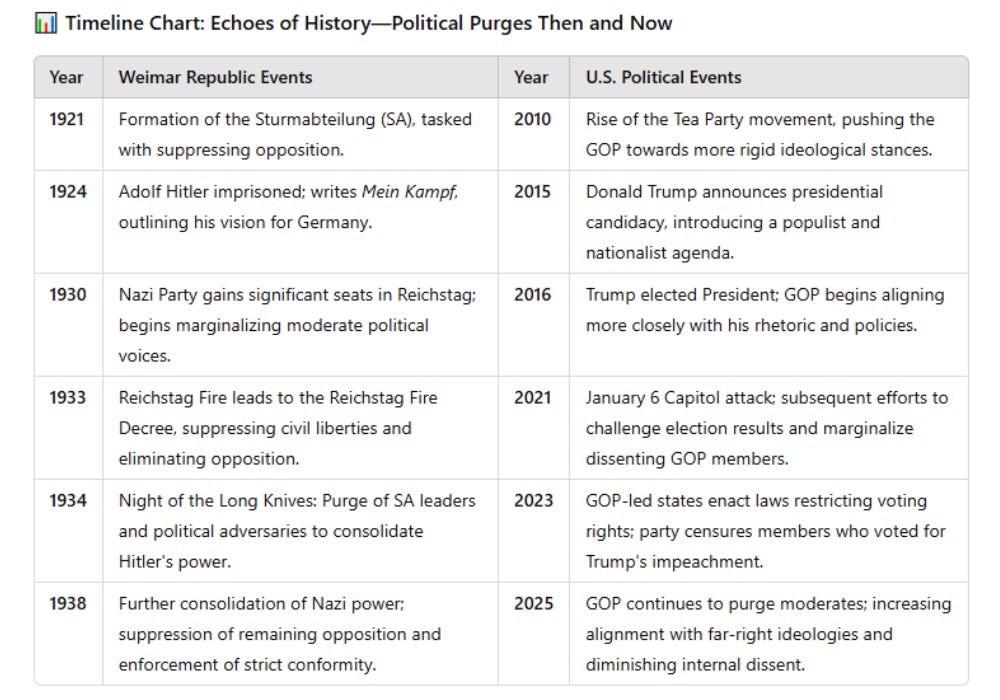
This visual comparison between the Weimar Republic and modern Republican purges illustrates just how dangerously parallel these paths are becoming.
The Cult of Loyalty: From Hitler to Trump
In authoritarian systems, loyalty to the leader becomes loyalty to the nation. We are witnessing a similar shift inside the GOP. Challenging Trump—whether on ethics, policy, or basic democratic norms—is now treated as a betrayal of the party itself.
Today’s Republican leadership is not interested in diversity of thought or ideological debate. It wants obedience. And it's using every institutional lever at its disposal—committee assignments, primary challenges, public shaming—to enforce it.
“Do not obey in advance. Most of the power of authoritarianism is freely given.”
— Timothy Snyder, On Tyranny
Moderates are being warned: fall in line, or fall away.
Why Committee Assignments Matter
Committee roles might sound like inside baseball, but they are where legislative power lives. These assignments determine who shapes policy, who is heard in hearings, and who influences the lawmaking process.
Removing a lawmaker from a committee isn’t just a punishment; it’s a muzzle. It cuts them off from the tools they need to represent their constituents, ask tough questions, or slow down harmful bills. It turns them into symbolic figures, not policymakers.
As moderates are purged and replaced with hardliners, policymaking shifts further to the extreme. Debate narrows. Compromise vanishes. Democracy doesn’t just stall; it begins to fracture.
The Global Pattern: Purging Moderates to Consolidate Power
What we see in the GOP is not unique to the United States. Around the world, authoritarian leaders have used the same playbook: purge the center, silence dissent, and rewrite the rules to entrench power.
After the Bolshevik Revolution, Lenin crushed moderate socialist voices to consolidate one-party rule. In Turkey, Recep Tayyip Erdoğan used purges and legal manipulation to gut the opposition and centralize control. In Hungary, Viktor Orbán has systematically dismantled institutional checks and marginalized dissent.
Everywhere this happens, it starts the same way: silence the voices who might say “no,” or “wait, let’s talk about this.”

What Now? This Is the Part Where We Fight
The most terrifying truth about democratic collapse is how ordinary it feels. A reassignment here, a censure there, a journalist fired, a protester charged—these are the soft sounds of democracy dying.
“To abandon facts is to abandon freedom. If nothing is true, then no one can criticize power.”
— Timothy Snyder
But we still have a choice. Our voices, our votes, our vigilance—they still matter.
Why should we care if the Republicans eat their own? Our system is built on bipartisanship. Whether we like the two-party system or not, it is what we have, and we need the ability to move across the aisle in both directions for true progress to occur.
Here’s what we must do:
Speak up. Share this message. Refuse to normalize this erosion.
Vote in every election, especially local and state races where these purges play out.
Support pro-democracy candidates, regardless of party label.
Demand accountability from media, institutions, and each other.
Silence is complicity. And complicity is how autocracy wins.
You may also find the following articles of interest:


Note: the 2nd article is more than 45 days old and is now in our archive behind a paywall. To access it, consider using a complimentary view or upgrading to paid to access the full archive and exclusive content.
We just hit 10,000 subscribers—thank you! We’re offering full access to The Coffman Chronicle for just $1 a week ($52/year) to celebrate.
Bibliography & Recommended Reading:
Snyder, Timothy. On Tyranny: Twenty Lessons from the Twentieth Century. Tim Duggan Books, 2017.
Levitsky, Steven, and Ziblatt, Daniel. How Democracies Die. Crown Publishing Group, 2018.
Shirer, William L. The Rise and Fall of the Third Reich: A History of Nazi Germany. Simon & Schuster, 1960.
Applebaum, Anne. Twilight of Democracy: The Seductive Lure of Authoritarianism. Doubleday, 2020.
Senchak, Amanda. “Another Republican Removed from NH House Committee for Voting with Democrats.” InDepthNH, March 24, 2025.
Sprunt, Barbara. “Republicans Censure Liz Cheney, Adam Kinzinger for January 6 Committee Work.” NPR, February 4, 2022.
Eisler, Peter, Ned Parker, Aram Roston, and Joseph Tanfani. "How Trump's Intimidation Tactics Have Reshaped the Republican Party." Reuters, August 2024.
"U.S. Rep. Tony Gonzales Outruns Texas GOP's Moderate Purge." San Antonio Report, May 2024.
We have something the German people didn't. The internet!!! Let's keep our democracy and protest online and in-person..
Going back at least 50 years & I guess even now, the GOP held that its Eleventh Commandment was, "Never speak ill of another Republican."