


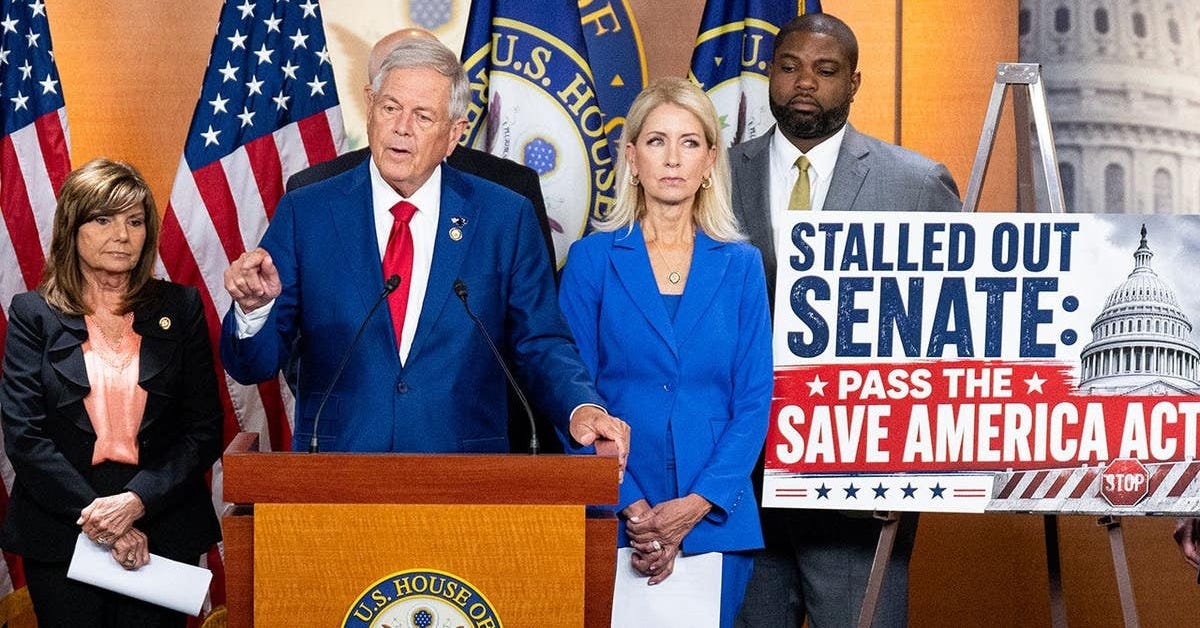
House Republicans are considering a fast-track budget maneuver to advance President Donald Trump’s preferred voting legislation, setting up a fight over both election law and Senate procedure.
Speaker Mike Johnson said Republicans are looking at using another reconciliation bill to move the SAVE America Act, according to Spectrum News. Johnson’s comments came after Trump demanded action on the voting bill and canceled a planned signing of a bipartisan housing package.
The SAVE Act would amend the National Voter Registration Act to require documentary proof of U.S. citizenship to register to vote in federal elections, according to bill text promoted by the White House. Accepted documents include a U.S. passport, certain government IDs, military identification with supporting records, birth certificates, naturalization documents and other federal proof of citizenship.
The political stakes are clear. The bill has struggled in the Senate, where most legislation needs 60 votes to overcome a filibuster. Republicans control 53 seats, and Senate Majority Leader John Thune has said passing the bill is “not realistic” under the current vote math, Spectrum reported.
Reconciliation would change that threshold. Under Senate rules, reconciliation bills cannot be filibustered and can pass with a simple majority. But the process is limited to budget-related legislation, and the Byrd Rule allows senators to challenge provisions with no budgetary effect or provisions whose budget impact is merely incidental to a broader policy goal.
Subscribe free for daily political analysis they won’t broadcast. Join 110K+ readers →
That is the central obstacle for Republicans. Voting rules are policy, not ordinary budget legislation. Johnson suggested creating a grant program tied to election policy, but any such structure could still face a Senate challenge if the policy goal outweighs the budget effect.
County officials have also warned that the proposal could create major administrative burdens. The National Association of Counties said the bill would impose new responsibilities on election offices without dedicated federal funding and could require 18 to 24 months to implement without disruption.
The next question is whether House Republicans can write a reconciliation package that survives Senate rules, or whether the SAVE Act remains blocked by the same filibuster they are trying to avoid.
Subscribe free for daily political analysis they won’t broadcast. Join 110K+ readers →