


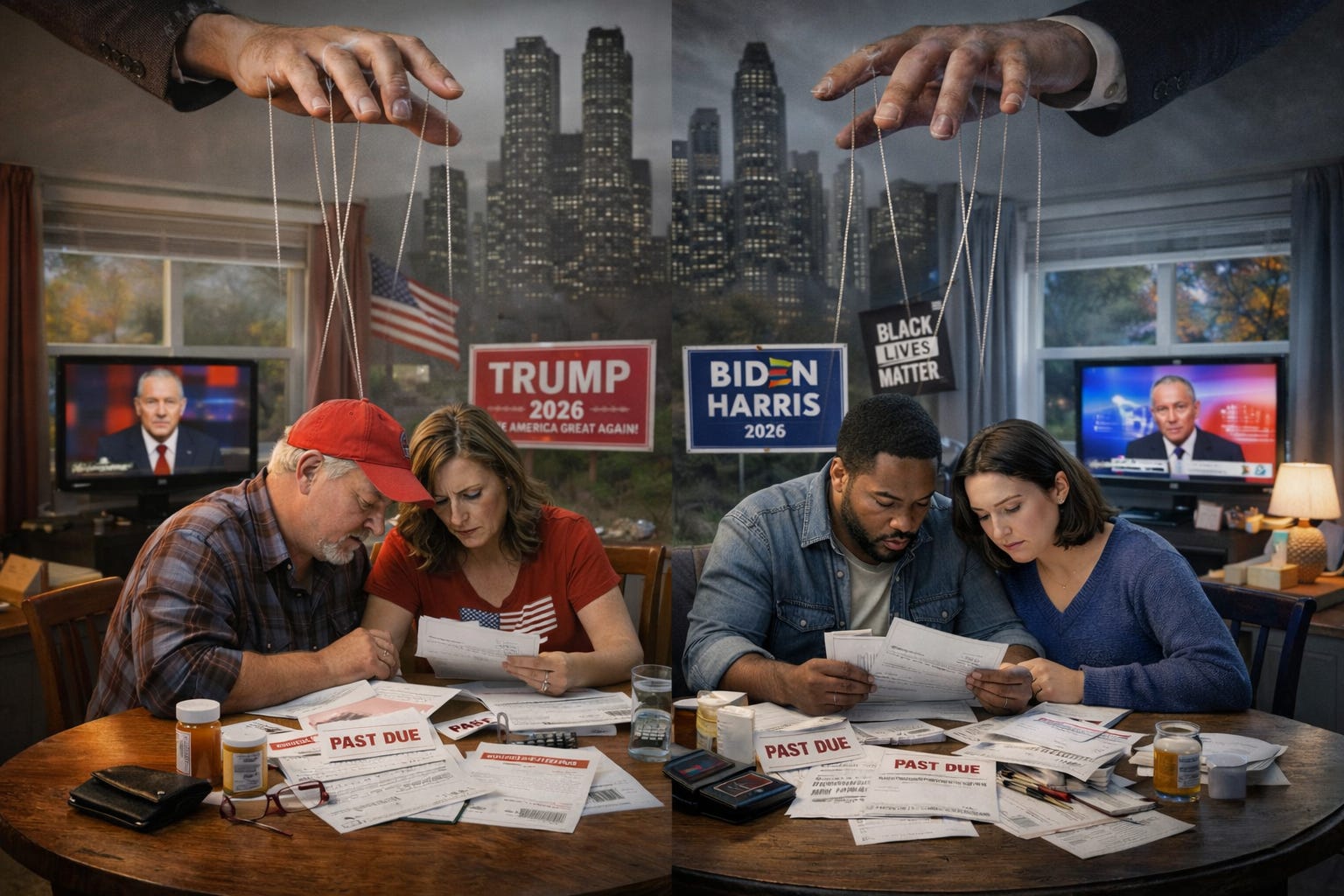
The Fight Americans Are Told to See
Americans are told, constantly, that the biggest threat in their lives is the person standing on the other side of the political divide. The neighbor with the wrong flag. The coworker with the wrong news channel on at night. The parent at the school board meeting had the wrong beliefs. The voter in the wrong county. The family in the wrong city. We are taught to look sideways at one another with suspicion, resentment, and anger, as if the central struggle in this country is a never-ending street fight between left and right.
It is one of the most effective cons in modern American life.
While ordinary people are being trained to treat politics like tribal warfare, the people at the top are doing what they have been doing for decades: taking more, paying less, shaping the rules, buying influence, and tightening their grip on the wealth this country produces. They benefit when working people see one another as enemies. They benefit when every grievance gets sorted into red and blue. They benefit when pain is politicized instead of traced upward to the people and institutions profiting from it.
That is why the real fight in America is not left versus right nearly as much as it is rich versus poor, power versus precarity, ownership versus survival. The culture war may dominate the screen, but the class war keeps showing up in the numbers: in wages that do not cover rent, in grocery bills that rise faster than paychecks, in medical debt, in impossible housing costs, in schools starved of resources, in towns hollowed out while markets boom for people who already own everything.
The poor keep losing this battle, not because they are weak or lazy, but because they are divided, distracted, and forced to fight on a battlefield designed by people who have no intention of sharing power. And the ugliest part is that this is not a flaw in the system. It is one of the system’s most reliable features. As long as struggling Americans keep blaming one another for conditions created and maintained by concentrated wealth, the people cashing in on that arrangement get to keep doing exactly what they are doing now: winning.
This Community Is Powered by You
What started as a small circle has grown into something much bigger, and it’s all because of readers like you.
Every time you forward this email, post it on socials, or bring someone new into the fold, you’re helping build one of the most passionate, independent political communities out there.
Want to keep the momentum going?
Share this newsletter with someone who should be part of this conversation.
Thank you for being here. It means everything.
The Great Misdirection
The genius of the modern American power structure is not simply that it protects wealth, but that it has learned to package that protection as a permanent emotional spectacle. Every day, millions of people are pulled into arguments over who is destroying the country, who hates freedom, who is ruining the schools, who is poisoning the culture, who is betraying “real America.” The details change, the outrage rotates, the villains are updated on a schedule, but the function stays the same. Keep ordinary people emotionally activated, tribally loyal, and pointed at one another.
That is what makes the left-right war so useful to the people who benefit from the deeper economic arrangement. It does not have to be fake to be effective. Many of the issues animating partisan conflict are real, and some are deeply moral and personal. However, in the American system, nearly every issue gets absorbed into a machine that turns human concern into political branding and political branding into social division. Before long, the conversation is no longer about who has power, who profits, who pays, or who is being crushed by the rules. It becomes a test of tribe. Which side are you on? Which people do you blame? Which team do you defend?
That shift is essential because tribal politics is easier to manipulate than material politics. A person focused on wages, healthcare, rent, monopoly power, tax policy, and labor rights is asking dangerous questions. A person trained to interpret everything through the lens of partisan identity is easier to steer. Their anger can be redirected, fear can be sharpened, and attention can be captured and sold. They can be convinced that defeating the other side is the same as improving their own lives, even as their bills keep climbing and their future keeps shrinking.
The result is one of the cruelest patterns in American life. People with nearly identical material struggles are taught to see each other as existential enemies. The rural worker and the urban worker. The Black worker and the white worker. The citizen and the immigrant. The union household and the non-union household. They may all be living under the same pressure of rising costs, low bargaining power, debt, medical insecurity, and economic fragility, but instead of recognizing that shared vulnerability, they are encouraged to interpret one another as the source of the threat.
The culture war is the stage. The class war is what is happening backstage.
The Two-Party Trap
America’s two-party system helps lock that pattern in place. It did not invent inequality or class conflict, but it has become one of the most effective delivery systems for both. It reduces a complicated country into two hostile camps and teaches people to filter every grievance through a binary choice. Which side are you on? Which team is to blame? Which coalition deserves your loyalty, even if neither one is materially improving your life?
That structure is powerful because it simplifies everything. A country shaped by corporate influence, regional inequality, media manipulation, institutional capture, and concentrated ownership gets reduced to a childish yet effective contest between red and blue. Once that happens, millions of people begin voting, arguing, donating, posting, and even forming their personal identities around partisan loyalty rather than material outcomes. The party becomes the lens. The tribe becomes the story. Any issue that might otherwise produce cross-party or cross-class solidarity gets folded back into the endless demand to defeat the other team.
That is a gift to the people already winning. When public anger is funneled into a binary political system, it becomes easier to manage. The poor and working class are offered two brands, two narratives, two approved enemy lists, but very rarely a genuine confrontation with the structures that keep wealth moving upward. One side blames bureaucrats and cultural elites. The other blames reactionaries and obstructionists. Sometimes those critiques contain truth. However, the larger pattern remains. The people at the top continue to accumulate wealth and influence while everyone else is told to pick a jersey and keep shouting.
The two-party setup also deepens fear. People are told, election after election, that the other side is not merely wrong but catastrophic. Every race is existential. Every loss is national ruin. Under those conditions, voters become easier to discipline. They are pushed to accept weak representation, compromised policies, broken promises, and narrow choices because the alternative is always framed as worse. The result is a politics of permanent emergency that drains public imagination and leaves millions feeling trapped inside a system they do not control but are constantly ordered to defend.
The two-party system did not create class inequality. It just gave concentrated wealth a cleaner way to keep the people it hurt fighting the wrong enemy.
The Real Scoreboard
If the loudest fight in America were really the most important one, the outcomes would look very different by now. After all this partisan warfare, you would expect ordinary people to be doing better. However, that is not what the scoreboard shows. The scoreboard shows that the people at the top keep pulling further away while those below are asked to survive with less security, less leverage, and less room to breathe.
That is the simplest way to test what kind of war this really is. Look at who is winning. Look at who can absorb inflation and who cannot. Look at who treats a housing spike as a portfolio opportunity and who treats it as a family emergency. Look at who can pay cash for healthcare, education, childcare, and legal protection, and who goes into debt just trying to remain stable. Look at who gets tax advantages for owning assets while workers are taxed on every paycheck and every purchase. Once you do that, the partisan smoke begins to clear. The fight may be narrated as left versus right, but the outcomes keep landing in the same place: upward.
Wages tell part of that story. Millions of people work harder, longer, and under more pressure than ever, yet still struggle to afford the basics. Productivity rises, expectations rise, stress rises, but security does not rise with them. Housing tells another part. Rent devours paychecks. Homeownership drifts further out of reach. Entire communities become extraction zones where people with capital can profit from scarcity, while everyone else competes for fewer affordable options. Healthcare tells the story with particular cruelty. In the richest country on earth, one illness, one accident, one diagnosis can still become a financial crisis. Education tells it too, turning what was sold as mobility into debt. Grocery bills tell it. Utility bills tell it. Childcare costs tell it. The monthly math tells it with more honesty than any campaign slogan ever will.
Then there is power on the job. For decades, workers have been told to be flexible, adaptable, and grateful, which in practice often means accepting weaker bargaining power and greater insecurity while wealth concentrates elsewhere. Unions are weakened or demonized, benefits shrink, schedules become less stable, and precarious work expands. Even people who technically have jobs are often living with the kind of fragility once associated only with unemployment. The apps get shinier, the corporate language gets friendlier, but the pattern remains brutally old. Labor absorbs risk while ownership collects reward.
Above all of this sits concentration: corporate, financial, media, and ownership concentration. The power to set terms, influence policy, shape narratives, and decide whose suffering counts as regrettable collateral damage. That is why the real scoreboard matters. It strips away the performance and forces a simpler question. If this system is supposed to be serving ordinary Americans, why do the people with the least margin for error keep carrying the heaviest burden while the people with the most power keep increasing their share of the winnings?
The scoreboard does not care about partisan branding. It only shows who is actually cashing the checks.
This Is Not an Accident
It is tempting to describe all this as dysfunction: a broken system, a failure to govern, a series of mistakes layered on top of one another until ordinary life became unaffordable for millions of people. However, that language can be too generous. It suggests randomness where there is pattern. It suggests incompetence where there is often design.
When the same kinds of people keep being protected, the same interests keep being prioritized, and the same kinds of pain keep being treated as acceptable collateral damage, it becomes harder to call the pattern accidental. These are the predictable results of policy choices, lobbying pressure, regulatory capture, ownership concentration, and a political culture that treats wealth as wisdom and suffering as personal failure. The rules did not drift into serving the powerful by coincidence. They were shaped, defended, and refined to do exactly that.
That is why so many public debates in America feel disconnected from the realities people live with every day. The arguments are loud, the rhetoric is dramatic, and the moral theater is endless, but the range of acceptable outcomes somehow remains narrow in all the ways that matter most to ordinary people. Working families are told there is no money for relief, no room for stronger protections, no realistic path to broader security. Yet somehow there is always capacity for tax advantages, subsidies, loopholes, bailouts, carve-outs, and favorable treatment when wealth and ownership are on the line. The system becomes very creative when the powerful need something and very restrained when ordinary people do.
Even the language of merit is used as camouflage. If the rich are rich because they earned it, then the poor must be poor because they failed. If wealth is treated as proof of intelligence, discipline, and virtue, then any challenge to concentrated wealth can be dismissed as envy or resentment. That story is one of the most useful lies in American life because it turns structural advantage into moral superiority. It tells the winners they deserve more and the losers they deserve their pain. Once that logic settles in, exploitation becomes easier to defend, and solidarity becomes easier to shame.
This is not chaos. This is maintenance.
Divide, Blame, Repeat
A system that concentrates wealth at the top cannot survive on economics alone. It also needs a story. It needs a way to explain why so many people are struggling without letting them see too clearly who benefits from that struggle. In America, that story is often built out of division. If people at the bottom ever fully recognized how much they share—how similar their instability is, how similar their fears are, how often they are being squeezed by the same forces—the political and economic order above them would have a real problem. The safer strategy is to keep them separated, suspicious, and angry.
That is why so much political energy gets spent teaching ordinary people to look sideways for the source of their pain. If wages are low, blame immigrants. If towns are declining, blame cities. If cities are struggling, blame rural backwardness. If jobs feel less secure, blame the unemployed. If resources are strained, blame the poor. If cultural change feels threatening, blame minorities, queer people, religious conservatives, secular liberals, teachers, parents, outsiders, insiders—whoever can be turned into a sufficiently emotional target. The categories shift depending on the audience, but the function remains remarkably stable: redirect pressure away from concentrated wealth and toward other people who are also trying to survive.
This works in part because scarcity makes division easier. People living under constant stress are more vulnerable to stories that offer simple enemies and quick emotional relief. When families are exhausted, underpaid, overbilled, medically insecure, and one setback away from crisis, they are not operating from a place of abundance. They are operating from fear, and fear is fertile ground for manipulation. It becomes easier to convince people that someone close to them is taking what should have been theirs, even when the much larger theft is happening above them in forms that look respectable, legal, and distant.
Race has been used this way. So has geography, immigration, religion, and gender. The purpose is not always to create hatred out of thin air. Often, it is to take existing tensions, historical wounds, or cultural differences and weaponize them so thoroughly that class solidarity never has room to breathe. Once people are trained to interpret every anxiety through identity conflict, they become less likely to notice how often their material interests overlap with those of people they have been taught to distrust.
A population taught to fear one another will have a much harder time noticing who is actually picking its pocket.
The Kitchen-Table Cost
All of this can sound abstract until you bring it back to the kitchen table, which is where the real damage always shows up. This is where political theater turns into unpaid bills and hard choices. For poor and working people, losing this fight does not mean losing an argument online or watching the wrong candidate win on television. It means living with a level of instability that seeps into every corner of daily life.
It means parents standing in the grocery store doing math in their heads and putting items back because everything costs more, but the paycheck did not stretch to keep up. It means a family delaying a doctor’s visit because even insured care can wreck a monthly budget. It means rent consuming so much income that saving becomes fantasy. It means people working full-time, sometimes more than full-time, and still living one car repair, one missed shift, or one emergency room visit away from financial trouble. It means debt not as a temporary setback but as a permanent feature of adulthood.
It also means exhaustion, and that exhaustion is political, whether people name it that way or not. A person who is always worried, always juggling, always recovering from the last bill and bracing for the next one, has less time and less energy to organize, read deeply, attend meetings, push back, or imagine something better. Economic pressure narrows life. It reduces the future to immediate survival. That makes people easier to manage. A population under constant strain is more likely to accept humiliation at work, neglect from government, predatory terms from lenders, and empty promises from politicians because the day-to-day fight to stay afloat leaves little room for anything else.
The damage is not only financial. It is emotional, physical, and generational. Stress reshapes families. Insecurity reshapes communities. Children absorb the instability of adults who are doing everything they can and still cannot create solid ground. People put off care, postpone plans, stay in bad jobs, remain in unsafe housing, delay having children, or give up on milestones that earlier generations were told to treat as normal. The result is not just poverty in the narrow sense. It is the slow theft of dignity, health, time, and confidence in the future.
The poor are not losing an abstract argument. They are losing years of their lives.
What the Powerful Fear Most
For all the noise in American politics, the people at the top have a very simple fear: that ordinary people might finally see the pattern clearly. Not perfectly. Not all at once. Just clearly enough to understand that they have been pushed into the wrong fight for a very long time. Because once poor and working people begin to recognize that their deepest common struggle is not with one another but with the systems and institutions extracting from all of them, the old tricks start to lose some of their power.
That is what makes class clarity dangerous to concentrated wealth. It rearranges the map. A person who thinks only in partisan terms may spend years trying to defeat the other side without ever challenging the deeper structures draining their life. But a person who sees the class dimension of the system begins to notice something harder to ignore: that the people making rent impossible, healthcare unaffordable, work more precarious, and politics more corrupted are not primarily their neighbors. They are the owners, donors, monopolists, lobbyists, financiers, and institutions that have learned how to convert other people’s insecurity into profit and power.
That recognition does not erase real disagreements among ordinary Americans. It does not mean every cultural, moral, or political conflict disappears the moment people talk about class. It means something more important. Those conflicts no longer serve as a complete map of reality. Poor and working people can disagree about many things and still understand that they are being squeezed by a system that is far more unified in protecting wealth than the public is in defending itself.
Once people develop class clarity, solidarity becomes more possible. It is not automatic or easy, but possible. The worker in a red county and the worker in a blue city can begin to see that they are both living under the same kind of pressure. The parent drowning in bills and the retiree watching fixed income lose value can begin to recognize the same upward extraction. The exhausted nurse, warehouse worker, teacher, mechanic, cashier, driver, caregiver, and laid-off office worker can all begin to understand that the daily humiliations they face are not isolated personal failures. They are connected outcomes in a system built to keep labor cheap, insecurity normal, and resistance fragmented.
The moment ordinary people see the pattern, the people at the top have a problem.
Name the Real War
America will keep going in circles as long as poor and working people are pushed into a fight that was designed to keep them confused about who is actually hurting them. As long as politics is reduced to an endless contest of partisan identity, outrage, and mutual suspicion, the people with the most money and the most power will keep getting exactly what they have been getting: more wealth, more influence, more insulation from the consequences of the system they help shape. The public will be told to pick a side, defend a tribe, fear the other camp, and call that democracy, even as the material ground beneath millions of lives keeps eroding.
That is the real tragedy. Not disagreement itself. Not the existence of left and right. A free society will always have conflict. The tragedy is that so much of America’s conflict has been organized in ways that protect concentrated wealth from concentrated accountability. Ordinary people are encouraged to pour their anger sideways while the system above them continues extracting, consolidating, and calling the result normal. The poor do not keep losing because they are incapable of winning. They keep losing because they are forced to fight on terms that were never built for their liberation.
At some point, the country has to be honest about what is happening. The central struggle in American life is not simply between liberals and conservatives, Democrats and Republicans, red states and blue states. Beneath all of that noise is a more consistent divide between people trying to survive and people gaining power from the conditions that make survival harder. That divide explains more about modern American life than most of the partisan language we are taught to use. It explains why wages lag behind costs, why debt becomes normal, why healthcare feels like a luxury, why exhaustion feels permanent, and why every election comes wrapped in moral drama while so many economic outcomes remain stubbornly familiar.
The rich do not need poor and working people to love one another. They do not need every cultural argument to disappear. They just need ordinary Americans to keep missing the real enemy. They need them angry, fragmented, exhausted, and pointed in the wrong direction. That has been enough to keep the arrangement alive for a very long time.
However, once people begin to name the real war, the performance starts to weaken. Once they see that the battle is not primarily left versus right but wealth versus survival, power versus precarity, ownership versus dignity, then the people at the top have something to fear that no election ad or outrage cycle can fully contain: a public that finally understands who has been winning, who has been losing, and why.
Support Independent Media-The Coffman Chronicle
If you’re tired of being told to fight your neighbor while the powerful keep rigging the game, help us keep naming the real war.
The Coffman Chronicle exists to cut through the noise, follow the money, and tell the truth about who is winning, who is losing, and why. If this kind of independent, kitchen-table journalism matters to you, consider becoming a paid subscriber.
Your support helps us keep digging, keep writing, and keep challenging the stories that power wants you to believe. It helps us stay independent, accountable to readers, and focused on the people living with the consequences of these decisions every day.
If you want more reporting that follows the receipts instead of the spin, become a paid subscriber to The Coffman Chronicle today.
Sources:
Economic Policy Institute. “The Productivity–Pay Gap.”
Federal Reserve Board. Economic Well-Being of U.S. Households in 2024. May 2025.
KFF. “The Burden of Medical Debt in the United States.” February 12, 2024.
Tax Policy Center. “Tax Expenditures: How We Spend Through the Tax Code.” June 6, 2025.
Tax Policy Center. “What Are the Largest Tax Expenditures?”
U.S. Bureau of Labor Statistics. Union Members—2025. USDL-26-0229. February 18, 2026.
U.S. Census Bureau. “Income, Poverty and Health Insurance Coverage in the U.S.: 2024.” September 9, 2025.
U.S. Census Bureau. Health Insurance Coverage in the United States: 2024. P60-288. September 2025.
Urban Institute. A Perfect Storm of Rising Costs Threatens America’s Housing Market. September 2025.
Urban Institute. “The American Affordability Tracker.”
You’re kidding me. You just figured this out? In the 60s when we marched in protest we chanted “Tax the rich feed the poor”.
I really believe that democracy erodes as capitalism rises, and to thrive a country needs a leader who is willing to put democracy ahead of capitalism. Otherwise, a country is doomed to fail in the long run. If capitalism wins out, a country will in all likelihood degenerate into a feudal structure which is already being discussed in terms of "freedom cities".