


They said it was about banning buzzwords, cutting through jargon, cleaning up bureaucracy, and restoring “neutrality” to government programs. Somewhere along the way, however, that rhetoric turned sharp. It began reshaping who gets to speak, who gets to be counted, and who gets to be helped.
Now, programs serving some of the nation’s most vulnerable communities are being told not to name the very struggles they were created to address. And somewhere else, a document meant to expose a national crisis simply vanished, not because the crisis was solved, but because it had become inconvenient to acknowledge.
This isn’t just a shift in language. It’s a shift in power, and the consequences are beginning to show.

Want to Know Your Rights?
Download a free digital copy of the U.S. Constitution, the same document Trump is trying to bulldoze. Learn exactly what he’s breaking, and how to fight back.
80,000+ strong — and counting.
This holiday, become a paid subscriber for just $1 a week and help us keep the truth alive.
Join The Coffman Chronicle — $1/Week
Head Start: When Saying the Truth Becomes a Funding Risk
Every year, thousands of Head Start centers across the United States submit grant applications to secure the federal funding they need to operate. These programs are the nation’s primary early‑childhood education safety net, serving families living in poverty, children with disabilities, children experiencing trauma, and communities of color. In fiscal year 2025 alone, Congress appropriated about $12.3 billion for Head Start.
Yet tell that to the local director struggling to keep classrooms open when the federal government won’t let her name the hurt she sees every day.
On December 5, 2025, the American Civil Liberties Union revealed that the Department of Health and Human Services, specifically the Administration for Children and Families, which administers Head Start grants, circulated a six‑page list of “prohibited words” that grantees were told to avoid in funding applications.
This wasn’t a short list of obscure bureaucratic jargon. It included terms like “disability,” “tribal,” “Black,” “inclusive,” and “women”, words that directly describe the communities these programs exist to serve.
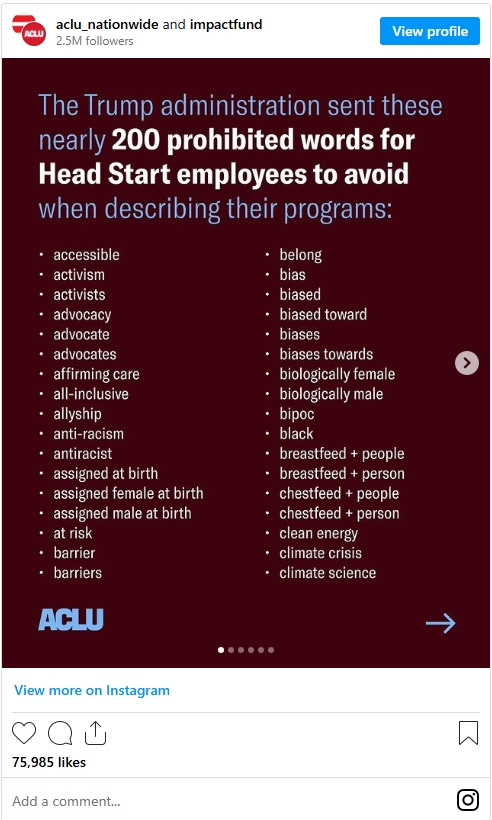
In other words, the very language that allows a program to explain who its children are and what challenges they face was suddenly framed as trouble — to be avoided, scrubbed, or risk jeopardizing funding.
For programs already operating on razor‑thin margins, that’s more than silly. It’s existential.
Silencing Need Has Real Consequences
To understand the seriousness of this shift, imagine how Head Start operates on the ground.
Across all 50 states, tribal lands, and U.S. territories, Head Start centers serve hundreds of thousands of children from low‑income families, often providing essential services beyond education, including nutritional support, health screenings, developmental resources for children with disabilities, and family‑support programs.
In the 2022–2023 program year, Head Start’s 1,700 facilities enrolled over 827,000 children and families, including:
~542,000 preschool‑age children
~245,000 infants and toddlers in Early Head Start
~12,000 pregnant women
Tens of thousands of children in Migrant and Seasonal Head Start or American Indian and Alaska Native Head Start programs.
If distributed equally, that would be close to $7 million per center or approximately $15,000 per client. Yet that is far from how funding is actually shared.
Research has documented how programs like this help close gaps in school readiness and provide stability for families in crisis, but only if they can be funded and sustained. Yet under the new guidance, centers are essentially told not to name trauma. Don’t describe disability. Don’t speak the language of diverse needs. Instead, the administration wants grantees to present a neutral, faceless application.
That matters because, while $12.3 billion is set aside for the program, that money is allocated through competitive grant awards to local agencies. Unless a waiver is granted, each is expected to raise 20% or more of their budget outside of these federal grants. This presumes equal access to quality grant writers. The reality is quite different.
In wealthy suburbs, programs often have access to experienced grant writers, sometimes from volunteers or partner organizations, who can craft compelling narratives that fit federal expectations. In rural, tribal, or deeply impoverished areas, that expertise is far scarcer, and expertise can make the difference between winning funding and watching services shrink.
However, when you also prohibit key words that describe community needs, the gulf between who can articulate their reality and who cannot widens even more. If a program cannot say “trauma” because it’s on a flagged list, it may be unable to justify critical resources. If it can’t say “disabled,” it may be denied support even as children with special needs linger on waiting lists.
This isn’t just bureaucratic hair‑splitting. It’s a structural barrier that disproportionately harms centers serving the children who need the most help, while advantaging those that can finely polish “neutral” grant language.
From Silenced Need to Erased People
Language matters, but sometimes the harm goes beyond words.
If restricting what can be written suppresses need in Head Start applications, what happens when the document that proves a crisis exists is taken down entirely?
That question cuts to the heart of one of the most disturbing policy developments of the anti‑DEI era, the removal of a federally mandated report on the crisis of Missing and Murdered Indigenous People (MMIP) including Missing and Murdered Indigenous Women (MMIW) from public federal websites.
What Not One More Was & Why It Was Historic
In 2020, Congress passed the Not Invisible Act, a bipartisan bill signed into law by then‑President Trump. It was the first legislation introduced and passed by four members of Congress who are enrolled tribal members, and it created the Not Invisible Act Commission to confront the longstanding crisis of Indigenous people going missing, being murdered, or trafficked in the U.S.
This commission was not a ceremonial task force. It was composed of tribal leaders, federal partners, law enforcement, advocates, survivors, and family members of victims. Over two years, they held public hearings across the country, gathering testimony from more than 250 individuals who had seen this crisis up close.
In November 2023, they issued their final product. This document— Not One More: Findings and Recommendations of the Not Invisible Act Commission— didn’t just describe the problem. It offered a roadmap, including recommendations to improve data collection, to enhance collaboration among tribal, state, and federal law enforcement, to ensure survivors and families had resources, and to address systemic barriers to justice.
For Indigenous communities, who have long suffered disproportionate rates of violence, the report was a rare instance of federal acknowledgment, documentation, and cooperative strategy. In many parts of Indian Country, murder or disappearance of tribal members, especially women and girls, has been met with little follow‑through from law enforcement or federal agencies for decades.
Indigenous women in the United States face violence at staggering rates. Research consistently shows that more than four out of five Indigenous women have experienced some form of violence in their lifetime — far above the national averages — and in some tribal counties, murder rates are estimated to be up to ten times higher than elsewhere. In 2016 alone, federal systems recorded more than 5,700 Indigenous women and girls as missing, yet only a small fraction of those cases ever made it into national databases. This massive undercount reflects a system that has long failed to track, investigate, and respond to disappearances and murders affecting Native communities.
The Not One More report was meant to change that.
The Report’s Removal and What It Signals
Then, on February 9, 2025, the report was taken down. Nearly 300 days later, it remains absent from the Department of Justice’s website and other federal portals. Initially, only tribal reporting raised the alarm. It was well into the fall before major networks picked up the absence. The official explanation tied the removal to earlier compliance with a series of executive orders aimed at stripping “DEI‑related content” from government web pages, including an order emphasizing biological definitions of “woman.”
For senators including Catherine Cortez Masto, who helped usher the Not Invisible Act into law, and Lisa Murkowski, chair of the Senate Indian Affairs Committee, the removal was shocking and unacceptable. They have publicly called for the report’s restoration, arguing that removing a congressionally mandated document undermines transparency and efforts to address the crisis.
That’s not hyperbole. The Not One More report wasn’t a ‘DEI brochure’ or academic paper. It was the federal record of a crisis, compiled with tribal testimony and strategic recommendations. When such a document disappears, the practical effect is clear. It becomes harder for advocates, policymakers, tribal law enforcement, researchers, and the public to even see the problem, let alone act on it.
Disappearance isn’t just symbolic here. The loss of this report cuts off a key source of federally acknowledged data and strategy that would have informed future legislation, funding requests, and coordinated enforcement efforts. Without it, the federal government cedes ground to ignorance, absolving itself of responsibility under the very law it once passed.
Beyond Headlines: What This Really Means
Neither the Head Start language guidance nor the removal of the Not One More report is an isolated quirk of policy. They are pieces of the same emerging pattern, a wave of anti‑DEI directives that began with the removal of thousands of pages from federal websites, including scientific research, public health materials, social services resources, and programs targeting marginalized groups.
At one level, language can feel like semantics, but when that language is tied to funding formulas and access to data, it becomes a lever of power, a way to decide who gets seen and resourced, and who is left out in the cold.
For Head Start centers, the practical harm is soon to show up in budgets, staffing, and the services they can offer. For Indigenous communities, the harm is more acute and visceral. A crisis that has already cost lives is made harder to track, harder to publicize, and easier to ignore.
This is why some advocates describe the removal of the Not One More report as a first blood moment in the anti‑DEI campaign, the first time the consequences of these policies have moved beyond intimidation and symbolism into measurable harm. When a roadmap for preventing violence is taken out of public view, when the official record of tragedy is scrubbed, that affects real investigations, policy decisions, and funding flows.
When Erasure Becomes Policy
There was a time when debates over diversity, equity, and inclusion lived largely in rhetoric and cultural flashpoints. However, when language becomes restricted in grant applications and entire federally mandated reports are removed from public access, we are no longer dealing with rhetoric. We are dealing with policy that reshapes what the government acknowledges, funds, and prioritizes.
Silencing the words that describe trauma and need means that need is less likely to be acted upon. Burying the evidence of violence means it is less likely to be addressed. These aren’t theoretical concerns. They are measurable harms that will ripple across classrooms, courtrooms, and communities for years.
This anti‑DEI push has crossed a line from culture war to structural violence, and its first real blood has been drawn.
Don’t let the bastards sneak anything past you. Subscribe and get your daily dose of rage and receipts delivered fresh, before the spin doctors can scrub it.
Sources:
“President Trump issues Executive Order on federal grantmaking” (Sep. 9, 2025) Education Counsel
“Trump Sent Head Start A List of 200 Words To Stop Using To Describe Their Programming” (Dec. 11, 2025). Scary Mommy
“The DOJ took down a report on Indigenous people — mandated by a law Trump signed — to comply with an anti‑DEI order” (Nov. 15, 2025). Mississippi Today
“‘A slap in the face’: activists reel as Trump administration removes crucial missing Indigenous peoples report” (Mar. 20, 2025). The Guardian
“Not Invisible Act Commission overview.” U.S. Department of the Interior
“Not One More: Findings and Recommendations” (Nov. 1, 2023). NIWRC
House letter opposing removal of Not Invisible Act report (Jul. 9, 2025). Gwen Moore
“2025 United States government online resource removals” Wikipedia
This is how dictators and cult leaders subjugate their victims.
This is wild - and not a good wild. It is the rise of autocracy - or the cementing of a Russia-like oligarchy. While midterm elections offer a glimpse of hope, much more damage can be done before they happen - and, if Trump is allowed to remain President for a full term, the cost of repairing institutions will be enormous. Yes, Democrats need a clear policy agenda - but also, a top priority must be the impeachment and removal of this President.