


When America’s Founding Fathers gathered in Philadelphia in 1787, they understood that a justice system, even a democratic one, would need a mechanism for mercy. Drawing from English legal traditions, they enshrined the pardon power in Article II of the U.S. Constitution, granting the president authority to “grant reprieves and pardons for offenses against the United States, except in cases of impeachment.”
In Federalist No. 74, Alexander Hamilton defended this power, arguing that the singular responsibility of the president would ensure accountability and swift action. He believed clemency could correct judicial errors, offer relief from undue severity, and even quell national unrest. Hamilton envisioned a system in which justice could bend, gently and wisely, toward humanity.
We just hit 14,000 subscribers—thank you!
Get exclusive access for just $1/week or $52 a year.
Get exclusive analysis and fearless reporting you won’t find in corporate media.
Hamilton’s Hope & Blind Spot
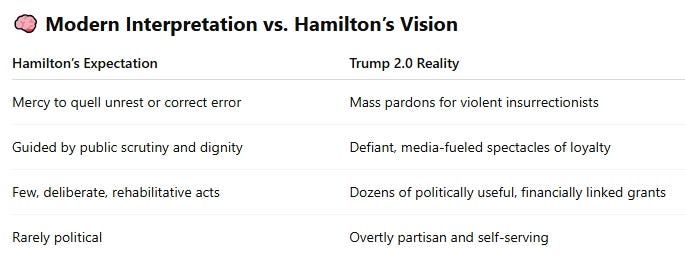
In Federalist No. 74, Alexander Hamilton offered a forceful defense of placing the pardon power solely in the hands of the president. He believed that responsibility, when undivided, would bring out caution and integrity. “The reflection,” he wrote, “that the fate of a fellow-creature depended on his sole fiat, would naturally inspire scrupulousness and caution.”
Hamilton assumed that the presidency would be occupied by individuals of “prudence and sound judgment,” guided by the weight of their office and the scrutiny of the public. He feared delay and bureaucracy more than abuse, trusting that the enormity of the power would inspire humility.
What Hamilton could not have foreseen was the rise of a political culture that rewards defiance over dignity, or a media environment in which scandal is fuel rather than friction. He did not anticipate the role of cable news, social media algorithms, or partisan echo chambers that would replace public scrutiny with tribal defense.
Most of all, Hamilton did not expect a president who would wield the pardon not as a solemn act of mercy, but as a performance of dominance, a signature of impunity rather than a correction of injustice.
A Tradition of Restraint
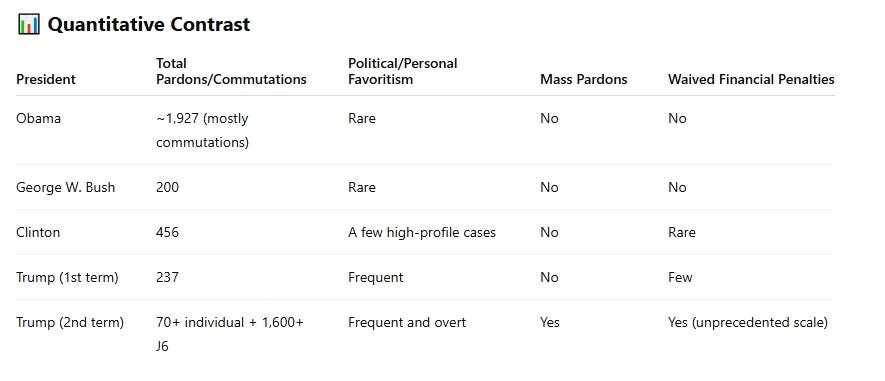
For much of U.S. history, presidents treated this power with measured restraint. Abraham Lincoln used pardons to begin reconciling the nation after the Civil War. Gerald Ford, controversially but with national healing in mind, pardoned Richard Nixon. Barack Obama issued mass commutations to nonviolent drug offenders, arguing that sentencing reform required executive intervention.
Even when controversial, like Bill Clinton’s last-minute pardon of financier Marc Rich, these actions were exceptions, not patterns. Most pardons followed a formal review process conducted by the Department of Justice, guided by standards of fairness, remorse, and rehabilitation. Clemency was used to correct, not to reward.
Trump’s First Term Broke Precedent. His Second One Dismantled It.
Donald Trump began undermining this tradition during his first term, when he pardoned political allies like Michael Flynn and Roger Stone, and celebrities whose causes were championed by conservative media. But in his second term, Trump has transformed the pardon into something far more systematic: a tool of political loyalty, financial favor, and ideological consolidation.
On Day One, he issued a sweeping pardon of over 1,500 individuals convicted for their roles in the January 6 insurrection. This wasn’t an act of reconciliation. It was a declaration of allegiance to the MAGA base and a signal that political violence in his name would not only be forgiven but honored.
A New Purpose: Erasing Debt for the Faithful
In a stunning departure from presidential norms, Trump has used the pardon not only to eliminate criminal convictions but also to erase financial penalties. Trevor Milton, the disgraced Nikola Motors founder convicted of securities fraud and ordered to pay over $680 million in restitution, saw his debts vanish with a stroke of Trump’s pen. So did the Chrisleys, reality TV stars who owed nearly $18 million for tax evasion and bank fraud.
Executives of the cryptocurrency platform BitMEX had a $100 million penalty reduced to zero. Paul Walczak, a Florida healthcare executive who defrauded the government of payroll taxes, was freed of a $4.4 million obligation. In nearly all of these cases, the recipients were either financial backers of Trump or represented ideological causes aligned with his base.
This is clemency as currency, a transformation of a constitutional tool into a reward system for the politically and financially loyal.
Mercy Weaponized
The gravity of this shift cannot be overstated. Where pardons were once used to reduce injustice, they are now wielded to consolidate power. The entire judicial process is undermined when criminal convictions, especially those involving fraud and corruption, are not only forgiven but also rendered consequence-free for those with the right connections.
This is not just an ethical deviation; it is a constitutional distortion. It redefines executive mercy from an instrument of justice into one of patronage. And with no legal limits on the pardon power, the implications are sobering.
Patterns of Power: Thematic Trends in Trump’s Pardons
A closer examination of Trump’s clemency decisions reveals that they’re not random acts of mercy, but rather consistent expressions of political alignment, grievance, and transactional loyalty. The pardons form a patterned playbook, one that reflects Trump’s ideology and his vision of who deserves protection from the law.
1. Mass Pardons for Ideological Soldiers
Trump’s pardons for over 1,500 January 6 defendants marked the first time a U.S. president mass-pardoned citizens for an attack on democratic institutions. But that wasn’t the only ideologically driven clemency.
Earlier in 2025, Trump also pardoned 23 anti-abortion activists convicted of violating the FACE Act, some of whom were repeat offenders in clinic blockades and trespassing. These pardons signal a weaponization of clemency to endorse direct-action culture war tactics, from insurrection to reproductive harassment.
2. White-Collar and Corporate Loyalty
Many of Trump’s most controversial pardons have gone to wealthy executives and financiers convicted of fraud, tax evasion, and securities violations. These aren’t mercy cases. They are rewards.
From Trevor Milton’s erased $680 million restitution to the Chrisleys’ vanishing debt, the theme is clear: if you have money, connections, or celebrity, Trump’s clemency is for sale or at least exchangeable for loyalty.
3. Favor for Friends, Family, and Inner Circle
Figures like Michele Fiore, Devon Archer, and multiple crypto entrepreneurs didn’t just share Trump’s politics; they shared personal ties. Whether through campaign donations, family relationships, or public defense of Trump’s causes, many pardoned individuals were socially embedded in the MAGA network.
This trend suggests a shift from public-service-based clemency to nepotism and movement loyalty.
4. Narrative Reinforcement Over Justice
The pardon decisions have increasingly served to validate Trump’s public narrative: that his enemies are politically persecuted, that his supporters are patriots, and that institutions like the FBI, IRS, and DOJ are corrupt. Pardons become rhetorical tools, not legal remedies, reasserting his version of reality and his grip on power.
Trump is also known for his pardons of celebrities. In addition to the Chrisleys, NBA YoungBoy, and others, he has been petitioned to offer his pen to Joe Exotic and Diddy.

Can This Be Reformed?
Legally, the president’s pardon power is almost absolute. Courts cannot reverse it, and Congress cannot nullify a clemency decision. However, that does not mean it must remain unchecked.
Congress can establish transparency requirements, revive the pardon attorney’s role as a gatekeeper, and mandate public disclosure of lobbying efforts related to pardons. Most critically, the public can pressure candidates and future presidents to commit to the ethical use of clemency.
If no action is taken, Trump’s second-term pardons will become the new baseline, in which clemency is not a moral corrective but rather a political payoff.
The Soul of the Pardon Is at Stake
The presidential pardon was designed as a last-resort tool to correct injustice and extend mercy. It now teeters on the edge of becoming a symbol of elite impunity and political favoritism.
Trump’s second-term strategy doesn’t just test the limits of the Constitution. It tests whether Americans will accept a system where justice is something that can be bought, bartered, or branded in the image of one man.
Take Action: Make Your Voice Heard
The presidential pardon power was designed as a tool for justice and mercy. Its misuse undermines the rule of law and public trust. Your voice can help uphold the integrity of our democracy.
🗣️ Call Your Elected Officials
Contacting your representatives is a powerful way to express your concerns.
Capitol Switchboard: Dial (202) 224-3121 and provide your ZIP code to be connected to your senators and representative.
Find Your Members: Use congress.gov/members/find-your-member to locate your elected officials and their contact information.
Sample Script:
Hello, my name is [Your Name], and I live in [Your City, State]. I'm calling to express my concern about the recent use of presidential pardons to absolve political allies and donors. I urge [Representative/Senator's Name] to support measures that promote transparency and accountability in the use of clemency powers. Thank you for your time.
For more tips on calling your elected officials, refer to this fact sheet.
Support Organizations Advocating for Justice
Consider supporting these organizations working towards criminal justice reform and legal aid:
Equal Justice Initiative (EJI): Provides legal representation to those who have been denied fair treatment in the legal system.
The Sentencing Project: Advocates for effective and humane responses to crime and promotes racial, economic, and gender justice.
Grassroots Law Project: Aims to radically transform the American legal system by stopping wrongful imprisonment and executions.
Your support can make a significant difference in promoting justice and accountability.
We just hit 14,000 subscribers—thank you!
Get exclusive access for just $1/week or $52 a year.
Get exclusive analysis and fearless reporting you won’t find in corporate media.
Bibliography:
U.S. Department of Justice. "Clemency Grants by President Donald J. Trump (2025–Present)." Office of the Pardon Attorney. Accessed June 1, 2025.
Parloff, Roger. "Trump Pardons or Commutes Terms of All Jan. 6 Rioters." Lawfare, January 20, 2025.
Faulders, Katherine, Rachel Scott, and Hannah Demissie. "Trump's Flurry of Pardons Include Some to Campaign Contributors." ABC News, May 29, 2025.
MacFarlane, Scott. "Key House Democrat Presses for More Details on Trump's Pardons, Alleging 'Favors' to Supporters." CBS News, May 30, 2025.
Tucker, Eric. "Trump's Latest Pardons Benefit an Array of Political Allies and Public Figures." The Washington Post, May 29, 2025.
Christie, Chris. "Chris Christie Says Trump Is Giving Free Rein to White-Collar Criminals." Politico, June 1, 2025.
Associated Press. "Trump Set to Pardon Reality TV Stars Todd and Julie Chrisley of Fraud and Tax Evasion Convictions." AP News, May 27, 2025.
The Times. "Trump Pardons Reality TV Fraudsters Who Used Glue to Steal $30m." The Times, May 28, 2025.
The Daily Beast. "Trump Reveals Pardon Plan for New Set of Violent MAGA Thugs." The Daily Beast, May 29, 2025.
NPR. "Trump Pardons Drug Kingpins Even as He Escalates U.S. Drug War Rhetoric." NPR, May 31, 2025.

It's also clear to me that this deranged animal in the White House is creating his private army to terrorize the population. Certainly with pardoning the J6 convicts but also with pardoning Larry Hoover it's easy to see what he's doing. Hoover owes Trump big favors. Don't be surprised if someone's house is set on fire. Oh! What a big surprise! It was the house of someone who was speaking out against him. It must be a coincidence.He has people who are ready, willing, and able to kill any of his enemies.
It's easy for Americans to think that things will easily get back to normal. They just haven't learned much world history of the past 250 years. Things can get horribly worse.
Well, this is‘t unexpected but disgusting.
But many American people are still sleeping or being unaware of that. It‘s hard to see this happening in broad daylight. Maybe people think, then it can’t be cruel because he's not hiding.? That’s ridiculous.