


While the country was distracted by the summer heat, Epstein files scandal, and congressional recess chatter, something quietly slipped through the legislative cracks: H.R. 1319, the Modern Worker Empowerment Act.
On July 23, 2025, just before lawmakers packed up for a six-week recess, the House Education and Workforce Committee voted 19–16 to advance the bill, without public fanfare, floor debate, or meaningful scrutiny. There were no major headlines, public hearings, or significant pushback from the media.
This wasn't an accident. This was legislative sleight of hand.
At a glance, H.R. 1319 looks like another procedural labor bill, dull, technical, forgettable. However, behind its lawyerly language lies a seismic shift in how labor is classified, protected, and compensated in the United States.
If passed, it would allow corporations to reclassify millions of employees as independent contractors, stripping away wage protections, unemployment insurance, collective bargaining rights, and job security, all under the guise of “flexibility.”
This bill didn’t arrive in a vacuum. It’s part of a larger pattern in the war on the American worker disguised as economic modernization.
And the timing couldn’t be more strategic:
With the House in recess, the public has little chance to respond.
With the Epstein scandal flaring, public attention is diverted.
With summer fatigue setting in, there’s less pressure on lawmakers.
But we should all be paying attention because this bill isn’t just about gig workers or freelancers. It’s about every person who relies on their job for income, benefits, and security.
It’s about you.
Oligarch Watch at The Coffman Chronicle is powered by YOU— no billionaires, no media moguls, no corporate puppeteers. We’re here to expose their BS, break down their schemes, and shine a light on the growing billionaire takeover.
What H.R. 1319 Says
Behind the lawyered-up language of H.R. 1319 lies a clear purpose: to narrow the definition of “employee” to such a degree that millions of American workers could be reclassified as independent contractors, stripped of rights, protections, and bargaining power.
At the heart of the bill is a new legal test, buried in amendments to the Fair Labor Standards Act (FLSA) and National Labor Relations Act (NLRA). It lays out two criteria that determine who qualifies as a contractor:
The company must not “exercise significant control over the details of the way the work is performed,”
and the worker must face “the opportunities and risks inherent with entrepreneurship.”
In plain English?
If your employer only controls what you produce—not how you produce it—and if you shoulder business risks, you’re no longer an employee. Even if you're working full-time, on a set schedule, with performance demands and zero autonomy.
Even more dangerously, the bill forbids courts or regulators from considering some of the most common signs of employment, including:
Whether the worker must comply with health or safety regulations
Whether they’re required to carry insurance
Whether they’re subject to deadlines
Whether they’re held to quality standards
All of that is now off the table.
To ensure this new definition applies uniformly, H.R. 1319 amends the NLRA to tie union eligibility to this reclassification standard. That means if you're labeled a contractor, you lose your right to organize. Period.
In short, rather than clarifying modern work, H.R. 1319 weaponizes ambiguity.
It claims to reduce confusion, but its real aim is to make control invisible, and therefore unaccountable.
What It Actually Means to Be a Contractor
Supporters of H.R. 1319 love to use words like flexibility, freedom, and modernization when describing the bill. They discuss empowering workers to be their own bosses, setting their own schedules, defining their own terms, and working on their own time.
That sounds great in theory. If you can complete the required work in a few hours that you choose and make the same amount, what’s not to love? However, let’s be honest about what it actually means to be an independent contractor in the United States.
No Benefits. No Safety Net.
The moment you're reclassified, you lose access to everything that makes a job livable:
No health insurance.
You’re on your own in the most expensive healthcare system on Earth.No paid leave.
Sick? Injured? Caring for a loved one? Too bad. If you don’t work, you don’t eat.No retirement match.
No 401(k), no pension, no employer contributions.No unemployment insurance.
When they cut your hours or drop your contract, there’s no help, just freefall.No workers' comp.
If you’re hurt on the job, you cover your own medical bills and lost wages.No overtime or wage guarantee.
Overtime is not guaranteed unless it is in the contract, and wages are not required to be tied to hourly minimum wage standards.
This isn’t freedom. It’s abandonment.
No Right to Organize
Under H.R. 1319’s new definitions, if you're a contractor, you're also stripped of your right to unionize. No NLRA protections. No collective bargaining. No grievance process. No strike rights.
If you try to organize, they can drop your contract on the spot, and it’s 100% legal.
This isn't flexibility. It's isolation by design.
All of the Cost, None of the Power
As a contractor, you:
Pay your own 15.3% self-employment tax (double what employees pay).
Purchase your own tools, technology, uniforms, fuel, gear, and, in many cases, even client databases.
Absorb 100% of the risk, with none of the stability.
But here’s the kicker: You’re still often subject to schedules, ratings, availability expectations, platform algorithms, and performance quotas.
You may not be called an “employee,” but you’re managed like one, without the rights, protections, or pay.
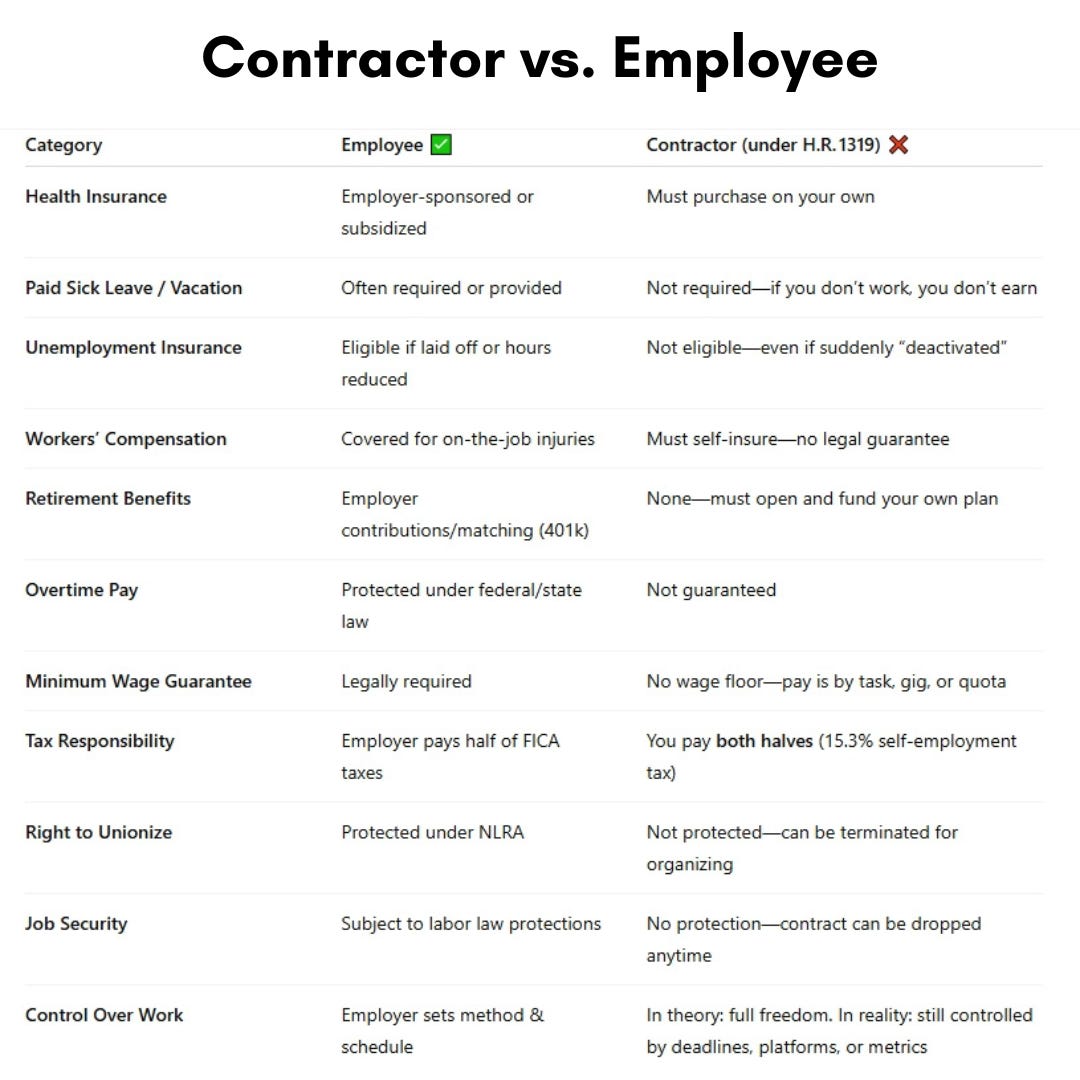
Being a contractor under this system means working without a net. It means trading a paycheck for a gamble, a job for a hustle, and a future for a constant fight to survive.
That’s exactly what H.R. 1319 would make easier for corporations to impose—not because it empowers workers, but because it lets companies shed responsibility while keeping control.
What’s Really Driving This Bill
On paper, H.R. 1319 is framed as a modernization, an update for a gig economy that’s “outpaced” traditional labor law.
However, peel back the rhetoric, and the intent becomes harder to ignore.
This isn’t about adapting to a changing workforce. It’s about protecting profits in a system that already favors capital over labor. It’s about cementing a structure where those at the top continue to earn more, while workers receive less and less for doing more and more.
Let’s call this what it is: a cost-cutting maneuver disguised as reform.
When workers are reclassified as independent contractors, employers win. They no longer have to offer health insurance or contribute to retirement plans. They don’t pay into unemployment insurance or workers' comp. They dodge wage protections, scheduling rules, and minimum pay requirements. They even sidestep taxes, because as a contractor, you pay both halves of Social Security and Medicare.
In exchange, you get “freedom.”
But freedom from what, exactly?
Certainly not from deadlines, or performance metrics, or algorithmic scheduling. Not from app-based surveillance or client reviews. Not from financial precarity. And definitely not from the cost of living that continues to rise while your wages do not.
No. The freedom is all theirs.
For corporations, this is a dream scenario. It cuts costs while maintaining control. It reduces liability while preserving productivity. It offloads risk to workers while keeping the profits flowing upward.
And the numbers tell the story:
In 2024, the median S&P 500 CEO earned $17.1 million.
Many made far more, often over 1,000 times what their average employee brought home.
At Starbucks, that ratio was 6,666 to 1.
That same year, corporations poured $1.2 trillion into stock buybacks, enriching shareholders while claiming they “couldn’t afford” to raise wages.
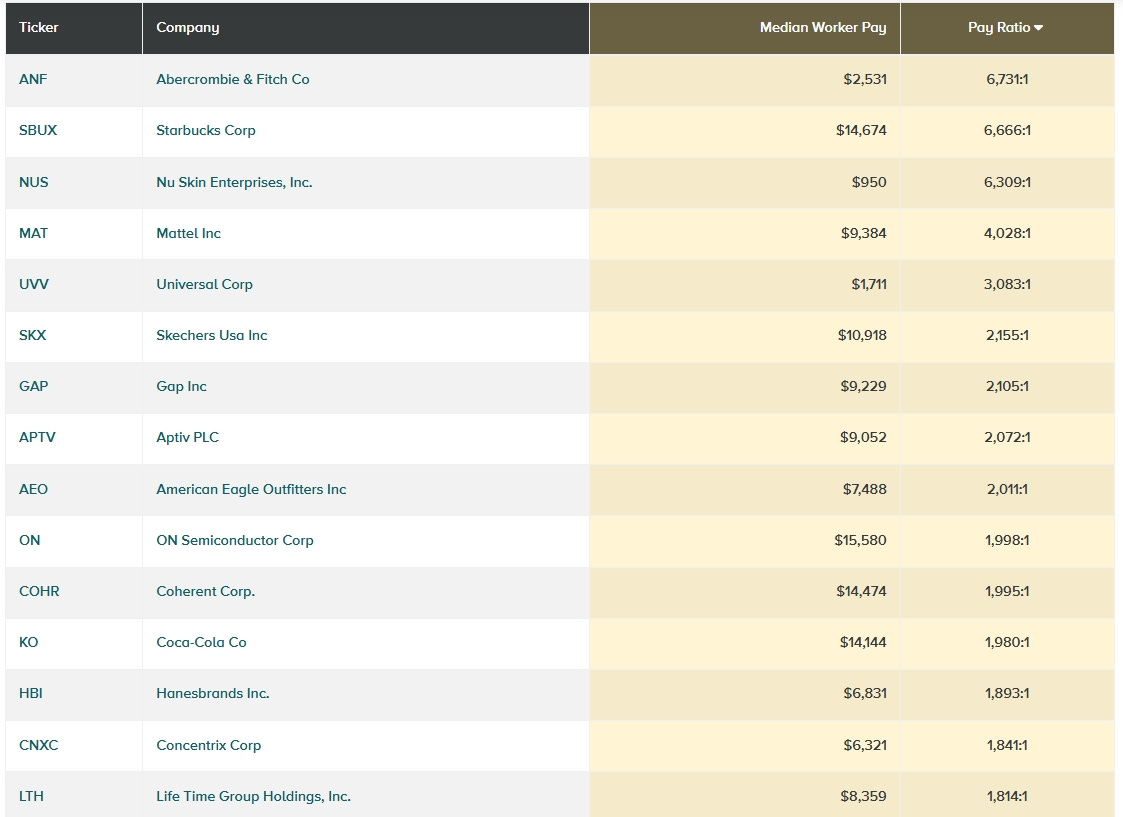
AFL-CIO Company Pay Ratios Top 15 by Ratio between CEO and Median Worker Pay
H.R. 1319 ensures that this kind of inequality doesn’t just persist, but instead accelerates.
It’s not about a new economy. It’s about preserving an old one, one where labor creates the value, and capital extracts it, where profits rise, but paychecks stay the same, where the worker is always told to sacrifice, and the CEO is always rewarded for asking.
If that feels familiar, it’s because it is.
The Foundation Is Broken: Minimum Wage & Tipped Workers
If the labor market were fair to begin with, a bill like H.R. 1319 might not be so devastating. But it’s not. The foundation is already cracked.
In the United States, the federal minimum wage has been frozen at $7.25 since 2009. That’s over fifteen years without a raise, while inflation, housing costs, health care, and childcare have surged. If the minimum wage had kept pace with productivity, it would be well over $20 today.
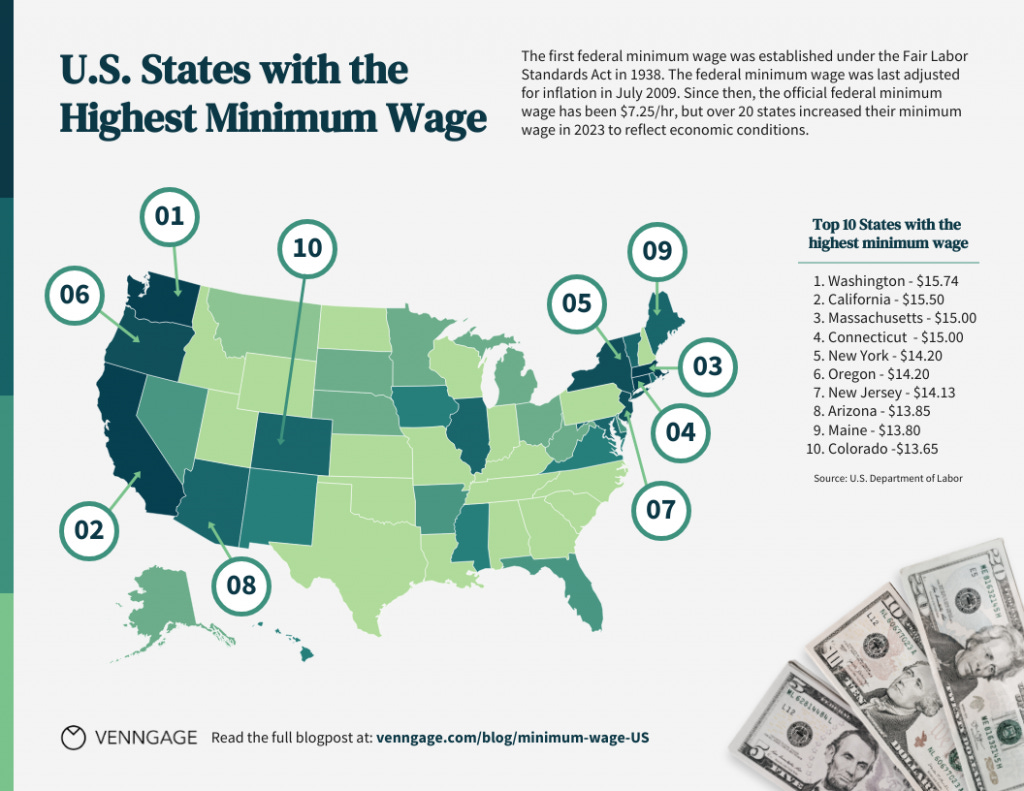
Instead, millions of Americans work full-time and still fall below the poverty line. They don’t need flexibility; they need a living wage.
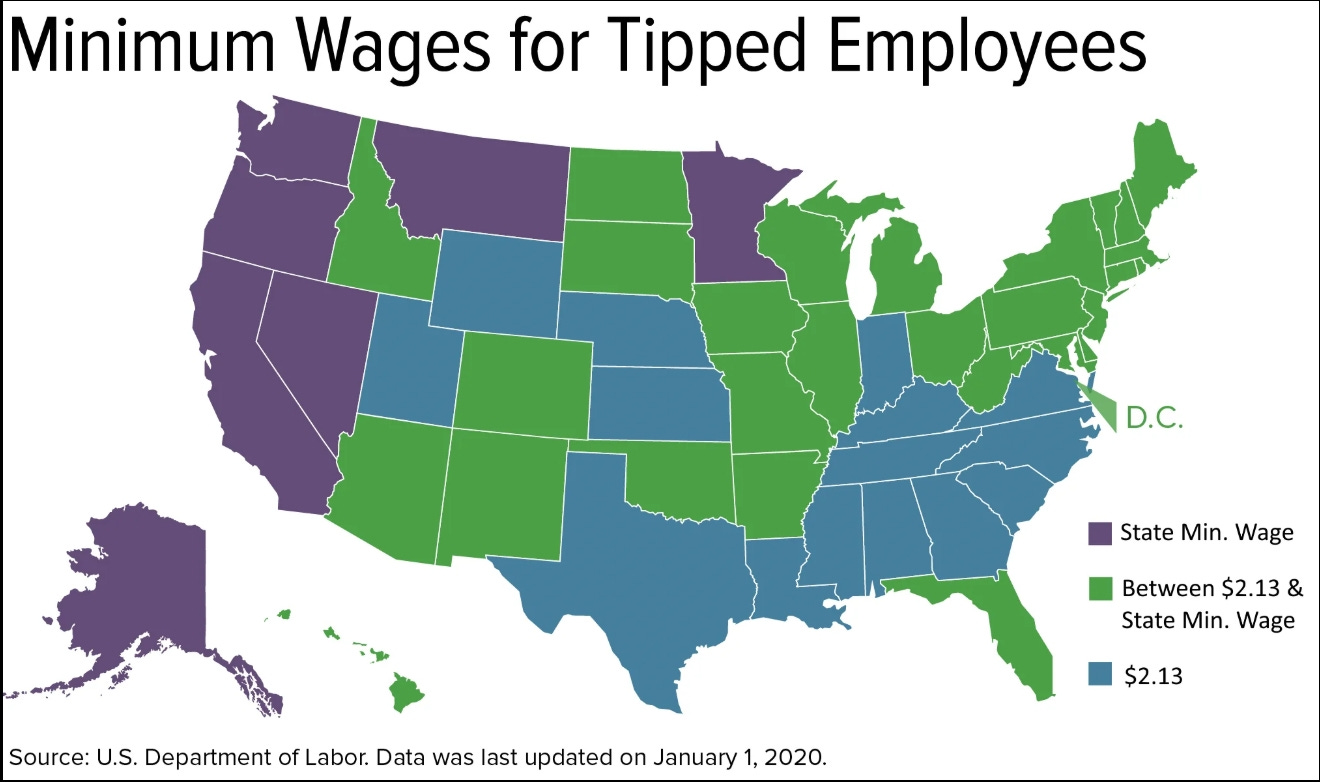
Then there’s the tipped wage.
In much of the country, tipped workers are paid as little as $2.13 an hour. Employers are supposed to make up the difference if tips don’t bring them to $7.25, but in practice, that rarely happens.
Tips can be withheld, pooled, used to punish, manipulated, or simply taken.
These workers, including servers, delivery drivers, and bartenders, are told they’re being rewarded for good service, that tips empower them. They have “unlimited earning potential” in a perfect world. But in reality, their income is at the mercy of customer moods, employer policies, and economic cycles.
Wage Inequality by Gender & Race
Beyond the labor reforms we’re demanding, there’s a deeper truth at the heart of how our economy fails Americans: Women—and especially women of color—consistently earn far less than white men, regardless of education or occupation.
The Gender Gap: Still Closed Too Slowly
By 2023, full-time women earned just 83.6% of the median weekly pay compared to men, approximately $1,005 per week versus $1,202. That’s roughly $0.83 to each $1 a man earns, and it’s been basically static for two decades.
Young women (ages 25–34) fare slightly better, earning 95% of what young men do, but the broader gap remains painful and persistent.
Compounded Inequality: Women of Color
When race intersects with gender, the gap widens dramatically:
Black women earn just 65.8% of what white men make, around $25,500 less per year.
Latinas bring in only 57–58% of white men’s earnings, losing more than $32,000 each year on average.
Even Asian women earn only ~94% compared to white men, the group's closest parity, but still short.
According to the Department of Labor, in 2023, combined wage losses totaled $42.7 billion for Black women and $53.3 billion for Hispanic women, compared to white men.
Latinas and Black women disproportionately work in low-paid, unstable sectors such as service, care, and hospitality, which H.R. 1319 would disproportionately put at risk.
Why This Matters in the H.R. 1319 Debate
These pay disparities aren’t due to education. They exist even among college graduates. A 2024 Census report found women still earn only ~71 cents per dollar compared to men at the same educational level, and the gap is steeper for women of color.
Misclassification, the erosion of rights, and lower wages hit marginalized women hardest, widening economic inequality at every turn.
A contractor economy, stripped of organizing power and benefits, compounds the risk for those already facing discrimination and income erosion.
Real Reform Must Be Intersectional
H.R. 1319 isn’t neutral; it’s inequitable. Without intentional, race- and gender-aware amendments, the bill could:
Pull vital protections from workers who need them most
Worsen the already devastating pay penalties faced by women of color
Reinforce a two-tier workforce, where economic precarity becomes racialized.
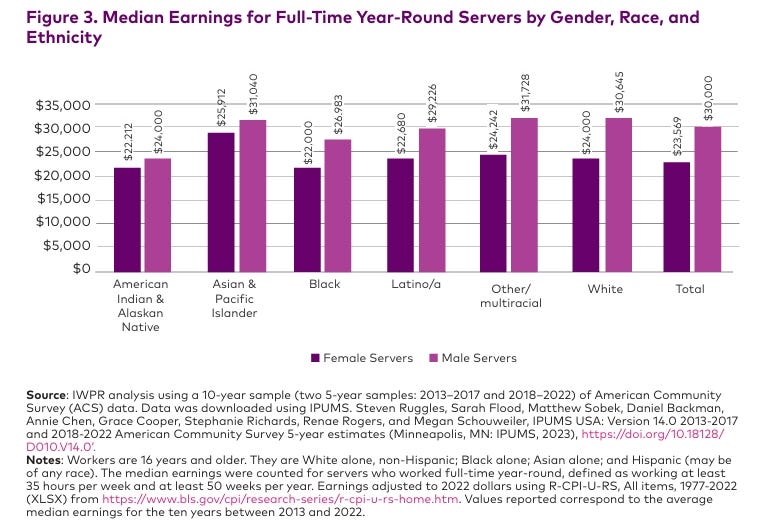
This isn’t “woke” or DEI. Studies have confirmed this disparity for decades.
The Higher Wage Irony
While corporate chains pretend they can’t afford to pay more, they still find plenty of room in the budget for executive bonuses and shareholder dividends.
The irony is that the real threat to small businesses isn’t the cost of fair wages. It’s corporate monopolies. The same megacorporations that want to reclassify workers as contractors are the ones undercutting local restaurants and retailers with bulk buying power, tax loopholes, and subsidized franchising.
Wages aren’t killing Main Street. Corporate extraction is.
When bills like H.R. 1319 come along and offer employers a legal way to reclassify workers, pay them less, deny them benefits, and block their path to organizing, it falls hardest on the workers who are already struggling to make ends meet.
They don’t need less protection. They need a complete rebuild of the system they’ve been surviving under for decades.
Stock Buybacks & Shareholder Extraction
Let’s step back and look at where corporate profits are actually going and where they’re not.
The Corporate Payout Machine
By the end of 2024, U.S. corporations had returned a staggering $1.6 trillion to shareholders, primarily through dividends and stock buybacks.
Buybacks alone reached $942.5 billion, setting a new annual record and marking an 18.5% increase from 2023. While dividends grew to $629.6 billion, corporate tax payments lagged far behind financially rewarded shareholders.
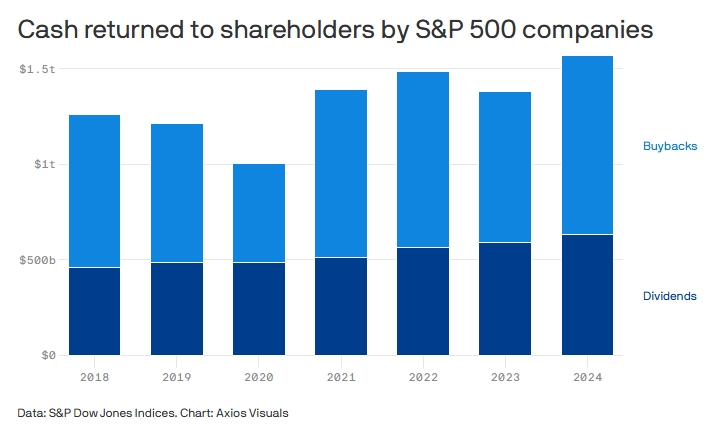
Axios - Stocks throw off more cash than ever
Together, dividends and buybacks made up as much as 60% of total shareholder payouts in the S&P 500, reinforcing a system where capital is prioritized over labor.
The Profit to Payout Disconnect
Between the pandemic and 2024, corporate profits rose to 16% of national income, up from 13.9% during the 2010–2019 period. Yet about 76% of that profit growth funneled directly into dividends, only 9% into corporate taxes, and the rest into undistributed profits or retained earnings.
In short, most profits empower shareholders; almost none lift wages.
Evaluation: What This Means for Workers
Stock buybacks are not reinvestment. They’re short-term financial engineering to boost share price and CEO compensation.
Less investment in capital goods, R&D, or worker training results in lower demand for labor and fewer growth opportunities for workers.
Institutional ownership concentration tightens control over corporate decisions, resulting in a shrinking workforce size and reduced wage growth across the board.
A Push-Back Against Labor Share Erosion
Over the decades, labor’s share of national income has declined from ~63% to about 58% today, partially driven by stock buyback cultures and shareholder-first governance.
Between 2003 and 2012, S&P 500 companies funneled 91% of profits to shareholders—54% in buybacks and 37% in dividends, with only 9% left for worker pay or reinvestment.
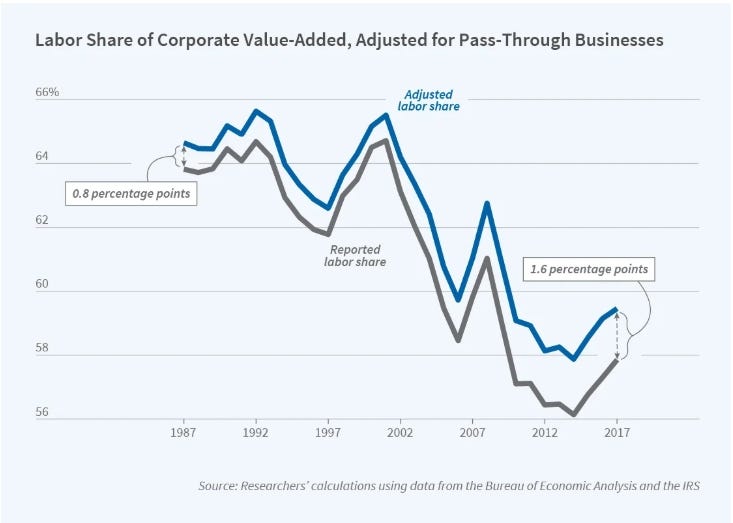
NBER - Rise of Pass-Throughs Understates Labor’s Share of Income
Put simply: The money is there, but it's flowing upward, not outward. If the profit pie grows, shareholders get their slice first, consistently leaving scraps for the working class.
Realistic Amendments to Make This Bill Workable
There is a legitimate conversation to be had about modernizing labor law. The rise of remote work, freelancing, and digital platforms has created real ambiguity around classification. However, H.R. 1319 doesn’t clarify. Instead, it exploits that ambiguity.
Still, if lawmakers are serious about protecting both flexibility and fairness, there are concrete steps that can be taken to improve this bill.
Here’s what needs to change. These are the minimum amendments required to make this even worth considering.
Not All Work Can—or Should—Be Contracted
While some jobs, such as graphic design, writing, or consulting, may be suited to project-based contracting, many others require consistent, scheduled, and human-centered labor. Retail, caregiving, food service, education, and hospitality are not contractor roles. These are structured, location-based, people-dependent jobs.
To pretend otherwise is to willfully ignore the nature of the work and to endanger both workers and the people they serve.
No one working a cash register, caring for a child, or staffing an emergency room should be treated like a freelance consultant.
That line must be made explicit. Otherwise, this bill will be weaponized far beyond its stated intent.
Tie Classification to Real-World Control, Not Legal Abstractions
H.R. 1319 claims that only “final result” oversight matters, not how the work is done. However, in reality, many so-called “independent contractors” are told when to work, how to perform, which tools to use, and even where to be. Their screens are monitored, their movements tracked, and their productivity micromanaged down to the second.
That’s not independence. That’s employment, repackaged.
To put it simply, if a contractor can accomplish the work in less time and at their own convenience, they are entitled to the same pay as someone who requires more time for the same work. Efficiency is not a breach of contract. It’s a mark of professionalism.
Amendment:
Reinstate the “economic realities” test, which looks at the full picture of control and dependency—not just outcome.
Prohibit the use of time-tracking software, GPS monitoring, or fixed scheduling for any worker classified as a contractor. If you control how the work is done, you’re the employer.
Establish a Minimum Compensation Floor for Contractors
If workers are to be reclassified as contractors, they should at least be guaranteed minimum compensation rates that account for the costs employers no longer cover, such as payroll taxes, health insurance, and business expenses.
Translation: If the contractor is responsible for the legally required taxes that the employer would have been responsible for, they must be compensated for it. Anything less is wage theft.
Amendment:
Require a “contractor premium”—e.g., 1.3× minimum wage—to reflect the lack of benefits and tax obligations.
Guarantee the Right to Organize for All Workers
Currently, contractors have no right to unionize under the National Labor Relations Act. That’s indefensible. If you can’t negotiate as a group, you’re not a partner. You’re a captive workforce.
Amendment:
Extend NLRA protections to all income-dependent workers, including contractors, temps, and gig workers.
Require Transparency in Classification & Recourse for Disputes
Many workers aren’t even told they’ve been reclassified until benefits vanish. Others are misled into thinking “1099” means freedom, only to find themselves with no protections and no appeal process.
Amendment:
Mandate full written disclosure of classification status, legal implications, and a grievance process for misclassification.
Offer Portable Benefits for Contractor-Heavy Industries
If we’re building a hybrid labor market, we need hybrid protections. That means creating systems where workers can transition between clients or gigs without losing access to healthcare, retirement benefits, or paid leave.
Amendment:
Fund and implement state-level portable benefit systems, especially in delivery, ride-share, and creative industries.
These amendments don’t eliminate flexibility. They protect it. They ensure that “independence” doesn’t mean disposability, and that labor rights evolve with the economy instead of being erased by it.
The Vision – What Real Labor Reform Looks Like
Amending a bad bill is one thing. Building a just labor system is another.
H.R. 1319 is a warning shot, one that tells us where corporate lobbying wants the future of work to head. We don’t have to follow that path. In fact, we can—and must—chart a different one, one that puts labor at the center of the economy, not as a cost to be cut, but as the source of all value.
Here’s what that future looks like at a minimum.
A Living Wage as a Baseline, Not a Goal
It’s time to raise the federal minimum wage to reflect the real cost of living. This is non-negotiable. It must be at least $17/hour, adjusted for inflation, local cost, and productivity. That means if it costs more to live in the region, employers must pay more. Tip penalties must be removed.
If corporations can pay their CEOs and shareholders millions, they can pay their workers enough to no longer need SNAP and other social safety nets.
Cap CEO-to-Worker Pay Ratios
If a company wants to pay its CEO millions, it can, but only if it also pays its workers fairly.
Policy:
Require that executive compensation not exceed 10× the lowest-paid worker’s earnings unless all employees receive proportionate wage increases or equity shares.
This would discourage wage suppression and force companies to reinvest in labor before enriching executives or shareholders. This includes stock options and other perks exclusively offered to CEOs as additional compensation.
End Shareholder-First Governance
Ban stock buybacks unless the company meets strict standards on worker pay, benefits, and investment. Require that a percentage of annual profits be distributed to employees or reinvested in long-term growth, rather than solely for stock price inflation. A company that profits owes its labor for making that possible. Full stop.
Policy:
Enact a Worker Dividend Act mandating that at least 30% of annual profits go to labor in the form of bonuses, raises, or benefits before any buybacks or dividends are issued.
Restore the Right to Organize For Everyone
Unions remain the single most powerful force for wage growth, equality, and workplace democracy, yet laws around organizing have been gutted for decades.
Policy:
Guarantee NLRA protections to all income-dependent workers, including contractors and gig workers.
Ban captive audience meetings. Protect digital organizing. Streamline union recognition processes.
Decouple Healthcare from Employment
No labor system is fair when basic health care depends on your boss’s generosity. A national public option or universal plan would free workers to change jobs, go independent, or start businesses without risking financial hardship due to medical expenses. If companies don’t want to be responsible for the monetary burden of providing healthcare, they should pay their labor enough to purchase their own or support universal healthcare.
The majority of the developed nations already provide this. It isn’t radical to ensure citizens have access to quality healthcare. A healthy workforce is a productive workforce.
Just Cause Employment Laws Nationwide
The U.S. is one of the only wealthy nations where you can be fired without cause or explanation. That creates fear, and it keeps workers from speaking up.
Policy:
Enact national “just cause” standards so that workers can only be terminated for legitimate, documented reasons, with rights to appeal and severance.
This is what labor justice looks like in the 21st century: dignity, security, equity, and power. But let’s be honest. It is the least we deserve and is long overdue.
Not just for tech freelancers or white-collar contractors, but for everyone who makes this country run—from servers and caregivers to warehouse workers and ride-share drivers.
If we’re serious about freedom, flexibility, and the future of work, this is where we start.
Call to Action – Use the Recess to Act
Congress is on a six-week summer recess. It’s your moment to strike at the root, rather than react after the bill passes.
Why Act Now?
H.R. 1319 has cleared the committee but has not yet been brought to a floor vote.
Advocacy now can shape amendments or stall the bill entirely.
Once reconvened, leadership can push it forward without debate.
This Congress is arguing they need to be able to trade stocks because they can’t live on $174,000 (base salary). Remind them who they work for.
See our recent article on congressional stock trading here:

How to Make Your Voice Heard
Call the Capitol Switchboard at (202) 224‑3121 and ask to be connected to your Representative’s office.
Use this script:
“Hi, my name is [Your Name], I’m a constituent from [City, State]. I’m calling about H.R. 1319, the Modern Worker Empowerment Act. There are significant issues that must be fixed. I urge my representative to support amendments that:
• Reinstate the economic realities test to preserve true classification based on control, not outcome.
• Guarantee a living wage and contractor premium to account for lost benefits and taxes.
• Ban time tracking, GPS surveillance, and fixed scheduling for genuine independent contractors.
• Extend the right to organize to all dependent workers, whether W-2 or 1099.
• Automatically classify on-site, schedule-bound service jobs as employees.Failure to address these will cement hyper-extractability and reward CEOs and shareholders at worker expense.
Thank you for listening.”
You can also send an email via your representative’s website or share on social media, tagging their official handles.
Support These Grassroots Watchdogs & Labor Justice Champions
These groups are on the ground protecting workers, pressuring lawmakers, and pushing for real reform:
National Domestic Workers Alliance (NDWA) — Empowers caregivers and domestic workers, advocating for living wages, labor rights, and a Domestic Workers Bill of Rights.
Restaurant Opportunities Centers United (ROC United) — Organizes restaurant workers to win fair wages, tipping justice, and industry standards.
Coalition of Immokalee Workers (CIW) — Champions farmworkers through the Fair Food Program, leveraging corporate accountability to enforce wage standards and human rights.
Working America (AFL‑CIO) — A five-million-member grassroots affiliate representing non-union workers. Mobilizes for policy change and public elections.
Labor Notes — A rank-and-file media and organizing network, supporting union activists and worker-led campaigns across industries.
International Labor Rights Forum / Global Labor Justice — National and global advocacy to hold corporations and governments accountable for labor abuses and ensure worker rights.
Supporting these groups through donations, volunteering, or amplifying their work multiplies your impact. They’re the boots on the ground pushing for justice long after headlines fade.
Without labor, there is no product, no profits, and no economy. And yet, our laws treat labor as a problem to be solved, not the force that powers everything. We will not be treated as indentured servants.
By demanding amendments to H.R. 1319 and advocating for broader reforms, such as fair CEO pay, profit-sharing, strong union protections, and universal labor rights, we don’t just fight for one bill. We reclaim the narrative of work.
Our demand isn’t just for cash. It’s for dignity, equity, and a seat at the table.
Stay Informed. Stay Loud.
Subscribe to The Coffman Chronicle for no-BS political analysis, action guides, and weekly truth bombs you won’t get from corporate media.
Bibliography:
U.S. Congress. H.R. 1319 – Modern Worker Empowerment Act, 119th Congress (2025–2026). Text of bill. Congress.gov.
AFL‑CIO. “New AFL‑CIO Report: Nation’s Top CEOs Made 285 Times Workers’ Pay in 2024.” Press release, July 23, 2025.
AFL‑CIO. “Company Pay Ratios – 2024.”
The Guardian. “Starbucks’ CEO Made 6,666 Times More Than His Workers in 2024.” July 24, 2025.
S&P Dow Jones Indices. “S&P 500 Q4 2024 Buybacks Increase 7.4 % and 2024 Expenditure Sets New Record by Increasing 18.5 %.” Press release, March 19, 2025.
Axios. “Stocks Throw Off More Cash Than Ever.” March 20, 2025.
MarketWatch. “Stock Buyback Programs Surge in Popularity in 2024, Despite 1 % Tax.”
Reuters. “Bank of America Authorizes $40 Billion Stock Repurchase Plan.” July 23, 2025.
Reuters. “Charles Schwab Authorizes $20 Billion Stock Buyback, Declares Dividends.” July 24, 2025.
Institute for Women’s Policy Research. “Black Women’s Equal Pay Day Fact Sheet 2025.” July 2025.
IWPR. “Gender and Racial Wage Gaps Worsened in 2023 and Pay Equity Still Decades Away.”
IWPR. “Black Women Earn Less Than White Men in Every State.” July 2023.
National Partnership for Women & Families. America’s Women and the Wage Gap (PDF). 2023.
Ogletree Deakins. “Beltway Buzz, February 21, 2025: Modern Worker Empowerment Act Summary.”
Pietragallo. “House Bills Proposing New Independent Contractor Status Test.” February 26, 2025.
House Education & Workforce Committee. “Chair Walberg Delivers Opening Statement at Markup to Empower … ” July 2025.
Janus Henderson. “Global Share Buybacks Surge to a Record $1.31 Trillion.” May 2023.
Motley Fool. “Stock Buyback Statistics.”
Thank you for this crucial information!
I've already spoken on the topic of the lawlessness of the current gang that's running this country. But, I will reiterate that "Congress can stop it!" The lawlessness, the theft of government resources, the trampling over the constitution, etc. Congress has the authority. And, guess what? We gave it to them. So, it all comes back to "We The People!" So, get up off your asses, boombard your reps offices, and demand they do their damn jobs, or else, they best look for other jobs!
#Forward
In the meantime, I would be most appreciative if you would patronize my store. It's Beaconwear on Walmart. Here's the link:
Thanks!
https://www.walmart.com/search?q=beaconwear