


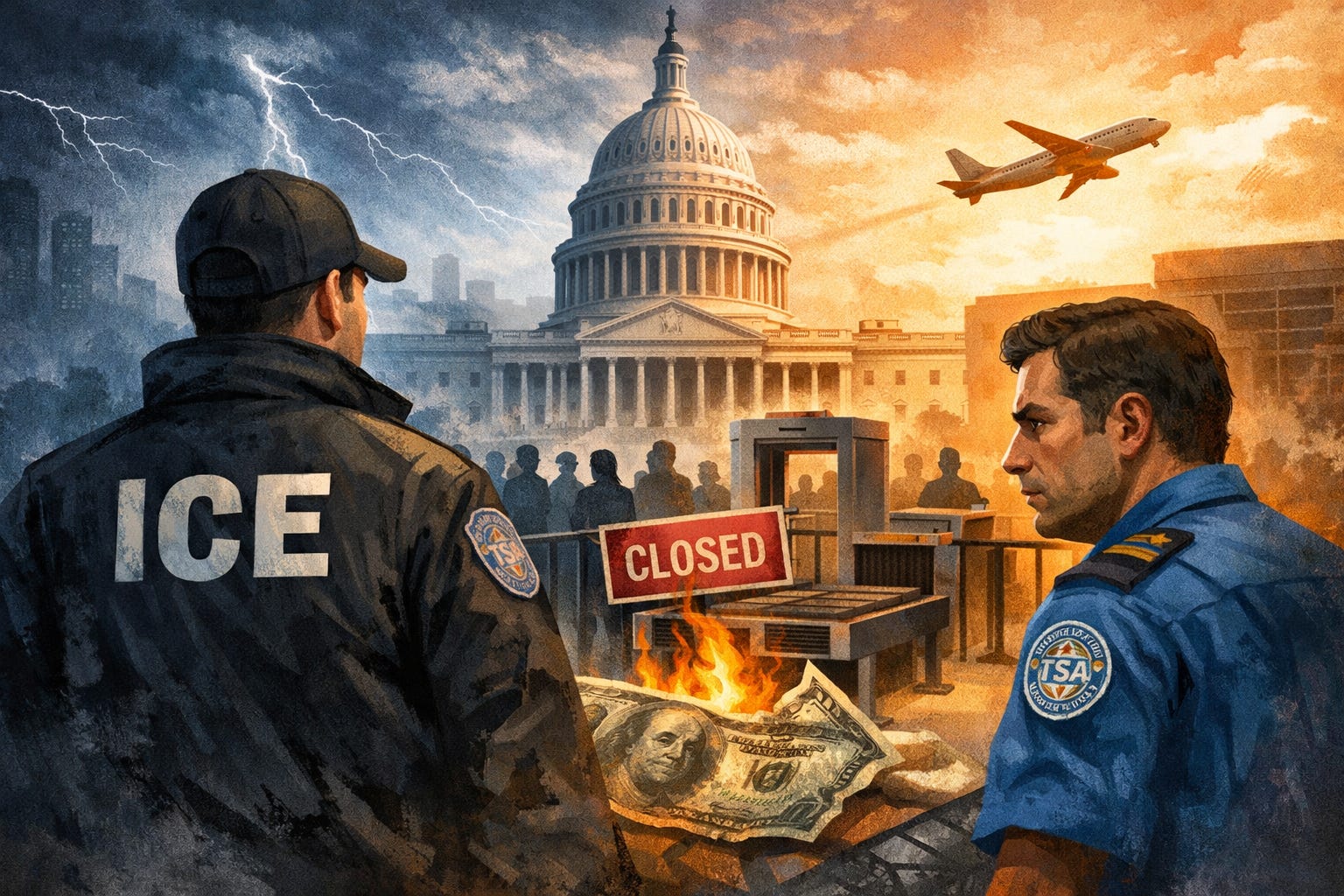
On Monday, March 23, federal agents from Immigration and Customs Enforcement were sent into more than a dozen U.S. airports. They were not there to conduct immigration enforcement or run security checkpoints. Their assignment was far more mundane on paper. They managed lines, monitored exit lanes, and helped with general crowd control as the Transportation Security Administration struggled through another week of a partial government shutdown.
That decision solved a narrow problem. Airports needed bodies to help manage growing lines and frustrated travelers. ICE agents provided that presence.
Yet the choice of who those bodies were carried consequences that went well beyond logistics.
ICE is not a neutral presence in 2026. Its role in immigration enforcement has made it one of the most politically charged federal agencies in the country. Bringing ICE into civilian travel spaces changed how passengers experienced the airport, regardless of the limited role those agents were actually performing. For some travelers, it introduced confusion. For others, it introduced fear or anger. Even when interactions did not escalate, the tone shifted.
Inside the workforce, the optics were just as fraught. TSA officers, many of whom have now gone weeks without pay, were asked to work alongside personnel from the same department who remained funded. That contrast is difficult to ignore. It is not simply about money. It is about what the government chooses to prioritize in a crisis.
The result is a decision that reads less like a solution and more like a signal. DHS responded to a staffing crisis with additional manpower that did not increase screening capacity, while also introducing new tensions into an already strained environment.
This Community Is Powered by You
What started as a small circle has grown into something much bigger, and it’s all because of readers like you.
Every time you forward this email, post it on socials, or bring someone new into the fold, you’re helping build one of the most passionate, independent political communities out there.
Want to keep the momentum going?
Share this newsletter with someone who should be part of this conversation.
Thank you for being here. It means everything.
The Shutdown Behind the Scenes
To understand why ICE was at the airport at all, you have to step back to February 14, when a partial shutdown of the Department of Homeland Security began. The standoff is tied to disputes over immigration policy and funding levels, and it has dragged on for weeks with no clear resolution.
See our ongoing reporting for additional context.
Note: As this has been ongoing for some time, some articles may have rolled into the archive. Become a paid subscriber for full access to our extensive archive.


The effects are uneven. Some parts of DHS continue to operate at full pay due to how they are funded. Others do not. TSA falls squarely into the latter category, along with agencies like FEMA and the Coast Guard. Tens of thousands of TSA officers have been reporting to work without paychecks, even as passenger volumes remain high. ICE and Border Patrol, however, continue to be paid.
Congress has not been entirely inactive. Lawmakers have floated proposals to restore pay for TSA workers or pass short-term funding measures. None have made it across the finish line. Each attempt runs into the same structural problem. Piecemeal fixes reduce pressure to resolve the broader shutdown, and the broader shutdown remains the central political fight.
So the standoff continues. Each additional week deepens the strain on the workforce and increases the risk of longer-term damage.
A Workforce Under Pressure
This is not the first time TSA has been here recently. By the numbers, this is the third funding lapse in roughly six months. Over that period, TSA officers have gone unpaid for a significant share of their working days.
That kind of instability hits differently in a job like this.
TSA officers are public-facing. They work irregular hours. Many are based in or near major metro areas where the cost of living is high. Their pay, even after recent reforms, is not especially generous relative to those demands. When paychecks stop, the impact is immediate and personal. Rent is still due. Childcare still needs to be paid. Groceries still have to be bought.
The result is predictable. Absenteeism rises. Morale drops. Some workers leave entirely. Reports indicate that hundreds of TSA officers have already resigned during this latest shutdown. Each departure thins the remaining workforce and makes the job harder for those who stay.
This is what a retention problem looks like in real time. It is not theoretical. It shows up in longer lines, slower throughput, and a workforce that is being asked to do more with less while navigating their own financial stress.
What Monday Looked Like
By the time ICE agents arrived on Monday, the system was already strained.
Lines at major airports stretched for hours. Travelers were advised to arrive earlier than usual. TSA staffing shortages remained the primary bottleneck, and the addition of ICE personnel did not change that basic reality.
The presence of ICE did change something else. It changed the atmosphere.
There were reports of tense exchanges between travelers and agents. Some passengers questioned why ICE was there at all. Others reacted more emotionally. In a high-stress environment where delays were already testing patience, the introduction of a politically charged agency added another layer of friction.
The TSA union made clear that the move was not seen as a welcome solution. AFGE President Everett Kelley warned that sending ICE into airports “does not fill a gap. It creates one.” His statement captured both the practical concern about training and the deeper frustration within the workforce.
“They deserve to be paid, not replaced by untrained, armed agents who have shown how dangerous they can be.”
Everett Kelley, AFGE President
Even in calmer interactions, the underlying tension was hard to miss. TSA officers remained responsible for the specialized work of screening passengers and luggage. ICE agents handled adjacent tasks. The lines kept moving, slowly. The fundamental problem remained.
A Bandage on a Structural Problem
There is a way to read Monday’s decision generously. Airports needed help managing crowds, and ICE agents are trained federal personnel who can maintain order in public spaces. In that sense, they may have eased pressure at the margins.
That reading misses the larger point.
The core issue facing TSA is not a shortage of people to stand in a line and direct passengers. The issue is a shortage of trained, certified screeners capable of operating checkpoints efficiently. That shortage is being driven by a mix of unpaid labor, recent resignations, and ongoing recruitment challenges. None of those factors were addressed by Monday’s deployment.
The decision also did nothing to resolve the underlying political standoff. TSA officers are still unpaid. Negotiations in Congress remain stalled. Proposals to provide targeted relief have failed to advance. The conditions that created the crisis are still in place.
What Monday did accomplish was to make the imbalance visible. Travelers saw long lines and a visible federal response. TSA officers saw colleagues from the same department who were still being paid. The public saw ICE in a setting where it is not usually present, and reacted accordingly.
That is why the move feels like a bandage. It covers part of the problem without treating the cause. It manages the symptoms while leaving the underlying condition untouched.
What Comes Next
If airport security is essential, then the people who provide it have to be treated as essential in practice. That means stable funding, reliable pay, and compensation that reflects the demands of the job. It also means insulating that workforce from repeated political brinkmanship that disrupts both their livelihoods and the systems they operate.
Sending ICE into airports may have helped manage lines at the edges, but it came at a cost. It also underscored a deeper failure. The government is trying to patch a specialized workforce crisis without fixing pay stability, retention, or the shutdown itself.
Until those issues are addressed, the lines will remain long, the workforce will remain strained, and each temporary fix will carry its own unintended consequences.
If you found this breakdown helpful, subscribe for clear, fact-driven analysis of the stories shaping our politics without the noise, spin, or false equivalence. We’ll keep connecting the dots so you can see not just what’s happening, but why it matters.
Sources:
I would be terrified if I walked into the airport and saw ICE in the building! I don’t care what they “claim” their role is! I do not trust any of them after the last few months!
If UCE is there, I am not. Too many loose cannons and in that cohort.