


The Line Americans Didn’t Cross
ICE as Message, Not Just Enforcement
In 2026, it’s hard to miss the change in the atmosphere around immigration enforcement. The point is no longer just to enforce the law. The point is to be seen enforcing it — visibly, loudly, often theatrically — as if the display itself is part of the policy. People don’t just fear what might happen if ICE knocks on their door. They fear what it means that the knock is now a governing instrument: a message, a warning, a signal about who belongs and who doesn’t.
What History Predicts When Policing Turns Political
History gives us a pretty grim expectation for what comes next when enforcement starts functioning like that. When state power becomes more political, more identity-driven, and more comfortable using fear as a tool, societies tend to harden. Protest escalates. Clashes become routine. Small factions radicalize. Violence becomes thinkable, then normal, then inevitable. The spiral doesn’t need a conspiracy, only a government willing to treat whole groups of people as a threat, and a public that decides the only language left is force.
The Story Nobody Credits: Public Restraint
But that’s not what has happened here. Not at scale. Not as a sustained response.
The under-reported story of the ICE era isn’t only what the agency has become under a governing framework critics describe as punitive, exclusionary, and racially charged. It’s what ordinary Americans have refused to become in response. For years, through raids, detentions, family separations, deaths in custody, and the daily stress of living under an enforcement regime designed to intimidate, the dominant public answer has not been revenge. It has been restraint: marches instead of reprisals, court filings instead of counterattacks, sanctuary instead of bloodshed, cameras and clipboards instead of weapons.
Restraint Isn’t Passive. It’s Discipline
That restraint isn’t passive. It is discipline. It is a choice made again and again at kitchen tables, in church basements, at courthouse steps, and on city sidewalks to fight state overreach without becoming a mirror image of it. And if we want to understand what’s holding the country together right now, we should pay attention to that choice before we take it for granted.
This Community Is Powered by You
What started as a small circle has grown into something much bigger, and it’s all because of readers like you.
Every time you forward this email, post it on socials, or bring someone new into the fold, you’re helping build one of the most passionate, independent political communities out there.
📢 Want to keep the momentum going?
Share this newsletter with someone who should be part of this conversation.
Thank you for being here. It means everything.
What ICE Was Supposed to Be
The Baseline: What ICE Was Built to Do
Before we can name what ICE looks like now, we need a baseline — not a defense, not nostalgia, just the institutional “job description” the public was told to expect.
ICE was created in 2003 within the newly formed Department of Homeland Security, built from enforcement functions that previously sat within older federal structures. It was born in the post-9/11 security state, when Washington was reorganizing everything around threat prevention, intelligence, and federal coordination. From the beginning, ICE’s critics warned that combining immigration enforcement with national-security logic would expand the government’s appetite for coercion. From the beginning, its defenders argued the opposite: that immigration violations, trafficking networks, and cross-border crime required a dedicated federal agency with investigative reach.
Controversial From the Start, But Legible
Whatever your view of ICE, its early self-image was relatively clear. It was framed as a law-enforcement body: investigate violations, pursue cases, coordinate with other agencies, make arrests, and process removals through legal procedures. The agency’s public rationale leaned heavily on the language of conventional enforcement—targeting criminals, disrupting smuggling operations, disrupting trafficking, and enforcing immigration rules. In the public mind, it was sold as a federal tool for controlling a system that had become messy and exploitable, not as a political instrument meant to reshape community behavior through fear.
Procedure, Casework, and the Old Justification
That distinction matters because controversy alone doesn’t explain posture. ICE has been controversial throughout its existence. The baseline isn’t “ICE used to be gentle.” The baseline is that ICE was presented and often understood as an enforcement agency whose legitimacy rested on a familiar logic: laws exist, violations occur, cases are built, and actions are taken within a procedural framework.
Even when enforcement was harsh, the public-facing justification was typically administrative: rule enforcement, public safety, national security, and criminal networks. It was the kind of explanation that, in theory, could be debated within normal democratic politics — too strict, too lax, too aggressive, too permissive — without assuming the enforcement posture itself was meant to function as a cultural message.
Why the Baseline Matters in 2026
That’s the baseline. And it’s what makes the next shift so consequential: because in 2026, the question isn’t only whether immigration enforcement is strict. The question is what enforcement is for, and what it is meant to communicate.
Posture, Policy, and the Character of Enforcement
Enforcement Follows Power
Enforcement agencies do not independently redefine their mission. They execute the governing priorities of the political leadership that oversees them. This is not a theory or a partisan claim. It is the basic architecture of executive governance. When enforcement posture changes, the first question is not what the agency “decided,” but what the governing framework began to reward, tolerate, and emphasize.
In recent years, immigration policy has been articulated less as administrative management and more as existential defense. Political leaders have repeatedly framed migration in terms of threats, invasions, and cultural destabilization. Migrants are not merely described as individuals navigating legal systems or humanitarian crises, but as forces acting upon the nation itself. That shift in language is not cosmetic. It alters how enforcement priorities are socially and politically interpreted.
Deterrence as Governing Logic
Policy narratives shape enforcement behavior by reshaping incentives.
When deterrence becomes the central objective, visibility becomes valuable. When the political system treats enforcement intensity as proof of resolve, operations take on symbolic weight beyond their immediate legal function. Raids become demonstrations. Arrests become signals. The performance of enforcement becomes inseparable from enforcement itself.
This dynamic does not require secret directives or institutional conspiracy. It emerges from ordinary political mechanics. Agencies are responsive to leadership signals because they are designed to be. Budgetary support, public praise, internal advancement structures, and political risk calculations all flow from the same source: elected authority. Over time, the enforcement posture begins to reflect not only statutory obligations but also the governing narratives that define what counts as success.
When Policy Becomes Posture
Critics of the current policy environment argue that this ideological framing carries an additional consequence — that rhetoric portraying migrants as collective threats or contaminants inevitably produces enforcement strategies comfortable with fear-heavy tactics. Whether one views this language as nationalist, restrictionist, or racially charged, its operational effects are difficult to ignore. Definitions of danger influence definitions of necessity. And definitions of necessity influence how state power is displayed.
Fear as an Operational Outcome
The practical effects of this shift are visible in the character of modern enforcement. Increased operational visibility, theatricality, and deterrence-centered messaging do not arise randomly. They align with a governing framework that treats immigration enforcement as both policy execution and political communication.
The social meaning of enforcement expands accordingly.
In earlier eras, enforcement actions could often be framed — however controversially — as discrete procedural events. In a deterrence-dominant environment, enforcement instead functions as ambient presence. Communities absorb not just the reality of state power, but its intended psychological footprint. The goal is no longer solely to remove specific individuals but to influence behavior through perception: who feels safe, who feels exposed, who feels perpetually at risk.
Fear becomes systemic rather than episodic.
Importantly, this transformation does not depend on individual officers' personal ideology. Institutional behavior aligns with governing priorities regardless of personal beliefs. The posture of enforcement reflects the posture of policy because agencies operate within incentive structures they do not control.
Understanding this relationship is critical to understanding ICE in 2026.
The question is not simply whether enforcement has grown more aggressive. The deeper question is why enforcement now so often appears designed to communicate strength, dominance, and deterrence as political signals. Posture is policy made visible. And policy is posture made durable.
What Political History Warns About
What Political History Warns About
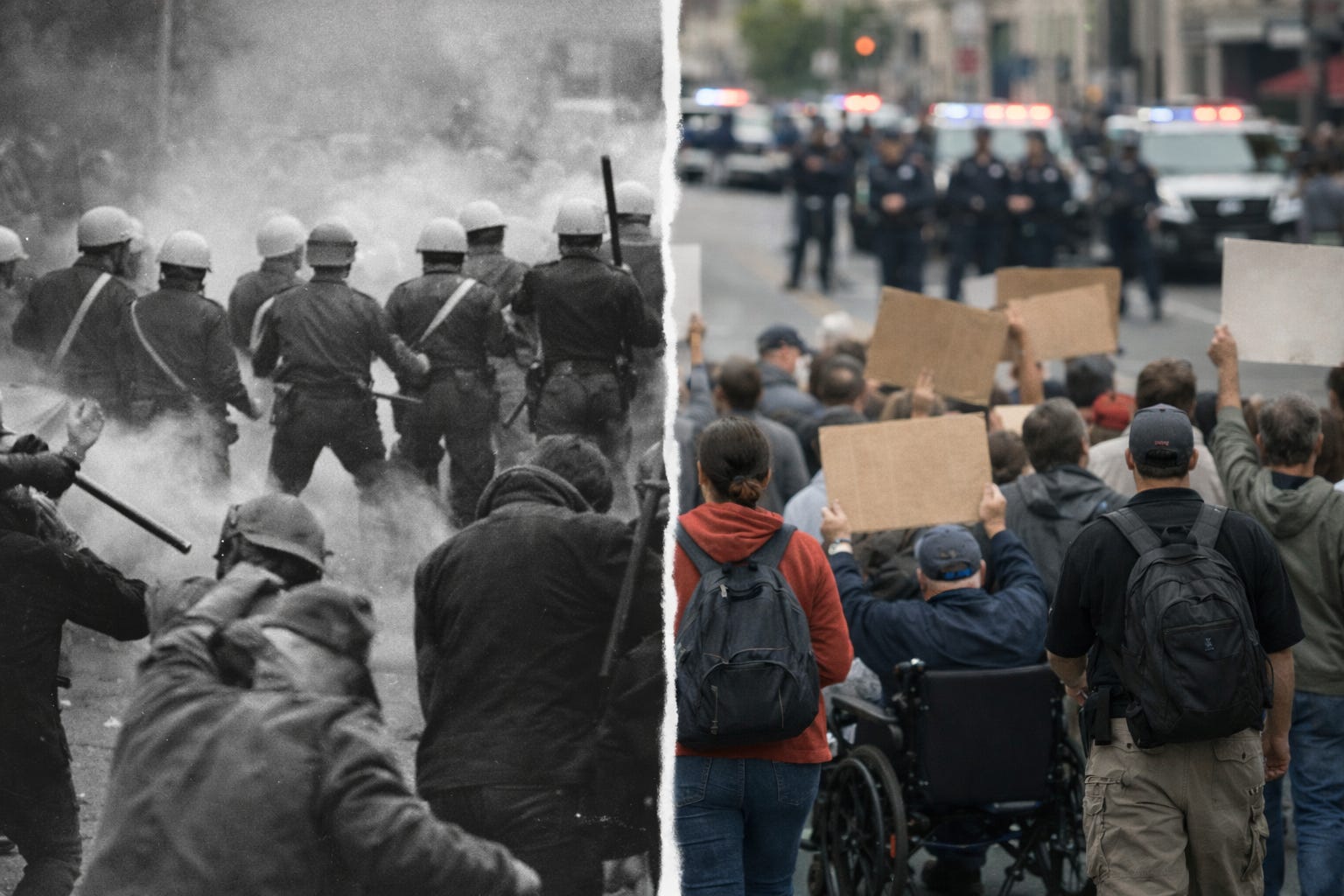
Political history is not subtle about what often follows when enforcement institutions begin operating through fear-heavy, highly visible postures. Across countries and decades, researchers have documented a recurring pattern: when policing becomes politically symbolic — when it communicates power and threat as much as it enforces law — tensions tend to intensify rather than stabilize.
The mechanism is not mysterious.
When populations perceive enforcement as identity-driven or politically charged, legitimacy fractures. Compliance shifts from civic obligation to risk calculation. Communities adapt defensively. Protest movements harden. Confrontations become more likely not because individuals suddenly change, but because the relationship between state authority and civilian populations becomes psychologically unstable.
Fear reshapes behavior on both sides of the encounter.
In such environments, escalation often follows a familiar trajectory. Public demonstrations grow more emotionally charged. Authorities respond with more assertive tactics. Each side interprets the other’s posture as justification for further hardening. What begins as symbolic conflict evolves into cycles of provocation and response, a feedback loop where restraint becomes increasingly difficult to sustain.
You can see versions of this in very different settings, from Latin American security crackdowns to late Cold War protest policing in Eastern Europe and post-colonial struggles where heavily armed state forces were visibly deployed against disfavored groups. The contexts differ, but the structural risk is consistent: fear-centered governance tends to generate instability pressures rather than civic calm.
Why Violence Often Emerges
Violence in these contexts rarely begins as a mass decision. It typically emerges from margins.
Small factions, convinced institutional channels are ineffective, adopt confrontational tactics. State authorities, citing security concerns, expand coercive responses. The presence of even limited violence then justifies broader crackdowns, which, in turn, validate the grievances driving the escalation. The cycle becomes self-reinforcing.
Political scientists sometimes describe this as reciprocal radicalization.
Each actor adapts to the other’s perceived threat level. Trust erodes. Moderation loses social credibility. The center of political conflict drifts toward confrontation because both sides increasingly treat the other as inherently hostile rather than politically oppositional.
Importantly, none of this requires widespread extremism. Structural pressures, not individual pathology, often drive escalation pathways. Once fear and legitimacy breakdown dominate the environment, violence becomes more statistically probable even if it remains widely unwanted.
The Expectation That Didn’t Materialize
Given these patterns, one might expect the United States to exhibit similar destabilization dynamics after more than two decades of highly controversial immigration enforcement, especially under rhetoric and policies many critics describe as punitive and exclusionary.
Yet the dominant American response has followed a markedly different trajectory.
Despite extraordinary levels of anger, fear, and political polarization, widespread retaliatory violence aimed at federal immigration authorities has not emerged as a defining feature of the conflict. Protests have occurred at scale. Resistance movements have grown. Legal battles have multiplied. But the anticipated spiral into organized political violence has largely failed to materialize.
That divergence is the real anomaly.
Political analysis often focuses on what states do. Far less attention is paid to what populations refuse to do even under sustained provocation. But the absence of escalation can be as politically significant as its presence.
What America Actually Produced Instead
The Response That Defies Expectation
If political history and social science offer warnings about how populations tend to react under fear-heavy enforcement regimes, the American response to ICE over the past two decades presents a striking divergence. Anger has been widespread. Fear has been pervasive. The policies themselves have been among the most contested in modern domestic politics. Yet the form of resistance has followed a path that looks markedly different from what escalation models might predict.
Mass unrest did not become the defining feature.
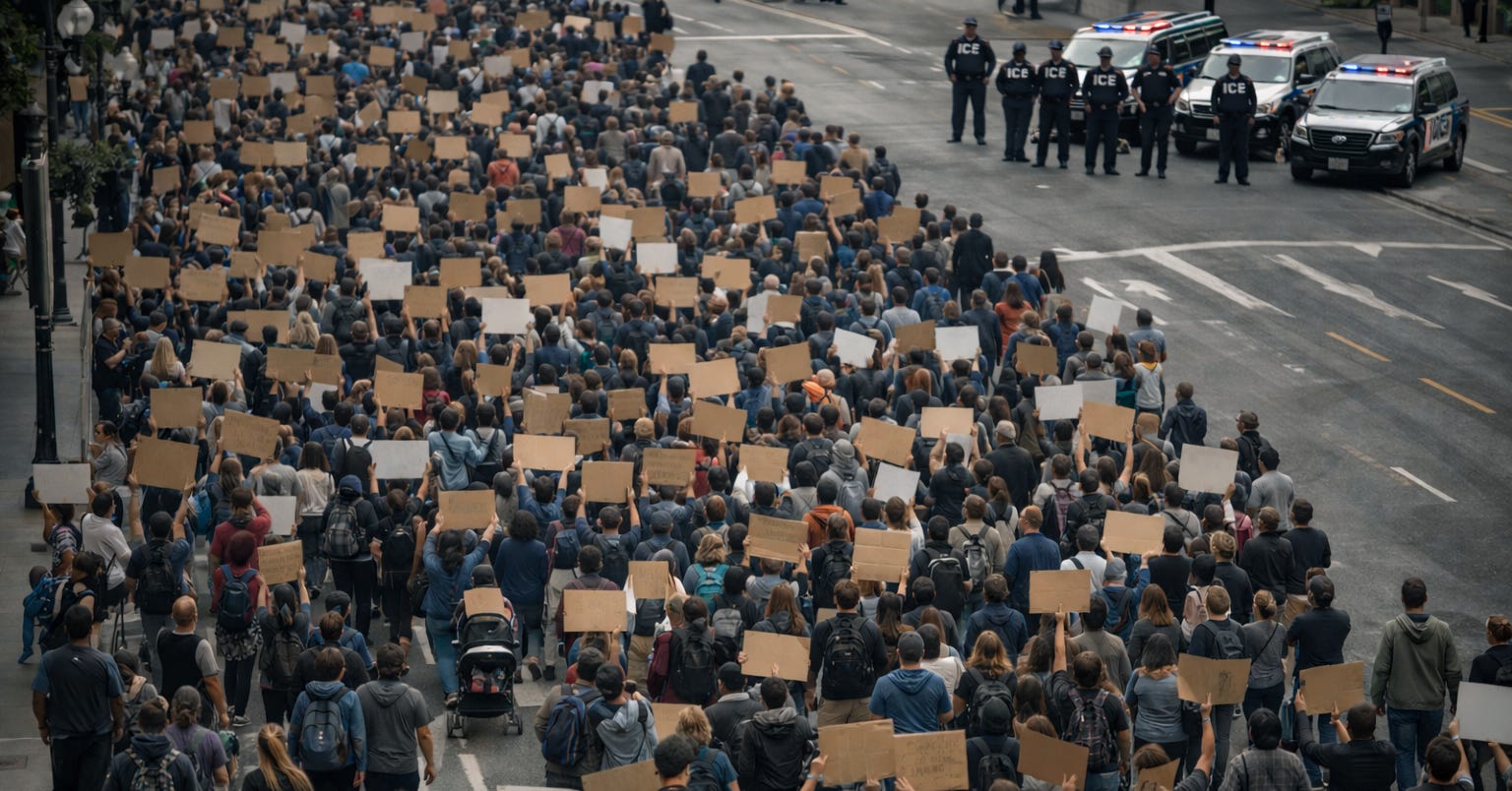
Instead, the dominant civic response has been structured, visible, and overwhelmingly nonviolent. Protest movements emerged not as insurgencies but as demonstrations. Streets filled with marchers rather than militias. Grievances were routed to the courts, the media, and local political battles rather than to campaigns of retaliatory force. The most common tools most people picked up were poster boards, cameras, and clipboards.
That pattern is neither accidental nor trivial.
Marches, Not Clashes
Large-scale protests against immigration enforcement have occurred repeatedly across the country — at airports after sudden policy shifts, outside detention facilities when images of children in cages and families in foil blankets reached the public, in downtown squares when raids swept through workplaces and neighborhoods. These gatherings were often emotionally charged, sometimes chaotic, and occasionally met with aggressive policing. But despite the intensity of feeling surrounding deportations, detentions, and family separations, sustained violent confrontation has remained the exception rather than the rule.
Demonstrations became rituals of visibility rather than theaters of open conflict.
Participants carried signs, not weapons. Strollers and wheelchairs showed up more often than shields. Chants replaced projectiles. Even when confrontations occurred, the overwhelming majority of actions reflected the logic of public expression rather than physical retaliation. In comparative terms, this is an unusual outcome for a policy arena so deeply intertwined with identity, belonging, and existential fear.
Sanctuary Instead of Retaliation
Perhaps more revealing is how many communities chose protection over escalation.
Religious institutions, local advocacy networks, and volunteer organizations constructed sanctuary systems designed to buffer vulnerable individuals from enforcement pressures. In city after city, churches opened their doors to families facing removal. Congregations organized food, housing, and legal support so that people could resist quietly but firmly, sometimes living for months within the walls of a sanctuary rather than risk a knock at the door.
These were not acts of passivity. They were deliberate forms of resistance grounded in the refusal to meet coercive state power with coercive counterforce.
Faced with fear, communities built shelters rather than factions.
Courts, Records, and Documentation
Another defining feature of the American response has been its reliance on institutional mechanisms.
Rather than treating enforcement conflicts as a battlefield dynamic, activists and civil liberties groups pursued injunctions, public records requests, litigation strategies, and media exposure. Lawyers camped out in airport conference rooms and federal courthouses. Local organizers built rapid-response text trees to send observers to raids with phones and notebooks, not bats. The struggle was repeatedly framed as a contest over legality, rights, and accountability.
Even for those who viewed the policies themselves as morally intolerable, the dominant tactic was to expand scrutiny rather than escalate confrontation.
Power was challenged through procedure, not violence.
The Violence That Didn’t Come
The absence of widespread retaliatory violence is itself one of the most politically significant aspects of this history.
In many societies, prolonged exposure to fear-centered enforcement produces radical flanks willing to treat agents of the state as legitimate targets. That development has not defined the American landscape. While isolated incidents and heated rhetoric have occurred, no sustained pattern of organized violence aimed at ICE personnel has emerged comparable to what historical analogues might lead observers to expect.
Given the pressures involved, that restraint is remarkable. It means that thousands of moments that could have tipped toward escalation — a raid gone wrong, a death in custody, a child torn from a parent — were instead channeled into vigils, lawsuits, and organizing meetings.
Restraint as Civic Behavior
Restraint is often misinterpreted as weakness or compliance. In reality, it frequently reflects discipline.
Across years of enforcement controversies, Americans did not simply remain inactive. They organized, protested, litigated, documented, voted, and resisted through institutional channels. The choice was not between action and passivity. It was between escalation and containment. Again and again, the dominant civic posture favored the latter.
At kitchen tables and in group chats, in union halls and church basements, the argument kept coming back to the same hard line: push, expose, and resist, but don’t become what you’re fighting.
Political conflict was expressed without collapsing into reciprocal violence.
Why This Restraint Matters More Than It Appears
Stability Is Not Automatic
Political stability is often treated as a default condition, something that simply exists until disrupted by extraordinary events. History suggests the opposite. Stability is typically the product of countless small decisions made by institutions and populations under stress. It is maintained not merely by laws or enforcement, but by behavioral norms — the largely invisible agreements governing how conflict is expressed.
Seen in that light, the American response to ICE takes on greater significance.
In a political environment saturated with fear, anger, and identity-driven rhetoric, large-scale violence did not become the dominant civic language. That outcome is not guaranteed in democratic systems. It reflects choices made by millions of individuals navigating grievances without resorting to escalation.
The Violence Spiral That Didn’t Form
Fear-heavy enforcement regimes historically carry a persistent risk: reciprocal hardening.
When communities experience state power primarily through intimidation or perceived hostility, pressures toward retaliation often increase. Violence becomes framed as defense. Repression becomes framed as a necessity. Each side’s posture justifies the other’s. The resulting spiral can destabilize even long-standing political systems.
That spiral has not defined the American landscape.
Despite years of volatile rhetoric and deeply contested policies, conflict has largely remained routed through demonstrations, courts, elections, and media rather than organized campaigns of physical retaliation. The absence of such escalation represents not political calm, but political containment, a distinction frequently overlooked.
Restraint as a Democratic Resource
Restraint is rarely celebrated in political discourse, yet it functions as one of democracy’s most critical stabilizers.
Democratic systems rely on the assumption that political conflict will not routinely devolve into violence. Institutions are designed around persuasion, procedure, and legitimacy precisely because widespread coercion destroys their operating logic. When populations sustain nonviolent norms despite provocation, they actively preserve the viability of democratic mechanisms.
In this sense, restraint is not passivity. It is infrastructure.
It is the behavioral foundation that allows disputes over policy, legitimacy, and power to remain within civic rather than insurgent boundaries.
The Asymmetry Few Acknowledge
Much commentary surrounding immigration enforcement focuses on institutional behavior — what agencies do, what policies mandate, what leaders declare. Far less attention is paid to the reciprocal dimension: how populations respond to coercive state power.
Yet the asymmetry is central to understanding systemic stability.
An enforcement apparatus, increasingly criticized for projecting fear, has been met with a public response defined largely by nonviolent resistance. That imbalance matters because it shapes the trajectory of political conflict. Escalation requires participation from both state and society. Restraint by either actor alters the entire dynamic.
Why This Pattern Is Politically Fragile
None of this implies permanence.
Political restraint is not a fixed cultural trait. It is contingent on perceived legitimacy, institutional accountability, and public belief that nonviolent mechanisms remain meaningful. History again provides the warning: when trust collapses, escalation thresholds can shift rapidly.
Which makes the persistence of restraint noteworthy, while its durability remains uncertain.
The Quiet Fragility of Civic Trust
Democratic systems do not ultimately depend solely on enforcement power. They depend on legitimacy, the largely invisible belief that authority is being exercised within boundaries broadly recognized as fair, predictable, and accountable. Laws can compel behavior, but legitimacy sustains order. When that legitimacy erodes, stability becomes less a function of rules and more a function of raw force.
That distinction is easy to overlook in moments of relative calm.
The absence of widespread violence can create the impression of durable equilibrium, as if restraint were a permanent feature of the political landscape rather than a contingent social behavior. History offers a more cautious interpretation. Periods of stability often mask underlying tensions, and trust, once weakened, can degrade slowly before shifting suddenly.
Civic trust is particularly sensitive to asymmetry.
When populations perceive enforcement institutions as politically charged, selectively punitive, or detached from neutral procedural logic, the psychological foundations of legitimacy can weaken even in the absence of visible unrest. Compliance persists, but its character changes. Fear replaces consent. Calculation replaces obligation. Stability becomes quieter, but also more brittle.
Restraint under such conditions is not guaranteed.
The civic discipline described throughout this history reflects choices repeatedly made by individuals and communities, not automatic cultural reflexes. Those choices are sustained by belief, belief that nonviolent mechanisms remain meaningful, that institutional channels remain responsive, that escalation is neither necessary nor inevitable.
History provides the warning embedded within that reality.
When legitimacy fractures beyond certain thresholds, behavioral norms can shift rapidly. Conflicts that once flowed through courts and protests can migrate toward confrontation. The same societies that appeared stable can change character with disorienting speed. Political order rarely collapses gradually. It often gives way through sudden recalibration of what citizens consider acceptable, necessary, or justified.
Which is what makes the American restraint story so politically significant and so precarious.
A system stabilized by civic discipline is not immune to stress. It is dependent on it. The same forces that make restraint possible also determine how long it endures. Democratic stability is not secured by the absence of violence, but by the continued rejection of it.
And rejection is always a choice.
Coffman Chronicle: Support Independent Media
If this piece helped you see something we’re not supposed to notice, that ordinary people have shown more discipline than the government asking them to live under fear, that’s the lane The Coffman Chronicle is trying to stay in. Not just, “Here’s what ICE did this week,” but “Here’s what that pressure is doing to our democracy, and what people are choosing not to do in return.”
If you want more work like this, long-form, receipts-heavy, kitchen-table analysis that doesn’t wait for permission, please consider becoming a paid subscriber.
Support independent media and become a paid subscriber to The Coffman Chronicle.
Sources:
“6 Deaths in ICE Custody and 2 Fatal Shootings: A Horrific Start to 2026.” American Immigration Council, February 11, 2026.
“Immigration Detention Expansion in Trump’s Second Term.” American Immigration Council, January 14, 2026.
American Immigration Council. “Detention.” About Immigration: Detention, n.d. Accessed February 20, 2026.
“Political Repression Motivates Anti-Government Violence.” Royal Society Open Science 10, no. 6 (June 2023).
“ICE Wants to Go After Dissenters as Well as Immigrants.” Brennan Center for Justice, November 21, 2025.
“Questions, Answers, and Some Cautionary Updates Regarding the 3.5% Rule.” Carr Center Discussion Paper Series 2020–005. Carr Center for Human Rights Policy, April 2020.
“The 3.5% Rule: Understanding What Makes Protest Powerful.” Carr Center for Human Rights Policy, n.d.
“ICE Expansion Has Outpaced Accountability. What Are the Remedies?” Brookings Institution, January 26, 2026.
“What Is Immigration and Customs Enforcement (ICE) and What Does It Do?” USAFacts, updated January 16, 2026.
“Co-escalation in Contentious Politics and Radicalization.” PRIF Working Paper No. 62, March 2024.
We cannot let ICE push our buttons. They are looking for any excuse to use violence. They get off on it.
Martin Luther King showed us nonviolence was a viable tactic that worked.