


They say a play is only as convincing as its stage. The walls, the lighting, and the architecture all shape what the actors can do. Protest is no different. The tactics you choose, the symbols you carry, the cadence you adopt echo something deeper: the memory, the wound, the pride of the land.
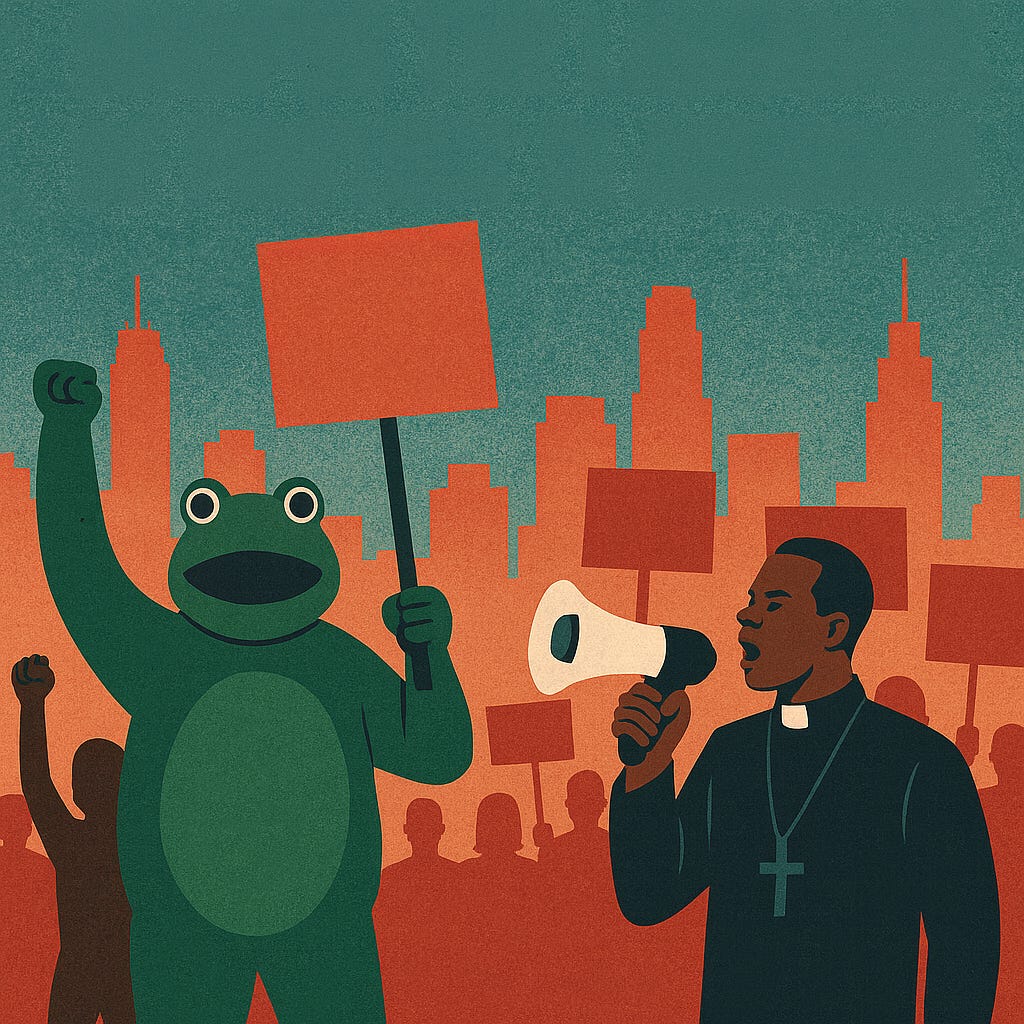
In Portland, you might ride nearly naked past federal agents, waving at onlookers in inflatable frog suits. In Chicago, you might hear a hymn rise from a circle of clergy, a sermon delivered between flash bangs. Neither approach is better, but one would feel deeply wrong in the other place.
America rejects Kings, and we reject corporate overlords. Join the movement for more deep dives, irreverent insights, and snarky commentary. You fuel the resistance.
For a limited time, enjoy 20% off a paid subscription in celebration of our recent milestones!
Portland: Where Resistance Wears a Mask
Portland has long blurred the lines between activism, performance art, and direct action. The city’s protest culture is visually loud, unpredictable, and steeped in satire. Its residents have protested in clown costumes, held dance parties outside ICE facilities, and built elaborate props, such as dragon heads and glowing umbrellas for nighttime marches. In Portland, absurdity is not out of place. It is resistance.
Earlier this month, Portland’s World Naked Bike Ride turned into a spontaneous anti-ICE demonstration. Riders in various states of undress joined protest routes, some carrying signs, others simply using their exposed bodies as statements against state control, bodily autonomy, and climate inaction.
Then came the frogs.


A protester dressed in an inflatable frog suit was pepper-sprayed by federal agents and instantly became a symbol. The image of state force used against a cartoonish, floppy frog was too precise. A local campaign, Operation Inflation, began encouraging protesters to adopt similar tactics: absurd costumes that made any overreaction look grotesque.
This isn’t new. Portland’s history is rich with street theater and symbolic protest. The 2002 “Bunny Brigade” — activists in rabbit suits outnumbering riot police — remains a touchstone. Groups like the Cacophony Society blurred the line between flash mob and demonstration. Public murals, mobile art carts, and light installations all serve protest aims. In Portland, art is not a medium of protest. It IS the protest.
Because of that heritage, these tactics are legible to locals. Authorities and journalists understand the genre. Whimsy has become part of the language of resistance.
Chicago: A City Where Protest Moves Like a March
In Chicago, protests tend to move in lines rather than scattered clusters. Participants march behind megaphones, chanting in call and response: “Show me what democracy looks like!” followed by a booming, “This is what democracy looks like!” The rhythm is familiar, disciplined, and grounded in movement tradition.
Demonstrators often carry printed signs, many of which share a unified message or design. Clergy walk in formation near the front, often wearing stoles or collars — visual cues that this isn’t just political, but moral. When a protest forms, you know who’s leading it. You can hear the cadence shift when the message changes.
At a recent protest outside the Broadview ICE facility, that structure was unmistakable. The crowd moved as one. Clergy formed a wall at the front. When violence broke out — a pastor struck by a flash bang, sprayed directly in the face — others moved quickly to shield him, not in chaos but in choreography. They knew their roles.


None of this was surreal. It was all painfully real.
Chicago is the city of Fred Hampton, of the 1968 DNC protests, of decades of police torture scandals, and court settlements. It is a city where the trauma of state violence lives in family albums and church sanctuaries. Here, protest is shaped by grief, scripture, and survival.
In cities like this, a protest is not a performance but a procession. It is rooted in the Black freedom struggle, in the Civil Rights Movement, in the weight of history and the solemnity of loss. It demands respect — not from the state, but from those who dare to march in its name.
Where Portland resists with satire, Chicago resists with formation.
When Styles Migrate And Misfire
What happens when someone brings an inflatable costume to a march in Detroit? Or when a gospel choir gathers in Asheville and is drowned out by rave beats and rainbow smoke?
The protest style that resonates in one city may ring false in another — not because one is wrong, but because each place has its own memory and relationship with power.
Of course, these cities are not monoliths. Portland has held candlelit vigils and solemn marches; Chicago has embraced dance, costume, and street theater. But in the national lens — and often in local memory — the dominant tone of protest reflects what each city has come to symbolize.
Absurdist tactics thrive in Portland because the city has built that genre over decades. However, in a city steeped in trauma, satire can feel misaligned. In the wrong setting, it may read not as clever but disrespectful.
But the reverse is also true. Solemn protest in Portland may be overlooked or dismissed. A prayer vigil might not cut through the spectacle. In a city where protest often looks like performance, silence or tradition may seem out of sync.
This is not about enforcing purity. It’s about reading the room — or the city. Protest must be fluent in the culture it enters. That means understanding not just the issue, but the street beneath your feet.
History Shapes Response Even Before Action
These differences matter not only to protesters but also to those observing, including police, the press, and the public.
In Portland, police know how to read satire. They may still respond with violence, but they are used to surreal visuals — glitter, puppets, naked cyclists. The same costume in Chicago could provoke confusion or escalation. Local law enforcement, shaped by a different protest history, may interpret performance as a threat instead of a statement.
In Portland, police are familiar with protests that resemble performance art — including costumes, satire, improvised chants, and dance. When faced with something outside that model — a disciplined, solemn march led by clergy, say — the disruption of expectation can itself be read as escalation. A structured protest may not look like resistance-as-usual. It may look like a movement. And that, to law enforcement trained to expect chaos cloaked in whimsy, may feel like an incoming army.
The media, too, is shaped by place. In Portland, a frog suit reads as strategic dissent. In Chicago, it could be dismissed as unserious or even mockery. The visual vocabulary of protest is local. And its effectiveness depends on whether it’s understood by those who hold the power to narrate it.
Know Your Stage
None of this is about shaming tactics. It’s a call to intentionality. Protest isn’t just what you say. It is also how your city hears it. And maybe there is space for overlap. Perhaps there is power in disrupting expectation. However, there may be unexpected pushback.
Bring absurdity to Portland, but know that even whimsy has weight. Bring solemnity to Chicago, but let it echo with purpose. In every city, there’s a memory you’re walking into. A story already unfolding. A tone already set.
The most powerful protests don’t overwrite that tone. They amplify it. They don’t just occupy space. They listen to it first.
Protest communicates, and cities have their own fluent protest languages. When you show up speaking a different dialect, you either disorient or amplify, depending on your goal and your audience.
If protest is theater, then we must respect the stage. Some places demand satire. Others demand prayer.
Ready for more? Subscribe today!

So we're saying have a solemn march of thousands dressed in inflatable toad costumes...?