


Currency is one of the most universal expressions of the state. In a monarchy or dictatorship, it depicts the leader. In a constitutional democracy, it is supposed to feel stable, familiar, and above politics. In the United States, it represents the state, not a person.
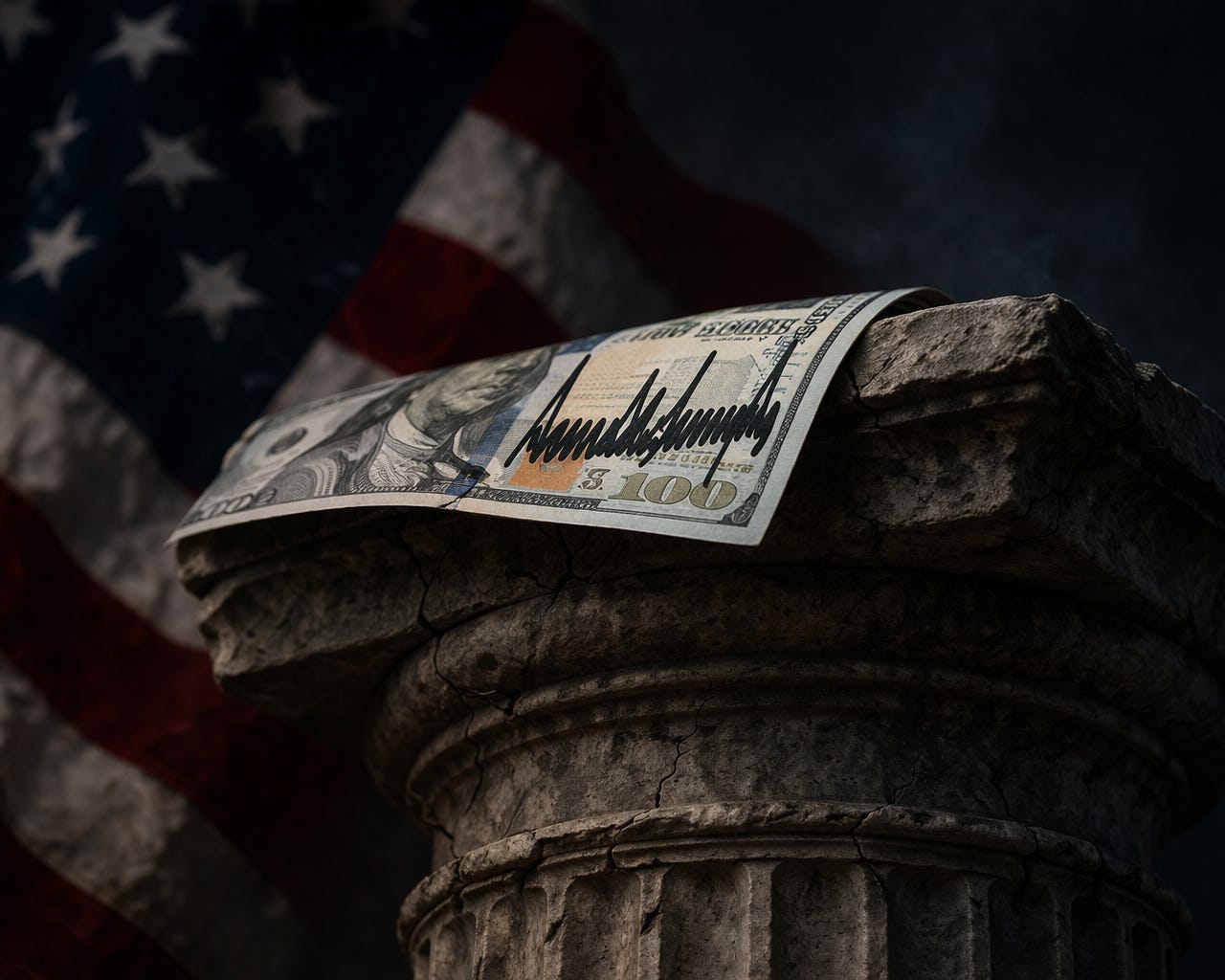
That is why the Treasury Department’s March 26, 2026 announcement lands poorly. Future U.S. paper currency will carry Donald Trump’s signature, beginning with new $100 bills entering circulation in June and expanding to other denominations over time. The change breaks with a 165-year tradition in which paper money carried the signatures of the Treasury Secretary and the Treasurer of the United States.
Treasury framed the move as part of the nation’s 250th anniversary. However, that explanation raises a more important question than it answers.
This Community Is Powered by You
What started as a small circle has grown into something much bigger, and it’s all because of readers like you.
Every time you forward this email, post it on socials, or bring someone new into the fold, you’re helping build one of the most passionate, independent political communities out there.
Want to keep the momentum going?
Share this newsletter with someone who should be part of this conversation.
Thank you for being here. It means everything.
If This Were About the 250th, We Already Know What That Looks Like
The United States already has a model for commemorating major national milestones, and it is not subtle. The U.S. Mint is issuing Semiquincentennial coins for 2026 with dual dates, 1776–2026, including one-year-only circulating designs and limited commemorative releases. These are explicitly tied to the anniversary, finite in scope, and centered on the country’s history rather than any individual.
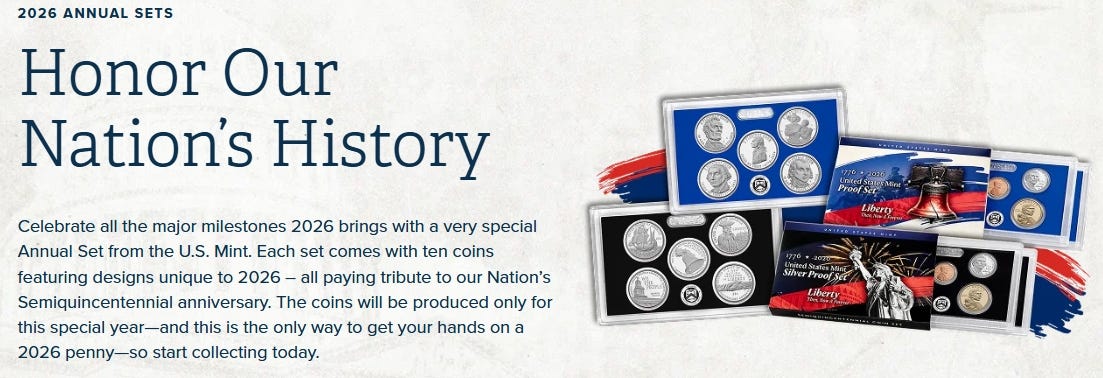
U.S. Mint Semiquincentennial Collection
That is what a commemoration looks like.
A commemorative issue has an endpoint. It marks a moment and then passes into history, where it belongs.
What Treasury Secretary Scott Bessent announced on Thursday does not resemble that model. The language broadly applies to future paper currency, with no stated sunset. The rollout follows the normal pattern for new notes, where older bills circulate alongside new ones until they gradually disappear. Nothing in the announcement suggests a limited 2026 run.
If the goal were to honor the founding, there are obvious ways to do so: the signers of the Declaration, the states, the Revolution, the country's civic story over two and a half centuries. The Mint is already doing that work.
This is something else.
“Under President Trump’s leadership, we are on a path toward unprecedented economic growth, lasting dollar dominance, and fiscal strength and stability. There is no more powerful way to recognize the historic achievements of our great country and President Donald J. Trump than U.S dollar bills bearing his name, and it is only appropriate that this historic currency be issued at the Semiquincentennial.”
-Secretary Scott Bessent
“As the 250th anniversary of our great nation approaches, American currency will continue to stand as a symbol of prosperity, strength, and the unshakable spirit of the American people under President Trump’s leadership. The President’s mark on history as the architect of America’s Golden Age economic revival is undeniable. Printing his signature on the American currency is not only appropriate, but also well deserved.”
-Treasurer Brandon Beach
How This Is Even Possible
The answer is not that there are no rules around American currency, but rather that the rules are narrower than many people assume. Federal law gives the Treasury Secretary broad authority over the engraving and printing of U.S. currency, and the Bureau of Engraving and Printing states plainly that the Secretary is responsible for the design of paper money. The statute does impose some limits. It requires the inscription “In God We Trust,” with placement chosen by the Secretary, and it provides that only the portrait of a deceased individual may appear on U.S. currency and securities. That is why a living president’s face cannot legally be put on a circulating bill.
What the law does not do is lock in every other feature people have come to think of as fixed. The longstanding practice of placing the signatures of the Treasury Secretary and the Treasurer on paper currency, for example, was treated as standard for generations. However, the relevant legal framework gives Treasury wide design discretion, and the reporting on this announcement reflects that experts see the signature change as falling within that authority. In other words, the law barred the most obvious form of personalizing the currency, yet it left room for a subtler one.
That reveals the deeper problem. This was not a case where Congress expressly authorized the sitting president to place his name on the nation’s money. It was a case where broad administrative power met a norm that had never been fully codified. The Treasury announcement this week is possible not because the boundary never existed culturally, but because it was protected more by custom than by statute.
The Pattern: Personal Branding of the State
It would be easier to dismiss the currency change as a one-off if it stood alone. As Trump has proven again and again, it does not.
The U.S. Institute of Peace
In December 2025, Donald Trump’s name was added to the U.S. Institute of Peace building. This is not a symbolic association or a nickname that emerged organically. It is literal branding placed on a public institution that represents American diplomacy and conflict resolution. To make optics worse, it happened after the building was seized, the staff largely dismissed, and the institute gutted under the Department of Government Efficiency.
See our reporting from December here:
Note: Articles roll into the archive over time. Become a paid subscriber for full access to our extensive catalog.

The Kennedy Center
The Kennedy Center, itself named after a former president, was rebranded to include Trump’s name while he is still in office. Presidents are traditionally honored after they leave power, not during it, and not by their own administration. The change is now tied up in litigation, with plaintiffs arguing it exceeded legal authority and violated the institution’s governing framework. The dispute underscores how far this move stretches beyond established practice.
See reporting from December here:
Note: Articles roll into the archive over time. Become a paid subscriber for full access to our extensive catalog.

TrumpRx.gov
The administration launched TrumpRx.gov as a federal portal for discounted medications. This is not a media nickname or partisan shorthand. It is an official government website, a public-facing service that carries the president’s name as part of its identity.
“Trump Baby Accounts”
A federally backed child savings initiative, including a government contribution for eligible newborns, has been branded as “Trump Baby Accounts.” A universal public benefit has been tied directly to the identity of the sitting executive.
Now, the Currency
And now, the president’s signature will appear on future U.S. paper currency, one of the most widely circulated and symbolically important instruments of the state. Unlike a commemorative coin, this change has no clear endpoint and will persist unless actively reversed.
Taken individually, each of these decisions can be debated on its own terms. Taken together, they show something harder to ignore.
The common thread is posture. Public institutions, public programs, and now public currency are being treated as available surfaces for presidential branding.
This Is Not How It Used to Work
The United States has never avoided associating policies with presidents. That association, however, has historically been indirect.
The Affordable Care Act became known as “Obamacare” in public discourse, yet the administration did not christen it that. The official title remained the Patient Protection and Affordable Care Act. The distinction may seem cosmetic, yet it reflects a deeper expectation that federal programs belong to the government, not to the individual who happens to be in office.
Other initiatives have used the office rather than the person. The President’s Emergency Plan for AIDS Relief is tied to the presidency as an institution, not to a surname, despite being a landmark initiative under President Bush. Even when presidents left a strong imprint on policy, the state did not adopt their name as its own.
Currency followed the same principle. The faces on American money are historical figures. The signatures were those of financial officers, not symbolic leaders. The design communicated continuity, not incumbency.
The rule that portraits on currency are limited to deceased individuals captured the most obvious boundary, but it failed to anticipate a subtler one.
The Gap Between Law and Assumption
That gap is where we are now, and it exposes a core truth we have ignored for far too long.
If your system only works when decent people run it, it doesn’t work.
The test of a constitutional system is not whether it performs well under honorable leadership. It is whether it holds when someone arrives determined to exploit every ambiguity it contains.
For generations, Americans relied on a combination of law and restraint. The law covered certain clear lines. Norms covered everything else. The assumption was that some possibilities were technically available but practically unthinkable.
We now know that assumption was doing more work than anyone realized.
While the law prevented placing a living president’s portrait on currency, it did not prevent placing the president’s signature there, perhaps because the law did not anticipate the systematic use of a president’s name across programs, buildings, and services. Those were left to custom.
As we’ve learned, custom is not a safeguard.
Aberration or Precedent
This is where the story actually begins.
Once a norm is broken without consequence, it stops being a norm and starts becoming precedent. The next administration does not have to justify the same action. Instead, it can point to what has already been done.
That is how systems drift, not through a single dramatic break, but through a series of smaller ones that gradually redefine what is considered acceptable.
The question is no longer whether an American president would do this. That question has now been answered. The question is whether future presidents will be allowed to.
Congress could choose to draw a line. It could prohibit the use of a sitting president’s name, likeness, or signature on federal currency, programs, buildings, and official government platforms except where explicitly authorized. That would not resolve every issue, yet it would convert a previously assumed boundary into an enforceable one.
If Congress does nothing, the opposite choice is made by default.
The Real Lesson
It is tempting to frame this as a story about Donald Trump, but that is too narrow to be useful.
Trump is the stress test, a symptom, the living embodiment of audacity and “it doesn’t say I can’t,” and “who will stop me?”
The lesson is about the system that preceded him. That system assumed that certain lines did not need to be written down because no one would cross them. It assumed that restraint would fill the gaps left by law, that decorum, decency, and shame would prevent transgression.
That assumption is no longer tenable.
A democratic system can survive a norm-breaking president. It has a much harder time surviving the decision to treat every broken norm as the new baseline.
If this is an aberration, it should be codified against. If it is not, it will be inherited.
There is no neutral outcome. There is only choice. That is the question before us now, and how it is answered could shift everything.
If you think democratic systems should be built for the worst actor, not the best one, subscribe for more.
Sources:
U.S. Department of the Treasury — “Treasury Announces President Donald J. Trump’s Signature to Appear on Future U.S. Paper Currency”, March 26, 2026.
Reuters — “Trump signature to appear on US currency, ending 165-year tradition”, March 26, 2026.
Associated Press — “US Treasury plans to put Trump’s signature on new paper currency in first for sitting president”, March 26, 2026.
Reuters — “Trump puts his own name on US Institute of Peace ahead of Rwanda-Congo peace deal”, December 4, 2025.
Reuters — “Kennedy Center wastes no time adding Trump’s name to the building”, December 19, 2025.
Associated Press — “Democratic lawmaker asks judge to take Trump’s name off Kennedy Center”, March 25, 2026.
Reuters — “Trump unveils TrumpRx discounted drugs website”, February 6, 2026.
Reuters — “Trump touts ‘Trump accounts’ for babies as part of affordability pitch”, January 28, 2026.
Reuters — “Bessent calls Trump baby accounts ‘backdoor for privatizing Social Security’”, July 30, 2025.
U.S. Mint — “United States Mint Semiquincentennial Circulating Coin Program Designs Unveiled”
U.S. Code, 31 U.S.C. § 5114 — “Engraving and printing currency and security documents”, accessed March 26, 2026.
Bureau of Engraving and Printing — “The Design of U.S. Paper Currency”, accessed March 26, 2026.
I find this very disgusting and upsetting.
Who knew what a flimsy democracy America really is?
“It was almost no trick at all, he saw, that to turn vice into virtue and slander into truth, impotence into abstinence, arrogance into humility, plunder into philanthropy, thievery into honor, blasphemy into wisdom, brutality into patriotism, and sadism into justice. Anybody could do it; it required no brains at all. It merely required no character.”
― Joseph Heller, Catch-22