


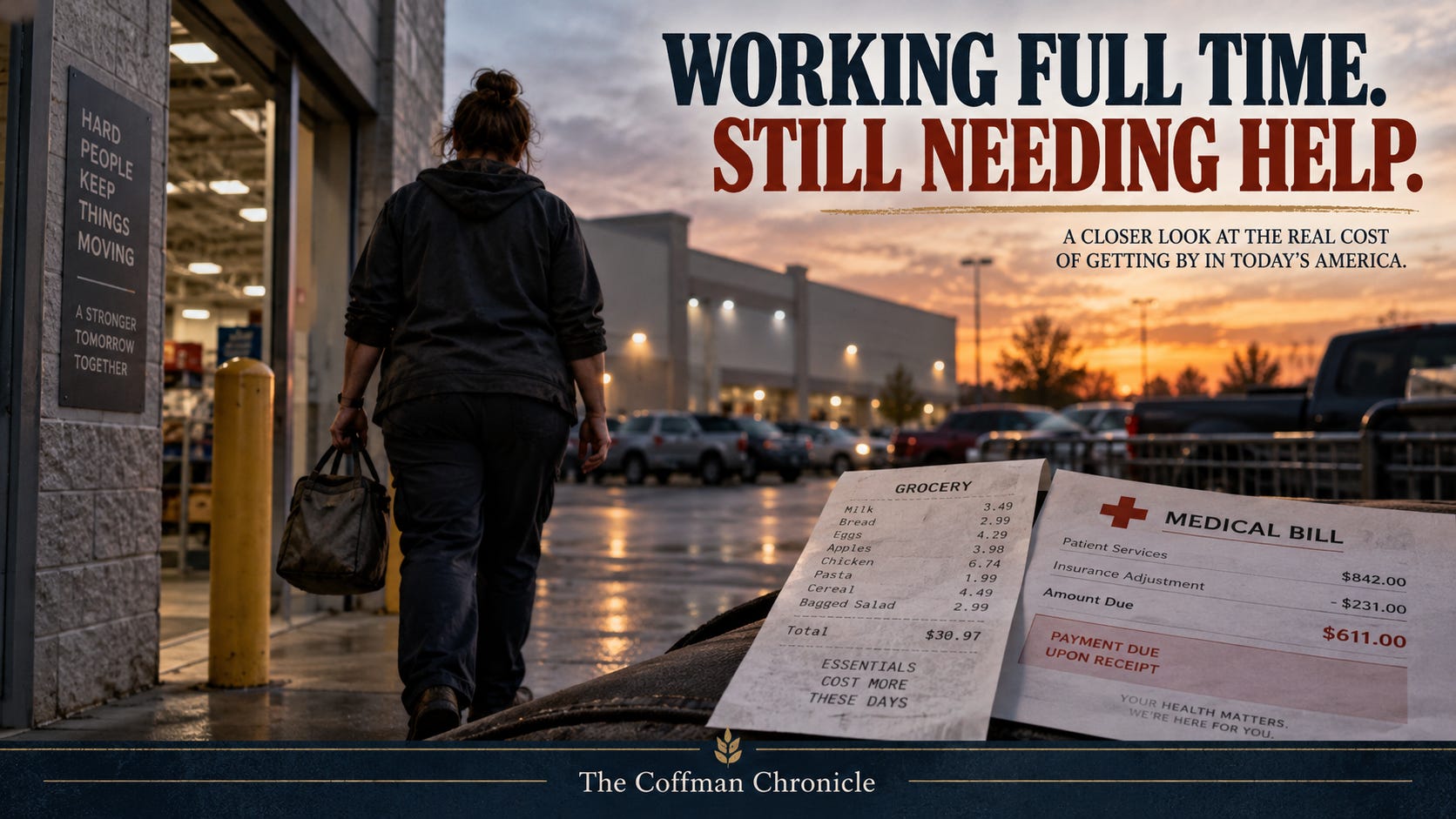
The paycheck had already been divided before it reached the bank. Rent took the largest piece, then came electricity, groceries, gasoline, the phone bill, and the prescription that could not simply be skipped because the refrigerator was getting empty.
The worker had done what Americans are constantly told they should do: show up, put in the hours, and work. The job was real. The employer was real. The paycheck was real. It just was not enough.
Medicaid helped with health care. SNAP helped with groceries. Maybe a tax credit helped keep the car insured long enough to get back to work Monday morning.
There is no shame in that. Those programs exist because people need food, medicine, and doctors whether their paycheck covers them or not.
However, someone else at that kitchen table rarely gets mentioned: the taxpayer. You did not hire the worker. You did not set the wage. You did not decide how much company revenue would go to payroll, investors, executives, expansion, or anything else. Yet, when the paycheck runs out before the necessities do, some of the bills can eventually reach you anyway.
Maybe the most important question is not why a working person needs help buying groceries or seeing a doctor. Maybe it is why someone can work substantial hours for a major corporation and still need the rest of us to help cover the cost of getting through the month.
Somebody always pays that cost. The only question is who.
This Community Is Powered by You
What started as a small circle has grown into something much bigger, and it’s all because of readers like you.
Every time you forward this email, post it on socials, or bring someone new into the fold, you’re helping build one of the most passionate, independent communities out there.
Want to keep the momentum going?
Share this newsletter with someone who should be part of this conversation.
Thank you for being here. It means everything.
This Is Bigger Than Walmart
Walmart is an easy name to reach for in a conversation about low wages and public assistance, but Walmart is not the story.
In a report reissued in August 2026, the Government Accountability Office estimated that 13.8 million adults ages 19 through 64 who were enrolled in Medicaid worked at some point during 2024. Another 10.6 million working-age adults who lived in households receiving Supplemental Nutrition Assistance Program benefits worked during the year. Roughly two-thirds of the Medicaid group and about 70% of the SNAP group worked at least 35 hours a week for some portion of the year. About 88% of wage earners in both groups worked in the private sector. U.S. Government Accountability Office, GAO-26-108703
GAO also obtained employer information from 11 states for September 2025. Those data are not nationally generalizable, and they do not show that every employee at any named company is poorly paid or that wages alone determined benefit eligibility. Household income, family size, hours, state rules, and other circumstances are factors.
Even with those limits, the pattern deserves attention. GAO found 46 companies that appeared among the top 25 employers of Medicaid enrollees or SNAP beneficiaries in at least two of the states studied. Seventeen were among the 50 largest Fortune 500 employers by workforce. State tables included names such as Walmart, Amazon, McDonald’s, Dollar General, Kroger, Home Depot, FedEx, Dollar Tree, and Target.
This is larger than one corporation. When working people receiving public assistance appear across retail, restaurants, grocery stores, warehouses, delivery networks, and other industries, the question becomes one about the American labor market itself.
How did we build an economy in which having a job does not necessarily mean escaping the safety net? To understand that, we have to go backward.
There Was a Time When the Paycheck Followed the Worker
For roughly a quarter-century after World War II, productivity and worker compensation moved remarkably close together. Between 1947 and 1973, labor productivity in the nonfarm business sector increased an average of 2.8% a year. Inflation-adjusted hourly compensation increased 2.6%. U.S. Bureau of Labor Statistics, “The Compensation-Productivity Gap”
That period should not be romanticized. Black Americans were excluded from opportunities routinely available to many white workers. Women faced enormous barriers in employment and compensation. Large parts of the prosperity we remember were distributed unequally. However, one economic relationship is still worth noticing: when workers produced more, their compensation generally rose with them.
Workers also possessed more collective bargaining power. BLS historical research places union membership at 28.3% of employed workers in 1954. BLS, “The Monthly Labor Review at 100—Part II”
The postwar arrangement was never universal, and it was never perfectly fair. However, a recognizable bargain underpinned much of it: if American workers helped make the economy more productive, they had a reasonable expectation that some of that prosperity would show up in their compensation.
Then the relationship began to weaken.
Then the Lines Began to Separate
No single day marked the end of the American employment bargain. No corporation issued a memo announcing that workers would no longer share as directly in the prosperity they helped create, and no single law explains what happened next.
However, the numbers changed. From 1979 through 1990, labor productivity continued to rise at an average of 1.4% annually, while inflation-adjusted hourly compensation increased only 0.5%. BLS data show the productivity-compensation gap persisting in later periods as well. U.S. Bureau of Labor Statistics, “The Compensation-Productivity Gap”
Many forces drove the shift. Global competition changed where companies produced goods, automation transformed jobs, and manufacturing employment shifted. Inflation and oil shocks battered household purchasing power. Employer-paid benefits became a larger part of compensation.
At the same time, worker bargaining power weakened. Comparable modern BLS data show union membership falling from 20.1% of wage and salary workers in 1983 to 9.9% in 2024. U.S. Bureau of Labor Statistics, “Union Members—2024”
The wage floor also weakened through neglect. The federal minimum wage reached $3.35 in January 1981 and did not rise again until April 1990. It reached $7.25 in July 2009, and the federal minimum for covered nonexempt workers remains $7.25 today. U.S. Department of Labor, minimum-wage history; U.S. Department of Labor, Fair Labor Standards Act wage guidance
None of those facts alone explains modern wage inequality. Together, they describe an economy in which the institutions that once helped translate growth into worker compensation became less powerful.
American workers did not stop becoming productive. The paycheck simply stopped keeping pace with productivity. Something else did not stop: the cost of being alive.
Low Wages Do Not Eliminate the Cost.
The landlord does not reduce the rent because wages stagnate. The grocery store does not lower its prices because workers have little bargaining power. Neither does the pharmacy, the gas station, the insurance company, or the mechanic who keeps the car running so somebody can get to work.
When compensation does not cover basic household costs, those expenses still have to be absorbed somewhere. Sometimes the worker absorbs them by postponing the dentist, stretching a prescription, carrying groceries on a credit card, or driving six more months on tires that should have been replaced. Sometimes family members help. Sometimes debt does. Sometimes charity does.
And sometimes government does. Medicaid helps with health care. SNAP helps with food. Tax credits, housing assistance, child-care programs, and other public supports can become part of the same household equation.
That does not make those programs mistakes. A society can decide that people should not go hungry or untreated simply because their earnings are low.
However, we should be honest about the accounting. The cost of sustaining a worker has not disappeared. It has been divided among the employer, the worker, the family, and sometimes the public. Low wages do not eliminate the cost of living. They move the bill.
Do Not Blame the Worker
The easiest person to blame is usually the person with the least power. The cashier applying for SNAP did not establish corporate payroll policy. The warehouse worker whose children qualify for Medicaid did not decide how the company would divide revenue among wages, investment, executives, and shareholders.
The worker made a simpler decision: take the job, do the work, and try to make the numbers add up. If they still do not, using a program for which the household legally qualifies is not the failure this article addresses.
The Square New Deal starts somewhere else. It asks where the power to make the compensation decision actually sits.
Government has responsibilities because government has power. Corporations have responsibilities because corporations have power. Citizens have responsibilities because citizenship carries obligations to one another and to the republic.
Those responsibilities are not interchangeable. If we take responsibility seriously, it should follow power.
The Taxpayer Has Become the Silent Third Party
Every business has labor costs. Wages are part of them. So are payroll taxes, benefits, training, and other expenses.
A corporation can reduce some of those costs by paying workers less, but lowering the wage does not lower the worker’s rent, grocery bill, or medical expenses. It changes who carries the burden.
That makes this a question of cost allocation. Businesses account for buildings, electricity, inventory, transportation, software, insurance, equipment, and maintenance. Labor should not be the one major input whose full economic cost can be pushed outside the company and treated as though it vanished.
When public assistance helps cover necessities for working households, the taxpayer becomes a silent third party in the employment relationship.
The Square New Deal proposal is meant to make that cost visible. It is not designed to outlaw profit, shame workers, or dictate every payroll decision. Instead, it asks whether a large employer whose compensation falls substantially below basic local needs should bear some responsibility for costs that move outside its ledger.
What Does a Living Wage Actually Mean?
“Living wage” can sound like a political slogan. It should be a calculation.
Living costs vary by place, so a serious benchmark cannot be one arbitrary national figure. Housing, transportation, food, health care, taxes, and other necessities differ across communities.
The Living Wage Calculator shows that you can build geographically specific estimates. Its 2026 methodology covers 3,144 counties and includes expenses such as food, child care, health care, housing, transportation, broadband and mobile service, other necessities, civic engagement, and taxes. Living Wage Calculator, methodology Its statewide Pennsylvania estimate for one adult with no children is $23.32 an hour. Living Wage Calculator, Pennsylvania
That does not mean Congress should simply adopt that number. The Square New Deal would instead establish a transparent federal Basic Needs Wage using public data and a published methodology.
The benchmark should begin with one adult without children. An employer’s obligation should not change because one worker has three children while another is single. That could create ugly hiring incentives. The wage standard attaches to the job, not to the worker’s family.
The Low-Wage Community Impact Assessment
Once a Basic Needs Wage exists, the mechanism becomes understandable. The assessment would apply only to large employers above a carefully defined threshold. Compare qualifying compensation with the Basic Needs Wage where the work is performed.
Suppose the Basic Needs Wage is $23 an hour and qualifying compensation is $17. The gap is $6.
If Congress chose, purely for illustration, to assess 50% of that gap, the company would owe $3 for each covered hour worked. Raise compensation to $20, and the assessment falls. Reach $23, and it disappears.
The 50% figure is an example, not a settled policy choice. Congress would need evidence for whatever rate it eventually selected and should examine how different rates affect wages, prices, hiring, hours, and public revenue.
However, the underlying incentive is straightforward: Pay the worker, or help pay the bill. The company retains choices. It can increase wages, improve qualifying benefits, pay the assessment, or restructure the position.
Under this proposal, it cannot treat the uncompensated portion of the workforce’s basic economic cost as though it automatically belongs to somebody else.
Tax the Compensation Decision, Not the Benefit Recipient
There is a dangerous way to write this law. Congress could simply count how many employees receive Medicaid or SNAP and bill the employer accordingly. That could make people who need public assistance more expensive to hire.
The Square New Deal should not make poverty a hiring disadvantage. As such, the assessment should never depend on whether Maria receives SNAP, whether John’s children are enrolled in Medicaid, or how many children Sarah has.
Government would look instead at the job: location, covered hours, qualifying compensation, the Basic Needs Wage, and employer size.
Two workers doing the same job for the same compensation in the same labor market would create the same assessment whether one receives public assistance and the other does not. That protects privacy and reduces incentives to discriminate against applicants based on economic circumstances.
The worker is not the taxable event. The compensation decision is.
Benefits Count, but Employers Have to Show Their Work
Wages are not the whole compensation package. Employer-paid health insurance, retirement contributions, paid leave, and other genuine benefits have economic value and can reduce expenses workers otherwise bear themselves. They should count, but only at their actual value to the worker.
An employee discount is not health insurance. A wellness app is not rent money. A benefit technically available but inaccessible to most workers because of hours or eligibility rules should not be credited as though everyone receives it.
If a corporation wants credit for compensation beyond wages, Congress should require it to demonstrate the value actually delivered. That protects employers that genuinely provide strong benefits without allowing accounting creativity to turn a low-wage position into a high-compensation job on paper.
The Money Should Follow the Burden
If the assessment exists because inadequate compensation can move costs outside the company, its revenue should have a visible relationship to those costs.
Some could support Medicaid, SNAP, worker tax credits, child care, housing, transportation, or workforce programs. Some should return geographically to the states and communities where the covered employment occurs.
Not every dollar needs to return to the ZIP code where it was collected. National programs are national for a reason, but the public should be able to see where the money went.
Corporations account for part of the cost pushed outward. Government accounts for how the money is used. That is stewardship on both sides.
The Objections Are Real
An easy way to defend this proposal is to pretend corporations will simply raise wages. That would be dishonest. Businesses respond to higher labor costs. Some may raise prices, reduce hours, slow hiring, automate jobs, outsource work, or absorb part of the cost through lower profits.
Research on minimum-wage increases is not identical to this proposal, but it provides a useful warning. CBO estimates that higher wage floors can increase earnings for many low-wage workers while reducing employment for some, and it emphasizes substantial uncertainty about the size of those employment effects. CBO also identifies possible effects through prices, business income, productivity, and worker turnover. Congressional Budget Office, “The Effects on Employment and Family Income of Increasing the Federal Minimum Wage”
A Square New Deal policy therefore needs a phase-in, predictable updates, economic monitoring, and congressional review.
Small businesses also require different treatment. A fourteen-person restaurant is not Walmart, and an independent hardware store is not Amazon. A genuine small-business exemption makes sense.
However, an exemption cannot become an instruction manual for avoidance. Large corporations should not escape through paper subsidiaries, staffing arrangements, contractors, or franchise structures while retaining the economic power that actually controls the work. Protect the small employer without creating large-business camouflage.
Congress Writes the Rule
This cannot be a temporary executive program whose definition changes with each presidency. Congress should write the law.
Article I, Section 8 gives Congress power to lay and collect taxes, duties, imposts, and excises for the general welfare, and separately gives Congress power to regulate interstate commerce. Constitution Annotated describes the federal taxing power as broad, while also recognizing constitutional limits on how it is exercised. Constitution Annotated, Article I, Section 8 Constitution Annotated, “Overview of Taxing Clause”
The Basic Needs Wage methodology, employer threshold, assessment formula, benefit rules, small-business protections, anti-evasion provisions, revenue distribution, and review requirements should therefore be established in statute.
That is harder than having a president announce a program and tell an agency to work out the details. It is supposed to be. Representatives vote. Senators vote. Definitions are written down. Exemptions are defended. The public can see the rule and who wrote it.
Government should have enough power to do the public’s work and enough constitutional discipline to use that power through durable, transparent rules.
Private companies may own the business. The American people own the rules under which business operates.
Profit Is Not the Problem. The Unpaid Bill Is.
There is nothing wrong with a corporation making money, expanding, investing, or rewarding the people who took the risk to build it. Profit is not the problem. The unpaid bill is.
Corporations do not operate outside society. Their trucks use public roads. Courts enforce their contracts. Public institutions protect their property. Schools educate workers. Infrastructure allows commerce to move. Sometimes public programs also help sustain people who are simultaneously working for private employers.
The Square New Deal draws its line at responsibility, not success. A corporation should be free to compete, innovate, and become enormously profitable, but corporate stewardship means accounting for costs that business decisions move onto the public. Shareholder profit cannot justify extraction from the community.
If an employer reaches the Basic Needs Wage through wages and real benefits, no assessment is needed. If it chooses not to, the proposal asks it to help cover part of the burden that remains outside the paycheck.
For decades, we have argued about whether government should help the worker. Maybe that is only half the question. If a worker puts in the hours and still needs help buying food or seeing a doctor, we can ask what government owes that person. We can also ask what the employer owes the system for helping keep that worker afloat.
Pay the worker, or help pay the bill, because low wages never made the cost disappear. They just moved it to somebody else’s kitchen table.
Support The Coffman Chronicle
If this argument makes sense to you, share it with someone who still believes a job should be enough to build a life around.
The Coffman Chronicle is built around a simple idea: power should come with responsibility, and the people paying the hidden costs deserve to see where those costs are going.
If you can afford to support this work, consider becoming a paid subscriber. If you cannot, reading, sharing, and passing these ideas along still matters.
The republic belongs to all of us. So does the work of repairing it.
Sources
Baker, Brian I. “The Monthly Labor Review at 100—Part II: The ‘Middle Years,’ 1930–80.” Monthly Labor Review. U.S. Bureau of Labor Statistics. May 2016.
Congressional Budget Office. “The Effects on Employment and Family Income of Increasing the Federal Minimum Wage.” July 8, 2019.
Living Wage Institute. “Living Wage Calculation for Pennsylvania.” Living Wage Calculator. Updated February 15, 2026.
Living Wage Institute. “What Is a Living Wage and How Is It Estimated?” Living Wage Calculator. 2026.
U.S. Bureau of Labor Statistics. “The Compensation-Productivity Gap.” The Economics Daily. February 24, 2011.
U.S. Bureau of Labor Statistics. “Union Members—2024.” USDL-25-0105. January 28, 2025.
U.S. Department of Labor, Wage and Hour Division. “History of Changes to the Minimum Wage Law.” Accessed September 18, 2026.
U.S. Department of Labor, Wage and Hour Division. “Wages and the Fair Labor Standards Act.” Accessed September 18, 2026.
U.S. Government Accountability Office. “Federal Social Safety Net Programs: Millions of Workers, Including Many Employed by Large Employers, Continue to Rely on Medicaid and SNAP.” GAO-26-108703. Published June 22, 2026. Publicly released July 22, 2026. Reissued with revisions August 24, 2026.
U.S. Library of Congress. Constitution Annotated. “Article I, Section 8: Enumerated Powers.” Congress.gov. Accessed September 18, 2026.
U.S. Library of Congress. Constitution Annotated. “Overview of Taxing Clause.” Congress.gov. Accessed September 18, 2026.
This is the case at Walmart. The people you were stocking the shelves, ringing up the sales and gathering up the shopping carts are not paid enough to survive without getting SNAP benefits and Medicaid. Cheapskate Walmart doesn’t pay them enough or offer proper benefits. The taxpayers are being used.
Economic Justice has never been a strength of the American Economic System. The Wealthy own the means of production and they routinely abuse that power to degrade the economic welfare of their employees...
Unions flourished for a short time and improved the lives of American workers until the Justice Department undermined the majority of them.
Especially under President Trump the Justice Department is in fact the INJustice Department!