


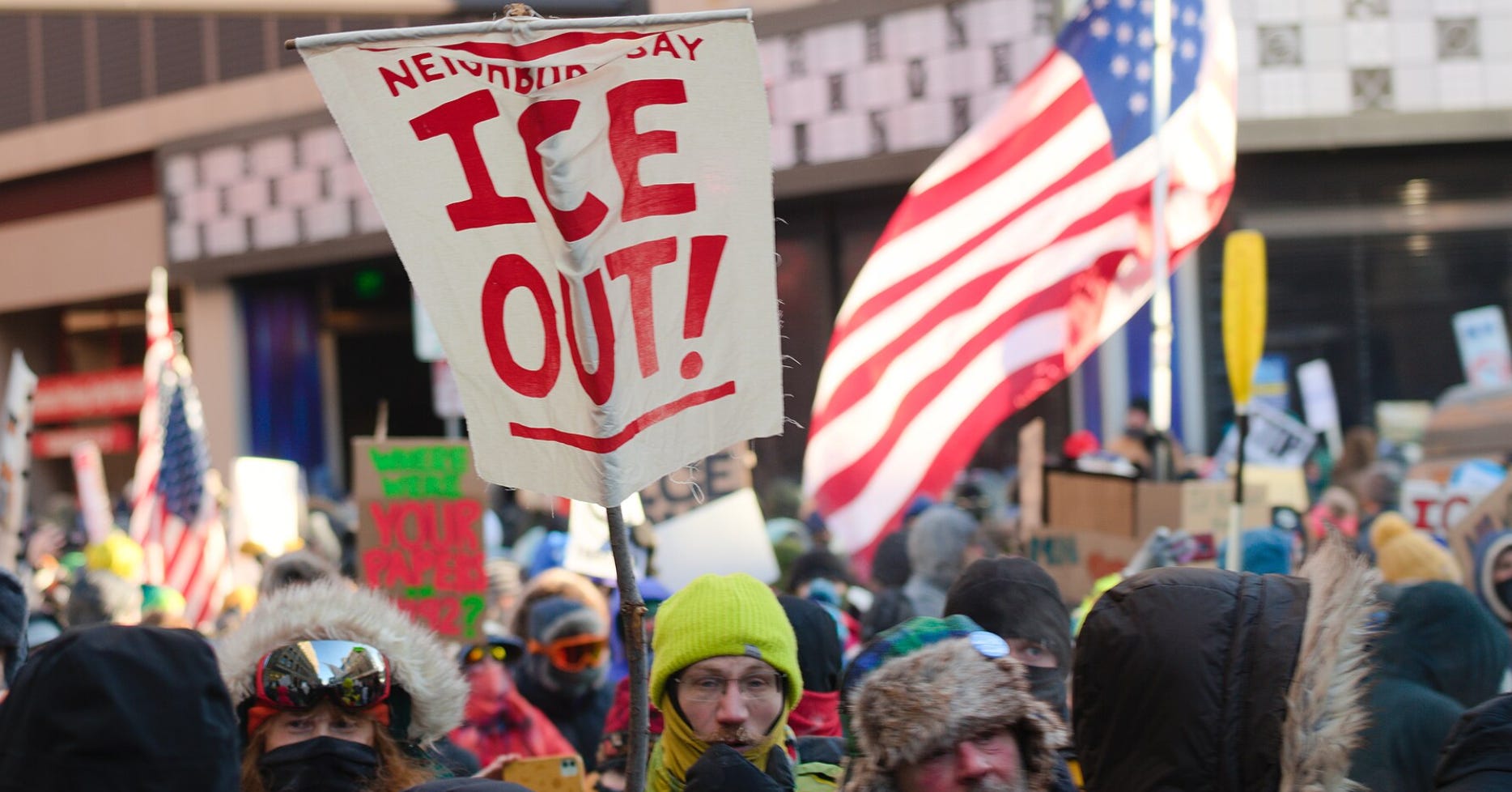
Immigration enforcement is necessary. Every country enforces its borders. Laws mean nothing if they aren’t applied.
However, enforcement only works if the public believes it is lawful, restrained, and accountable, and right now, that belief is breaking.
New polling showing rising support for abolishing Immigration and Customs Enforcement isn’t a sudden embrace of open borders or chaos. It’s something far more dangerous: a loss of public consent. Americans aren’t rejecting immigration law. Rather, they’re reacting to an enforcement agency that increasingly feels politicized, insulated from oversight, and disconnected from the people it claims to protect.
When an institution charged with enforcing the law starts losing trust across party lines, including among voters who once backed it, the problem isn’t ideology, but legitimacy. History shows that when enforcement loses legitimacy, doubling down on power doesn’t restore order. It accelerates the collapse.
This Community Is Powered by You
What started as a small circle has grown into something much bigger, and it’s all because of readers like you.
Every time you forward this email, post it on socials, or bring someone new into the fold, you’re helping build one of the most passionate, independent political communities out there.
Want to keep the momentum going?
Share this newsletter with someone who should be part of this conversation.
Thank you for being here. It means everything.
What the Polls Are Really Saying
The topline numbers are easy to misread, and Washington is already doing it.
Recent polling showing a surge in support for “abolishing ICE” is being framed as a radical shift in immigration attitudes. It isn’t. A closer look at the data reveals something far more precise and significant. Americans still believe immigration enforcement is necessary, but they are rapidly losing confidence in the agency tasked with carrying it out.
Across multiple surveys, support for immigration enforcement remains broadly intact. What’s collapsing is trust — trust that enforcement is being conducted lawfully, proportionally, and with meaningful oversight. That distinction matters. When respondents say they support abolishing ICE, they are not voting on policy architecture. They are signaling rejection of an institution they no longer recognize as legitimate.
This is why the shift is bipartisan. Democrats have long criticized ICE’s structure and tactics, but the notable change is among independents and Republicans, voters who historically supported aggressive enforcement. Their movement isn’t ideological drift, but a behavioral response. These voters are reacting to what they see: escalation without transparency, power without accountability, and enforcement that appears increasingly political rather than procedural.
Polling language often collapses complex public sentiment into blunt choices. “Abolish” becomes a catch-all response for frustration when reform feels unavailable, and oversight feels absent. In that sense, abolition polling is not a roadmap but a warning light. It tells us that a growing share of the public no longer believes the system can correct itself from within.
That’s the danger zone for any enforcement institution. When public consent erodes, enforcement doesn’t quietly weaken. It destabilizes. People stop distinguishing between the law and the agency enforcing it. Once that line blurs, legitimacy doesn’t decline gradually. It falls off a cliff.
When Enforcement Escalates, Trust Collapses
Public trust in enforcement institutions doesn’t collapse because of slogans. It collapses because of behavior.
The sharp shift in attitudes toward ICE follows a series of enforcement actions that feel less like law enforcement and more like escalation, specifically operations marked by speed, secrecy, and force, with little visible accountability when things go wrong. In several high-profile incidents, civilians were shot and killed during ICE operations. These weren’t abstract policy debates or theoretical abuses. They were moments when enforcement crossed from procedure into spectacle, and Americans noticed.
For many voters, especially those who historically supported strong immigration enforcement, this was the breaking point. Law enforcement is granted extraordinary authority on the assumption it will be exercised with restraint. When that restraint appears to disappear, support doesn’t harden. It fractures. People don’t parse agency charters or statutory jurisdictions in moments like these. They ask a simpler question: Is this still under control?
This is where legitimacy begins to fail. An enforcement agency doesn’t need to be universally loved to function. It needs to be predictable, bounded, and accountable. Once the public perceives that force is being applied inconsistently or politically — or that consequences stop at the agency’s door — enforcement stops feeling like law and starts feeling like power.
ICE’s defenders often respond to criticism by pointing to the scale of its mission or the difficulty of the job. However, difficulty is not a waiver. Every enforcement agency operates under pressure. What separates legitimacy from backlash is not perfection, but correction. When errors occur, the public expects transparency, review, and visible consequences. When those are absent, trust doesn’t recover. It compounds its losses.
This is how institutions radicalize the public without intending to. As reform channels narrow and oversight weakens, frustration doesn’t dissipate. It intensifies. Poll responses harden. Language sharpens. “Reform” becomes “abolish” not because the public has abandoned enforcement, but because it no longer believes the institution is capable of reforming itself.
That’s the pattern Washington keeps missing. Escalation without accountability doesn’t restore order. It accelerates alienation, and once enforcement agencies lose the benefit of the doubt, every operation becomes a referendum, not just on policy, but on whether the institution itself still deserves the authority it holds.
Why Washington Responds to Legitimacy Crises With More Force
When public trust collapses, institutions face two paths: reform or reinforcement. Washington has chosen reinforcement every time.
Instead of responding to eroding confidence with tighter oversight, clearer guardrails, or structural reform, federal leaders have treated criticism of ICE as a threat to be neutralized. Budgets expand. Recruitment accelerates. Operational tempo increases. The assumption is simple and deeply flawed: that more enforcement will restore faith in enforcement.
It never does.
ICE’s recent expansion has occurred alongside a visible contraction in accountability. Rapid hiring surges have outpaced the capacity for training and oversight. Incentive programs, including bonuses and loan forgiveness, have prioritized speed over institutional culture. Internal review mechanisms remain largely opaque, and external oversight is treated as interference rather than necessity. The result is an agency that feels increasingly insulated from the consequences of its own actions.
This is not accidental. Politically, enforcement agencies become shields. When legitimacy falters, elected officials lean on force because it is immediate, while reform is slow. Doubling down allows leaders to signal “control” without confronting the harder question of whether the system is still functioning as intended.
However, enforcement divorced from consent doesn’t stabilize governance. It destabilizes it. Each expansion undertaken without public buy-in widens the gap between authority and legitimacy. Each operation conducted without transparency deepens suspicion. Each unanswered incident trains the public to expect escalation instead of accountability.
History offers no shortage of warnings here. Institutions that respond to legitimacy crises by concentrating power don’t reverse decline; they accelerate it. Public trust is not rebuilt through volume or velocity. It’s rebuilt through visible limits, proof that authority has boundaries and that crossing them carries consequences.
Washington’s failure is not that it enforces immigration law. It’s that it treats enforcement itself as the solution to a crisis caused by enforcement gone unmoored. The more this cycle repeats, the less space remains for reform, and the more radical public responses become.
That is how you end up with abolition polling in a country that still believes in borders— not because enforcement is unnecessary, but because legitimacy has been allowed to rot.
The Kitchen-Table Test and What History Says Happens Next
Most Americans don’t sit around debating federal agency structures. They decide whether something works the same way they decide whether a mechanic, a school, or a local police department works: Does this feel under control? Does anyone answer when something goes wrong? Would I trust this system if it turned its attention toward me?
That’s the kitchen-table test, and right now, ICE is failing it.
When enforcement agencies lose public consent, the consequences don’t stay abstract. They show up as fear, confusion, and withdrawal. People stop cooperating. Communities stop distinguishing between lawful authority and unchecked power. Routine enforcement actions trigger public backlash not because the law is unpopular, but because the institution enforcing it no longer commands trust.
History is clear about what happens next, and it’s never stability.
In democratic systems, enforcement derives legitimacy not just from statute, but from restraint. The moment force becomes unpredictable or insulated from accountability, it ceases to function as law enforcement and becomes a stressor. That stress doesn’t dissipate. It migrates into courts, local governments, workplaces, and families, as they try to understand whether “the law” still means what it used to.
We’ve seen this pattern before. From federal crackdowns that hardened public resistance rather than compliance, to policing eras where escalation replaced community trust, the result is always the same: enforcement becomes louder, faster, and more aggressive while public cooperation collapses. The state spends more to achieve less. Tension rises. Legitimacy erodes further.
This is the part Washington refuses to acknowledge. Enforcement without consent doesn’t deter disorder. It produces it. When people feel that power is being applied arbitrarily or politically, they don’t rally around institutions. They retreat from them.
That’s why abolition language spreads even among people who believe enforcement is necessary. It’s not a policy demand. It’s a signal of desperation, a way of saying, “This system no longer feels safe, predictable, or accountable, and no one seems willing to fix it.”
At the kitchen table, that translates into a simple fear: if the system won’t restrain itself, who will?
Democracies survive enforcement only when enforcement remembers its limits. The moment those limits vanish from view, history shows us what follows — not reform by default, but rupture.
Reform, or the Collapse of Consent
This is the choice in front of us, whether Washington wants to admit it or not.
Immigration enforcement is not optional. Every functioning nation enforces its laws. However, enforcement that loses public consent doesn’t quietly persist. It mutates. It grows more aggressive, more insulated, and more detached from the people it claims to serve. When that happens, the damage isn’t limited to one agency. It bleeds outward, eroding trust in law itself.
The polling Washington keeps misreading isn’t a mandate to abolish enforcement. It’s a verdict on failure. A growing share of Americans are saying, in plain language, that the system no longer feels bounded or accountable, and that when something goes wrong, no one answers for it.
That is the danger zone for a democracy.
History shows there is a narrow window in moments like this. Institutions can either accept limits and rebuild legitimacy, or they can chase control and accelerate backlash. One path restores trust. The other radicalizes the public and hardens opposition, even among those who still believe in the underlying mission.
ICE doesn’t need louder defenses or bigger budgets to survive this moment. It needs restraint, transparency, and real oversight. It needs visible consequences for crossing the lines and clear standards that the public can understand and trust. Without that, enforcement ceases to be a stabilizing force and becomes a permanent source of instability.
The rise in abolition language is not the cause of this crisis. It’s the warning flare, A signal that Americans are losing faith not in immigration law, but in the institution enforcing it. Ignoring that signal won’t make it disappear. Doubling down on power won’t make it reverse.
Consent is the foundation on which enforcement stands. Once it cracks, no amount of force can hold the structure together.
The question now is whether Washington chooses reform while consent can still be rebuilt, or waits until the public decides the system is beyond saving.
Coffman Chronicle. Support Independent Media
If this piece helped you understand why institutions fail — not just what they did — that’s the work daily coverage rarely has time or incentive to do.
The Coffman Chronicle is fully reader-supported, so it can follow power where it actually moves, trace patterns others miss, and publish without permission from political parties, advertisers, or institutions under scrutiny. That independence is the point.
If you value reporting that treats accountability as a civic requirement — not a partisan slogan — consider becoming a paid subscriber. Your support directly funds long-form investigations, historical context, and kitchen-table journalism built to hold up over time.
Support independent media. Consider becoming a paid subscriber.
Sources:
“Support for Abolishing ICE Is Surging Among Republicans”, TIME, January 26, 2026.
“Today more Americans support than oppose abolishing ICE”, YouGov, January 25, 2026.
“Would you support or oppose abolishing ICE? YouGov survey results”, YouGov, January 25, 2026.
“More Americans view the ICE shooting in Minnesota as unjustified than justified”, YouGov, January 13, 2026.
“After the shooting in Minneapolis, majorities view ICE unfavorably and support major changes”, YouGov, January 14, 2026.
“Can ICE agents be prosecuted for Minneapolis shootings?”, Reuters, January 26, 2026.
“A second U.S. citizen was killed by federal forces in Minneapolis. Here’s what we know”, PBS NewsHour, January 26, 2026.
“Judge set to hear arguments on Minnesota’s immigration crackdown”, ABC30 (AP), January 26, 2026.
“Protesters and federal agents repeatedly square off in Minnesota”, PBS NewsHour, January 13, 2026.
“Judge grants restraining order against DHS after Border Patrol kills Alex Pretti in Minneapolis”, CBS News (Minnesota), January 27, 2026.
“A Majority of Voters Are Unfavorable of ICE, Are Divided on What 'Abolish ICE' Means,” Data for Progress, January 22, 2026.
Never cease to amaze me how intelligent you are! How well you explain the factors affecting the breakdown of consent. It is certainly what we are seeing play out - just as you explain it. The general concern about what is happening is that ICE is doing whatever they want, however they want with no regard for the law or humanity. And when they blatantly break the law to the point of murder with no accountability, that's the breaking point for many. Biggest problem in the United States is we have all kinds of immigration laws that must be followed, but offer no assistance with the path moving forward. My niece married an immigrant about eight years ago. Took thousands of dollars for an immigration lawyer and many years to navigate the process. That is wrong. Most immigrants face great hardship to get here with nothing more than a grocery bag of possessions. And most go on to find jobs, raise families and become decent members of the community. That should count for something - a lot actually. If they are willing to struggle and work for a better life, I think we need more humanity in how we see them and treat them.
I'm forwarding this essay to my regional newspapers. It's very helpful to point out the difference between dissenting from abusive practices and treasonous rebellion. Protest without violence is a constitutional right in this country. Provoking rebellion (such as the Jan. 6, 2021 assault on the Capitol) is not a right but a violation of law and order. Minneapolis protestors who don't violently impede licit law enforcement are not rebelling or inciting rebellion. A good Samaritan's effort to help a victim of ICE brutality did not deserve to be shot at all, to say nothing of being killed.