


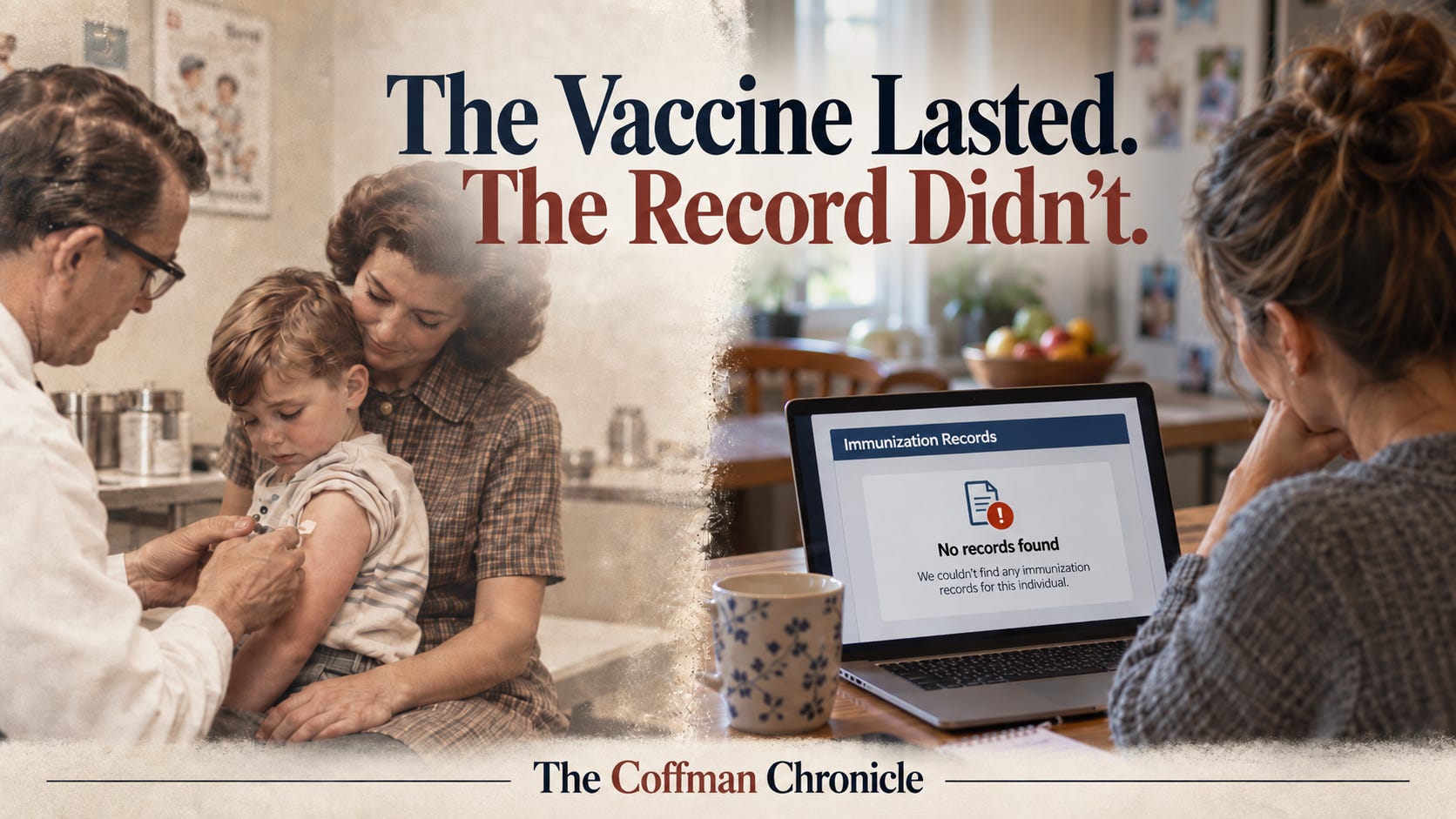
The Filing Cabinet Problem
Somewhere in Pennsylvania, an adult is being told to check their childhood vaccination records. That sounds reasonable until you think about what is actually being asked. Find the piece of paper your mother may have been given when you were five years old. Find the records from a pediatrician who may have retired thirty years ago. Call the school district you attended before computers sat on every desk. Hope somebody kept a file through multiple moves, doctors, insurance companies, and half a century of ordinary life. Then figure out exactly which measles vaccine you received.
Pennsylvania is in the middle of a serious measles outbreak. As of September 30th, the Department of Health had confirmed 943 cases across 39 counties, including 176 hospitalizations and five measles-associated deaths. However, the evidence does not suggest that millions of properly vaccinated adults suddenly lost their protection. Of those 943 confirmed cases, the state reported just four among people who were appropriately vaccinated for their age. Two doses of the measles, mumps, and rubella vaccine, or MMR, remain about 97% effective.
The harder question for many adults comes before that one. Do they know what protection they have?
For some people, the answer is surprisingly simple. The Centers for Disease Control and Prevention generally considers anyone born before 1957 presumptively immune because measles circulated so widely before vaccination that most people in that generation were infected naturally as children.
For others, the answer may depend on what happened in a doctor’s office more than sixty years ago. The first measles vaccines became available in 1963. Between 1963 and 1967, fewer than one million Americans received an inactivated, or “killed,” vaccine that was later found not to provide adequate protection. People who know they received it should be revaccinated with the current MMR vaccine. The CDC also says people vaccinated before 1968 who don't know which version they received should be revaccinated if they have no medical contraindication.
Now ask someone in their sixties whether the shot they received before kindergarten was the live vaccine or the killed vaccine. They may remember the doctor’s office. They may remember their mother holding their hand. They probably do not remember the formulation.
And why would they? They were children. Their parents followed the medical advice available at the time. They went to school. They grew up. Decades passed. The measles vaccine can provide lifelong protection. The paperwork apparently was expected to do the same.
This Community Is Powered by You
What started as a small circle has grown into something much bigger, and it’s all because of readers like you.
Every time you forward this email, post it on socials, or bring someone new into the fold, you’re helping build one of the most passionate, independent communities out there.
Want to keep the momentum going?
Share this newsletter with someone who should be part of this conversation.
Thank you for being here. It means everything.
Pennsylvania Has Made the Question Urgent
This would be an interesting records problem even without an outbreak. Pennsylvania has turned it into an immediate one.
During a serious outbreak, knowing whether you are protected is essential. For many adults, that means answering questions they have not thought about in decades. Did I receive one dose or two? Was the vaccine I received in the 1960s the live vaccine or the older killed version? Did I have measles naturally before vaccines became widely available? Can I prove any of it?
Pennsylvanians are clearly asking. During a typical month, healthcare providers across the state administer about 25,000 MMR doses. In September, as the outbreak grew, they administered more than 53,000. State health center staff also operated 180 pop-up clinics in affected communities.
That response makes sense. People see cases climbing and want to know whether they are protected, but there is a difference between refusing a vaccine and being unable to reconstruct what happened to you before you were old enough to understand the word vaccination.
A sixty-year-old who cannot locate a childhood immunization card is not necessarily someone who ignored public-health advice. They may be someone whose parents followed every recommendation they were given and whose only mistake was failing to preserve a piece of paper for six decades.
Three Generations, Three Different Answers
The easiest way to understand the confusion is to stop treating every American adult as though they grew up under the same vaccination system. They did not.
For people born before 1957, CDC generally considers them presumptively immune. Measles was so widespread before vaccination that nearly everyone was infected in childhood, and most people in that generation are presumed protected. Healthcare workers can face additional recommendations because of their occupational exposure, but the general rule for other adults is straightforward.
That cutoff can sound strange because the first measles vaccines were not licensed until 1963, but 1957 and 1963 answer two different questions: 1963 tells us when vaccination began, while 1957 is the year the CDC uses to identify the generation presumed to have been exposed naturally.
Someone born in 1955 is therefore generally presumed immune even without a vaccination record. Someone born in 1959 does not receive that same presumption simply because no measles vaccine existed when they were born.
Then comes the generation caught in the transition. When vaccination began in 1963, Americans did not all receive the same vaccine. A live vaccine was available, but so was the killed version used from 1963 through 1967. People with documentation showing they received the live vaccine generally do not need to be revaccinated simply because they received the shot decades ago. People who received the killed vaccine, or do not know which type they received during those years, are different.
Put yourself in the position of someone who was six years old in 1965. Your mother took you to the doctor. A nurse gave you a shot. You went home. More than sixty years later, someone asks whether that syringe contained a live attenuated vaccine or an inactivated one. That is not a reasonable test of memory.
The physician may be dead. The practice may have closed before medical records were digitized. Your school may have merged with another district. Your parents may no longer be alive to ask, and even if they were, there is no particular reason they would remember the formulation of a childhood vaccine administered in 1965.
Then there are younger adults who grew up firmly in the live-vaccine era. Their situation is generally simpler, particularly if they have documentation. The CDC says adults who received two appropriately spaced doses are considered protected and do not need routine measles boosters.
The adult population is not one undifferentiated group wondering whether an old vaccine “wore off.” Some people are presumed immune because they were born into a world where nearly everybody eventually caught measles. Some were vaccinated during a brief period when two very different vaccines were being used. Others received the modern live vaccine but may no longer possess documentation showing when or how many doses they received.
Moreover, that is before we account for another change in the schedule.
Even the Schedule Changed
For years, one dose of live measles vaccine was the standard childhood protection in the United States. That changed in 1989, when outbreaks among vaccinated school-aged children led federal health officials to recommend a routine two-dose schedule.
The second dose was not primarily meant to rescue people whose immunity had worn off. It was intended to reduce the number of people who remained susceptible because the first dose had not produced immunity.
That history creates another easy misunderstanding today. Someone who received only one measles vaccination as a child before the two-dose schedule became routine may hear that children now receive two doses and reasonably wonder whether they have been inadequately vaccinated for decades.
For most adults, that is not what the CDC guidance says. One dose of MMR vaccine is about 93% effective at preventing measles. Two doses are about 97% effective. The CDC considers most adults born in 1957 or later with at least one appropriate dose to have evidence of protection unless they belong to a group for which two doses are recommended. Those groups include healthcare personnel, international travelers, postsecondary students, close contacts of immunocompromised people, and some people at increased risk during a local outbreak.
The move to a routine two-dose childhood schedule in 1989 therefore does not mean every American who grew up before 1989 now needs another shot. The problem is knowing which rule applies to you.
For a parent looking at a child’s electronic medical record today, that may require a few clicks. For an adult trying to reconstruct vaccinations administered before Ronald Reagan entered the White House, it may require considerably more detective work.
The Vaccine Isn’t the Weak Link. The Record Is.
If adults vaccinated decades ago are uncertain about their measles protection, it can sound as though the vaccine itself has become unreliable with age. The evidence doesn't support that. CDC says people who received the recommended doses are considered protected, and Pennsylvania’s outbreak data reinforce the point: appropriately vaccinated people account for only a tiny fraction of confirmed cases.
The uncertainty is often not biological, but documentary. Today’s immunization information systems are designed to consolidate vaccination histories from participating providers. However, the modern infrastructure came long after many of the adults now being asked about childhood measles vaccination had already grown up. CDC’s original core data standards for computerized immunization registries date to 1995, decades after the first measles vaccines were administered.
A person vaccinated in 1965 was not entered into some nationwide electronic database that quietly followed them through every move and every doctor since kindergarten. A pediatrician, a school, a county health department, or their parents might have held their record, it might have been transferred somewhere along the way, or it might not have been.
No national organization still maintains every American’s vaccination history. The CDC advises people looking for old records to check with parents, former healthcare providers, schools, colleges, previous employers, and state or local immunization programs.
No villain is in that story. Doctors practiced medicine using the systems available at the time. Parents kept whatever records they understood they needed. Schools collected information for their own purposes. Public-health agencies built better systems as technology made them possible.
However, a system can develop reasonably and still leave behind a problem that becomes obvious only decades later. Measles has exposed one of them. Public-health officials can tell Americans with remarkable precision which vaccine, how many doses, and which years matter. What they cannot always tell an individual citizen is what happened to them. That deserves a different response than another argument over whether vaccines work.
Citizen Stewardship Does Not Mean Guessing
Citizen stewardship begins with responsibility. If measles is spreading in your community and you do not know whether you are protected, ignoring the question is not much of an answer, but neither is guessing.
The CDC recognizes several ways a person can establish evidence of measles immunity: written documentation of adequate vaccination, laboratory evidence of immunity, laboratory confirmation of previous measles infection, or birth before 1957. For people who cannot find their records, a healthcare provider can help determine whether vaccination or a blood test for evidence of immunity makes sense. The CDC also says there is no harm in receiving another MMR dose if someone may already be immune, as long as the vaccine is medically appropriate for that person.
Those options also create responsibility. Citizen stewardship does not require everyone to become an amateur epidemiologist. It requires taking reasonable steps when your choices can affect people beyond yourself.
Measles is exceptionally contagious. Uncertainty about immunity therefore does not remain entirely private. It can matter to infants too young to be fully vaccinated, people whose immune systems leave them especially vulnerable, and others who may encounter an infected person before anyone realizes an exposure occurred.
That does not give government unlimited authority over someone’s body. It does mean citizenship carries obligations that extend beyond the front door.
The Square New Deal asks a question that applies well beyond vaccines: What kind of citizen are you? A citizen who takes stewardship seriously does not need government to make every decision for them, but they also do not treat uncertainty as permission to ignore a preventable risk to everyone around them. They ask the question, check the record, talk to their doctor, and determine which guidance applies to them.
That is personal responsibility in a functioning social contract, but responsibility cannot run in only one direction.
Government Stewardship Means Making That Possible
If government expects citizens to know their status, understand rules that have changed over several generations, and act responsibly during an outbreak, it has an obligation to make that reasonably possible.
Pennsylvania has already built part of that infrastructure. The Pennsylvania Immunization Electronic Registry System, or PIERS, lets adults access official immunization records documented in the state system. Residents can save and print those records through a public portal or submit a formal request when they cannot use the portal. Philadelphia maintains its own immunization registry, PhilaVax, rather than reporting vaccinations through PIERS.
That is useful government, but PIERS can only return information that made its way into PIERS. A computerized registry created decades after someone received a childhood vaccine cannot create a record that was never entered. Older records may still be scattered among families, former doctors, schools, clinics, and state or local systems. That leaves government with a responsibility beyond maintaining a database. It has to explain what happens when the database comes up empty.
A person born before 1957 should be able to learn quickly that the general rule is presumptive immunity. Someone vaccinated between 1963 and 1967 should understand why the type of vaccine they received could matter. Someone with one documented dose should be able to determine whether that is sufficient for their circumstances. And someone with no usable record should not have to piece together the answer from six government webpages and a forty-year-old school file. Public health works better when the instructions survive contact with ordinary life.
Pennsylvania has also shown during this outbreak that government can move resources toward people rather than simply waiting for people to find them. State health officials have operated pop-up vaccination clinics in affected communities while healthcare providers have administered tens of thousands of additional MMR doses.
Government stewardship is not assuming every citizen has perfect records, treating every uncertain adult as though they refused to participate, or telling everyone to get another shot regardless of their circumstances. The obligation is to make the path understandable: tell people which birth years matter, which vaccine years deserve a second look, where they can search for existing records, and what their options are when those records are gone.
Government cannot preserve every piece of paper from every doctor’s office that closed during the last sixty years. It can make sure losing that piece of paper does not leave a citizen without a next step.
You Shouldn’t Need Your Mother’s Filing Cabinet
There is something almost absurd about asking a sixty-year-old American to prove what happened in a pediatrician’s office before they learned long division. During a measles outbreak, however, that information can matter.
For some people, the answer is easy. They were born before 1957 and are generally presumed immune. Others have clear documentation showing they received the live vaccine. Many younger adults have records showing the recommended doses and can be reasonably confident that their protection remains strong.
The difficult cases are the people in between. They remember getting shots, going to school, and watching their parents fill out forms. What they lack is a complete medical archive from childhood. That should not be treated as irresponsibility.
A child vaccinated in 1966 did not choose the vaccine formulation. A teenager vaccinated under a one-dose schedule did not write the schedule. A parent who eventually lost an immunization card did not anticipate needing it sixty years later.
The systems changed. The recommendations changed. The records changed. The citizen grew older inside it all.
That does not erase personal responsibility. If measles is spreading and you genuinely do not know whether you are protected, the responsible thing is to find out, but responsibility works best when government meets the citizen halfway.
A functioning public-health system should be able to tell people, in plain language, which rules apply to them and what to do when the record is gone. That is not paternalism. It is stewardship.
Citizens have a duty to take reasonable care of their own health and to consider the people around them. Government has a duty to make responsible action possible without requiring people to become historians of their own childhood medical care.
The measles vaccine can protect a person for decades. Our expectations of public-health infrastructure should follow the same timeline. No one should need their mother’s filing cabinet to figure out whether they did what society asked of them sixty years ago. And when the filing cabinet is gone, the system should still know how to help them find the answer.
Support Independent Media - The Coffman Chronicle
If this article helped you make sense of a public-health question that is more complicated than it first appears, please share it with someone who may be asking the same questions.
The Coffman Chronicle is reader-supported. If you can afford to become a paid subscriber, your support helps keep this work independent and allows us to keep digging past the headline into the systems, responsibilities, and consequences underneath it.
And whether you subscribe for free, become a paid supporter, or simply pass an article along, thank you for reading.
The republic works better when citizens have enough information to ask better questions.
Sources
Centers for Disease Control and Prevention. “Clinical Questions about Measles.” Measles (Rubeola). Accessed October 3, 2026. CDC — Clinical Questions about Measles
Centers for Disease Control and Prevention. “Historical IIS Core Data Elements.” Immunization Information Systems. July 31, 2024. Accessed October 3, 2026. CDC — Historical IIS Core Data Elements
Centers for Disease Control and Prevention. “Measles Vaccination.” Measles (Rubeola). Updated April 29, 2026. Accessed October 3, 2026. CDC — Measles Vaccination
Centers for Disease Control and Prevention. “Measles — United States, First 26 Weeks, 1989.” Morbidity and Mortality Weekly Report 38 (1989). Accessed October 3, 2026. CDC — Measles, United States, First 26 Weeks, 1989
Centers for Disease Control and Prevention. “Questions About Measles.” Measles (Rubeola). Accessed October 3, 2026. CDC — Questions About Measles
Centers for Disease Control and Prevention. “Staying Up to Date with Your Vaccine Records.” Adult Vaccines. June 13, 2024. Accessed October 3, 2026. CDC — Staying Up to Date with Your Vaccine Records
Pennsylvania Department of Health. “Pennsylvania Department of Health Confirms Fifth Measles-Associated Death, Provides Statewide Update on Outbreak as Cases Reach 943 in 39 Counties.” September 30, 2026. Accessed October 3, 2026. Pennsylvania Department of Health — September 30 Measles Update
Pennsylvania Department of Health. “PIERS Public Portal.” Pennsylvania Immunization Electronic Registry System. Accessed October 3, 2026. Pennsylvania Department of Health — PIERS Public Portal
Great article! Thank you!
I am old enough (66) that I actually had measles, mumps, and chicken pox all when I was 6-7 years old.
I have pictures and really remember having each of them with my brother and sister. They were younger than me, I was in first grade and I probably gave them the viruses.
I had all the required childhood vaccinations. I remember being in line to get them. I remember the polio sugar cube and I had the small pox bump and scar.
I think they didn't have the vaccines for measles and mumps yet when I was that age.
I truly don't want my grandchildren to have to deal that now though when it can mostly be avoided.
Info I just looked up, I live in TN:
The MMR vaccine wasn't available till like 1971?
Glad this information help you. Thanks for the like...