


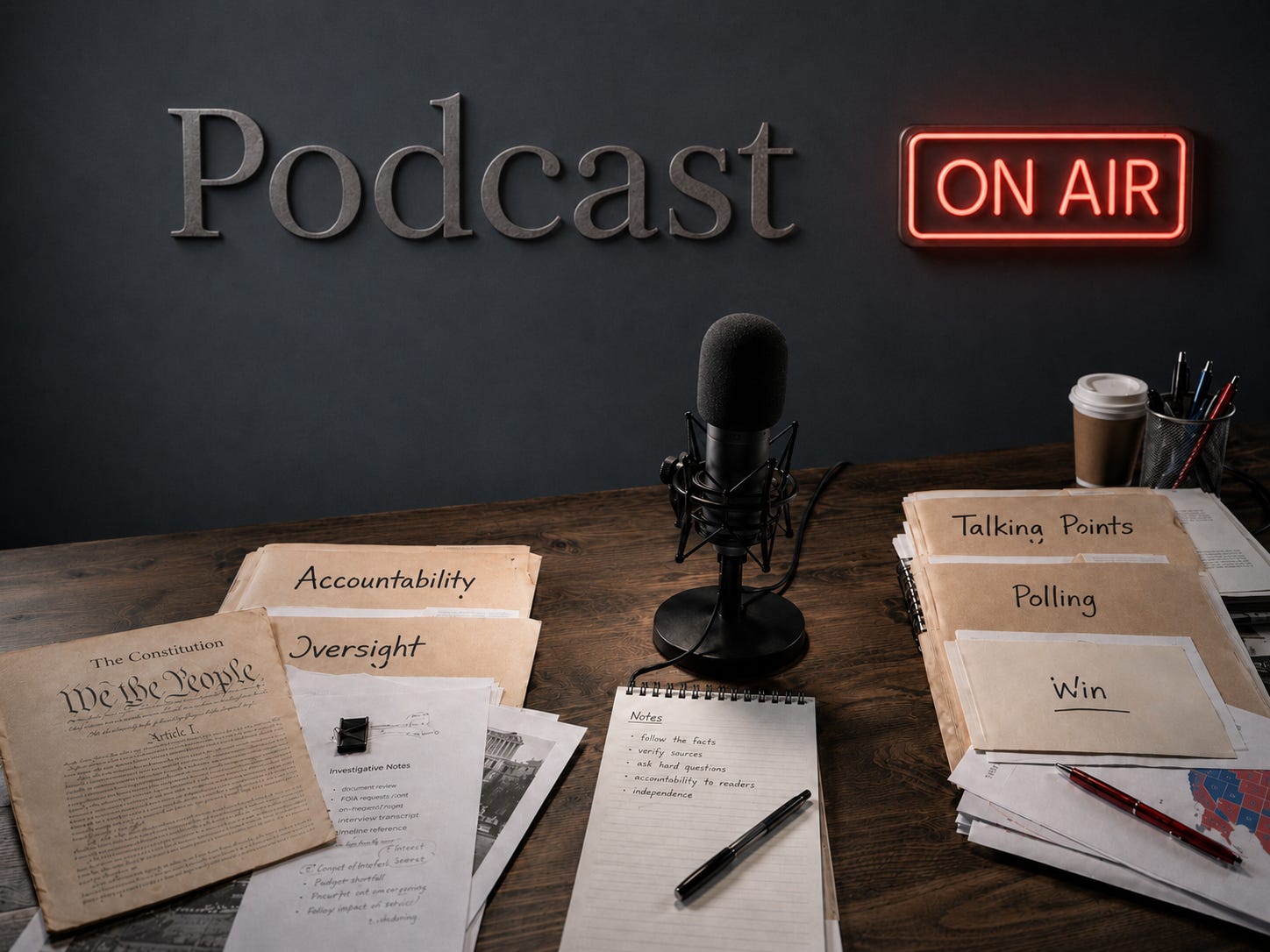
A simple thing is happening in plain sight.
Creators, streamers, influencers, Substack writers, YouTubers, podcasters, and anti-establishment commentators increasingly describe themselves as “independent media.” Many of them mean it. They are not sitting behind a cable news desk. They are not drawing a paycheck from a party committee. They are not waiting for permission from a corporate newsroom before they speak.
But listen closely when elections come up.
“We won.” “We lost.” “We need to hold the Senate.” “We have to take back the House.” “We need better messaging.” That word — we — is small, but it gives away a great deal.
It reveals where the speaker believes they are standing— not outside power, not above the field, not watching the machinery with suspicion, but somewhere inside the coalition, emotionally invested in its victories, wounded by its defeats, and tempted to treat criticism as disloyalty.
A current example is playing out on the right. A new Washington Post report on Ben Shapiro and The Daily Wire describes a conservative media company that rose inside the MAGA media ecosystem and is now facing layoffs, audience fragmentation, ideological fights, and questions about its future relevance. The point is not Shapiro personally, nor is it The Daily Wire alone. The point is the structure. Once media becomes fused to a political movement, it inherits that movement’s incentives, purity tests, fractures, and emotional demands.
That warning does not belong only to the right. It applies to every creator, outlet, streamer, writer, and commentator who claims independence while emotionally identifying with a political coalition. The danger is not simply having opinions. The danger is becoming psychologically absorbed into the coalition you are supposed to scrutinize.
That does not make someone corrupt, dishonest, a bad person, or a party operative.
What it does is raise the question that independent media cannot avoid: Independent from what?
Independence is not proven by broadcasting from a spare bedroom instead of a studio, nor by refusing a corporate title. It is not proven by criticizing cable news while recreating its tribal habits in smaller form.
Independence is a discipline, and the first discipline is knowing the difference between supporting an outcome and joining the army that benefits from it.
A person can want Democrats to win an election because the Republican alternative is dangerous. A person can want Republicans to lose because they are attacking voting rights, courts, prosecutors, immigrants, educators, civil servants, journalists, or democratic norms. That is not the problem. The problem begins when independent media stops treating the winning side as power and starts treating it as family.
Power does not become innocent because it wears your colors. It does not become harmless because it defeated someone worse. Power does not become constitutional because your audience is relieved it won.
The purpose of independent media is not to help power win. The purpose is to hold power accountable after it wins. That is the line.
Once that line disappears, independent media becomes something else. It may still be loud. It may still be entertaining. It may still be useful during elections. However, it is no longer functioning as an accountability mechanism. It is functioning as an emotional extension of a political coalition.
That is where credibility begins to die.
This Community Is Powered by You
What started as a small circle has grown into something much bigger, and it’s all because of readers like you.
Every time you forward this email, post it on socials, or bring someone new into the fold, you’re helping build one of the most passionate, independent political communities out there.
Want to keep the momentum going?
Share this newsletter with someone who should be part of this conversation.
Thank you for being here. It means everything.
The Watchdog and the Campaign Dog
There is nothing wrong with advocacy when it is honest about what it is.
Advocacy says, “This outcome is better.” Accountability says, “Now prove it.”
Advocacy says, “These people should win.” Accountability says, “Winning did not make them safe.”
Advocacy says, “The other side is worse.” Accountability says, “That may be true, and it still does not excuse concentrated power.”
That distinction matters because constitutional government is not built on trust in the right personalities. It is built on distrust of concentrated power.
The American system assumes power will reach. It assumes factions will form, ambition will dress itself up as necessity, and presidents will want more authority, lawmakers will dodge responsibility, courts will rationalize their own influence, donors will purchase access, and parties will excuse almost anything when victory is on the line.
That is why power is divided and why Congress exists. That is why courts and elections exist. That is why a free press matters.
Independent media is not Article I, Article II, or Article III. It does not pass laws, execute laws, or interpret laws. In a healthy republic, it helps the public see when those powers are being abused, sold, surrendered, or hidden. That’s why it is encoded in the First Amendment.
That role is too important to reduce to campaign reinforcement. A watchdog can understand danger without becoming a campaign dog.
It can recognize authoritarian threats without becoming a public relations shop for the opposition. It can say one side is more dangerous without granting the other side immunity. It can support an electoral result while still preparing to scrutinize those who benefit from it.
That is not “both sides.” That is constitutional accountability.
“Both sides” politics pretends all conduct is equal. Constitutional accountability asks the same question regardless of who holds office: Who has power, what are they doing with it, and who is being made to pay?
That is the terrain where independent media earns its name.
How Resistance Became a Market
The anti-Trump media ecosystem did not come from nowhere. It grew because millions of Americans saw something real happening. They saw democratic norms attacked in the open, courts pressured, prosecutors threatened, civil servants purged, watchdogs fired, journalists smeared, election workers endangered, and public agencies treated as instruments of personal power.
People went looking for voices that would say plainly what legacy institutions often buried under polite language.
They did not want another panel discussion about “controversy.” They wanted someone to say that trying to overturn an election was an attack on self-government. They wanted someone to say that political violence was not just “heated rhetoric,” that using the state to punish enemies was not normal politics.
That hunger was legitimate.
A lot of independent media rose because legacy media failed to meet the moment with enough moral clarity. People wanted alarm with receipts. They wanted constitutional seriousness, someone who would not flatten every crisis into a messaging problem.
However, every resistance movement faces the same test once it has built an audience. Does it remain loyal to the principle that created it? Or does it become loyal to the coalition that rewards it?
That is the danger now.
Being anti-Trump is not automatically the same thing as being independent. It may be necessary, even justified. It may be morally clear. However, independence is not measured only by who you oppose. It is measured by what you refuse to excuse.
Do you still question executive overreach when it comes from someone your audience voted for? Do you still scrutinize donors when they fund the candidates your side prefers? Do you still challenge Congress when it surrenders power to a president you like? Do you still defend civil liberties when the target is unpopular? Do you still ask whether working people are being served, or merely used as campaign imagery?
That is where the independent label gets tested, not during the outrage cycle, but after the victory speech.
The Real Danger Is Incentive Capture
The greatest threat to independent media is not always a check from a billionaire, a secret call from a party strategist, or an editor killing a story.
Sometimes the capture is softer than that. Sometimes nobody gives an order.
Nobody has to. The audience trains the creator. Applause becomes instruction. Subscriptions become pressure. Retweets become discipline. Invitations become rewards. Silence becomes fear.
Creators learn which criticisms grow the channel and which ones cost them followers. They learn which targets are safe and which trigger accusations of betrayal. They learn which hypocrisies the audience wants exposed and which ones it wants explained away.
Over time, a creator may still feel independent because no party boss is controlling them, but the incentive structure is controlling the room.
That is incentive capture, not dependence on a corporation, not dependence on a newsroom, but dependence on keeping the tribe emotionally fed.
This is why so many audiences are becoming skeptical. They can hear when analysis turns into reinforcement. They can tell when a commentator is following the evidence and when the evidence is being marched toward a preferred conclusion. They know when outrage is principled and when outrage is scheduled.
Working people are especially good at spotting this. They have spent their lives listening to powerful people explain why now is not the time, not the time to raise wages, to lower drug prices, to confront monopolies, to challenge donors. Not the time to criticize leadership. Not the time because an election is coming.
In modern America, an election is always coming. There is always a Senate map, a House margin, a court vacancy. There is always a messaging concern, a coalition-management problem, a reason accountability has to wait.
However, accountability delayed until after the next election usually becomes accountability forgotten.
Independent media cannot accept that bargain. If the press waits for power to be comfortable before it asks hard questions, power will never be questioned at all.
Principle Is Not Purity
This is not an argument for purity tests, nor is it an argument that every criticism deserves the same volume. It is not an argument that creators should pretend there is no difference between authoritarianism and ordinary political failure, nor an argument that people should ignore the real dangers of voter suppression, corruption, political violence, or executive lawlessness.
Serious politics requires judgment, but judgment is not the same thing as loyalty.
Independent media can make strategic distinctions without becoming strategically obedient. It can say, “This threat is worse,” without saying, “Therefore, my preferred coalition gets a pass.” It can tell the truth about one party’s extremism without becoming a shield for the other party’s failures.
That is the difference between principle and team identity.
Team identity asks, “Does this help us?” Principle asks, “Does this hold power accountable?”
Team identity asks, “Will this hurt the coalition?” Principle asks, “Is the public being told the truth?”
Team identity asks, “Can we afford to say this before the election?” Principle asks, “Can the public afford for us not to?”
Those are different missions.
The working-class reader does not need another partisan pep rally with a different logo. They do not need a livestream version of cable news. They do not need to be told that every concern must be filtered through the emotional needs of a political coalition.
They need someone to ask whether power is serving them or using them.
Is the hospital staying open? Are wages keeping up? Are schools being protected? Are courts being captured? Are rights being narrowed? Are public agencies being hollowed out? Are donors getting the meeting while families get the bill?
Those questions do not stop mattering because one party is worse than the other. In fact, they matter more when fear of the worse party is used to silence scrutiny of the better one.
That is not cynicism. That is citizenship.
When “We” Becomes a Warning Sign
The word “we” is not always wrong.
There is a democratic “we.” There is a civic “we.” There is a working-class “we.” There is a constitutional “we” that refers to the people, the public, the country, and the communities living with the consequences of power.
But there is also a partisan “we.” That version means the team.
It means the consultants, the candidates, the donors, the activists, the influencers, the aligned media personalities, and the audience all moving as one emotional formation.
That “we” is dangerous for independent media because it narrows the field of vision. It changes the basic posture from suspicion to protection. It turns criticism into a family dispute and accountability into bad timing.
Once that happens, the same conduct gets judged differently depending on who does it.
Executive overreach becomes bold leadership. Broken promises become political reality. Donor access becomes coalition building. Civil liberties concerns become distractions. Congressional cowardice becomes strategy, and ordinary people are told to be patient because the alternative is worse.
That is how principle becomes branding. That is how independent media becomes partisan media with better lighting.
The danger is not that creators have opinions. They should. A person with no opinions about democracy, corruption, rights, labor, inequality, courts, or state power has no business doing political commentary.
The danger is when those opinions harden into emotional membership, because once the coalition becomes part of the creator’s identity, criticism of the coalition feels like self-harm. And when criticism feels like self-harm, it gets postponed, softened, redirected, or buried.
That is how accountability dies quietly, not always by censorship. Sometimes by belonging.
The Higher Loyalty
Independent media needs a higher loyalty than party victory. That higher loyalty is not neutrality. Neutrality can become cowardice when democracy is under attack.
The higher loyalty is constitutional accountability.
It means Republicans must be confronted when they attack voting rights, weaponize state power, excuse political violence, undermine courts, or treat public office as personal property.
It also means Democrats must be confronted when they hide behind the language of democracy while protecting donors, avoiding hard fights, expanding executive power, dodging congressional responsibility, or telling working people to settle for symbolism instead of material change.
The standard is not equal criticism. The standard is honest criticism.
Equal criticism is arithmetic. Honest criticism is judgment.
Independent media should not count paragraphs to make sure every party gets the same scolding. It should follow power, money, and consequences. It should follow the people who are least protected when institutions fail.
Sometimes that will lead to one party far more than the other. So be it. But when power shifts, the scrutiny must shift with it. That is the job.
Independent media should make powerful people uncomfortable. It should make donors nervous. It should make consultants annoyed. It should make elected officials hesitate before assuming friendly audiences will protect them. It should even make its own audience uncomfortable when the facts require it.
If a creator cannot risk audience discomfort, they are not independent. They are doing customer service for a political mood.
That may be profitable. It may be popular. It may be emotionally satisfying. But it is not watchdog work.
The Line Worth Defending
The crisis in American media is not only that people distrust institutions. It is that many institutions earned that distrust, and many replacements learned the wrong lesson.
They saw audiences reject corporate media and concluded that the answer was more intimate partisanship.
Cable news gave people polished tribalism. Independent media risks giving them personalized tribalism. The wrapper changed. The emotional mechanism did not.
That is why the word “independent” has to be defended before it becomes a costume. It should mean more than not having a boss. It should mean more than owning the microphone, more than being willing to criticize legacy media while adopting the same habits of selective outrage, audience flattery, and coalition protection.
Independence means refusing to let any political faction own your judgment. It means saying plainly when Republicans assault democratic institutions and when Democrats avoid accountability. It means saying plainly when courts protect power rather than check it, and when Congress surrenders its authority. It means saying plainly when presidents of either party try to govern by personal will instead of constitutional process. It means remembering that the public is not served by media that helps power feel misunderstood.
The public is served by media that makes power answer. That is the mission— not to help power win, to soothe the coalition, to protect the brand, or to keep the audience comfortable. The mission is to watch the machinery after the cheering stops.
Victory is not accountability. Winning an election does not cleanse power. Defeating a dangerous opponent does not eliminate the need for scrutiny. A better outcome is still only an outcome. What matters next is what power does with the authority it has been handed.
That is where independent media must stand, at the perimeter, watching the gates, asking who is getting in, who is being kept out, and who is being asked to pay for the celebration.
If independent media starts speaking as part of political power instead of against concentrated power, it eventually stops being independent at all.
Support Independent Media
Independent media only matters if it is willing to hold power accountable after the cheering stops.
That is the work we are trying to do here at The Coffman Chronicle: not serving a party, not flattering a coalition, not telling readers what they already want to hear, but following power wherever it goes and asking who pays the price when it is left unchecked.
If you believe independent media should answer to the public instead of politicians, donors, consultants, or algorithms, consider becoming a paid subscriber.
If you can afford it, your support helps keep this work independent, reader-supported, and focused on the people too often left outside the room when power makes its deals.
Because the job is not to help power win.
The job is to make power answer.
Sources
“The Daily Wire Undergoing Round of Layoffs.” Barrett Media, May 1, 2026.
“Daily Wire Co-CEO Jeremy Boreing to Step Down.” Axios, March 18, 2025.
“Trust in Media at New Low of 28% in U.S.” Gallup, October 2, 2025.
“Inside Ben Shapiro’s MAGA Meltdown.” The Washington Post, May 9, 2026.
“Free Range.” Columbia Journalism Review, December 8, 2025.
“First Amendment.” Constitution Annotated.
“Federalist No. 51.” National Constitution Center. Originally published 1788.
“Overview and Key Findings of the 2025 Digital News Report.” Reuters Institute for the Study of Journalism, June 17, 2025.
“Outrage as a Business Model: How Ben Shapiro Is Using Facebook to Build an Empire.” Georgia Public Broadcasting, July 19, 2021.
“America’s News Influencers.” Pew Research Center, November 18, 2024.
“News Influencers Fact Sheet.” Pew Research Center, November 4, 2025.
It’s a tough job sifting through all the noise of politics. Thanks for reminding me to continue to question who, what, when & why👍