


Homeland Security Secretary Kristi Noem did not just have a bad week in Washington. She had the kind of week that ends careers.
On Tuesday, March 3, she sat for an oversight hearing before the Senate Judiciary Committee, facing pointed questions about everything from the fatal shootings of two civilians by federal officers in Minneapolis to a $220 million ad campaign plastered with her face.
On Wednesday, March 4, she went through a second round of grilling at the House Judiciary Committee, defending the administration’s mass deportation policies and her public labeling of the Minneapolis victims as “domestic terrorists.”
On Thursday, March 5, President Trump fired her.
The Associated Press and others reported that Trump announced Noem’s ouster that afternoon and said he would nominate Oklahoma Senator Markwayne Mullin as his new Homeland Security secretary, subject to Senate confirmation. Noem became the first Senate-confirmed Cabinet member to be removed in Trump’s second term, after months of controversy over deadly enforcement tactics, spending questions, and ethics stories that never quite stopped coming.
If the story ended there, this would be a straightforward piece about a political fall from grace. However, in this haunted timeline, it does not end there.
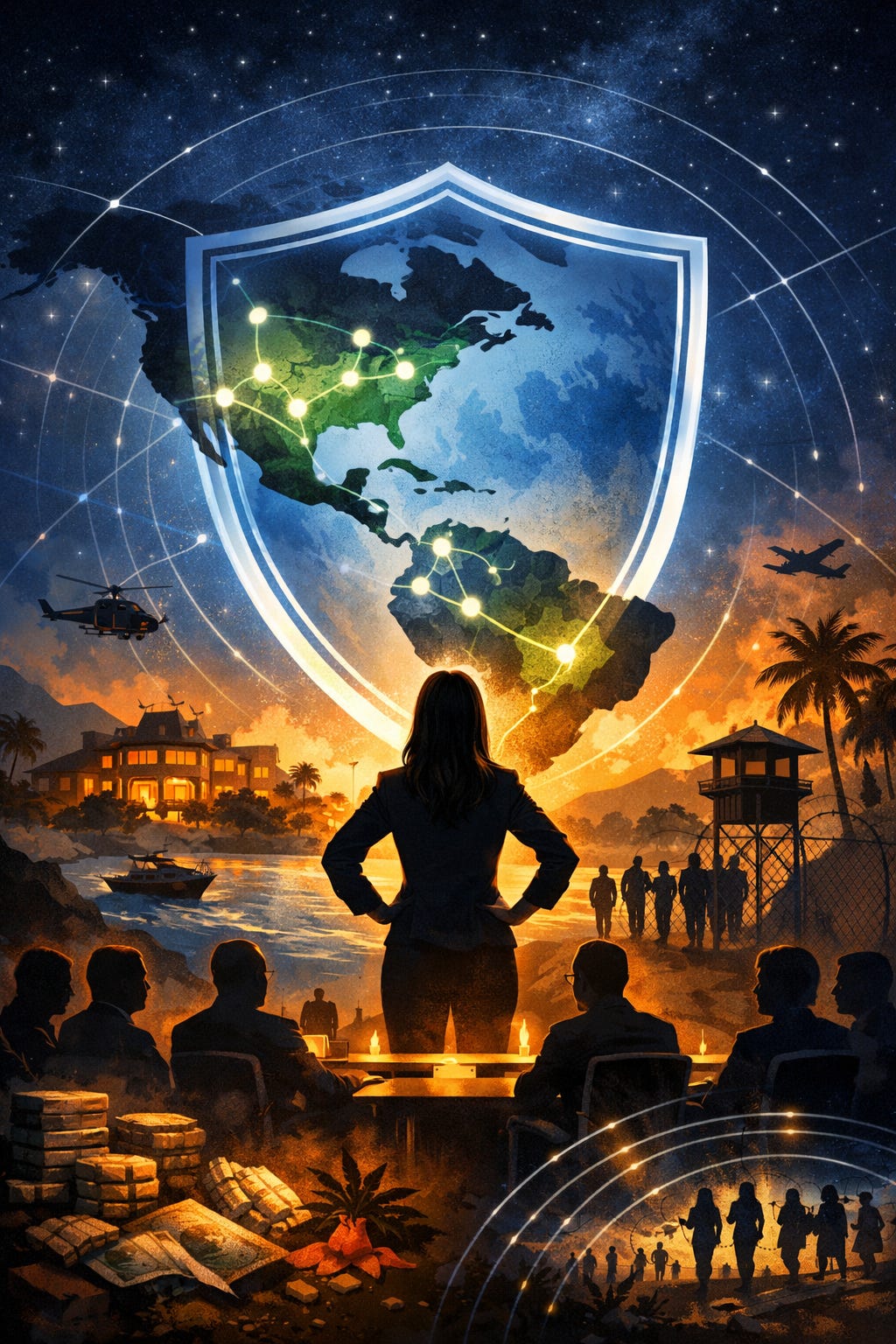
When Trump announced Noem’s removal, he also announced her promotion. She would leave DHS and become his “Special Envoy for The Shield of the Americas,” a new Western Hemisphere security initiative he plans to unveil at a summit on Saturday, March 7, at his golf resort in Doral, Florida.
The obvious next question is the one that sat in our notes in all caps: what tf is the Shield of the Americas?
This Community Is Powered by You
What started as a small circle has grown into something much bigger, and it’s all because of readers like you.
Every time you forward this email, post it on socials, or bring someone new into the fold, you’re helping build one of the most passionate, independent political communities out there.
Want to keep the momentum going?
Share this newsletter with someone who should be part of this conversation.
Thank you for being here. It means everything.
Fired, Reassigned, and Reintroduced to the Hemisphere: Cruelty, But Make It International
Formally, Noem has been removed from one job and assigned to another. The timing makes it hard to pretend that two days of hostile questioning on Capitol Hill and the firing are unrelated. Yet the substance of her new assignment tells us something more important than her personal trajectory.
Trump is not simply washing his hands of Kristi Noem. He is moving her from a domestic, Senate-confirmed Cabinet post into a looser, more political role built around a project called “The Shield of the Americas” that almost no one outside the administration had heard of before this week.
According to public statements, the White House says Shield will focus on crime, migration, and regional security in the Western Hemisphere, with particular emphasis on cartels and narco-trafficking. Trump is hosting leaders from eleven Latin American and Caribbean countries at the Doral summit and presenting this as a new phase of U.S. strategy in the hemisphere.
Before Noem’s reassignment, that summit was a line on the schedule. Afterward, Shield of the Americas suddenly looks like something larger: a branded, U.S.-led regional security project, with a handpicked guest list and a newly minted envoy.
So what exactly is being launched in Doral, and why does the invite list give off serious oh-my-vibes?
What We Knew Before Noem’s Move
Until this week, Shield of the Americas was more of a label than a program.
Local reporting in South Florida and White House announcements indicated that Trump would host a Shield of the Americas summit at Trump National Doral on Saturday, March 7, with the stated goal of promoting “freedom, security, and prosperity in our region.” Some foreign leaders had already alluded to the meeting, and Doral’s mayor says she first heard about it “a few weeks” ago in Washington, when the idea was still to hold the summit in the capital rather than at Trump’s property.
Even then, the administration had not released a detailed public blueprint. There was a name, a venue, and a broad theme. There was no clear legal architecture, no budget, and no obvious explanation for which leaders would be in the room.
That changed on March 5, when Trump announced that Noem would become his special envoy for Shield and that the first summit would happen in Doral in two days. From that moment, Shield stopped being a vague summit title and became the thing Noem is being reassigned to help build.
What Shield of the Americas Is Supposed to Be
The administration’s public description is ambitious and, so far, deliberately broad.
In its most detailed form, Shield is described as a new security initiative focused on the Western Hemisphere that will put greater emphasis on the region in U.S. national security strategy and leverage U.S. military and intelligence assets in ways not seen there since the end of the Cold War. The Doral summit is supposed to strengthen cooperation on irregular migration toward the United States, narco-trafficking and organized crime, and broader regional security, including countering foreign influence.
Trump himself has highlighted cartels and drug trafficking, promising what Noem has described as a “big agreement” on how to “go after cartels and drug trafficking in the entire Western Hemisphere.”
The timing of one specific development makes that framing more concrete: the new joint U.S.–Ecuador military operation.
On March 3, two days before Noem was fired, U.S. Southern Command announced that U.S. and Ecuadorian forces had begun joint military operations inside Ecuador against “Designated Terrorist Organizations,” described as narco-terrorist groups. It is the first publicly acknowledged land operation under Trump’s expanded anti-cartel campaign in the region, following earlier air and maritime interdictions.
If Shield of the Americas is supposed to be the political and diplomatic umbrella for a tougher regional security posture, then Ecuador looks very much like a preview of the model: a friendly government, a right-leaning president, and a U.S. military footprint on the ground to fight narco-terrorism.
Which raises the next question: who else has been invited to stand under this new shield?
Who Is in the Room in Doral?
According to the White House, the leaders of eleven countries have confirmed they will attend the Shield summit at Trump National Doral: Argentina, Bolivia, Chile, Costa Rica, the Dominican Republic, Ecuador, El Salvador, Honduras, Panama, Paraguay, and Trinidad and Tobago.
The easiest way to understand what those countries have in common is to look at who leads them.
Argentina
In Argentina, President Javier Milei has become the most prominent far-right figure in the region, known for his chainsaw antics and wild hair. He is a libertarian, radical free-market reformer elected on a promise to slash the state and tilt hard against what he calls the “political caste.” He has been openly warm toward Trump, and the Trump administration has elevated him as proof that Latin America is drifting rightward.
El Salvador
In El Salvador, Nayib Bukele has turned his country into a showcase for a harsh security model built on mass incarceration and emergency powers. International rights groups have accused his government of serious abuses, especially at the mega prison now being used to house deportees sent from the United States. Trump has repeatedly held up Bukele’s gang crackdown as an example of the toughness he wants from partners, and Bukele has leaned into that image, at one point jokingly calling himself “the world’s coolest dictator.”
Ecuador
Ecuador’s Daniel Noboa is a young, business-friendly leader who declared an “internal armed conflict” with organized crime earlier this year and invited U.S. troops to help his forces fight narco-terrorist gangs. The March 3 joint operation with U.S. Southern Command, framed explicitly as a fight against “Designated Terrorist Organizations,” is already being treated by analysts as a new phase in regional security cooperation.
Honduras
Honduras’s Nasry Asfura is a conservative who received unusual attention from Trump during his 2025 campaign. Regional observers have grouped Asfura with Milei, Noboa, Bukele, and Paraguay’s Santiago Peña as part of a new cadre of leaders sympathetic to Trump’s approach to security and trade.
Paraguay, Costa Rica & Panama
Paraguay’s Peña leads a traditional conservative party and has kept Paraguay closely aligned with U.S. preferences on issues such as recognition of Taiwan. Costa Rica’s Laura Fernández recently won on a right-leaning, law-and-order platform in a country that has historically leaned more centrist. Panama’s José Raúl Mulino campaigned on shutting down the Darién Gap migration route and has already signed new migration and security agreements with Washington.
The Caribbean: The Dominican Republic and Trinidad and Tobago
The Dominican Republic’s Luis Abinader is generally seen as a pro-business, anti-corruption centrist or center-right, with a firm line on migration from crisis-hit Haiti. Trinidad and Tobago’s Kamla Persad-Bissessar does not slot neatly into the Latin American right, yet her government has become one of Washington’s more enthusiastic partners on security cooperation and regional operations in recent months.
Chile
Chile offers a special case. The figure associated with Doral is José Antonio Kast, the president-elect who will take office on March 11. He is widely described as a far-right or ultra-conservative politician with a nostalgic view of the Pinochet era and a strong law-and-order, anti-immigration platform. The summit is scheduled for the weekend immediately before he is sworn in, which helps explain why Trump would rather invite Kast than the outgoing government.
Taken together, this is not a random slice of the Americas. It is a cross-section of governments Trump already knows he can work with: far-right populists, security hawks, and pro-U.S. economic partners, with a few pragmatists who are exceptionally open to U.S. military and migration deals.
That casts the most interesting light on the countries that are not in the room.
Do the Invitees Match Shield’s Stated Goals?
Trump world has offered several overlapping justifications for Shield of the Americas. It will be about migration. It will be about cartels and narco-trafficking. It will be about Chinese influence in the hemisphere. It will be about “freedom, security and prosperity.”
These are real problems. The question is whether the Doral guest list lines up with them.
Migration
If Shield is primarily a migration initiative, the absence of Mexico is very hard to explain.
For years, U.S. border and asylum policy has depended on deals with Mexico, which serves both as an origin country for migrants and as the key overland corridor for people from Central and South America and beyond. It is almost impossible to talk seriously about migration to the United States without Mexico in the conversation.
Yet Mexico is not part of Shield’s first summit, even as smaller countries to its south are. The White House has not offered any public rationale for that choice.
The absence of Haiti and Venezuela deepens the mismatch. Haiti’s political and security collapse has contributed to displacement through the Caribbean and toward the United States, while Venezuela’s ongoing crisis has produced one of the largest displacement flows in the region. Both are central to the migration story, yet neither government is part of the Doral launch. In Haiti’s case, the transitional governing mandate has expired with no clear successor, leaving the country in limbo. In Venezuela’s case, the administration is in the middle of a delicate transition period after the removal of Nicolás Maduro, and Washington is still negotiating what that transition should look like.
Shield may well have something to say about migration. However, the initial roster does not appear to be a map of the region’s main migration nodes.
Narcotrafficking
If Shield is instead understood first as a new counternarcotics architecture, the gaps move north and west.
Colombia has been at the center of the U.S. anti-drug strategy for decades. Venezuela sits at a crucial junction for trafficking networks and is a constant reference point in U.S. “narco-terror” rhetoric. Neither one is at Doral.
By contrast, invited Ecuador has just become the site of the first land-based U.S. anti-cartel operation announced under Trump’s expanded campaign. That does not make Ecuador an odd choice. It makes it a very logical one. It does, however, reinforce the sense that Shield is being built around willing partners rather than around a comprehensive list of every state that matters for drug production and trafficking.
Chinese Influence
If the central concern is Chinese influence, another pair of absences stands out.
Brazil is the largest country in South America and one of China’s most important partners in the region. In early February, Brazil was considering pushing for Mercosur to open trade talks with China, underscoring the depth of that relationship.
Peru, which also did not make the Doral list, hosts the Chinese-financed Chancay megaport and has deep historical and economic ties to China, including a longstanding Chinese diaspora.
If Shield were primarily a counter-China forum, excluding those two countries would be baffling. Seen as a meeting of leaders who are already closer to Washington or at least willing to hedge away from Beijing, the selection makes more sense.
Hemispheric Security
Finally, if Shield is meant to be a sweeping security project across the Western Hemisphere, the map has even larger holes.
Canada is not part of the summit, despite Trump’s frequent claims that drugs cross the northern border. Mexico is not part of it, despite its centrality to both security and migration. Brazil, Colombia, Peru, and Venezuela are all absent, even though each one is central to some combination of regional crime, trade, or diplomacy.
As a “shield of the Americas,” the initial structure looks less like a hemisphere-wide system and more like a ring of selected governments.
A Plausible Explanation: A First Circle, Not a Final Map
It is important to be honest about what we do not know. The White House has not published a charter for Shield of the Americas, nor has Congress debated any authorizing statute. Much of this is still being fleshed out behind closed doors, and we are working from public reporting, official statements, and the fact of who has been invited.
With that caveat, one explanation fits the facts better than the official talking points.
Shield looks less like a neutral gathering of the countries most relevant to migration, narcotrafficking, or Chinese influence, and more like an early coalition of leaders Trump considers ideologically compatible, politically reliable, or unusually open to U.S. security and trade deals.
The pattern across the invite list is a tilt toward right-wing or security-hardline governments such as Argentina under Milei, El Salvador under Bukele, Ecuador under Noboa, and the soon-to-be Chile under Kast; conservative or pro-business leaders in Paraguay, Costa Rica, the Dominican Republic, and Panama who have already signaled a willingness to cooperate with Washington; and a pragmatic outlier such as Trinidad and Tobago, whose government has recently leaned into expanded security cooperation with the United States.
The choices around countries in transition are also telling. Haiti and Venezuela, which are in the middle of unstable and contested transitions, are absent. Chile, which is about to undergo an orderly, ideologically favorable transition, is represented by its president-elect. That suggests the rule is not “no countries in transition,” but rather “no transitions we do not trust.”
It is possible that this is exactly what it looks like: Trump starting with the governments he already trusts or believes he can move quickly, then planning to approach the missing heavyweights later if Shield can claim some early successes.
That would also explain why this is happening in Doral rather than under the umbrella of the Summit of the Americas, the established hemispheric leaders’ forum for which the Organization of American States serves as the technical secretariat. A bespoke summit at a Trump-owned resort gives the administration far more control over the room, the agenda, and the optics, and has already revived familiar conflict-of-interest questions, though those are secondary to understanding the initiative itself.
In other words, Shield of the Americas may not be the final map. It may be the first circle. For now, that circle is said to be focused on security. Whether that is the ultimate goal remains to be seen, and is no doubt causing concern in the leadership of the nations not invited.
One senior aide even framed Shield as part of what they now call the “Donroe Doctrine,” a Trump-branded revival of the 1823 Monroe Doctrine that treats almost any foreign footprint in the hemisphere as a threat to U.S. primacy. The name sounds like a tabloid joke because, originally, it was. The content is less funny: a claim that Trump’s second term is asserting a kind of hemispheric veto, with Shield of the Americas as one of its tools.
Where Does This Leave Kristi Noem?
All of this brings us back to the person who turned Shield of the Americas from a little-noticed summit into a national story.
Noem just experienced what looks, from the outside, like a classic Washington fall. She endured two bruising days of oversight hearings. She lost her Cabinet job after bipartisan criticism and open talk of impeachment.
Yet she has not been exiled from Trump’s security and immigration agenda. She has, instead, been reassigned to an initiative aimed at extending that agenda across the hemisphere.
The administration has not issued a detailed description of what a “Special Envoy for The Shield of the Americas” will actually do. Envoys of this kind usually serve as senior presidential representatives, cutting across agencies and dealing directly with foreign governments on a particular set of issues. Based on the reporting so far, that issue set will look very familiar: migration, international narcotrafficking, and security cooperation with partners willing to sign on to Trump’s version of hemispheric order.
Shield may give her a broader geographic scope and fewer statutory guardrails. It does not move her away from the core fights that defined her time at DHS.
If Shield of the Americas is, in fact, the early stage of a selective security coalition, then Kristi Noem’s story is not just one of impeachment scares and hearings gone wrong. It is the story of a political figure being shifted from the domestic frontline of Trump’s immigration crackdown to a new, outward-facing role within the broader project.
The personnel move and the initiative launch are not separate stories. Taken together, they are the first clear signal that the administration is trying to take Trump’s hard-edge vision for immigration and security and organize a group of willing governments around it.
Whether that experiment becomes a true hemispheric framework for security or remains a club of the like-minded is the question that will linger long after the Doral photo-ops are over.
If you want more coverage that connects the dots between Hill hearings, quiet summits, and the people driving them, subscribe to support this work. We’ll keep following Shield of the Americas and what it means for U.S. politics long after the Doral photos disappear.
Sources:
“Trump fires Kristi Noem as homeland secretary after storm over shootings, spending.” Reuters, March 5, 2026.
“What is the ‘Shield of the Americas,’ Trump’s new security initiative in the Western Hemisphere?” Associated Press via WLWT, updated March 5, 2026.
“Trump to meet Latin American leaders at security summit in Doral: WH.” NBC 6 South Florida, March 4, 2026.
“What Is ‘Shield of the Americas’? What We Know About Kristi Noem’s New Role.” Newsweek, March 5, 2026.
“What is ‘The Shield of the Americas’ that Kristi Noem will serve as envoy to?” The Independent, March 5, 2026.
If this administration thinks that the 200+ years old monroe doctrine is going to be welcomed here in Colombia, where I live, and other South American countries, they are mistaken.
What is her new job—ambassador to Epstein Island?