


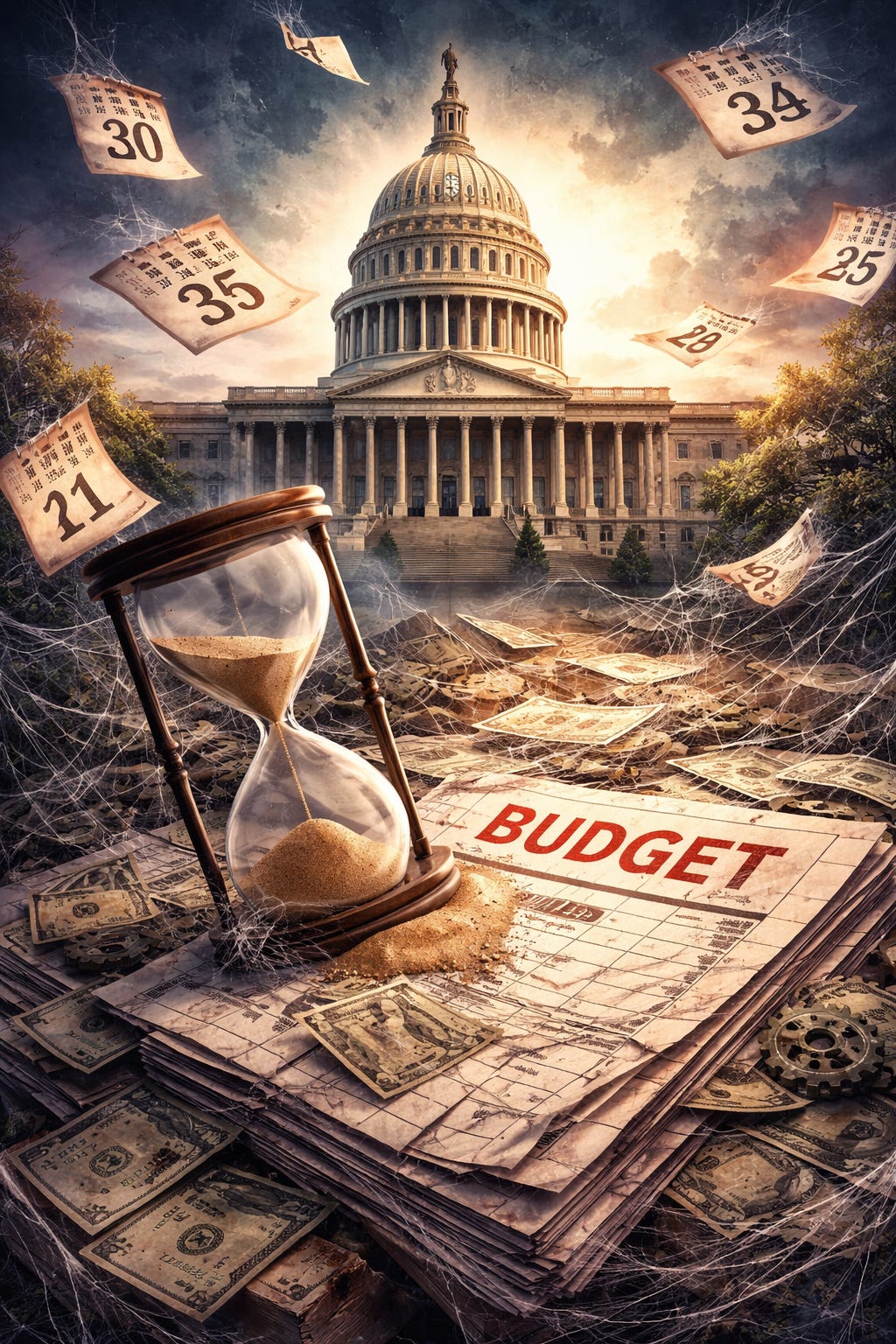
As this year draws to a close, North Carolina still has not finalized its state budget. The fiscal year began months ago, and while negotiations have continued intermittently, there is now a growing expectation that a new budget may not be enacted before the end of the calendar year.
This is not a government shutdown. In North Carolina, the previous budget continues in effect until a new one is signed into law. Agencies remain open, employees continue to work, and services continue to be delivered. On the surface, the state appears to be functioning normally.
That quiet continuity is precisely the point. When the most visible consequences of a missed deadline are absorbed automatically, delay stops feeling like a failure and becomes a tolerable option. Over time, it becomes something closer to the default.
North Carolina’s situation is not unique, but it is illustrative. It shows how a system can technically operate while the underlying obligation to govern on time quietly erodes.
Want to Know Your Rights?
Download a free digital copy of the U.S. Constitution, the same document Trump is trying to bulldoze. Learn exactly what he’s breaking, and how to fight back.
80,000+ strong — and counting.
This holiday, become a paid subscriber for just $1 a week and help us keep the truth alive.
Join The Coffman Chronicle — $1/Week
This Is Not an Isolated Case
North Carolina is not alone in struggling to pass a budget on schedule. Pennsylvania offers one of the most recent and consequential examples. This year, Pennsylvania’s budget was passed more than four months after the constitutionally required deadline. During that delay, counties were forced to take out short-term loans to remain operational. School districts, libraries, and nonprofit service providers faced uncertainty and delayed payments. Programs continued only when local entities absorbed the financial risk.
Other states have experienced late budgets as well, sometimes resolving them more quickly, sometimes not. The details vary. What does not vary is the trend. Budget lateness is no longer rare. Instead, it is increasingly routine.
The fact that these delays do not always produce dramatic shutdowns has helped normalize them. The absence of spectacle has obscured the presence of harm, at least on the surface.
Different Systems, Different Consequences
One reason budget delays are difficult to discuss coherently is that “no budget” does not mean the same thing in every state. The legal and procedural consequences vary widely.
In North Carolina, the continuation of the prior budget prevents immediate disruption. The tradeoff is that there are no inflation adjustments, no program expansions, and no ability to respond meaningfully to emerging needs. Over time, this produces erosion. Costs rise while funding remains static, and agencies are asked to do more with less without ever formally acknowledging the gap.
California offers a sharply different model. After a 2010 constitutional change, California lawmakers lose their pay and daily living allowances for each day the budget is late. Late budgets still occur, but they are far less frequent and typically far shorter. The difference is not political harmony or simplicity. California is large, complex, and polarized. While a few other states have hard deadlines for late budgets, California is one of the few that have seen improved timing outcomes. The difference is that missing the deadline has direct, personal consequences for those responsible for meeting it.
Texas represents a third structure. With a biennial legislature and long gaps between sessions, Texas relies heavily on executive discretion when legislative action stalls. Agencies continue operating, but decisions about timing, prioritization, and cuts increasingly shift to the executive branch. Power does not disappear when a legislature fails to act. It moves.
These systems are outliers in different directions, but together they illustrate a broader pattern. Where consequences are weak or indirect, delays persist. Where consequences are personal and automatic, deadlines matter.
Where Most States Actually Fall
Most states operate somewhere between these models. Many rely on temporary appropriations, partial funding measures, or short-term fixes when budgets are late. Very few impose direct penalties on lawmakers. Almost all shift the immediate costs of delay away from legislators themselves.
When deadlines are missed, it is agencies that freeze hiring, local governments that borrow to cover cash flow, and service providers that reduce hours or programs. The burden is externalized downward, away from the people with the authority to resolve the impasse.
This is not an accident of design. It is the predictable outcome of systems that rely on political pressure rather than enforceable consequences.
Who Pays When Budgets Are Late
Across different systems, the people most affected by late budgets share a common trait. They are dependent on state funding and lack meaningful leverage over the budget process.
In Pennsylvania, that meant counties and school districts taking on debt to bridge the gap. In North Carolina, it means public workers and service recipients absorbing the long-term effects of inflation and frozen funding. In Texas, it can mean quiet program cuts or reallocations decided administratively rather than through open legislative debate.
In every case, the harm is borne by those least able to force resolution. Budget delays are not neutral. They redistribute risk and instability onto populations with the fewest tools to respond.
The Federal Context: How Delay Became Normal
The same dynamic is visible at the federal level. The United States Congress has increasingly relied on continuing resolutions, or CRs, to fund the government temporarily when full appropriations bills are not enacted on time. What began as an emergency measure has become routine. Many fiscal years now begin under a CR. Omnibus bills, often hundreds or thousands of pages long, replace the regular passage of individual appropriations.
The federal budget crisis did not emerge overnight. It is the cumulative result of eroded institutional norms and guardrails that once enforced timely action. As partisan polarization intensified, the budget increasingly shifted from a tool of governance to a tool of ideological signaling. In that environment, delay became survivable and then strategic.
For much of American history, the federal budget was not passed as a single, comprehensive package. Individual appropriations moved through committees responsible for specific agencies, and lawmakers debated funding decisions in discrete, domain-specific pieces. The process was slow and often contentious, but it was legible. Members went on the record for funding or cutting particular programs, and missing deadlines carried political cost.
That structure began to change in the mid-1970s, when Congress adopted a centralized budget process intended to bring greater coherence and fiscal control. The reform was designed to improve transparency and strengthen congressional authority over spending. It did not include enforcement mechanisms for missed deadlines and relied heavily on institutional norms. Over time, as polarization increased and those norms weakened, the centralized process made it easier to delay, bundle decisions, and obscure tradeoffs that would once have been debated openly.
Continuing resolutions softened the consequences of missed deadlines. Omnibus bills provided cover for opaque tradeoffs. Over time, the exception hardened into routine.
From Governance to Ideological Signaling
As polarization deepened, the incentives surrounding the budget changed. Passing a budget quietly no longer offered much political reward. Fighting over it did.
Budgets became vehicles for ideological wins rather than instruments of stewardship. Delay signaled resolve, brinkmanship demonstrated loyalty, and compromise became suspect. In that environment, delay was no longer a failure. It was a feature.
This shift also hollowed out the committee system. Committees exist to apply subject-matter expertise, manage interdependent systems, and make incremental adjustments grounded in reality. Crisis-driven budgeting centralizes power instead, sidelining expertise in favor of leadership-driven negotiations conducted under artificial deadlines.
The result is volatility rather than stability. Large funding swings driven by majority status replace incremental change. Agencies are asked to absorb shocks they were never designed to handle.
Why Committees and Guardrails Matter
Government programs exist because real problems persist. The people who rely on those programs do not disappear because a new priority emerges or a different ideology takes hold. Committees serve as a reminder of that continuity. They exist to ensure that expertise, institutional memory, and system-level interdependence remain part of the decision-making process.
When committees are bypassed, budgets stop reflecting reality and start reflecting dominance. Needs are treated as negotiable abstractions rather than ongoing obligations. Essential functions are starved to fund symbolic priorities. Over time, the system weakens, even if individual wins feel satisfying in the moment.
The Cost of Normalized Dysfunction
This is not a story about one party or one state. It is a story about incentives replacing norms. When missing a deadline carries no consequence, delay becomes rational. When delay becomes routine, governance shifts toward crisis management. When crisis becomes constant, accountability dissolves.
Budgets are not ideological manifestos. They are maintenance documents for complex, interdependent systems. When governance stops being boring, predictable, and precedented, it stops functioning. The costs are not borne by those who miss the deadlines. They are borne by the public, quietly and repeatedly.
What North Carolina shows is not a unique failure. It shows what happens when delay becomes acceptable and when guardrails fade. It shows how dysfunction becomes the system, not through collapse, but through normalization.
And once that happens, the hardest thing is to remember that it does not have to be this way.
Don’t let the bastards sneak anything past you. Subscribe and get your daily dose of rage and receipts delivered fresh, before the spin doctors can scrub it.
Sources:
NC legislature likely done for 2025 without budget, Medicaid agreement - WUNC (Oct. 22, 2025)
Is a late state budget unusual for NC? Why and how it’s happened before - News Observer (Sept. 2, 2025)
North Carolina still hasn’t passed a budget. Now it’s affecting Duke - Duke Chronicle (Oct. 6, 2025)
More than 100 days after the deadline, North Carolina General Assembly has not passed budget - The Daily Tarheel (Oct. 27, 2025)
No new NC budget likely until at least 2026, as GOP leaders adjourn - WRAL (Oct. 22, 2025)
Governor Stein criticizes legislature’s budget delay, urges focus on veterans’ support - WCTI12 (Nov. 1, 2025)
North Carolina’s budget deadlock - Axios (Sept. 8, 2025)
General Assembly “mini budget” carves chunks out of health and human services spending - North Carolina Health News (Aug. 1, 2025)
What is the NC budget process and why 2025 is delayed - NC Local (Oct. 29, 2025)
135 days late, $50.1 billion Pennsylvania budget earns bipartisan support - Penn Capital Star (Nov. 12, 2025)
City & State’s 2025-26 Pennsylvania state budget tracker - City & State PA (Nov. 12, 2025)
Belt tightening is underway for libraries, foster care, and more as Pa. budget sits unfinished - Spotlight PA (Aug. 20, 20250)
Pennsylvania education administrators sound alarm over state budget impasse that froze millions for schools, teachers - WHYY (Oct. 16, 2025)
Governor Shapiro Signs 2025-26 Budget into Law that Cuts Taxes for Working Families, Addresses Critical Workforce Needs, Makes Historic Investments in Education, and Delivers for Pennsylvanians - PA.gov (Nov. 12, 2025)
Pennsylvania budget impasses - Wikipedia
Congressional Budget and Impoundment Control Act of 1974 - House History (Jul. 12, 1974)
Congressional Budget and Impoundment Control Act of 1974 - Wikipedia
Primer: The Federal budget process - Concord Coalition (Oct. 31, 2025)
The Impoundment Control Act of 1974: Background and Congressional Consideration of Rescissions - Congress.gov
Federal budget process overview (budget calendar)
https://www.nvfc.org/the-federal-budget-process-fact-sheet/Changes Legislative Vote Requirement to Pass a Budget From Two Thirds to a Simple Majority. Retains Two-Thirds Vote Requirement for Taxes. Initiative Constitutional Amendment. - Legislative Analyst’s Office (Jul. 15, 2010)
Interesting and scary. Is there something that can be done about it to prevent it?
(Please Share 🎄 Merry Christmas and Happy Holidays!)
🌟 “The Manger, the Map, and the Mercy Parade” 🌟
On Christmas Day night, in a town packed tight,
no room, no warm bed, not a candle-lit light.
So love found a barn with a straw-scented floor—
and Hope came in crying… then opened a door.
Now picture that door (as the years tumble on),
for families still travel till dusk becomes dawn.
With toddlers and bundles and prayers in their sleeves,
they’re chasing one thing: a safe place to breathe.
And Pope Leo calls out, “Be welcoming—please!”
Not walls made of fury, but bridges of peace.
With pastors and rabbis and imams who say:
“Compassion grows neighborhoods—day after day!”
For kindness is practical—yes, that’s the surprise:
it lifts up our spirits and brightens our eyes.
A newcomer bakes bread! A young nurse takes a shift!
And whole little towns get a marvelous lift.
So hush all the shouting, the papers-and-scowl—
don’t turn law into hardness, don’t turn power foul.
When cruelty comes stomping in raid-after-raid,
we choose the brave mercy our forebears once made.
No “ICE-cold” routines where the human gets missed—
let due process be honored, let families exist.
Let clergy stand steady, let neighbors stand too,
and meet fear with the doing of what’s right and true.
And overseas, where the sirens still call—
in Ukraine’s cold trenches, in Gaza’s torn wall—
may leaders lay weapons and listen, and then
let children see mornings as children again.
So light up your feed like a lantern at night—
share truth, share compassion, keep justice in sight.
Because Christmas means Love that won’t stay in one place—
it walks into crowds… with a warm, open face. 🎄🕊️📣
#ResharingBrigade #GrandparentsForTruth #IndyMedia #ProDemocracy #SupportUkraine #SupportPalestine #SupportAfghanVets#PeoplePoweredPolicies