


You don’t prepare for a controlled burn unless you’re planning to light something on fire.
In wildfire management, a controlled burn is deliberate. It’s a calculated risk. Before a single match is lit, teams gather, authorities are alerted, crews are positioned, gear is stockpiled, and containment lines are set up, not because something is burning but because they’re about to make it burn.
So when leaks and unnamed officials reveal a Pentagon plan to create two federally coordinated “Quick Reaction Force” hubs for domestic unrest—one in Arizona and one in Alabama—we should all be asking the same thing:
What are they planning to ignite?
These are not disaster relief stations. They aren’t FEMA bases or flood response outposts. These are militarized staging areas, each hosting 300 National Guard troops on constant rotation, drawn from states across the country, trained, equipped, and waiting for civil unrest.
It’s a system built not for prevention, but for containment.
And if it sounds like overreach, that’s because it is.
This post isn’t about conspiracy. It’s about connecting the dots between a vague federal plan, the quiet militarization of civilian life, and the disturbing pattern of governance by force rather than by service.
If you’re preparing to use troops against your own people, the real emergency isn’t the unrest; it’s the system that plans for it.
Because democracy doesn’t defend itself, and neither does your sanity. Subscribe here to keep your eyes open and your sarcasm sharp.
What We Know About the Plan
The proposal, as reported by The Washington Post, The Guardian, and others, is deceptively simple on the surface: create two “Quick Reaction Force” hubs made up of National Guard troops ready to deploy within one hour to civil unrest events anywhere in the country. The information comes not from the Pentagon directly, but rather from a leak and unnamed officials, citing predetermination files from July and August. Notably, the Pentagon has not denied the plan, nor have they released additional information.
Here’s what we know so far:
The plan calls for 600 total troops, divided into two 300-person teams.
The eastern hub would be stationed in Alabama; the western hub in Arizona.
These troops would rotate through on 90-day assignments, drawn from Guard units across multiple states.
Participating states listed so far include: California, Illinois, Maryland, Michigan, Mississippi, Missouri, Nebraska, New Mexico, North Carolina, North Dakota, Pennsylvania, South Carolina, and Tennessee.
There’s no clear explanation for how states are selected or how many troops each must provide.
There’s no published oversight structure, no public documentation on rules of engagement, and no evidence of formal governor consent despite troops being pulled from state-controlled forces.
The stated purpose is to be ready to respond “within one hour” to outbreaks of civil unrest despite the fact that these hubs are hundreds to thousands of miles away from most of the country’s population centers.
What’s more, this isn’t being rolled out by FEMA or Homeland Security. It’s being led by the Pentagon.
This isn’t a public safety measure. It’s a military staging initiative.
And the fact that it’s happening without public hearings, gubernatorial coordination, or legislative approval should concern everyone—left, right, or center.
Why This Doesn’t Make Sense Unless You Expect Unrest
At face value, the plan doesn’t hold up to basic scrutiny. The math, the geography, and the logistics all break down quickly.
Let’s start with the numbers.
The plan is for 600 troops to be split between two hubs. That’s 300 in Alabama and 300 in Arizona, tasked with covering half the country each. In a true emergency, that force is barely scalable to a single major metro area, let alone a coordinated national crisis. Yet the government is calling it a “rapid response capability.”
Even the “rapid” part is questionable. Say unrest breaks out in Minneapolis. The western hub in Arizona is over 1,500 miles away. By the time those troops are in the air, landed, staged, and coordinated with local authorities, “rapid response” is 12 to 24 hours behind the news cycle.
Meanwhile, Minnesota already has its own National Guard. So do Iowa, Wisconsin, North Dakota, and Illinois. In fact, every state already has Guard units trained and ready for domestic deployment. There’s no need to fly troops across the country unless you’re trying to federalize control and sidestep local decision-making.
Then there's the cost.
The logistics of long-distance troop deployments aren’t cheap. Moving personnel, gear, vehicles, and command staff to sit in standby mode, doing nothing, until something happens, is spendy. If the government can afford this, why can’t it fully fund FEMA, SNAP, Medicaid, or public housing?
Which brings us to the uncomfortable truth: This only makes sense if someone, somewhere, is expecting something big.
Either the government has intelligence pointing to massive unrest, possibly tied to militia activity, political violence, or an electoral crisis—or…
They’re preparing for the backlash to their own future actions.
Because you don’t set up cross-country riot suppression unless you believe the public might soon have reason to riot.
If It’s About Extremism, Why Gut the Intel?
If this plan is really about readiness, about confronting real threats like extremism, militia violence, or domestic terrorism, then here’s the obvious question: Why is the federal government actively dismantling the very agencies and programs that track those threats?
In the last seven months, we’ve seen a systematic deprioritization of domestic extremism across multiple federal agencies:
The FBI has scaled back its focus on white nationalist groups and militia networks, despite identifying them as the #1 domestic terror threat just a few years ago.
DHS has dismantled or sidelined offices designed to track disinformation, election interference, and hate group organizing.
Civil rights divisions at the DOJ—responsible for investigating hate crimes, police abuse, and political violence—have been underfunded, weakened, or politically neutered.
Annual domestic terror reports have been delayed or sanitized, stripping language about far-right violence, white supremacy, or Christian nationalism.
If the federal government is truly worried about violent uprisings or extremist threats, why are they silencing the very tools that could detect and stop them?
See some our previous reporting on these changes here:
Note: This article is more than 45 days old and now lives in our archive. Consider becoming a paid subscriber for exclusive perks including full access to our nearly 900 articles.


One possible answer is that they’re not really worried about those groups.
Instead, they’re worried about you and what happens when the public decides to resist.
And there is plenty to resist. We report on it daily: Voter suppression and gerrymandering, mass deportations and DEI crackdowns, climate inaction and science suppression, executive overreach and congressional antics, tariffs and rising costs, civil rights erosions and normalization of authoritarianism. Honestly, what isn’t there to resist?
The enemy, in this framework, isn’t the violent militia camp. It’s the city protest, the labor strike, the sit-in, and the mass march.
And when you silence the warnings about real extremist violence, but build a standing force to suppress civilian unrest, the intent becomes clear.
You’re not preparing for danger. You’re preparing to suppress dissent.
Political Implications: Location, Secrecy, and Control
When a national plan doesn’t make sense logistically, legally, or financially, it’s time to ask what it does make sense as.
In this case, it makes perfect sense as a political operation.
The Hub Locations: Arizona and Alabama
These aren’t random choices, and they’re certainly not central to the regions they’re meant to cover. If you were trying to rapidly respond to unrest from Montana to Maine, you'd put your forces in Kansas or Ohio, not on the southern edge of the country.
However, Arizona and Alabama do have one thing in common: they’re both red states with conservative governments that won’t question federal troop deployments. They’re also both close to flashpoints:
Arizona sits near the border, where immigration crackdowns and potential deportation waves are expected.
Alabama sits near historical and contemporary centers of civil rights activism, labor organizing, and abortion resistance.
These aren't logistics choices. They’re control staging zones.
The Secrecy
The Pentagon dropped this bombshell with apparent little preemptive planning. There were no public hearings, governor briefings, or congressional debates. There was just a Pentagon plan, quietly advanced through internal channels and media leaks.
Even the list of participating states is incomplete and unexplained. Some states are contributing troops. Others aren’t. There’s no published formula, no rotation guidelines, and no transparency about how long this force will exist or who ultimately commands it.
What It Really Is
This is a federally controlled force, detached from state accountability, pre-staged in politically friendly territory, with no oversight, no clear rules, and a mission focused on suppressing civil unrest.
It doesn’t respond to wildfires, floods, hurricanes, power outages, or pandemics.
It responds to you if you dare to protest.
The Math Doesn’t Add Up Unless You’re Gaming It
On paper, this force should be easy to build fairly. The math is simple. 600 total troops, drawn from the National Guard forces of all 50 states.
That’s 12 troops per state, barely a dent in even the smallest Guard unit. For comparison:
California has over 20,000 Guard troops.
Vermont has around 2,500.
Even a dozen troops from Vermont would represent just 0.5% of their force.
So why isn’t every state contributing?
Instead, the plan pulls troops from a selective, uneven group of roughly 15 states, many of them either GOP-aligned or historically compliant with federal National Guard deployments. It does not appear to favor more populous states, those with larger National Guards, or those closest to the proposed hubs. The list includes California, but excludes states like Massachusetts, Washington, and New Jersey. There’s no public explanation for this draw, no stated criteria, and no proportional formula.
Two-Track Strategy: Favor Some, Drain Others
This isn’t a contradiction; it’s a strategy.
Some states are protected by exemption. Others are weakened by overuse.
The imbalance is the point.
Red states may be spared heavy participation, keeping their forces intact for local emergencies, elections, or border operations.
Blue or swing states, especially those with robust protest activity, may be tapped more heavily, removing troops from their communities under the guise of "readiness."
This creates a system where the administration can quietly tip the scales, undermining state-level readiness without firing a shot.
Political Leverage Disguised as Logistics
If the federal government wanted to:
Undercut emergency capacity in a disfavored state,
Deter protest planning in high-risk cities,
Or shift Guard loyalty from governors to federal command…
All they’d need to do is tweak the rotation quotas, privately, silently, and without oversight.
If this were really about protecting everyone, you’d ask everyone to contribute, fairly and proportionally. However, if you're only pulling from some states, it’s not a national force. It’s a political one.
The Price Tag They’re Not Talking About
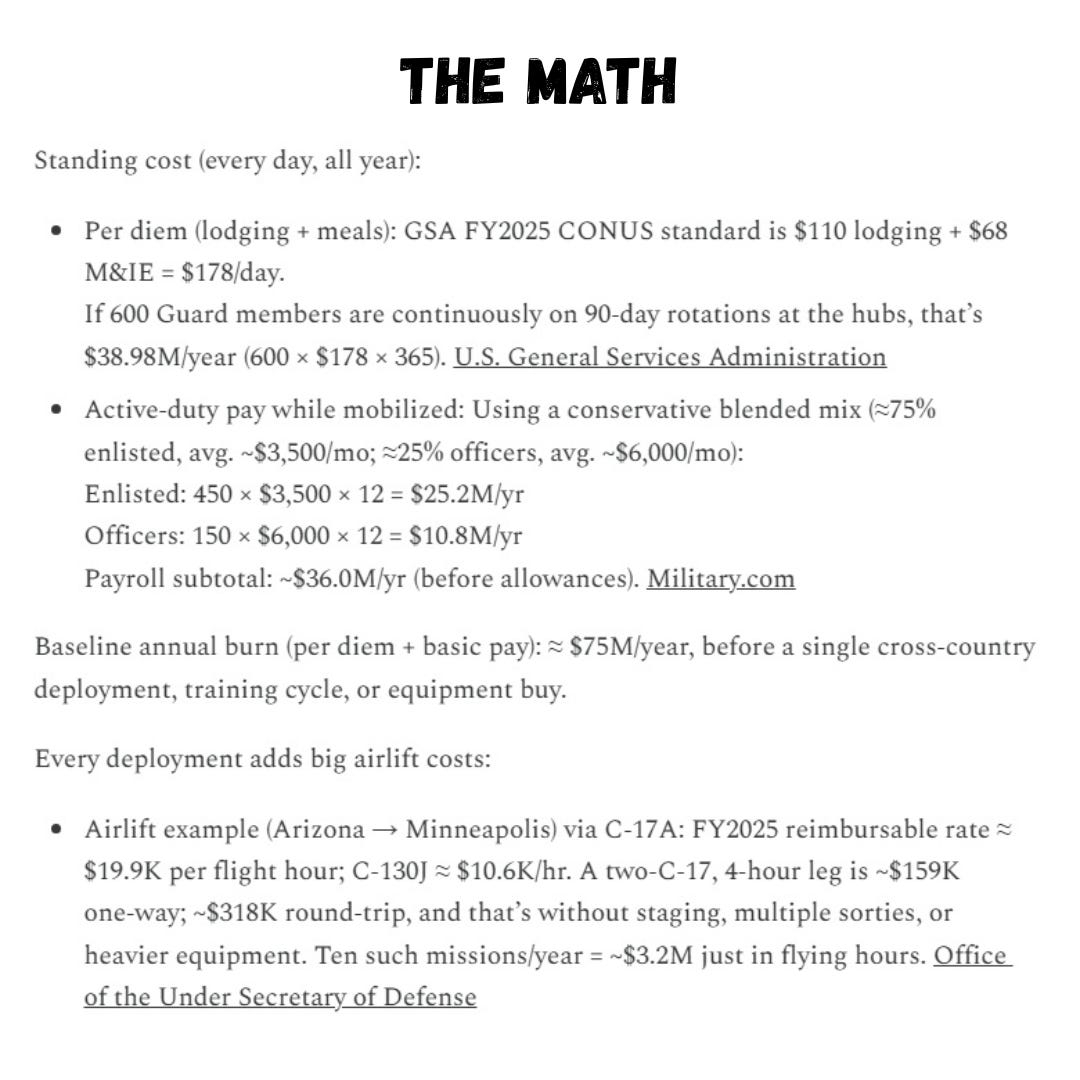
Then there is the fiscal reality. The leaked planning documents point to a baseline cost of at least $75 million a year just to keep these hubs running before any deployment, training cycle, or new piece of riot gear. That’s the cost of paying, housing, and feeding 600 Guard members on permanent rotation.
Once you add transportation, airlifts, specialized training, and equipment, the total could easily reach hundreds of millions annually.
For the same money, we could:
Fully cover FEMA’s funding gap for disaster recovery in multiple states
Provide SNAP benefits to over 60,000 families for a year
Hire 1,000+ full-time firefighters during wildfire season
Instead, we’re building a standing military force to respond to civilian protests.
Citizen-Soldiers, Not Federal Enforcers
The National Guard is not a standing army. It’s a part-time, community-based force made up of teachers, nurses, electricians, small business owners, engineers, students, and parents.
They train one weekend a month, two weeks a year, and spend the rest of their time in civilian life until they’re called up for a mission.
What They Actually Do
Fight wildfires
Respond to hurricanes, floods, and tornadoes
Assist in search-and-rescue operations
Support local hospitals and infrastructure in emergencies
Provide logistics and engineering for rural or underserved areas
Help manage public safety during large civic events
In other words, they work here, they live here, and they serve here.
What This Plan Means for Them and Us
A 90-day federal rotation to a distant hub pulls them:
Out of their civilian jobs
Away from their families
Away from their communities during disasters or crises
Into a role many never signed up for, using military force on civilians hundreds of miles from home
It’s not just disruptive for the Guardsmen. It’s disruptive for the towns they leave behind. The EMT is gone. The high school science teacher is absent. The volunteer fire captain must be replaced for 90 days.
And for what? To wait in Arizona or Alabama for a protest they may never be called to?
The Guard works because it’s local. This plan breaks that bond and replaces neighbors with strangers in uniform.
Governors Can’t Say No
If this were a cooperative national program, one truly aimed at public safety, you’d expect governors to be leading the conversation. After all, the National Guard is, by design, a state-controlled force unless federalized.
But under this plan, they don’t get a say.
The Pentagon is operating under the authority of Title 32 of the U.S. Code, where National Guard troops remain under nominal state control, but are paid, directed, and coordinated by the federal government. That setup creates a gray zone where governors may technically “control” their troops, but in practice, they’re expected to comply with federal planning.
If they resist, the federal government can simply shift the designation to Title 10, fully federalizing those troops and stripping governors of all authority.
This isn’t a collaboration. It’s a command.
What That Means in Practice
A state like California could be required to send 200 troops, far more than its “share.”
A state like Texas could send zero, depending on its political favor with the administration.
A governor might object, but under Title 10 or coercive use of Title 32, it won’t matter.
There is no mechanism built into this plan to ensure consent, equity, or even notification of these decisions.
And That’s the Real Problem
The National Guard was designed to serve the state first, to protect local communities, assist during natural disasters, and supplement civilian institutions. When the federal government quietly redirects that force toward crowd suppression, while cutting states out of the loop, you’re not preserving democracy. You’re gutting it.
You can’t call it a state militia if the state can’t say no.
Trump has already tested this boundary in both California and now D.C. See our reporting here:
Note: This article regarding Los Angeles is more than 45 days old and now lives in our archive. Consider becoming a paid subscriber for exclusive perks, including full access to all of our nearly 900 articles.


In a Functional Democracy, This Wouldn’t Happen Like This
There’s a way a national emergency preparedness initiative should happen, if the goal is public safety, democratic accountability, and equitable response, and then there’s how this one happened.
If the government were genuinely concerned about increasing unrest, it would have followed a basic democratic playbook.
What Should Have Happened
Threat Assessment & Transparency
DHS, FBI, or the DOJ would publish a public threat briefing explaining the risks of mass unrest and why existing systems aren’t sufficient.Consultation with Governors
Each state would be briefed on the proposal, asked to contribute proportionally based on Guard size and readiness, and given a say in deployment policies.Congressional Hearings
Lawmakers would review the scope, cost, and legality of the hubs, ensuring the public understood what was being built and why.Clear Rotation Guidelines
States would receive equal or proportional assignments, published in advance. No state would be punished. No state would be exempted without cause.Rules of Engagement & Civil Rights Review
The DOJ and civil liberties groups would be involved to ensure that any deployment of troops for domestic unrest was legal, transparent, and accountable.Public Notification and Oversight
Local communities would know if troops were stationed nearby, and under what conditions they could be deployed.
What Actually Happened
None of that.
Instead, the Pentagon moved forward without hearings, without governors’ input, and without clear legal frameworks. The rotation model remains secretive. The public found out through media leaks. And there is no evidence of any civilian oversight, even though these troops may be deployed against civilian populations.
This isn’t policy. It’s maneuvering.
And it’s happening in the shadows, just enough outside the public spotlight to escape resistance, while setting the stage for a future no one agreed to.
“Sending armed troops into cities to suppress protest should be a non-starter in any healthy democracy, but especially in a country founded on a strong presumption against the military policing civilians. The right to protest is core to the constitution and who we are as a nation, yet the Trump administration seems ready to betray our basic values in order to muzzle political expression across the country.” - Hina Shamsi, the director of the ACLU’s National Security Project
The Real Agenda: Controlled Burn, Not Public Safety
Let’s return to the metaphor that started all of this: You don’t prepare for a controlled burn unless you plan to light something on fire.
Everything about this plan—the secrecy, the locations, the selective rotations, the removal of local authority—suggests not a system designed to respond to a crisis, but one meant to manage the fallout of a crisis someone expects to trigger.
This isn’t emergency response, but rather preemptive force projection.
If the real threat were extremist violence, why gut the intelligence units that track it? If the real goal were readiness, why exclude governors and ignore proportionality? If the concern were safety, why concentrate forces in red-state strongholds, far from the population centers they’d supposedly protect?
None of it holds up, unless you assume something darker: That someone in power expects the policies they pursue—whether deportation raids, abortion bans, voter roll purges, or election interference—to ignite unrest, and they want to be ready not to stop it, but to crush it.
They’re not funding FEMA, SNAP, mental health, housing, education, or emergency preparedness. They’re funding this.
They’re not planning for a fire to break out. They’re preparing to manage the one they’re going to set.
What We Demand: End This, Full Stop
Let’s be clear: We don’t need this fixed, tweaked, balanced, or expanded. We need it scrapped entirely.
This isn’t a plan to protect the public, but rather to control it.
It doesn’t respond to emergencies, but anticipates resistance.
It doesn’t strengthen communities. It undermines them, one quiet deployment at a time.
Our Demands Are Simple:
Dismantle the reaction hubs.
They’re unnecessary, unaccountable, and corrosive to democracy.
Cancel the troop rotations.
Citizen-soldiers belong in their communities, not stationed across the country waiting for protests to crush.
Cease militarizing civil unrest.
Public protest is not war. Dissent is not a threat. Uniformed force is not the answer.
This is not about the budget. It’s about priorities, and this plan reveals exactly where they stand.
End the plan and dismantle the hubs. Let this burn down before it’s lit for real.
Don’t let the bastards sneak anything past you. Subscribe and get your daily dose of rage and receipts delivered fresh, before the spin doctors can scrub it.
Bibliography:
“Pentagon Plan Would Create Military ‘Reaction Force’ for Civil Unrest.” Washington Post, August 12, 2025.
“Trump Could Expand Role of National Guard for ‘Quick Reaction’ to Unrest.” The Guardian, August 12, 2025.
“Trump Wants His Own Troops to Crush Unrest in U.S. Cities.” The Daily Beast, August 12, 2025.
“As Trump Militarises DC, Pentagon Plans 24/7 Force for Every City.” The Times, August 12, 2025.
Taylor, Caleb. “Pentagon Planning New National Guard ‘Domestic Civil Disturbance Quick Reaction Force’ to Be Stationed in Alabama.” 1819 News, August 13, 2025.
“Pentagon mulls National Guard force for rapid city deployments.” NZ Herald, August 12, 2025.
“Report: Pentagon Plans Call for U.S. Troops to Put Down Civil Unrest.” UPI, August 12, 2025.
“Domestic Civil Disturbance Quick Reaction Force.” Wikipedia.
General Services Administration (GSA). “GSA Releases FY 2025 CONUS Per Diem Rates for Federal Travelers.” GSA.gov, August 16, 2024.
“2025 Military Pay Charts (All Pay Grades).” NavyCyberSpace.com, March 14, 2025.
United States Department of Defense, Office of the Comptroller. “Fiscal Year (FY) 2025 Department of Defense Fixed Wing Reimbursable Rates.” comptroller.defense.gov.
This post is deadly accurate, the facts are terrible, and the outcome is simple and fearful.
MARTIAL LAW.
It was only a matter of time before Goebbels and his gerbils found a way around the Posse Comitatus Act.