


Since January, more than 446 major U.S. companies have filed for bankruptcy, marking the highest seven-month total since 2010. July alone saw 71 filings, the most in a single month since the early days of the pandemic. From Joann Fabrics to Rite Aid, Party City to Bravo Brio, the collapse is not limited to obscure firms or digital startups. These are household names, community anchors, and once-ordinary parts of everyday life, now gone.
But this isn’t just a bad year for business. It’s not a blip. It’s not “the market doing what markets do.” The scale, the speed, and the common threads running through these bankruptcies point to something deeper, something more deliberate.
This is a system breaking in the exact ways it was built to break.
This Labor Day, invest in democracy, not distractions. Subscribe to The Coffman Chronicle today and save 40% on your yearly plan. Stay ahead of the chaos with urgent rundowns, fearless analysis, and independent commentary that refuses to stay silent.
📅 Hurry — this Labor Day sale won’t last long.
They Didn’t All Trip at Once. They Were Pushed
Across industries, the details differ, but the mechanics of collapse are strikingly familiar.
Retailers like Joann, Claire’s, and Big Lots fell victim to a sharp drop in discretionary spending because their customers simply don’t have money to spend. Casual dining chains like Bravo Brio and Red Lobster cite inflation, staffing shortages, and shrinking margins. Healthcare systems, such as Steward Health Care, and pharmacy chains, like Rite Aid, are buckling under unsustainable debt loads and shrinking reimbursement rates.
Even the future isn’t safe. More than ten alternative energy companies—from solar developers to EV infrastructure firms—have filed for bankruptcy in 2025 alone. These aren’t failures of vision. They’re casualties of a political climate hostile to clean energy, where regulatory whiplash and gutted tax incentives have left once-promising firms stranded mid-transition.
In every case, the trigger is different. The cause is not.
What unites these bankruptcies isn’t industry failure. It’s a consumer base too financially gutted to participate in the economy, and a system of ownership designed to extract value until nothing remains.
Companies acquired by private equity are often burdened with debt, stripped of assets, and left to fail.
Businesses reliant on imports or supply chains are crushed by rising tariffs and unpredictable trade policies.
Brands that depend on working-class spending—hobbies, parties, dinners out, after-school jobs—are seeing their customer base evaporate under the weight of inflation, credit card debt, and vanishing savings.
Clean energy firms, dependent on policy consistency and infrastructure investment, are being abandoned in favor of short-term fossil fuel profits.
These aren’t bad business models. They’re bad economic conditions manufactured by policy, fueled by greed, and allowed to fester by decades of deregulation.
A deeper signal of systemic strain lies in the broader market: nearly 43% of companies in the Russell 2000 (the small-cap index that tracks America’s mid-size businesses) are now unprofitable, a stark contrast to the healthiest era of working businesses.
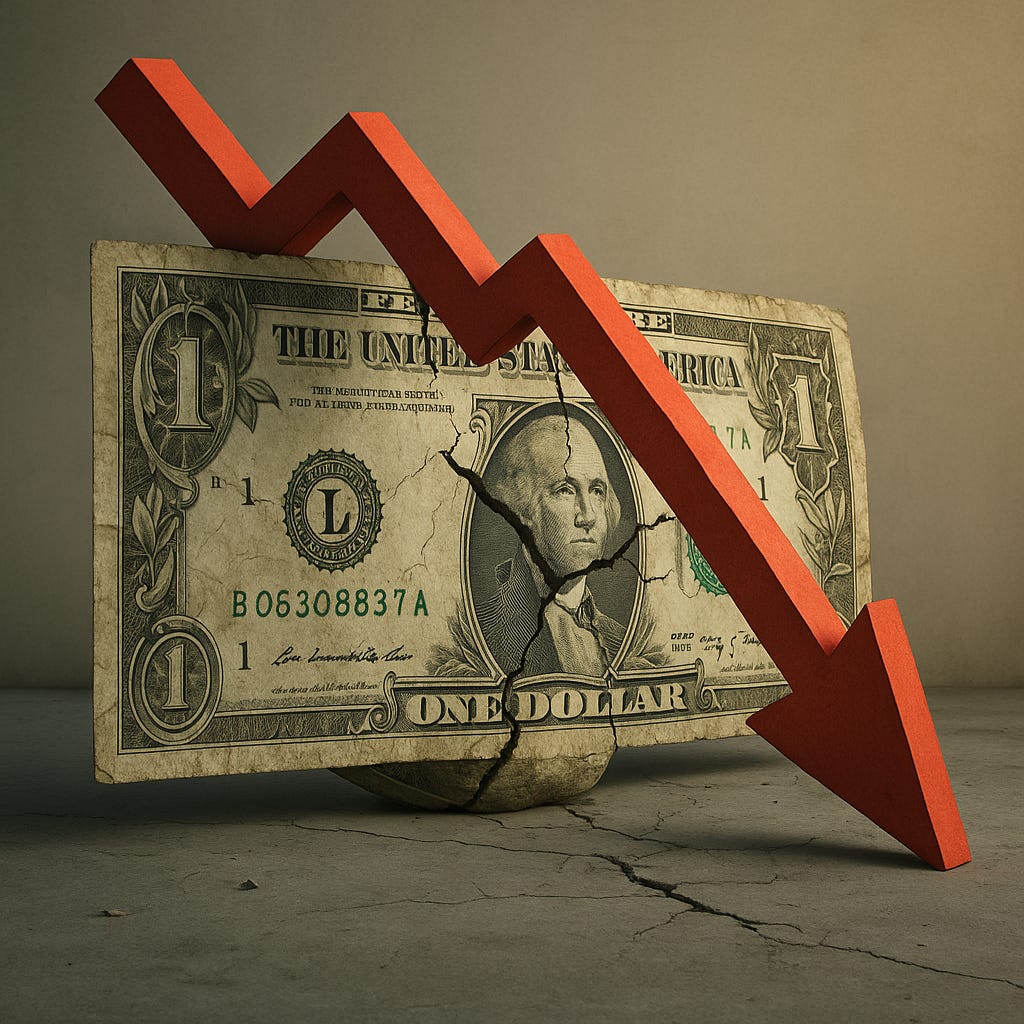
Meanwhile, the U.S. dollar has lost over 10% of its value in just the first half of 2025, marking the steepest decline since the 1970s, eroding every dollar working-class Americans have left.
Trump’s Economic Policy: Chaos by Design
If the first wave of bankruptcies signaled distress, the second wave told us why: Trump’s economic policies aren’t failing. They’re functioning exactly as intended.
In just seven months, Trump’s administration has unleashed a series of aggressive policies that have directly contributed to the accelerating collapse of vulnerable businesses:
Tariffs That Gut, Not Guard
Over $300 billion in tariffs—some as high as 145%—have been levied against imports, with no clear strategy beyond punishment. The result is a crushing burden on import-heavy sectors, such as furniture, auto parts, electronics, and building materials. Companies like At Home, National Tile, and dozens more have explicitly cited tariffs as a reason for filing Chapter 11.
Deregulation That Disguises Looting
Hospitals and pharmacies, already struggling under decades of profit-first health policy, are collapsing faster thanks to Trump’s rollback of healthcare protections, including delays in rules aimed at curbing medical debt exploitation. This isn’t a market correction, but rather a case of predatory neglect.
Private Equity Runs Free
The Trump administration has shown little appetite for regulating private equity firms that buy distressed companies, saddle them with debt, extract value, and then walk away. These firms are allowed to operate without transparency, without guardrails, and, most critically, without consequence.
Tax Cuts for the Few, Cuts for Everyone Else
The “One Big Beautiful Bill” tax plan continues the Trump legacy of rewarding passive wealth and punishing labor. Corporations keep their loopholes. Private equity keeps its carried interest. Meanwhile, public services face cuts, and working Americans face an increasingly rigged system.
Not familiar with the OBBB? See our previous reporting here:
Note: These are more than 45 days old and now live in the archive. Become a paid subscriber for exclusive perks including full access to all of our 900+ articles.


This isn’t an economic strategy. It’s a controlled demolition with the exit doors locked for everyone but the architects.
Consumers Aren’t Choosing to Spend Less. They’re Tapped Out
While corporate bankruptcies dominate the headlines, another wave is quietly rising: personal bankruptcies, particularly those driven by medical debt, credit card dependence, and rising cost of living.
After years of relative decline, personal bankruptcy filings increased significantly in 2025, with over 360,000 new cases reported in the first half of the year alone, representing a 16% year-over-year rise. The reasons are predictable but brutal:
Medical debt remains the leading cause of bankruptcy in the U.S., a phenomenon virtually unheard of in the rest of the developed world.
Inflation may have slowed on paper, but the cost of food, housing, and transportation remains well above wage growth.
Interest rate hikes, while aimed at controlling inflation, have trapped consumers in compounding debt, especially those who relied on credit to navigate the pandemic-era job losses and post-COVID inflation spikes.
They’re not skipping the craft store, the pizza place, or the birthday dinner because they’re “choosing to save.” They’re not visiting because they can’t afford to live, let alone spend.
That missing spending power is the very oxygen that businesses—especially local and mid-tier ones—need to survive. And it’s being suffocated out of the economy by a policy landscape that keeps consumers poor, precarious, and in debt.
The System Isn’t Collapsing. It’s Consolidating
Once you track the bankruptcies, personal debt, and policy choices to their source, the bigger picture becomes undeniable: This isn’t dysfunction. It’s consolidation. And it’s happening by design.
The goal isn’t to save the economy for everyone. It’s to strip it down to what serves the few, and let the rest rot in the margins.
What we’re seeing now isn’t just economic decay. It’s oligarchical curation, the careful pruning of an economy until only monopolies, private equity conglomerates, and elite-serving institutions remain.
Shrink the Market, Own What’s Left
As small businesses collapse and mid-tier brands fall, market share gets vacuumed up by the giants. Amazon, Walmart, UnitedHealth, Blackstone—they don’t need 10 competitors. They need five to fail so they can buy the scraps and double their margins.
Privatize, Strip, Repeat
Hospitals, housing, education, energy—everything gets converted into an asset class. Once it stops being profitable? Shut it down. Sell it off. Leave the public with the fallout.
Disempower the Consumer, Disengage the Citizen
When economic mobility disappears, so too does political agency. A broke, sick, overworked population can’t strike, can’t organize, and can’t meaningfully resist. This isn’t just about wealth. It’s about control.
The U.S. economy is being reshaped, not to lift up the many, but to enshrine the power of the few. And the rest of us? We’re left to GoFundMe our healthcare, DoorDash our side hustle, and pray the algorithm doesn’t turn against us next.
This Isn’t the Bottom. It’s the Blueprint
If you’ve made it this far, you probably don’t need convincing that what we’re watching isn’t just economic “bad luck.” It’s a long-engineered unraveling. From private equity raiding companies to tariff policy gutting supply chains, from energy sabotage to a collapsing consumer base, this isn’t a free market. It’s a fire sale.
The oligarchs aren’t worried. They don’t need public schools, public healthcare, or public stability. When the hospitals close and the grocery stores vanish, they’ll be fine. They have jets, foreign passports, and private networks.
The rest of us? We’re the ones being told to tighten our belts while the floor falls away.
We don’t offer you a petition link. We’re not ending with a cheerful list of bullet-point solutions. We’re ending with what we can offer: Clarity, recognition, and the confirmation that you’re not imagining this.
You’ve seen this pattern before. So have we. It’s not new, but it is accelerating. And pretending otherwise is a luxury we no longer have.
We don’t want to be right. We’d love to be wrong, but if this is what “winning” looks like, then we’ve lost more than we’ve been told.
Don’t let the bastards sneak anything past you. Subscribe and get your daily dose of rage and receipts delivered fresh, before the spin doctors can scrub it.
Sources:
“2025 Bankruptcy Filings on Pace for a 15-Year High” – S&P Global Market Intelligence
“July US Corporate Bankruptcy Filings Hit Highest Monthly Total in 5 Years” – S&P Global Market Intelligence
“Boom Fades for US Clean Energy as Trump Guts Subsidies” – Reuters
“Trump’s Moves to Dismantle the U.S. Wind and Solar Energy Industries” – Reuters
“Economic Consequences of a Second Trump Administration” – CEPR
“There Are Signs the Economy May Be on Weaker Footing Than the Latest Data Suggests” – Business Insider
“Why Is the US Dollar Falling by Record Levels in 2025?” – Al Jazeera
“US Dollar Declines: What It Means for the Economy” – Morgan Stanley
“Nearly Half of Russell 2000 Firms Are Unprofitable” – Apollo Academy
“One Big Beautiful Bill Act: Trump’s Tax Overhaul and Its Risks” – Washington Post
“Trump’s Fed Attacks Add to Fears Treasury Faces Emerging Market–Style Risks” – MarketWatch
“The Economic Consequences of a Second Trump Administration” – CEPR
“Beware Populist Economics” – Financial Times
“Get Ready for the End of Fed Independence” – Wall Street Journal

Looks like that MIT thesis that was done in the 70s about civilization falling in 2030 will be true unless something major changes the pathway of the United States.
This is the oligarchy blueprint, for sure - the final nail in the coffin of any semblance of functioning democracy