


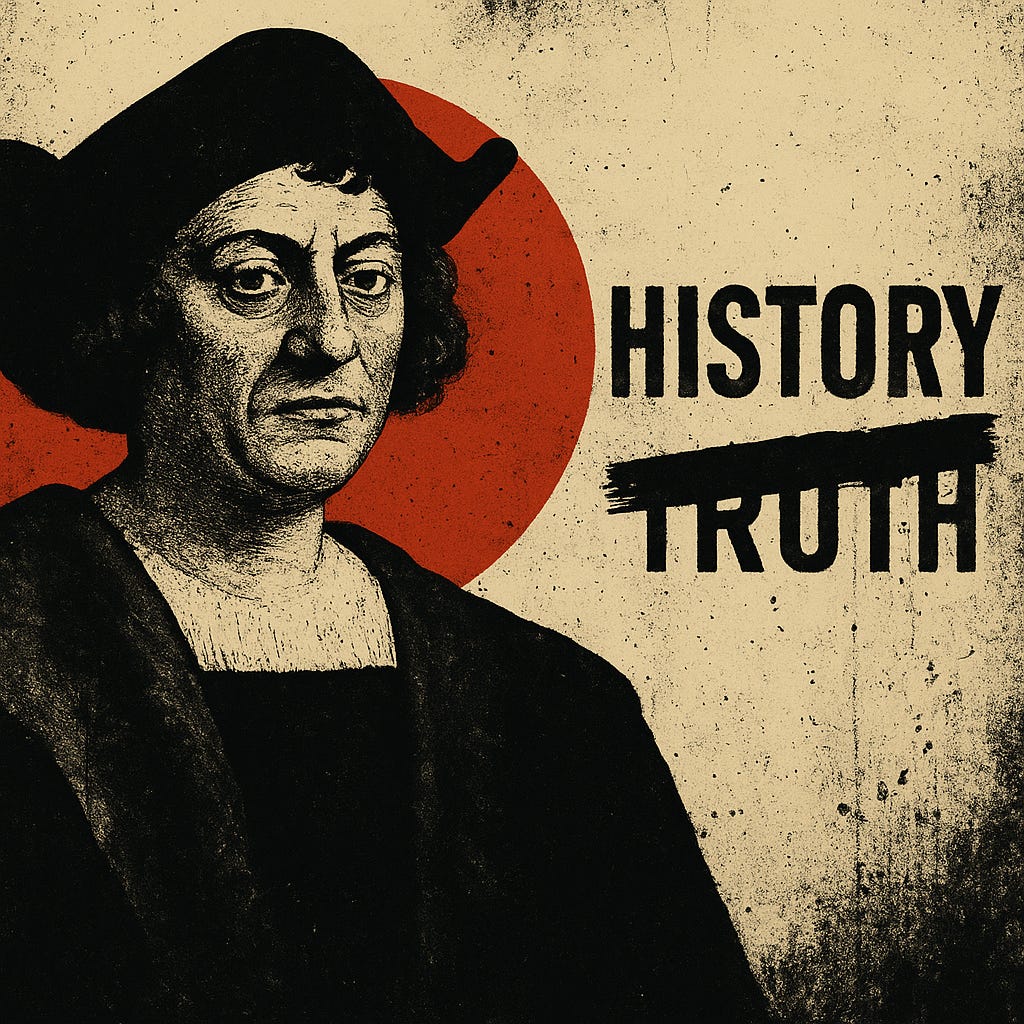
America’s story doesn’t begin with truth. It begins with a man who was lost, who was wrong, and who was brutal—and who we turned into a hero.
What does that say about the story we’ve built, about the myths we choose to honor, and about the kind of people we claim to be?
As Banned Books Week closes and Indigenous Peoples’ Day dawns, it’s hard not to see the symbolism: one moment we’re fighting over what truths are allowed in school libraries, the next we’re debating whether a genocidal colonizer still deserves a national holiday.
It’s not just about Columbus. It’s about the national myth factory, how we elevate mediocrity when it supports dominance, and erase reality when it challenges comfort.
We just hit 25,000 subscribers, 1,000 articles, and 1,000 podcast episodes. To celebrate, paid subscriptions are 20% off for a limited time. That’s just $64/year—less than $1.25 a week.
Join the movement here.
The Mediocre Man Who Became a Monument
Columbus wasn’t a genius. His own country said no. Experts told him he was wrong. He wasn’t the first to imagine sailing west, and he wasn’t the first European to make it to the Americas. He was, by most accounts, lost.
And when he arrived? It wasn’t discovery. It was devastation: slavery, mutilation, forced conversions, and mass death. He governed brutally and was eventually arrested and returned to Spain in chains. Even in his own time, he was not seen as noble.
But centuries later, America made him a holiday.
We didn’t need him to be right. We needed him to be useful. And that says more about us than it does him.
We Didn’t Need a Man. We Needed a Myth.
If the point was to mark a pivotal moment in world history—the beginning of mass migration between continents, the merging of cultures, and the birth of the modern global era—we could have done that.
But instead of embracing that complexity, we chose a man, a white man (white enough), whose legacy could be scrubbed clean and draped in flags.
By mythologizing Columbus, we erased the blood. We erased the people. We erased the truth.
That wasn’t an accident. It was complicity.
A Holiday Built on Myth, and the Fear of Losing It
This isn’t just a cultural reckoning. It’s a political one. And the story of how Columbus Day became a national holiday is itself a lesson in how America deals with history: not as a record of facts, but as a tool of identity.
Columbus Day was never inevitable. It was invented.
The Myth to Unite
In 1937, it became a federal holiday thanks in large part to lobbying from Catholic and Italian American organizations, including the Knights of Columbus, who wanted a figure that could tie immigrant communities to the American mythos. For Italian immigrants in particular—who were often seen as racial outsiders, non-Anglo, and Catholic in a Protestant-majority country—Columbus was a political lifeline. He was “one of ours,” and also, crucially, white and European enough to be elevated without challenging the racial hierarchy.
Even earlier, in 1892, President Benjamin Harrison declared a one-time Columbus Day celebration, not to honor the explorer per se, but to cool tensions after the lynching of 11 Italian immigrants in New Orleans. That lynching, one of the largest mass lynchings in U.S. history, sparked outrage from Italy and within immigrant communities. Columbus, conveniently, became a symbol of inclusion that didn’t threaten the dominant power structure. He was both Italian and palatable to white America. He was a sanitized compromise.
But this was never about historical accuracy. Columbus was a stand-in, a symbol that could carry a narrative of discovery, Christian expansion, and Euro-American destiny. In the process, his brutality, failures, and arrest for misrule were scrubbed from the story.
The erasure wasn’t an accident, but rather a feature.
The Pushback
Beginning most forcefully in the 1970s and gaining steam in the 1990s, Indigenous activists, educators, and community leaders had begun to push back in force. South Dakota replaced Columbus Day with Native American Day in 1990. Berkeley, California, followed in 1992 with Indigenous Peoples’ Day. Since then, dozens of cities and states have made the shift, rejecting the conquest narrative and choosing to honor the peoples who were here before Columbus arrived. Overdue, yes, but a necessary start to the moral historical reckoning.
Then in 2021, President Joe Biden issued a proclamation formally recognizing Indigenous Peoples’ Day alongside Columbus Day, the first president to do so. It wasn’t a legal change, but it was a symbolic turning point: a federal acknowledgment that the old story was broken.
Which made the backlash inevitable.
The Last Gasps of Superiority
In April 2025, Donald Trump announced he would no longer recognize Indigenous Peoples’ Day. He reinstated Columbus Day as the sole observance, called Columbus “the original American hero,” and cast the renaming movement as an attack on American values.
See that reporting here:
Note: This article is more than 45 days old and now lives in our archive. Consider becoming a paid subscriber for exclusive perks including full access to our 1100+ article archive.
Columbus, Cuts, and the Continued Erasure of Indigenous America
·On April 28, Donald Trump stood before a crowd and declared he would “bring Columbus Day back from the ashes.” He spoke as if a national tragedy had occurred, not the centuries of violence that followed 1492, but the perceived loss of a holiday. For many Americans, it sounded like red-meat rhetoric, a nod to patriotic nostalgia. But for Indigenous commu…

This isn’t just about a holiday. It’s about control of the story.
At the same time, Trump’s administration removed signage acknowledging Indigenous histories at national monuments. Federal websites about Native treaties and tribal sovereignty were stripped down or buried. Books by Indigenous authors continue to appear on banned lists. Curricula are being rewritten to avoid “divisive” history.
These aren’t acts of patriotism. They’re acts of fear.
Because when the truth threatens the myth, the people in power don’t try to tell a better story. They try to shut the book.
From Banned Books to Buried Truths
That need for control is still alive and well. Just last week, we observed Banned Books Week, an annual reminder that the battle over truth is far from over. Indigenous authors, queer authors, Black authors have been systematically targeted in a nationwide push to silence the complexity of American identity.
See our recent report here:

The very next day? Columbus Day.
The overlap isn’t incidental. It’s a mirror. A government that still refuses to rescind the Medals of Honor given to soldiers who massacred Lakota people at Wounded Knee in 1890 is the same government that insists on honoring a man who helped launch 400 years of colonial violence.
See our reporting here:

This is about more than history. It’s about now, about whose voices still get erased, and who gets enshrined in bronze.
The Story Was Already Here
Columbus didn’t discover America. He arrived in a land rich with history, culture, governance, and language. We erased all of that to center a man who didn’t even know where he was.
And that’s the story America has kept telling, that history begins when the white man shows up, that the land was empty, that the people were savage, and that violence was destiny.
We didn’t build a holiday to honor discovery but to reinforce supremacy.
The Chinese Emperor and the Erased Past
One of the earliest recorded acts of mass censorship occurred in ancient China. An emperor ordered all historical records destroyed and the scholars who preserved them buried alive, so that history would begin with him.
That’s the authoritarian dream, isn’t it? To be the starting point, to define truth by decree, to make everything that came before irrelevant—or worse, invisible.
That’s not far from what Columbus Day represents, a deliberate effort to make the story start with conquest, and to silence what came before.
But we are not an illiterate empire. We are not bound by one narrative. We carry the receipts in our pockets. The truth is out there—in books, in testimony, in the resistance of people who were never truly erased.
We Can Do Better
Columbus Day is more than outdated. It’s dishonest. It props up a version of history that begins with conquest, ignores genocide, and celebrates mediocrity as greatness, so long as it preserves the dominant story.
We don’t need statues to lies anymore. We need truth, nuance, and courage.
We can stop mythologizing. We can stop pretending that cherry trees, wooden teeth, and brave European explorers are the whole story. We can honor the Indigenous peoples who were here long before 1492. We can celebrate the cultures that survived the unimaginable. And we can teach our children not that we were always right, but that we are strong enough to tell the truth.
Full Circle
What does it say about a country that begins its mythology with a man who was lost? Who was wrong? Who was brutal?
It says we were never taught to value truth, only triumph. That we’d rather elevate the familiar than confront the factual.
But the myth is cracking. The reckoning is here.
The question now is whether we keep pretending the story began with him, or whether we start telling the story as it really was.
Because we are long overdue for a national reckoning with our history, and the last dying gasps of the American mythos may be loud, but only because they are desperate. We are more than our idealized history. We are more than the story they sold us. Together, we are and can be so much more than the sum of our parts. Together, perhaps, if we are willing, we can aspire to be the more perfect union we promised.
Independent media is fueled by you. If you made it this far, we hope you would like more. Please like, share, and subscribe to keep the resistance loud and unflinching.
Sources:
Trump Calls Christopher Columbus ‘the Original American Hero’ as He Sidesteps Indigenous Peoples’ Day: ‘We’re Back, Italians’ People.com
Trump says Columbus Day will now just be Columbus Day AP News
Trump says he’s bringing back Columbus Day, but it never went anywhere Axios
The first Columbus Day was born of violence — and political calculation The Washington Post
The Evolution of Columbus Day Celebrations, From Italian Immigrant Pride to Indigenous Recognition Smithsonian Magazine
Christopher Columbus: How The Explorer’s Legend Grew—and then Drew Fire HISTORY
Trump says Columbus Day will now just be Columbus Day CityNews Vancouver
Trump issues a Columbus Day proclamation to ‘reclaim’ the explorer’s legacy LAist
Trump says he is ‘bringing Columbus Day back from the ashes’ even though the holiday never actually went away Fortune
Trump Wants to Save Columbus Day. From What, Exactly? Atmos
Proclamation 2101 — Columbus Day The American Presidency Project
Columbus Day or Indigenous Peoples’ Day? How the holiday has been shaped by oppression National Geographic
Trump Is Trying to Reinstate Columbus Day, Which Was Never Canceled TIME
Executive Order 14253 — Restoring Truth and Sanity to American History Wikipedia

Stolen land built with stolen people framed in legal justifications and systematic racism. This is history MAGA wants to bury. We can't move foward until the TRUTH is recognized. We can't fix the PAST but we certainly can atone for misjustice and work towards a better future.