


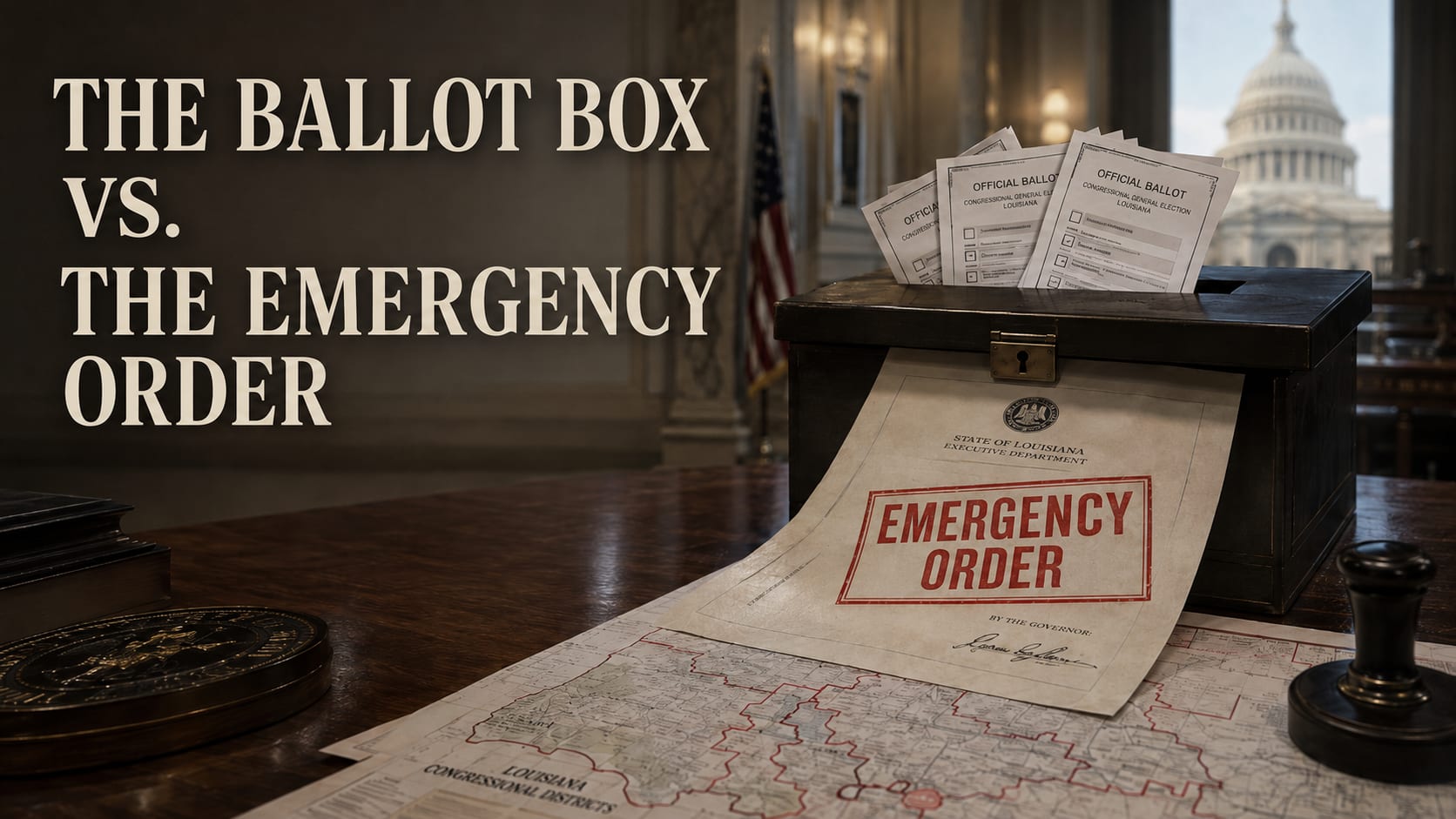
The most dangerous phrase in American politics may not be “the election was stolen.” It may be vote again.
That is the message now hanging over Louisiana, where Gov. Jeff Landry suspended the state’s U.S. House primaries after the Supreme Court’s decision in Louisiana v. Callais. His office said the order applied only to congressional races, while other elections continued. That may matter legally. It does not erase the democratic shock. Voting had already begun. Ballots had already been returned. Then the state changed the election that voters thought they were participating in.
On 60 Minutes, Cecilia Vega pressed Landry on the obvious question: what happens to the ballots already returned? Landry’s answer was blunt. Those ballots would be discarded, and those voters would vote again in November. When pressed on what voters should do if they believed they had been wronged, he told them to take it to the United States Supreme Court.
The story is bigger than Louisiana. This is not a claim that Donald Trump personally ordered Landry to suspend the primaries. Landry has denied that. The stronger point is more serious: this looks like the kind of election manipulation Americans have been conditioned to fear in the Trump era.
Voters tried to choose their representatives. Executive power stepped in. The rules changed after participation had begun. The public was then told to trust a process that had already shifted under its feet. Article I is supposed to be representation. Executive power is command. And in Louisiana, the ballot box just ran headfirst into the emergency order.
This Community Is Powered by You
What started as a small circle has grown into something much bigger, and it’s all because of readers like you.
Every time you forward this email, post it on socials, or bring someone new into the fold, you’re helping build one of the most passionate, independent political communities out there.
Want to keep the momentum going?
Share this newsletter with someone who should be part of this conversation.
Thank you for being here. It means everything.
The Vote Had Already Started
The first fact cannot get buried under legal language: this election was already underway.
Landry’s order suspended Louisiana’s closed party primaries only for U.S. House races, following the Supreme Court’s ruling in Louisiana v. Callais. Other races continued. That distinction may help lawyers sort the case. It does not solve the problem for voters who had already acted under the state’s election calendar.
This is what separates the story from an ordinary redistricting fight. States redraw maps. Courts intervene. Legislatures respond. Election administrators adjust. None of that is new. But voters are supposed to know the rules before they participate. They are not supposed to cast ballots first and then learn that part of the election has been suspended, canceled, or rendered irrelevant by a map fight they did not control.
That is the democratic line Louisiana crossed. A voter does not experience this as procedure. A voter experiences it as whiplash. The state said an election was happening. The voter participated. Then the state said the congressional part of that election would not proceed the way voters had been told. That is not just an administrative complication. That is the beginning of a trust collapse.
“Those Ballots Are Discarded”
The sentence that gave this story national weight was not complicated: those ballots are discarded.
That is what Landry told 60 Minutes when asked about ballots already returned in the suspended congressional primaries. The Associated Press reported that nearly 179,000 primary ballots had been cast as of Friday, including about 53,000 absentee ballots returned by mail, and that the ballots included U.S. House races whose votes would not be counted.
That is the emotional center of the piece because it exposes the gap between power and the voter. For officials, this may be about timing, litigation, map compliance, and emergency authority. For voters, it is simpler: they cast a ballot, and now the state says that part of it does not count.
That distinction matters. The promise of democracy is not that your preferred candidate wins. The promise is that your participation is counted under rules known in advance. When those rules shift after voting begins, the damage is not limited to a single district or ballot line. It teaches voters that the machinery is stronger than the vote. And once voters believe their ballots can be made conditional, every future election starts under suspicion.
People Will Connect This to Trump
People will connect this to Trump because the Trump-era politics have trained the country to watch election machinery with suspicion. The pattern is now familiar: pressure the rules, challenge the process, attack confidence, claim emergency, and then insist the public accept whatever result power produces. That does not mean every election dispute is Trump’s personal command. It means the atmosphere he helped create now shapes how people interpret events like this.
And in Louisiana, the public does not need a secret memo to understand the danger. A governor suspended congressional primaries after voting had already begun. Lawmakers moved toward redrawing the congressional map. The outcome could affect representation in the U.S. House. Reuters reported that the Louisiana fight is part of a broader redistricting battle across Southern states following the Supreme Court ruling, with Republican proposals that could eliminate majority-Black, Democratic-held districts.
The connection is not a command chain. It is political gravity. When power changes the battlefield after voters have already stepped onto it, people recognize the pattern.
Article I vs. Executive Command
The constitutional frame matters. The House of Representatives is supposed to be the chamber closest to the people. It is where voters most directly choose federal representation. Article I is not decorative. It is the constitutional home of legislative power, representation, and lawmaking.
The Elections Clause gives state legislatures the first role in setting the times, places, and manner of congressional elections, while Congress can alter those rules by law. That structure matters because congressional elections are not supposed to feel like a privilege granted by executive power. They are the mechanism by which the people choose the people’s branch.
Landry is a state governor, not the federal president. This is not Article II power in the narrow federal sense, but the political struggle is the same. Representation is being interrupted by command. Voters were choosing Article I representatives. An executive order stepped into that process. The result is a constitutional warning, even if the mechanics are at the state level.
Article I represents deliberation, lawmaking, representation, and the people’s voice. Executive power represents speed, command, emergency, and enforcement. A functioning constitutional system needs administration. It needs courts. It needs lawful corrections when maps violate the Constitution. But when emergency power reaches into an active election and tells voters to start over, the balance changes. The question becomes bigger than Louisiana: are voters choosing power, or is power deciding when voters are allowed to choose?
The Great American Realignment Is Not Just Left vs. Right
This is why the Louisiana story belongs inside the Great American Realignment. Too often, realignment is described only as voters moving between parties: working-class voters shifting right, suburban voters shifting left, rural counties hardening, cities polarizing, and education becoming a sharper political divide. All of that matters, but it is not the whole story.
The deeper realignment is institutional. America is splitting between people who still believe legitimacy flows upward from voters and people who increasingly treat election rules as tools to be controlled by those already in power. That is more dangerous than party preference. A normal political party tries to win voters under the rules. A power-centered political movement tries to shape the rules so voters have less room to decide.
That is what makes Louisiana feel bigger than Louisiana. The rushed redistricting fights across several Southern states have created voter confusion and administrative strain, even as primary season is already underway. The upheaval is also part of a broader fight over control of the U.S. House.
That is the realignment moving from rhetoric into machinery. It is not only about what voters believe. It is about who controls maps, calendars, emergency powers, courts, and ballot counting. The old question was: which side will voters choose? The new question is: who gets to decide what kind of election voters are allowed to have?
The Kitchen-Table Consequence: Your Vote Becomes Conditional
For ordinary voters, this is not an abstract civics lesson. It is a broken promise.
Someone requested a ballot, filled it out, and mailed it back. Someone went to an early voting site, stood in line, looked at a ballot, and tried to participate in the election their state told them was happening. Then the state told them the congressional race had changed status.
That is the kitchen-table consequence. Democracy becomes another system that ordinary people are expected to navigate while insiders move the rules around. Working people do not have unlimited time to decode election litigation. Elderly voters do not always get a second easy trip to the polls. Disabled voters, rural voters, shift workers, caregivers, students, and people without flexible schedules often plan their voting around narrow windows.
When the government says “vote again,” it is not simply issuing a legal correction. It is shifting the burden onto the voter. And that burden is not evenly distributed. People with money, time, transportation, legal knowledge, and political connections can adapt more easily. People already pushed to the margins experience confusion as disenfranchisement. It is not paper. It is trust, effort, citizenship, and time that are treated as disposable.
The Racial and Representational Stakes
There is no honest way to discuss this without discussing representation. The ACLU and other voting-rights groups filed an emergency challenge arguing that Louisiana officials’ actions could disenfranchise tens of thousands of voters who had already voted. The groups also tied the dispute to the congressional map at issue in Callais, which had included two majority-Black districts.
Reuters reported that Black voters make up about one-third of Louisiana’s electorate and that Republican proposals could erase one or both of the state’s two Democratic-held majority-Black districts. That does not make this only a race story. It makes it a representation story with racial consequences.
Maps decide who has political power before a single ballot is cast. When maps are redrawn after voting has already begun, voters are not merely watching lines move on a page. They are watching the value of their political voice change in real time.
This is where the broader miscalculation comes in. Power may think it is winning the map war by weakening race-conscious voting protections and moving quickly before voters can respond. But the long-term cost is legitimacy. If voters come to believe maps are manipulated to predetermine outcomes, the winner may hold the seat while the system loses credibility. A democracy can survive hardball politics. It has a much harder time surviving the belief that the field is rigged before voters arrive.
The Trust Collapse
The sequence is the scandal: voting started, ballots came in, the governor suspended the congressional primaries, lawmakers moved toward a new map, and voters were told they would have to vote again.
Each step can be wrapped in a legal argument. The state can cite the Supreme Court. The governor can call it an emergency. Legislators can say they are complying with a ruling. Lawyers can fight over timing, authority, and remedy. Voters, however, experience the sequence as one event. They were told to participate, then the process changed.
That is why this cannot be contained inside Louisiana. Election trust is national now. Every state-level fight is filtered through years of claims about fraud, stolen elections, rigged systems, partisan courts, gerrymandered maps, and officials who bend rules when power is on the line.
Once trust collapses, even legal actions look suspicious. That is the danger officials keep underestimating. They act as if legitimacy is restored by winning in court. It is not. Courts can settle legality. They cannot automatically restore public faith. Public faith depends on something simpler: voters believing the rules are clear, stable, and not rewritten after participation begins. Louisiana has now given the country the opposite image.
The Ballot Box or the Emergency Order
The Great American Realignment is not only happening in polls, speeches, podcasts, party labels, or cable-news arguments. It is happening inside the machinery of democracy itself. It is happening when maps are redrawn midstream, when elections are paused after voting begins, when ballots are discarded, and when voters are told to trust a process that changed after they entered it.
Article I is representation. Executive-style power is command. The American system needs law, administration, courts, and lawful remedies when maps violate constitutional rules. But the ballot must remain the source of legitimate power.
When command reaches into representation and tells voters to start over, the constitutional balance begins to tilt. The question is not only whether Louisiana’s move survives in court. The question is what lesson voters take from it.
Once people believe their vote counts only when power allows it to count, democracy does not collapse all at once. It becomes conditional. It becomes negotiable. It becomes another process the powerful manage, and the public is expected to endure.
In Louisiana, the ballot box ran into the emergency order. The rest of the country should pay attention to which one survives.
Support Independent Media - The Coffman Chronicle
Stories like this are why independent journalism matters. The fight over democracy is not always loud. Sometimes it happens in court filings, emergency orders, redistricting calendars, ballot deadlines, and procedural decisions that most people never hear about until the damage is already done.
At The Coffman Chronicle, we follow those quiet changes because they are often where power moves first. If this work helps you understand what is happening beneath the headlines, consider becoming a paid subscriber. If you can afford it, your support helps keep this reporting independent, reader-funded, and focused on the people most affected when the machinery of democracy starts moving against them.
The ballot box only works if people are watching what happens around it. Thank you for helping us keep watch.
Sources:
American Civil Liberties Union. “Civil Rights Groups File Emergency Federal Challenge to Louisiana Officials’ Attempt to Suspend Election Already Underway.” May 4, 2026.
“Louisiana’s Governor on the Supreme Court Decision and His Suspending of House Primary Elections.” 60 Minutes, May 10, 2026.
“Congress and the Elections Clause.” U.S. Constitution Annotated.
“Anger, Confusion as Louisiana Republicans Move to Erase Majority-Black US House District.” Reuters, May 9, 2026.
Louisiana Office of the Governor. “Governor Jeff Landry Suspends Only U.S. House Primary Elections Following Supreme Court Ruling.” April 30, 2026.
Louisiana Office of the Governor. “Executive Order JML 26-038.” April 30, 2026.
Supreme Court of the United States. Louisiana v. Callais, 608 U.S. ___ (2026). April 29, 2026.
Supreme Court of the United States. Callais v. Louisiana, No. 25A1197. May 4, 2026.
“Voter Confusion and Headaches for Election Officials Follow Hasty GOP Push to Redraw US House Seats.” Associated Press, May 11, 2026. Republished by WFTV.
Can we insist that in these election rulings by the Supreme Court or states include language that says that they shall not go into effect until X number of months or until after any election falling within X months to allow for the orderly and equitable changeover of procedures ? Having been an election worker, the lead time for ballot /election changes is necessarily long in order to properly and securely change ANYTHING. What this Governor did is immoral and self serving, and as well, it should be illegal. Let’s use some common sense here. I fb reside it will be a tactic come next Halloween to rush changes in place that cannot be sanely dealt with, thus turning the midterms into a debacle. Horrible prospect in this democracy.