

Imagine you’re a Michigan lawmaker. You spend years in office, writing laws that shape the state's future. The moment you leave, you land a six-figure job lobbying your former colleagues, using the very connections you built in public service to push corporate interests.
Sound corrupt? That’s because it is. And until now, Michigan had no law stopping it.
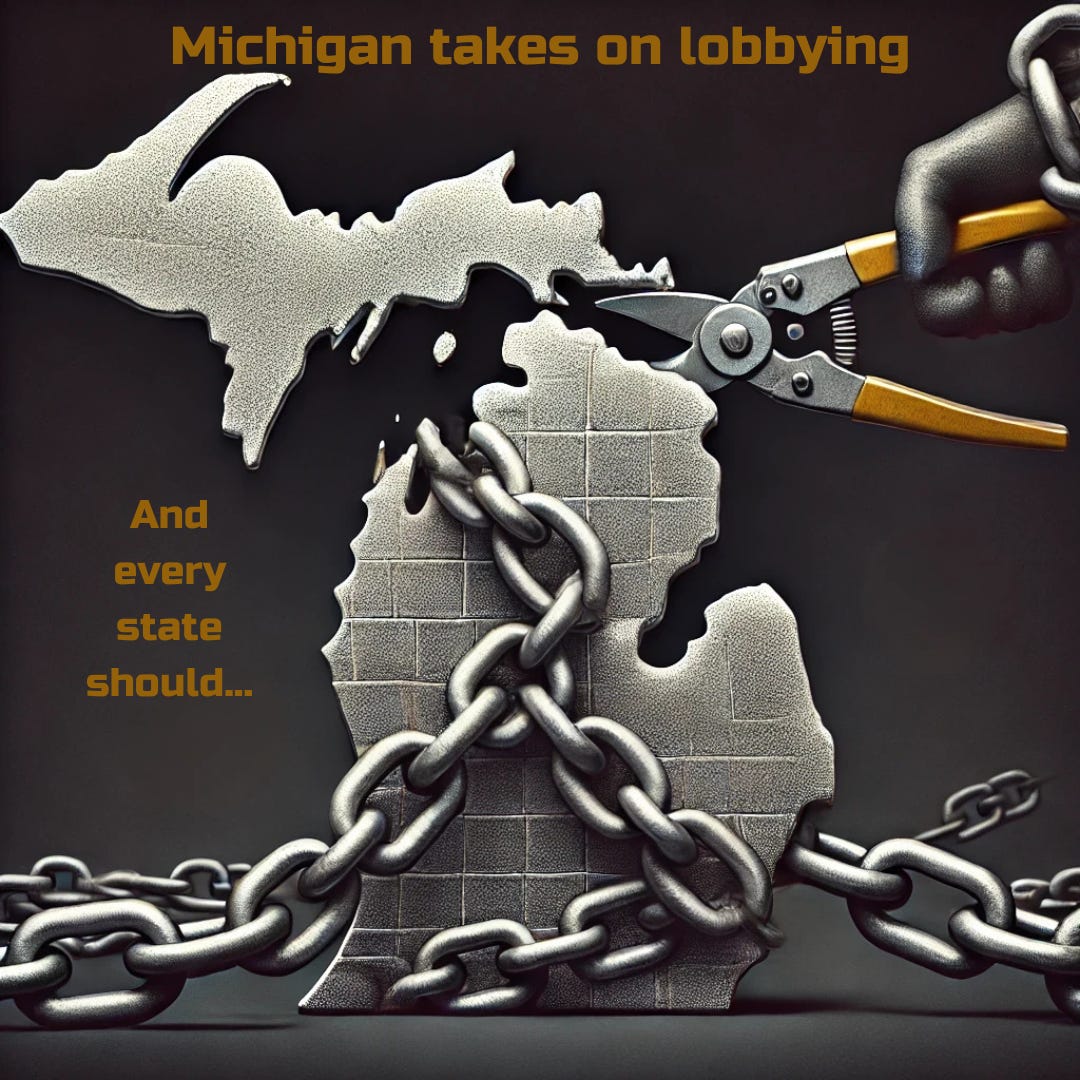
But that’s changing. In a historic move, Michigan lawmakers have passed key bills to restrict the influence of lobbyists and special interests. With bipartisan support, two new anti-lobbying bills (HB 4062 & HB 4063) and the BRITE Act package (HB 5581 & HB 5586) are advancing through the legislature, signaling a significant shift in Michigan’s approach to government ethics.
The reforms also have strong backing from Michigan’s top watchdogs, including Secretary of State Jocelyn Benson and Attorney General Dana Nessel, who have championed government transparency and accountability.
The fight isn’t over yet, but Michigan is finally stepping up to close the revolving door between public service and corporate lobbying.
The Coffman Chronicle is powered by YOU—no billionaires, no corporate overlords. Help us expose the BS, deliver sharp insights, and keep you informed.
You can fuel the fight and join the movement for just $8 a month or $80 a year.
Not ready to subscribe? No worries, chaos loves company, and you're always welcome.
Breaking Down Michigan’s Lobbying Reform Bills
There are four different bills currently moving through Michigan’s legislature that aim to curb the influence of lobbyists:
1. House Bill 4062 – Legislative Lobbying Restrictions
📌 Bans former state legislators from becoming lobbyists for a set period after leaving office.
2. House Bill 4063 – Executive Branch Lobbying Restrictions
📌 Imposes a two-year cooling-off period for former executive branch officials, including the Governor and department heads, before they can lobby.
3. House Bill 5586 – BRITE Act: Cooling-Off Period for State Officials
📌 Creates a one-year cooling-off period before top state officials (e.g., Governor, legislators, state executives) can work as lobbyists.
4. House Bill 5581 – BRITE Act: Expanding the Definition of "Lobbyable Officials"
📌 Expands lobbying restrictions to include legislative staff and key executive branch positions because lobbyists don’t just target lawmakers; they also influence policy through their staff.
Bonus: House Bill 5583 – Strengthening Campaign Finance Enforcement
📌 Gives the Secretary of State the power to take immediate legal action against campaign finance violations, strengthening Michigan’s ability to enforce election laws.
Potential Conflict: Two Cooling-Off Periods for the Governor?
While Michigan lawmakers are making historic progress on lobbying reform, a potential issue needs to be addressed.
Both House Bill 4063 and House Bill 5586 propose cooling-off periods for the Governor and executive branch officials, but they don’t match:
HB 4063 (general lobbying reform bill): Two-year ban for former executive branch officials (including the Governor).
HB 5586 (BRITE Act package): One-year ban for the Governor, legislators, and top officials.
If both bills pass in their current forms, Michigan could have contradictory laws, creating enforcement confusion or allowing lobbyists to push for weaker rules.
How to Fix It:
💡 Lawmakers should amend HB 5586 to match HB 4063’s more substantial two-year restriction, ensuring Michigan adopts the toughest possible lobbying rules.
💡 If a conflict arises, the Senate or Governor should prioritize the extended ban to maximize accountability and prevent corporate influence.
Michigan has a chance to pass some of the strongest ethics laws in the country, but only if lawmakers get the details right.
Key Endorsements: Benson and Nessel Push for Stronger Reforms
Two of Michigan’s top legal and election officials have publicly endorsed these bills, reinforcing the need for real accountability:
📢 Secretary of State Jocelyn Benson: Has praised House Bill 5583, arguing that giving the Secretary of State’s office enforcement power over campaign finance violations is critical for ensuring free and fair elections.
📢 Attorney General Dana Nessel: Has called for even stronger reforms, stating that these bills are “long overdue” to address Michigan’s history of corruption and lack of oversight.
The bills have gained additional credibility with these endorsements, but the corporate lobbying machine is still pushing back.
The Pushback: Who’s Fighting These Reforms?
Of course, not everyone is happy about these bills. Corporate lobbyists and their allies argue that restrictions "limit career opportunities" and that a one-year ban is "too strict."
But let’s be honest—they really mean that these reforms limit their ability to sell out their public service for corporate cash.
The truth? Michigan’s proposed rules are actually weaker than those in many other states. If anything, lawmakers should be fighting to make them stronger.
What Comes Next—and How You Can Fight for More
Michigan lawmakers have made historic progress, but the fight isn’t over. Here’s what still needs to happen:
🔹 A two-year cooling-off period for all officials to match federal standards.
🔹 Stricter donation limits so lobbyists can’t just buy influence through PACs.
🔹 Real penalties for corruption, so violating these laws has actual consequences.
📞 Call your Michigan Senator. Tell them to pass these bills and push for even stronger ethics laws.
📣 Share this article. The more people know about lobbying corruption, the harder it is for lawmakers to ignore.
🗳️ Vote for candidates who support real reform. If your representative is siding with lobbyists, vote them out.
Because corporate lobbyists won’t stop fighting for power—but neither should we.
Should we go further? We think so. See our coverage here:

Final Thoughts: A Step Forward, But Not a Blueprint
Michigan is finally taking action against the pay-to-play system that has corrupted its politics for decades. But this fight is bigger than just one state.
Many states—including Florida, Iowa, and Kentucky—already have stronger two-year lobbying bans, proving that stricter reforms work. Rather than being a blueprint, Michigan is catching up to a national movement for ethics reform.
If lawmakers truly want to restore trust in government, they should push for even stronger laws because the fight for ethics reform doesn’t end here.
See more of our reporting on state-level actions here:


Bibliography
Michigan House Bill 4062 – Legislative Lobbying Restrictions
Michigan House Bill 4063 – Executive Branch Lobbying Restrictions
Michigan House Bill 5586 – BRITE Act: Cooling-Off Period for State Officials
Michigan House Bill 5581 – BRITE Act: Expanding the Definition of "Lobbyable Officials"
Michigan House Bill 5583 – Strengthening Campaign Finance Enforcement
Michigan House Democrats: BRITE Act Bills See Movement in Committee
The Detroit News “Outgoing State Officials Turn to Lobbying Under Lax Michigan Rules” January 23, 2019
Michigan Advance “Nessel & Benson Endorse Government Transparency Legislation” April 18, 2024
Michigan Secretary of State “Statement on House Passage of Ethics Legislation” September 25, 2024
No, it Doesn't Go Far Enough, We Can Not, For A Minute Think , That They Will Care Enough to Act, Immediately, in a Timely manner.....
We Have to Act Immediately to Remove this Disability, From the White House, NOW....
He is Disqualified STILL, and Illegally Seated in OUR WHITE HOUSE.....
He Must be Removed, Because of His Direct Defiance to the Rules of the Constitution....
He has Broke His Oath to the Constitution of the United States of America....
The 14th Amendment, Sec. 3
Doesn't Require 2/3rd Vote, to Remove....
2/3rd, is if Amnesty Comes Up....and is Not Required in Trump, and JD VANCE, ELON, Case... They are a Direct Threat to Democracy....to our Country's FREEDOM....
https://youtu.be/pmzK3-dhsG4?si=fKPSRh5NgxAcmecD