


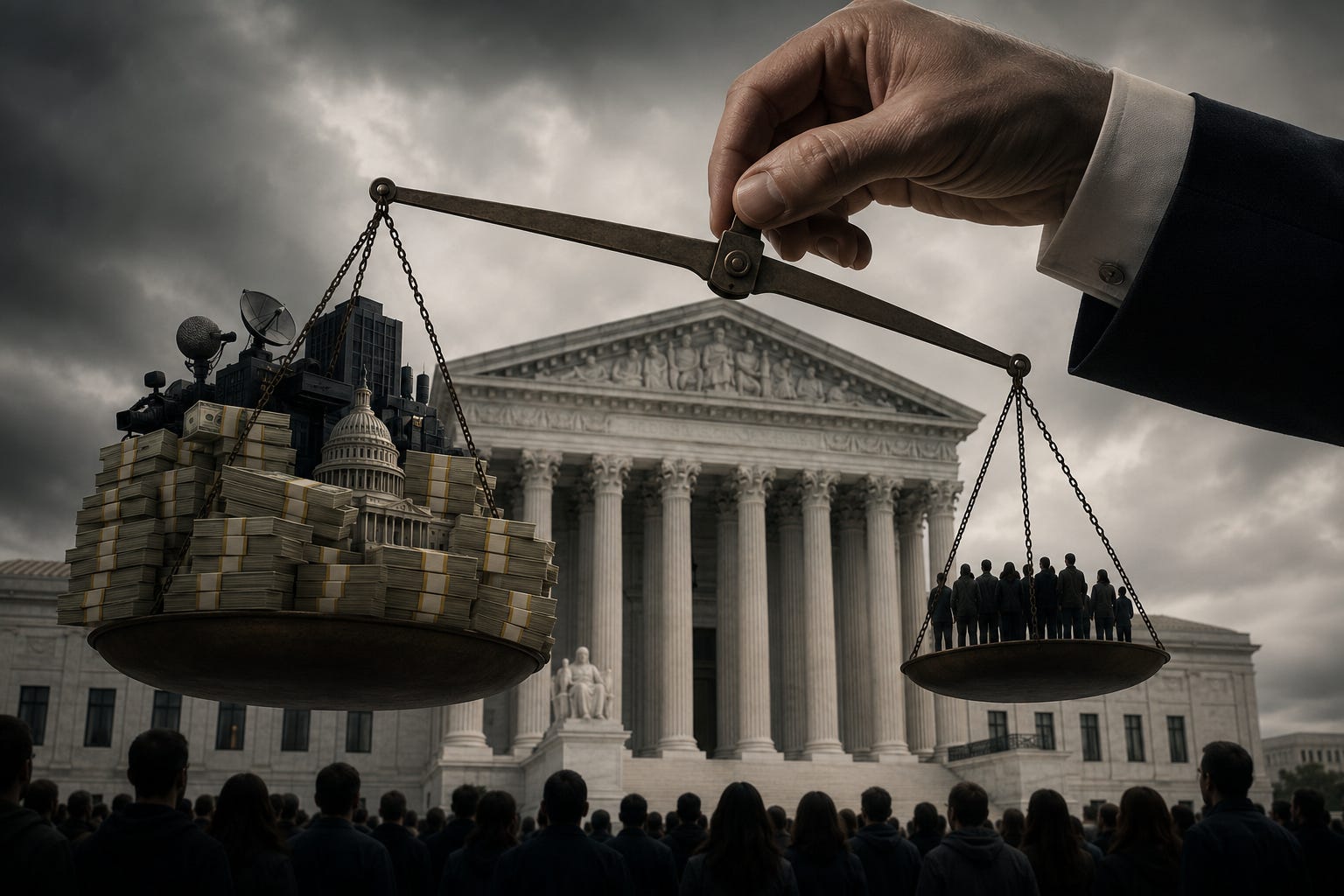
The Supreme Court may soon hand wealthy donors and political parties another enormous victory. In National Republican Senatorial Committee v. Federal Election Commission, the Court appears poised to weaken or eliminate longstanding limits on how much political parties can spend in direct coordination with candidates. On paper, the case is about campaign finance law. In practice, it is about something much larger. It is about whether American democracy can still place meaningful limits on concentrated wealth in politics when the Supreme Court increasingly treats money as speech and corruption as only the most explicit form of bribery.
The case arrives at a moment when many Americans already feel that political influence is becoming increasingly unequal. Campaigns cost staggering amounts of money. Billionaires and corporate interests dominate political fundraising. Media ecosystems are concentrated in the hands of a relatively small number of wealthy owners and conglomerates. At the same time, trust in democratic institutions continues to erode. Against that backdrop, the Court seems prepared to move even further toward a constitutional framework that treats attempts to equalize political influence with deep suspicion.
The implications stretch well beyond one election cycle or one party. The Court is deciding whether democracy should primarily protect liberty from government interference, or whether it must also grapple with the problem of private concentrations of power overwhelming the political system itself.
This Community Is Powered by You
What started as a small circle has grown into something much bigger, and it’s all because of readers like you.
Every time you forward this email, post it on socials, or bring someone new into the fold, you’re helping build one of the most passionate, independent political communities out there.
Want to keep the momentum going?
Share this newsletter with someone who should be part of this conversation.
Thank you for being here. It means everything.
What This Case Is Actually About
Current federal law limits how much political parties can spend in coordination with candidates. Those rules were designed to prevent wealthy donors from using party committees as vehicles to funnel massive amounts of money into campaigns while sidestepping contribution limits. Independent spending by outside groups is already largely unrestricted after Citizens United v. Federal Election Commission in 2010. The case currently before the court concerns something different. It asks whether parties themselves should also be free to spend unlimited sums while working directly with candidates.
The challenge was brought by the National Republican Senatorial Committee, the National Republican Congressional Committee, and Vice President JD Vance, who was serving as a Senate candidate when the litigation began. Republicans argue that the limits violate the First Amendment by restricting political speech and association between parties and their own candidates.
See some of our previous reporting on Citizens United here:

Several conservative justices appeared sympathetic during oral arguments in December 2025. Chief Justice John Roberts questioned whether there is any meaningful difference between coordinated party spending and ordinary political advocacy. Justice Brett Kavanaugh suggested that previous campaign finance rulings may have weakened political parties while empowering outside groups, such as super PACs. Justice Samuel Alito repeatedly expressed skepticism toward the procedural arguments advanced by defenders of the law and questioned whether the restrictions could withstand heightened constitutional scrutiny.
The current limits trace back to concerns that emerged after Watergate. Congress concluded that wealthy donors and corporations had used political committees and opaque financing structures to gain influence over elected officials. In response, lawmakers created modern campaign finance rules intended to reduce corruption, increase transparency, and limit the ability of moneyed interests to dominate the political system.
In 2001, the Supreme Court upheld limits on coordinated party spending in Federal Election Commission v. Colorado Republican Federal Campaign Committee. The Court reasoned that coordinated spending was functionally similar to a direct contribution because it allowed donors to route money through party organizations to benefit specific candidates. The majority feared that without limits, contribution caps would become meaningless.
That decision now appears vulnerable. The Roberts Court has spent more than a decade narrowing the government’s ability to regulate political money. If the justices strike down these limits, they may effectively dismantle one of the last major guardrails left from the post-Watergate era.
The Court’s Narrow Definition of Corruption
At the center of this case is a deceptively simple question. What counts as corruption?
For decades, American courts accepted a broad understanding of political corruption. Corruption did not only mean literal cash-for-votes bribery. It also included donor dependency, privileged access, influence networks, and the public perception that the government was increasingly responsive to wealthy interests rather than ordinary citizens.
That broader understanding shaped campaign finance law for generations. The concern was not merely that politicians might accept envelopes of cash or gold bars in exchange for official acts. Lawmakers also worried about systems in which elected officials became structurally dependent on wealthy donors and powerful institutions in order to remain politically viable.
The Roberts Court has steadily narrowed that concept. In decisions such as Citizens United and McCutcheon v. Federal Election Commission in 2014, the Court increasingly defined corruption as explicit quid pro quo exchanges. In plain English, the Court focused on direct trades of money for official action.
Under that framework, influence alone is not corruption. Neither is access. Wealthy donors securing meetings with lawmakers is not corruption, and politicians aligning themselves with donor interests is generally not corruption unless prosecutors can prove a specific transactional agreement.
The more limited definition has enormous consequences. Once corruption is defined narrowly, many campaign finance laws become constitutionally vulnerable. Restrictions that were once justified as protections against systemic influence begin to look, in the eyes of the Court, like improper limits on protected political speech.
Critics argue that this framework misunderstands how power actually operates in modern politics. Sophisticated corruption rarely resembles a cartoon villain handing over a suitcase full of cash. Influence is often quieter and more structural. Wealthy donors build relationships over years, even decades. Political careers become dependent on fundraising networks. Candidates internalize the preferences of those who can finance campaigns long before any explicit deal is ever discussed.
The Court, however, has repeatedly signaled in recent years its discomfort with regulating those softer forms of influence. Conservative justices have warned that broader definitions of corruption could allow government officials to suppress political advocacy under the guise of fairness. In their view, restricting political spending in order to reduce unequal influence risks violating core First Amendment protections.
That constitutional philosophy is now colliding with a political system that many Americans already perceive as deeply unequal.
Money as Speech Means the Rich Get More Speech
The central logic behind modern campaign finance doctrine is straightforward. Political speech requires money. Advertising, campaign staff, and organizing cost money. Restricting political spending, therefore, restricts the ability to disseminate political ideas.
The doctrine is internally coherent, yet it produces a deeply uncomfortable democratic reality.
If spending is treated as speech, then those with greater financial resources possess greater practical ability to shape public discourse. Formally, every citizen retains one vote. In practice, some individuals can finance nationwide media campaigns while others struggle to afford a yard sign.
The Supreme Court has repeatedly rejected the idea that the government may limit political spending in order to equalize influence. The conservative majority generally views equality-based restrictions with suspicion. The Court worries that allowing the government to determine how much political advocacy is too much could open the door to censorship and partisan abuse.
However, the practical consequence is that economic inequality becomes political inequality.
See some of our previous reporting here:


That concern feels especially acute in modern America because wealth concentration has reached extraordinary levels. A relatively small number of billionaires now possess enough resources to fund presidential campaigns, finance media networks, shape primary elections, support legal advocacy organizations, and sustain permanent political infrastructure.
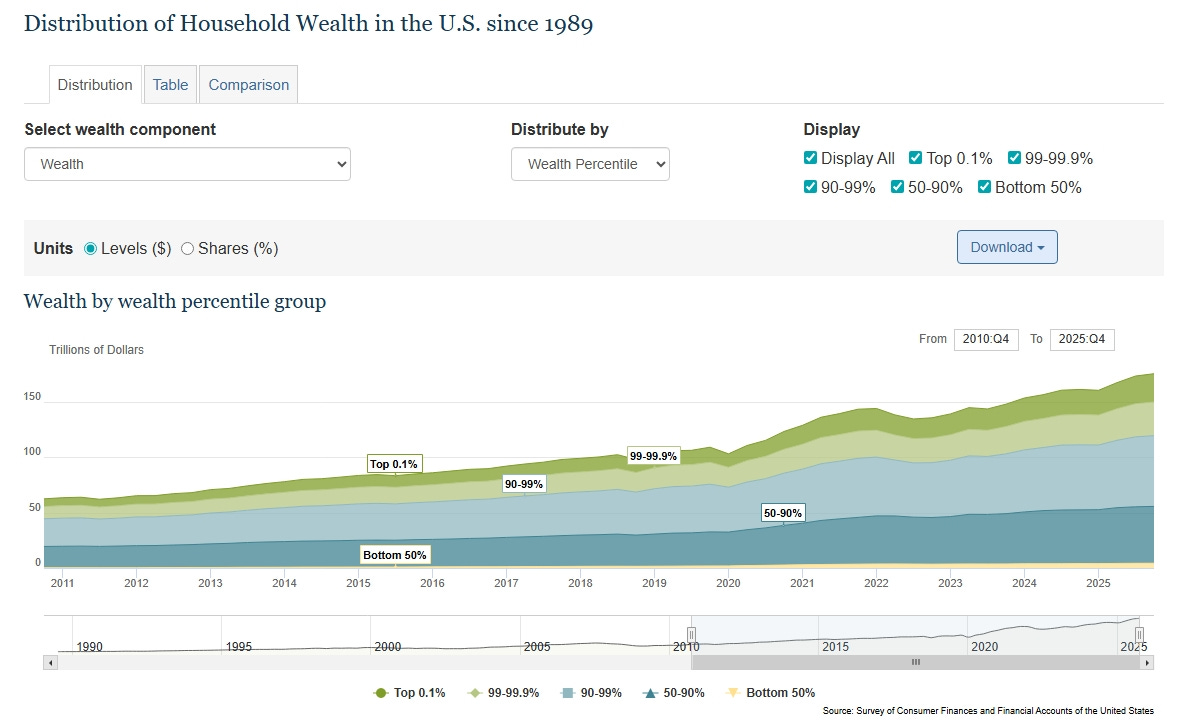
Source: Federal Reserve
This is one reason the pending case resonates beyond the realm of technical election law. The constitutional theory behind modern campaign finance doctrine emerged in an America that was already unequal, yet nowhere near today’s level of concentrated wealth. The combination of extreme inequality and aggressive deregulation creates a system in which money does not merely influence politics at the margins. It increasingly shapes the boundaries of political possibility itself.
The Oligarchy Feedback Loop
The danger critics see is not simply that wealthy people have political opinions. The danger is a self-reinforcing cycle.
Wealth creates political influence. Political influence shapes tax policy, labor law, regulation, judicial appointments, and economic policy. Those policies often further increase concentrated wealth. Increased wealth, in turn, generates even more political influence.
Over time, democracy can begin to feel less like a system of equal citizenship and more like a competition between networks of elite power.
Campaign finance operates within a much larger ecosystem. Wealthy individuals and corporations fund think tanks, legal advocacy groups, media organizations, lobbying firms, and political action committees. They help determine which candidates are considered viable long before voters cast ballots. They influence which issues dominate public debate and which proposals are dismissed as unrealistic.
Even the ability to run for office increasingly depends on access to serious capital. Modern campaigns require legal teams, consultants, advertising operations, staff, travel budgets, voter data systems, and relentless fundraising infrastructure. Many potentially talented or popular candidates never become politically viable because they cannot access the financial machinery necessary to compete.
This does not mean elections are meaningless or predetermined. Wealthy interests often disagree with one another, and outsider candidates occasionally break through traditional power structures. Yet the broader concern remains difficult to ignore. When the cost of political participation becomes extraordinarily high, democracy begins to filter candidates through financial viability before voters ever meaningfully weigh in.
The result can resemble a softer form of oligarchy. Elections continue, constitutional procedures remain intact, yet political influence becomes increasingly concentrated among those with the resources to shape the public sphere at scale.
The Liberty Trap
Defenders of the Court’s approach are not arguing that billionaires should rule the country, not explicitly. Their core concern is different. They believe, according to their arguments, that government power poses the greater danger.
From this perspective, allowing officials to regulate political spending in the name of fairness could easily become a tool for suppressing dissent, protecting incumbents, or punishing unpopular speech. The First Amendment, in their view, exists precisely to prevent government from deciding whose political advocacy deserves limitation.
That concern is not frivolous. History offers many examples of governments abusing regulatory power for political ends.
However, the Court’s framework often treats liberty and equality as though they exist in entirely separate constitutional universes. The justices vigorously defend freedom from government restriction while showing far less concern about how private concentrations of wealth can distort democratic participation in practice.
This tension becomes particularly unsettling in the current political climate. President Trump and allies have repeatedly attacked the press, threatened political opponents, and portrayed critics as enemies of the country. At the same time, the Court appears prepared to further expand the role of concentrated wealth in the political system.
Many Americans increasingly worry that liberty is unevenly distributed. Wealthy interests enjoy extraordinary freedom to shape politics through money and influence. Meanwhile, journalists, protesters, dissidents, and ordinary citizens often face escalating pressure, intimidation, or marginalization.
That combination creates a profound democratic anxiety. A system can remain formally free while becoming substantively unequal. Citizens may retain constitutional rights on paper while possessing radically different practical ability to shape political reality.
The Stakes for Democracy
The question before the Supreme Court is not whether wealthy people possess free speech rights. They do. The question is whether democracy can survive indefinitely when wealth translates so directly into political amplification.
For much of modern American history, campaign finance law represented an imperfect attempt to balance liberty with democratic equality. The system was flawed and often inconsistent, yet it reflected a basic recognition that concentrated money can distort representative government long before overt criminal bribery becomes apparent.
The Roberts Court increasingly rejects that premise. The justices seem willing to tolerate immense disparities in political influence so long as explicit quid pro quo corruption remains difficult to prove. In doing so, the Court risks reducing corruption to only its most obvious and theatrical forms while treating broader systems of dependency and influence as constitutionally untouchable.
That may ultimately prove to be the defining democratic question of this era. Can a republic built on political equality endure when economic inequality becomes extreme, and political money receives near-absolute constitutional protection?
The Supreme Court appears increasingly confident that the answer is yes. A growing number of Americans are no longer so sure.
If you value independent progressive commentary that connects the headlines to the deeper structural forces shaping American democracy, consider subscribing. We cover the stories beneath the stories, from Supreme Court decisions and political power to media ecosystems, authoritarian drift, and the future of democratic institutions.
Sources:
Supreme Court of the United States: “Oral Argument - Audio, NRSC v. FEC, No. 24-621” Date argued: December 9, 2025.
Supreme Court of the United States: “24-621 Oral Argument Transcript” Posted: December 10, 2025.
Washington Post: “Supreme Court weighs further loosening campaign finance limits,” December 9, 2025.
Reuters: “In JD Vance case, US Supreme Court may again chip away campaign finance limits,” December 4, 2025.
Politico: “GOP takes aim at campaign finance limits in big Supreme Court test,” December 9, 2025.
Federal Election Commission: “Coordinated party expenditure limits adjusted for 2026,” March 3, 2026.
Campaign Legal Center: “Defending Limits on Coordinated Spending by Political Parties,” October 1, 2025.
Brennan Center for Justice: “FEC v. Colorado Republican Federal Campaign Committee 2001,” June 25, 2001.
Justia: “McCutcheon v. FEC, 572 U.S. 185 (2014),” April 2, 2014.
Justia: “Federal Election Comm’n v. Colorado Republican Federal Campaign Committee, 533 U.S. 431 (2001),” June 25, 2001.
Pew Research Center: “7 facts about Americans’ views of money in politics,” October 23, 2023.
Federal Reserve: “Distribution of Household Wealth in the U.S. since 1989,” March 27, 2026.
Columbia Journalism Review: “Megan Greenwell on How Private Equity Is Devastating Media,” July 9, 2025.
Columbia Journalism Review: “When Local Newspapers Die, Corruption Festers,” June 9, 2025.
The comment above says it all. Big business is allowed by the courts to influence public policy via politicians. Public policy dictates what in fact is good for big business. The public is not consulted and if they are then they are ignored, the AI data centers are an example. From what I read it appears that the Supreme Court Justices are allowed to take all sorts of perks, so they are in in the game too. Not matter which you cut the public is left out of the equation and is usually robbed blind. The money does not cause the corruption, no not at all, corrupt people cause the corruption.
I have always felt that Citizens United really should not have happened - I mean, obviously, but someone should have called SCOTUS on it right then. "Money is speech" is a truism, like "Might makes right", and as a rule, should not have been enshrined in law, even as a mere precedent.