


In September 2025, Donald Trump announced that the United States would host the 2026 G20 summit at Trump National Doral, a golf resort he owns outside Miami. The decision landed with a familiar thud. Ethics questions surfaced immediately, as they had years earlier when Trump first floated the idea of hosting an international summit at one of his properties.
At first glance, it looked like a reprise of an old controversy. However, the venue is only one piece of a much larger story. Over the past several months, multiple developments have converged around the U.S. presidency of the Group of Twenty (G20). Taken together, these decisions offer a window into how this administration understands global economic leadership. The issue is not simply optics or protocol. It is about who benefits, who participates, and which economic realities are treated as central.
This Community Is Powered by You
What started as a small circle has grown into something much bigger, and it’s all because of readers like you.
Every time you forward this email, post it on socials, or bring someone new into the fold, you’re helping build one of the most passionate, independent political communities out there.
Want to keep the momentum going?
Share this newsletter with someone who should be part of this conversation.
Thank you for being here. It means everything.
What the G20 is and who sits at the table
A forum for the world’s largest economies
The G20 is, at its core, an economic forum. It was created in 1999 after the Asian Financial Crisis and elevated to a leaders’ summit during the 2008 global financial crisis. Its purpose is to coordinate policy among the world’s largest economies on issues such as financial stability, global growth, trade, and debt. India’s official 2023 G20 materials described the group in those terms, emphasizing its origins in financial crisis management and its central role in global economic coordination.
The membership is fixed. It includes 19 countries, among them the United States, China, India, Brazil, and South Africa, as well as the European Union and, since 2023, the African Union. Together, they account for most global output and trade. Each year, one country holds the rotating presidency. The host sets the agenda, organizes meetings, and invites additional guest countries. Those invitations, however, apply to non-members. G20 members themselves are not optional participants. They are the forum.
That distinction matters for understanding what is unfolding now.
The venue is not just symbolic
Why Doral matters
There is no serious argument that Trump National Doral is incapable of hosting a summit. It is a large resort with hundreds of rooms and extensive meeting space. High-security events can be held in controlled environments like this, and there are obvious logistical advantages to concentrating activities on a single property. Trump National Doral advertises 643 guest rooms and more than 100,000 square feet of meeting space, while the State Department’s host-year planning notice contemplated a government contract for meeting space and room nights as part of the 2026 U.S. presidency.
The question is not whether Doral can work. It is whether it needed to be chosen.
Miami has multiple purpose-built venues, including the Miami Beach Convention Center, that resemble the kinds of sites used for past G20 summits. Those events are typically held in large public or civic complexes designed to accommodate thousands of delegates, media personnel, and security operations. The United States has extensive experience securing such venues for high-level gatherings, including events that involve large numbers of foreign dignitaries in dense urban environments. The Secret Service and the Department of Homeland Security treat such events as repeatable interagency operations rather than unique exceptions.
Choosing Doral, therefore, looks less like a necessity and more like a preference. Predictably, that preference carries financial implications. The summit will involve contracts for meeting space, lodging, and hospitality. Some of those costs will be borne by the U.S. government, others by foreign delegations. Not every dollar will flow directly to the resort, yet a meaningful share could. The public record does not show the final contract pricing, but the structure of the host-year planning documents makes clear that payments tied to space and rooms can come from both government accounts and self-pay occupants.
This is not a theoretical concern. It is a straightforward consequence of holding a major international summit at a property owned by the sitting president. The ethical issue is not whether the venue exists or can host the event, but rather that the line between public function and private benefit becomes difficult to ignore.
South Africa is not a guest
Membership is not supposed to be optional
The second development is more unusual and, in some ways, more consequential. In late November 2025, Trump said publicly that South Africa would not be invited to the 2026 G20 summit. Subsequent reporting indicated that the exclusion could extend to G20 meetings throughout the U.S. presidency.
That move stands out because South Africa is not an invited guest. It is a full G20 member. It also happens to be the immediate past chair, having hosted the 2025 summit in Johannesburg.
The G20 operates with a continuity mechanism known as the troika, which includes the previous, current, and next presidencies. For 2026, that grouping is South Africa, the United States, and the United Kingdom. Its purpose is to preserve continuity from one host year to the next. Excluding South Africa does not merely create a diplomatic snub. It disrupts one of the forum’s basic operating norms.
The timeline makes that rupture harder to dismiss as a procedural dispute. Earlier in November 2025, Trump said that no U.S. government official would attend the Johannesburg summit, and later reporting described the United States as having officially boycotted the meeting. Weeks later, he cited a dispute over how the G20 presidency was handed over at that same summit as a reason for excluding South Africa the following year.
Washington declined to participate in the outgoing chair’s summit and then treated the summit's outcome as grounds for sidelining the outgoing chair. Even before considering the broader political tensions between the two governments, the optics are difficult to reconcile with the idea of continuity that the troika is meant to protect.
Historically, hosts have had wide latitude to invite additional countries. They have not exercised comparable authority to exclude members. Even in moments of severe geopolitical tension, such as after Russia’s annexation of Crimea in 2014, efforts to bar a member faced resistance and ultimately did not succeed. That makes the treatment of South Africa all the more remarkable.
The website tells the story
From institutional hub to presidential branding
A normal G20 presidency website functions as more than a digital brochure. It is typically the public record of the year’s work. Past hosts such as India, Brazil, and South Africa used their sites to explain the forum, list all members, outline priorities, document meetings, and publish communiqués and outcomes as they emerged. The emphasis was on process, continuity, and the institution's collective nature.
The current U.S. site presents something noticeably different.
On the surface, it includes familiar elements. There is an events calendar, a working groups page, and a growing set of news items. Yet the substance of those sections is thinner than in past presidencies. The events page references meetings that have already taken place, but offers little detail about what was discussed or accomplished. There are no images of delegates, negotiations, or ministerial gatherings. The Asheville finance meeting earlier this year appears, but the accompanying photos focus on scenery rather than participants or proceedings.
The working groups page follows a similar pattern. It lists the groups and describes them largely in terms of the administration’s stated priorities. What is missing is any real sense of ongoing work or collaboration. At the top of the page sits an image of Trump alongside Secretary of State Marco Rubio, reinforcing the impression that the groups are extensions of a political agenda rather than multilateral bodies engaged in continuous negotiation.
The omissions extend to the basics. On the “About” page, South Africa does not appear in the member list, despite being a full G20 member and the immediate past chair. In a forum where continuity is built into the structure, that absence is not a small oversight.
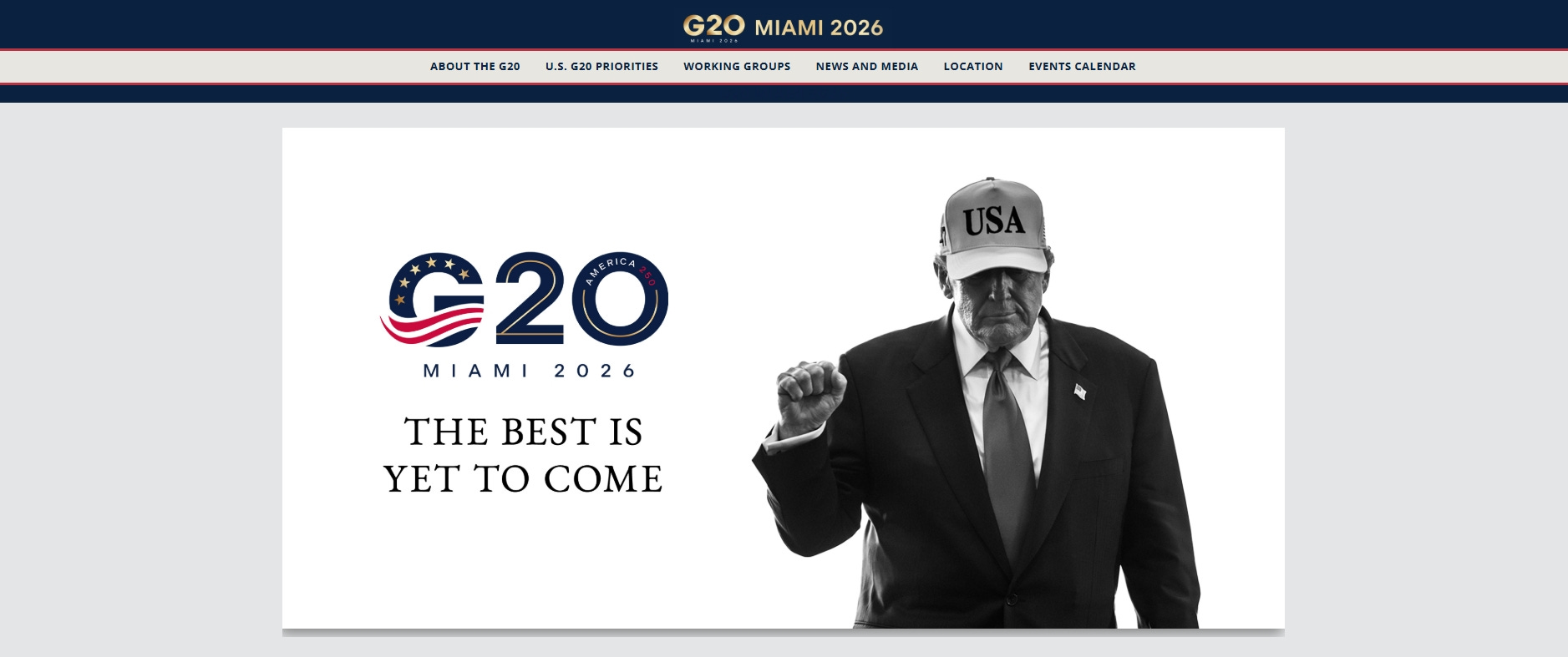
The visual language ties these elements together. The homepage features a large image of Trump with the slogan “The Best Is Yet to Come.” The working groups page includes Trump and Rubio. The location page returns to Trump alone. Across the site, the only images featuring people center on the same figure.
Individually, none of these choices would define a presidency. Taken together, they point in a clear direction. The site is oriented less toward documenting a year of multilateral work and more toward projecting a host-country narrative, one that is tightly aligned with Trump himself and the priorities he has chosen to emphasize.
That may seem like a matter of presentation, yet presentation shapes perception. When the world’s primary forum for economic coordination is framed this way, it suggests that the work of the G20 is being treated less as a shared process and more as a stage for a single country, and a single leader, to define what matters.
Download a FREE Pocket Constitution NOW →

A narrower definition of the economy
What the agenda shift really means
The next shift is less visible than the venue controversy and website focus, and less dramatic than the South Africa exclusion. It may nevertheless prove the most significant, because it concerns the agenda itself.
The U.S. framing for 2026 emphasizes three priorities: reducing regulatory burdens, ensuring affordable and secure energy supply chains, and advancing innovation, particularly in areas such as artificial intelligence. The State Department and the official G20 U.S. materials describe this as a return to the G20’s “core mission” of economic growth and prosperity.
That description is not wrong, but it is also incomplete. The debate is not over whether the G20 should focus on economics. It is over what counts as an economic issue.
In recent years, G20 presidencies have expanded the agenda to include climate change, debt sustainability, inequality, and development finance. Those topics were not treated as peripheral. They were understood as central to economic stability, particularly for countries facing high borrowing costs, climate vulnerability, and structural barriers to growth. South Africa’s 2025 presidency made that perspective explicit. Its official priorities included debt sustainability for low-income countries, finance for a just energy transition, disaster resilience, critical minerals for inclusive growth, and reduced inequality.
The U.S. approach narrows that frame. Energy is discussed primarily in terms of affordability and supply. Regulation is framed as a drag on growth. Technology is positioned as a driver of prosperity. These are legitimate economic concerns, but they also reflect a particular vantage point, one more aligned with advanced economies and capital-intensive industries than with the pressures facing poorer and more climate-vulnerable states. Analysts at the Council on Foreign Relations have described the U.S. agenda as a sharp narrowing that sidelines climate, inequality, and development in favor of deregulation, fossil-fuel-friendly energy politics, and innovation rhetoric.
What recedes in this formulation are the issues many countries in the Global South have spent years trying to elevate. Debt distress becomes a technical matter rather than a structural constraint. Climate shifts from a collective risk to a lower-order concern. Inequality becomes less visible as a driver of instability. This is not a neutral recalibration. It is a shift in emphasis that changes whose economic realities are treated as urgent.
Deregulation and the memory of extraction
Why this language lands differently outside the West
The emphasis on deregulation deserves particular attention. In the United States and other wealthy countries, deregulation is often framed as a way to reduce bureaucracy and encourage investment. That framing does not translate cleanly across all contexts.
For many countries in the Global South, especially those with histories of colonial rule, regulation has been one of the main tools used to push back against extractive economic patterns in which foreign capital captured value, leaving local populations with environmental damage, weak local industry, and unstable public revenues. The United Nations Conference on Trade and Development has highlighted local content policies, transparency rules, and governance frameworks in commodity sectors as key ways in which resource-rich developing countries seek to retain more value from extraction and to make it serve broader development.
These policies are not flawless. Some are badly designed or unevenly enforced. Yet they represent attempts to keep natural wealth from flowing outward while communities absorb the costs. When deregulation is presented as a universal good, it can sound very different in these settings. It can suggest a rollback of the few protections that stand between development and extraction without development. OECD guidance on the extractive sector similarly emphasizes stakeholder engagement, due diligence, and responsible sourcing, all of which depend on governance rather than its erosion.
This is why the agenda shift resonates unevenly. What appears as efficiency in one setting can appear as vulnerability in another.
A summit that tells on itself
Money, membership, and mission
Each of these elements can be examined on its own. Together, they form a pattern.
The choice of Doral blurs the line between public office and private gain. The exclusion of South Africa challenges the assumption that G20 membership is stable and inclusive. The website redesign recasts a multilateral institution in the image of a single leader. The narrowing of the agenda redefines what counts as an economic priority in ways that favor some countries over others.
None of this means the G20 will cease to function. Other member states will continue to advocate for their interests. Negotiations will proceed, and compromises will be made. Multilateral institutions are resilient, in part because they must be. Yet the direction of travel is clear. The 2026 summit is shaping up as a test of whether the G20 remains a forum for broad coordination among diverse economies or becomes something narrower, more transactional, and more reflective of the priorities of its most powerful members.
The question is not only where the summit will be held or who will attend. It is what kind of global economic order the gathering is meant to sustain, and who in that order is expected to adapt.
If you found this analysis useful, consider subscribing for more clear-eyed coverage of U.S. politics and global power. We focus on the stories beneath the headlines—the decisions, structures, and incentives that shape what actually happens.
Subscribe to get new pieces straight to your inbox.
Sources:
Reuters, “Trump says South Africa won’t receive invitation to G20 in 2026,” November 26, 2025.
Reuters, “Germany says Trump should invite South Africa to G20 summit,” November 27, 2025.
Reuters, “US says it will use G20 presidency to focus on economic growth,” December 1, 2025.
Reuters, “South Africa vows not to bend to US pressure after G20 snub,” December 4, 2025.
Reuters, “US to host meeting of G20 officials without South Africa’s participation, sources say,” December 10, 2025.
Reuters, “G20 declaration in defiance of US marks rare victory for multilateralism,” November 24, 2025.
Reuters, “Trump says no US government official will attend G20 summit in South Africa,” November 7, 2025.
Reuters, “South Africa agrees new climate loan, critical minerals cooperation on Germany visit,” April 13, 2026.
Federal Register, “2026 United States’ Host Year of the G20,” January 7, 2025.
G20 Miami 2026, “Homepage - G20 Miami 2026,” accessed April 15, 2026.
G20 Miami 2026, “G20 Miami 2026,” accessed April 15, 2026.
G20 Miami 2026, “U.S. G20 Priorities,” accessed April 15, 2026.
G20 Miami 2026, “Events Calendar,” accessed April 15, 2026.
U.S. Department of the Treasury, “Secretary Bessent Announces 2026 G20 Finance Track Agenda and Finance Ministers and Central Bank Governors Meeting in Asheville, North Carolina,” February 19, 2026.
TRT Afrika, “Trump removes all South Africa traces from G20 website as US takes over presidency,” December 2, 2025.
Eyewitness News, “US-South Africa relations seem dicey after Trump removes SA from G20 website,” December 3, 2025.
Council on Foreign Relations, “US G20 Presidency: A Narrower Agenda for 2026,” accessed April 15, 2026.
South Africa G20 Presidency, “G20 Presidency,” accessed April 15, 2026.
India G20 Presidency, “About G20,” accessed April 15, 2026.
Yep the king invites world economic leaders to his private castle and charges us taxpayers.