


Each election cycle, debate flares over immigration: who gets to come, who gets to stay, and who supposedly takes more than they give. Lost in the noise is a group that lives in the gray zone between resident and guest: visa holders.
They are software engineers, seasonal farm workers, nurses, researchers, and students. They build bridges, write code, pick produce, care for patients, and yes, they pay taxes.
The data tells a story politicians often ignore: visa holders not only participate in the U.S. economy; they strengthen it. And in many cases, they do so with fewer rights and protections than the citizens they support.
Independent News. Just $1/Week.
We just hit 10,000 subscribers—thank you! We’re offering full access to The Coffman Chronicle for just $1 a week ($52/year) to celebrate.
Get exclusive analysis and fearless reporting you won’t find in corporate media.
Support truth. Stay informed.
A Legacy We Lean On
The U.S. has long relied on visa programs to fill labor gaps, from the Bracero Program in the 1940s to the modern H-1B and H-2A systems. Yet as the economy evolved, policy lagged. Today’s temporary workers fill essential, long-term roles in tech, healthcare, and agriculture, often without a long-term stake in the country they help sustain.
“Foreign-born workers on temporary visas are essential to maintaining U.S. economic competitiveness,” says Julia Gelatt, senior policy analyst at the Migration Policy Institute. “They bring skills we can’t easily source domestically, and their contributions far exceed the benefits they can access.”
Contribution Snapshot: What Visa Holders Give (and Don’t Get)
Rather than compare paychecks, here’s what visa holders really bring to the U.S., and what they’re often denied in return:
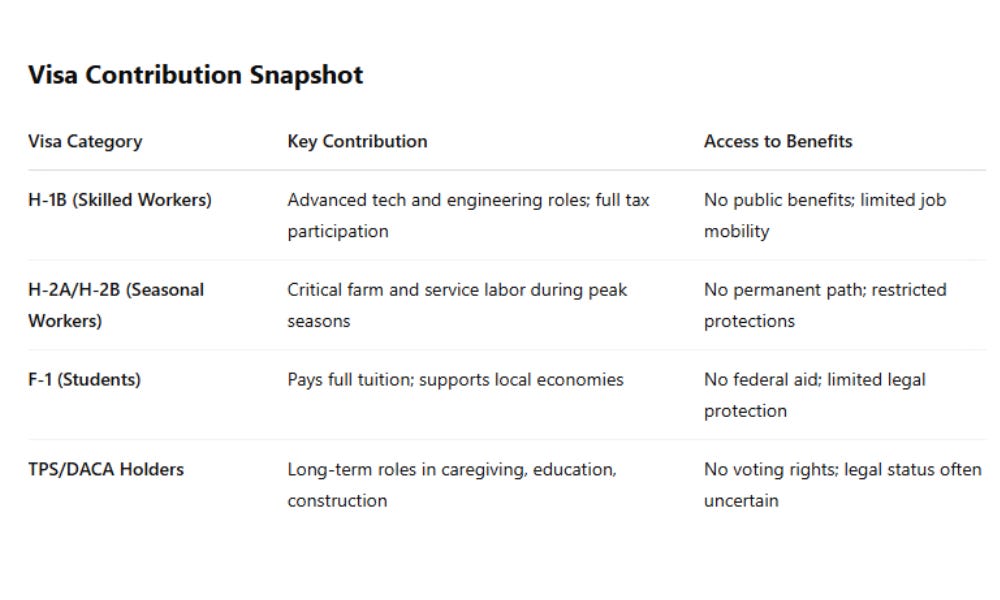
Visa holders don’t just participate in the economy—they prop it up. Yet they do so with limited rights, temporary status, and often no voice in the policies that shape their lives.
Yes, Visa Holders Pay Taxes
One of the most persistent myths is that immigrants—especially those on temporary visas—don’t pay taxes. In reality, most visa holders are full tax participants:
Federal Income Tax
State and Local Taxes
Payroll Taxes (FICA)
Sales and Property Taxes
Examples:
In 2021, TPS holders paid nearly $2.3 billion in combined federal and state/local taxes.
International students contributed over $40 billion to the U.S. economy through tuition, housing, and local spending, supporting nearly 378,000 jobs.
H-1B workers routinely pay tens of thousands of dollars annually in taxes, and may never collect Social Security or Medicare.
Real People, Real Stakes
Meet Divya, a 29-year-old software developer working for a fintech firm in Austin. She arrived from India on an F-1 visa for grad school, graduated at the top of her class, and now holds H-1B status. Her tax bill last year? Nearly $30,000.
She rents downtown, donates locally, sends money home, and still can’t vote.
“It’s frustrating,” she said. “People say we’re taking jobs, but I applied to over 50 before one would sponsor me. I’m here legally, I contribute, but I feel invisible.”
Divya’s story is not unique. Visa holders are everywhere—in hospitals, farms, labs, and restaurants. They show up every day and pay into systems they may never benefit from.
Why This Matters
Americans are aging. Birth rates are falling. Social Security and Medicare face structural strain.
Visa holders are part of the solution:
They are working-age
They are taxpaying
They are essential across industries
They’re not replacing Americans: they’re reinforcing the system that supports everyone.
Policy: What Needs to Change
We could modernize immigration policy to reflect these realities:
1. Portable Work Visas
Allow visa holders to change employers without risking deportation.
2. Visa-to-Green Card Paths
Create clear, fair ways for long-term contributors to stay.
3. Refundable FICA Taxes
Let workers departing the U.S. reclaim part of what they paid in.
4. Data-Based Visa Caps
Align visa availability with real labor market data, not political whims.
These are not radical demands. They’re reality-based reforms.
A Better Conversation
We need to talk about immigration not just in terms of enforcement, but in terms of contribution.
Visa holders are not a burden. They’re an asset.
They fund retirement systems, build infrastructure, feed us, heal us, teach our kids, and code our future.
They’re already doing the work.
Maybe it’s time our policies caught up.
We’ve reported extensively on the current immigration policy under the Trump regime. Read more here:
Note: Articles over 45 days old now live in the archive. Consider becoming a paid subscriber for $1/week to gain exclusive access to the archive, special content, and early releases.


We just hit 10,000 subscribers—thank you! We’re offering full access to The Coffman Chronicle for just $1 a week ($52/year) to celebrate.
Get exclusive analysis and fearless reporting you won’t find in corporate media.
Bibliography:
U.S. Census Bureau. “Who Has Retirement Accounts?” U.S. Census Bureau, August 30, 2022. https://www.census.gov/library/stories/2022/08/who-has-retirement-accounts.html
American Immigration Council. “The H-1B Visa Program: A Primer on the Program and Its Impact on Jobs, Wages, and the Economy.” American Immigration Council, April 6, 2021. https://www.americanimmigrationcouncil.org/research/h1b-visa-program-fact-sheet
American Immigration Council. “Contributions of Temporary Protected Status Holders in the United States.” American Immigration Council, June 2, 2021.
https://www.americanimmigrationcouncil.org/research/contributions-temporary-protected-status-holders-us-economyNAFSA: Association of International Educators. “International Students Contribute $40 Billion to the U.S. Economy.” NAFSA, November 16, 2021.
https://www.nafsa.org/about/about-nafsa/international-students-contribute-record-breaking-level-spending-and-378000-jobsTergesen, Anne. “There’s Already a Caregiver Crisis—So Who Will Take Care of Mom If Immigrant Workers Get Deported?” MarketWatch, March 13, 2023.
https://www.marketwatch.com/story/theres-already-a-caregiver-crisis-so-who-will-take-care-of-mom-if-immigrant-workers-get-deported-c7309b53U.S. Department of Labor. “H-1B Disclosure Data and Performance Reports.” U.S. Department of Labor, Employment and Training Administration, 2024.
https://www.dol.gov/agencies/eta/foreign-labor/performance
There's another twist to the benefits of visa holders....there are tax-paying Americans like me who provide services to those visa holders. In my case, I provide Accent Reduction services to them. My clients care deeply about doing their best to communicate clearly with everyone around them, so they invest in my services. What will happen to my business if no one is allowed to come on these visas? Where are they going to find all the software engineers to replace the visa holders? Seems like every company I work with has loads of engineers on visas. Never mind that our culture is far richer from the experience of knowing people from other countries. It's all just idiocy on steroids with destruction as the goal.