

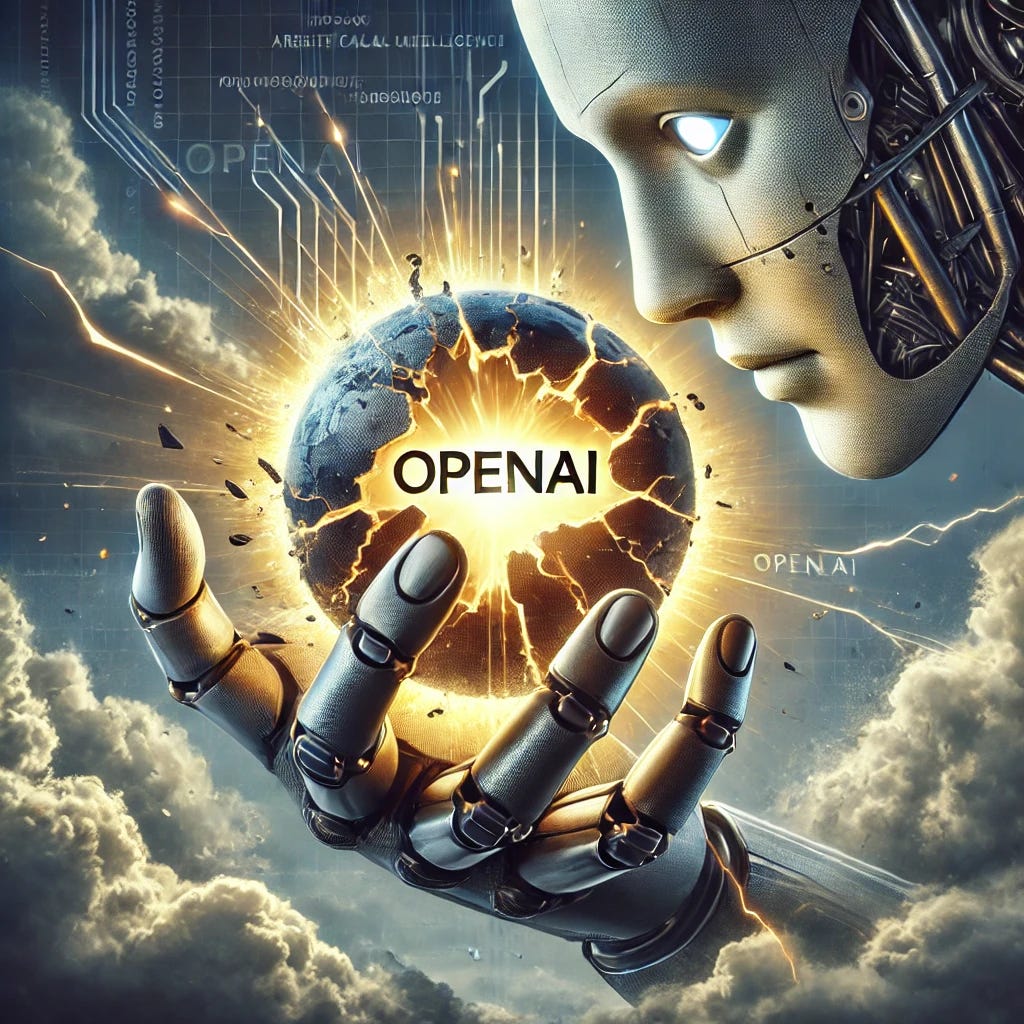
Elon Musk, the billionaire tech mogul who helped found OpenAI, has once again found himself at the center of controversy with an unsolicited $97.4 billion bid to buy the AI powerhouse outright. The offer, which OpenAI’s board unanimously rejected, raises a glaring contradiction: Musk has spent the past year legally battling OpenAI to prevent it from becoming a for-profit entity, yet now he seeks to acquire it personally. What exactly is Musk’s endgame?
Oligarch Watch at The Coffman Chronicle is powered by YOU— no billionaires, no media moguls, no corporate puppeteers. We’re here to expose their BS, break down their schemes, and shine a light on the growing billionaire takeover.
For just $8 a month or $80 a year, you can fuel the fight and help us stay sharp, loud, and unfiltered.
Not ready to subscribe? No problem— chaos thrives on company, and you’re always welcome here. But if you’re ready to stand up to the billionaire class and stay informed, hit that subscribe button now!
To understand this power play, we have to rewind. Musk was an early backer of OpenAI, pouring in millions to help build an artificial intelligence company that, in theory, would serve the public good rather than corporate interests. However, as OpenAI grew in influence, particularly with the launch of ChatGPT, it took a sharp turn away from its original nonprofit model, evolving into a “capped-profit” enterprise that attracted major investments—including billions from Microsoft. Feeling sidelined and betrayed, Musk launched a lawsuit in 2024 against OpenAI and CEO Sam Altman, arguing that the company had strayed from its mission and was now prioritizing profit over humanity.
Musk’s lawsuit wasn’t just a symbolic protest—it was an attempt to block OpenAI from becoming a fully private, for-profit company. He positioned himself as a guardian of OpenAI’s founding principles, arguing that artificial general intelligence (AGI) should be developed to serve society, not corporate shareholders. But his recent attempt to outright purchase the company undercuts that entire legal argument. If OpenAI belongs to the public trust, as Musk has claimed in court, then why is he now trying to bring it under his personal control?
This contradiction is even more striking when considering Musk’s AI company, xAI, which develops Grok, a for-profit chatbot integrated into X (formerly Twitter). While Musk criticizes OpenAI’s shift from nonprofit status, his AI product is monetized through X Premium subscriptions and a planned paid model. If he truly believed AI should remain nonprofit, he could have structured xAI similarly. Instead, he’s commercializing his AI while attacking OpenAI for doing the same thing.
This contradiction exposes a more profound truth: Musk isn’t waging a battle for AI ethics—he’s fighting for dominance in a technology race that will define the next century. His own AI venture, xAI, is still in its infancy compared to OpenAI, and with Microsoft backing Altman’s firm, Musk is playing catch-up. Buying OpenAI would fast-track his ambitions and consolidate power, but it would also completely invalidate his lawsuit, which frames OpenAI as a rogue actor betraying its duty to the public.
OpenAI’s board saw through this charade and swiftly rejected Musk’s bid. But this fight isn’t over. Musk is already locked in a legal war over OpenAI’s direction, and now, with his failed acquisition attempt, it’s clear he wants control by any means necessary. This saga isn’t about whether OpenAI should be a public benefit entity—it’s about who gets to call the shots in the future of AI.
As the legal and corporate battle lines are drawn, one thing is clear: Musk’s moves are less about preserving OpenAI’s mission and more about ensuring he remains at the center of AI’s future. The self-proclaimed defender of ethical AI now finds himself on both sides of a fight, revealing that, in the end, control—not principle—may be his real objective.
No surprise there. He is setting up AI capability to take over from government emoyees and of course he intends to be the selling the AI systems into government as a monopolist to further enrich himself and entrench reliance on his companies