


On July 24, 2025, the Federal Communications Commission approved a media merger that once would have been unthinkable: the acquisition of Paramount Global by Skydance Media. Valued at over $8 billion, the deal folds CBS, MTV, Nickelodeon, Comedy Central, and Paramount Pictures into a single corporate umbrella, all overseen by a company known for its close ideological alignment with the Trump administration. The merger is expected to be finalized by August 7th.
However, it isn’t just the size of the deal that draws scrutiny. It is the conditions.
The merger was greenlit only after Skydance agreed to a slate of ideological demands: cutting DEI-related programming, appointing a politically vetted “news ombudsman,” and demonstrating editorial “balance” as defined by Trump-aligned FCC Chair Brendan Carr. It was a staggering example of state-aligned media manipulation, but even more tellingly, it was entirely legal.
That’s because the U.S. no longer meaningfully regulates media consolidation. Over the past five decades, the structural safeguards that once protected press freedom, from antitrust enforcement to cross-ownership bans and content fairness mandates, have been systematically dismantled. The Paramount–Skydance merger isn’t an outlier. It’s the endgame.
This chapter examines how that happened. From the breakup of NBC’s radio monopoly in the 1940s to the repeal of the Fairness Doctrine in the 1980s and the deregulatory free-for-all of the 1990s, America went from policing media power to enabling it. Today, just five conglomerates control most of what Americans watch, read, and stream.
We didn’t arrive here overnight, and we didn’t get here by accident.
Stay Informed. Stay Loud.
Subscribe to The Coffman Chronicle for no-BS political analysis, action guides, and weekly truth bombs you won’t get from corporate media.
The Barriers That Once Existed
Before a handful of conglomerates controlled the lion’s share of American media, there were real guardrails, including rules, rulings, and regulations that limited corporate consolidation, preserved local ownership, and protected the diversity of public discourse. These protections weren’t accidental. They were born out of a recognition that mass communication, unlike other industries, shapes democracy itself.
The Early Era of Media Regulation
In 1941, the FCC’s “Report on Chain Broadcasting” forced NBC to divest one of its two national radio networks. The resulting sale created ABC, breaking up one of the first media monopolies and reinforcing the idea that no single company should dominate national conversation. That same year, the Supreme Court upheld the FCC’s authority to regulate affiliate contracts and content networks, establishing a precedent that public interest, not private profit, should govern the airwaves.
This belief held for decades. In the 1970s, the FCC implemented the Financial Interest and Syndication (Fin-Syn) Rules, which barred the three major television networks (ABC, CBS, and NBC) from owning the content they broadcast in prime time. It was designed to prevent vertical integration. Networks couldn’t both produce and distribute shows. The result was that independent production companies flourished, and a broader range of stories made it to air.
Ownership Limits to Promote Localism
Around the same time, the FCC imposed cross-ownership bans, prohibiting a single company from owning a newspaper and a television or radio station in the same market. This rule reinforced media pluralism at the local level. A community couldn’t be dominated by one editorial voice across print, radio, and TV. This supported the view that local democracy depends on a diversity of outlets.
When it came to national infrastructure, regulators weren’t shy either. In 1982, the U.S. government reached a landmark antitrust settlement with AT&T, forcing the telecommunications giant to break itself up into seven regional “Baby Bells.” That action recognized the dangers of letting one company control both the delivery system and the content it carried.
Together, these rules weren’t just bureaucratic red tape. They embodied a vision of media as a civic utility, not just a business.
The Dismantling
If the mid-20th century was marked by vigilance against media monopoly, the late 20th century reversed course. One by one, the safeguards were dismantled, not by public demand, but by ideological shifts, industry lobbying, and a deregulatory consensus that treated media like any other commodity.
Reagan’s Deregulatory FCC and the Fall of the Fairness Doctrine
The first major crack came in 1987, during the Reagan administration. For nearly four decades, the Fairness Doctrine had guided American broadcasting as a formal policy of the Federal Communications Commission. Adopted in 1949, it required licensed broadcasters to cover controversial public issues and to present contrasting views, based on the idea that limited access to the airwaves gave the government a duty to ensure viewpoint diversity. In 1969, the Supreme Court upheld the doctrine in Red Lion Broadcasting Co. v. FCC, affirming its constitutionality under the First Amendment, citing the scarcity of available spectrum.
But by the late 1980s, that philosophy was in retreat. Reagan’s FCC, led by Chairman Mark Fowler, embraced a radically different view that broadcasters were not public trustees, but market actors. Fowler famously declared, “Television is just another appliance—a toaster with pictures,” reducing decades of civic-minded regulation to a matter of consumer choice. It was a sound bite that signaled the beginning of the end.
In June 1987, Congress, fearing that the FCC would dismantle the doctrine, passed legislation to codify it into federal law. The bill had overwhelming bipartisan support, clearing the House 302 to 102 and passing the Senate earlier that spring.
President Reagan vetoed it, declaring the doctrine a violation of free speech. Congress chose not to override the veto, and the FCC acted swiftly. In August, the Commission voted unanimously to abolish the Fairness Doctrine altogether.
With that single stroke, one of the last structural commitments to broadcast balance and pluralism disappeared, not because the public demanded it, but because political ideology and corporate pressure found common cause.
Its removal opened the floodgates. Talk radio quickly polarized, and networks no longer needed to offer contrasting perspectives. Partisan cable channels found fertile ground to grow. The age of media pluralism gave way to the age of ideological echo chambers.
The 1996 Telecommunications Act: Deregulation on Overdrive
If Reagan’s FCC weakened the foundation, President Clinton’s Telecommunications Act of 1996 bulldozed the structure. Marketed as modernization, the Act eliminated national caps on radio station ownership, eased TV ownership limits, and loosened cross-media restrictions.
In the wake of the Act:
Clear Channel ballooned from 40 radio stations to over 1,200.
Sinclair Broadcast Group quietly acquired local TV stations and centralized editorial control.
Cable and broadband providers began merging with content companies, laying the groundwork for mergers such as Comcast-NBC, AT&T-Time Warner, and others.
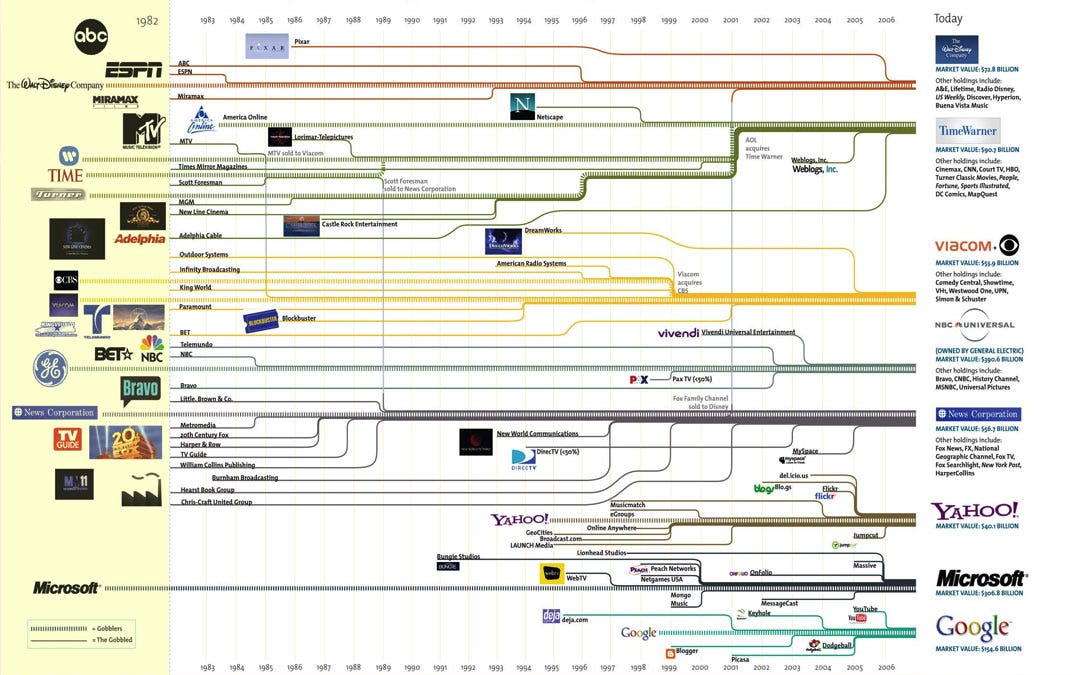
Decades of deregulation transformed American media from a pluralistic ecosystem into a vertically integrated oligopoly. Each merger wasn’t just business. It was the quiet loss of another public voice.
This wasn’t merely market efficiency. It was a matter of political and ideological engineering, facilitated by a bipartisan consensus that prioritized scale over scrutiny. The FCC, once a guardian of the public airwaves, became a rubber stamp for mergers.
The Courts Join In
Even when citizens and advocacy groups challenged this collapse, the courts often sided with industry. In Prometheus Radio Project v. FCC (2004 and again in 2019), public interest groups sought to block further consolidation. Though they won early rulings, the U.S. Supreme Court eventually overturned the lower courts, affirming the FCC’s relaxed rules in 2021.
Today, regulatory oversight barely exists. Political appointees to the FCC reflect the ideology of the ruling administration. Under Trump1.0 and again in 2025, FCC decisions increasingly reflect partisan priorities rather than public consensus.
What We’re Left With
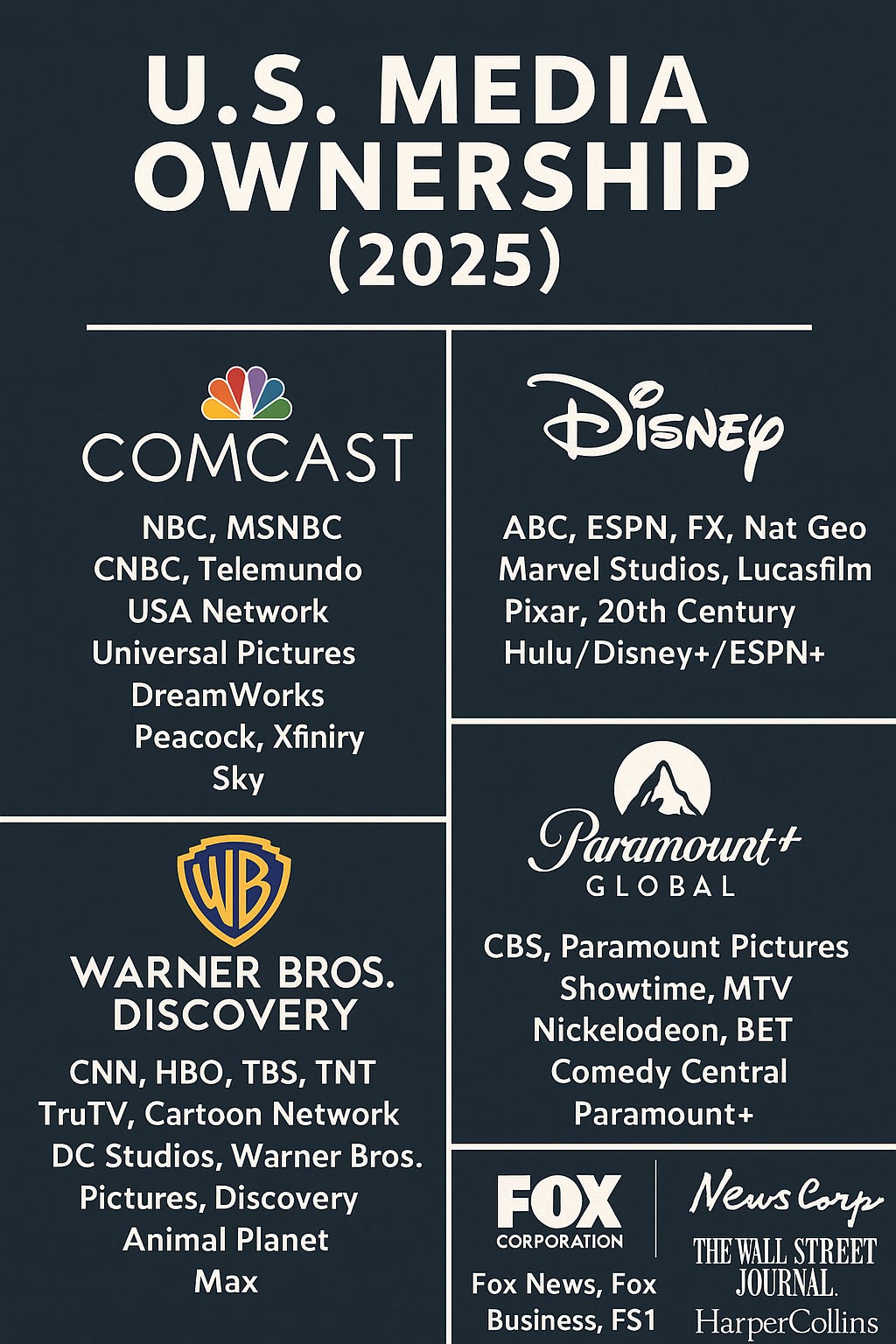
What once was a complex, pluralistic media ecosystem filled with locally owned stations, independent production houses, and diverse editorial voices has hardened into a narrow pipeline controlled by five conglomerates: Comcast, Disney, Warner Bros. Discovery, Paramount Global, and Fox Corporation.
Between them, these corporations own nearly every major broadcast network (NBC, ABC, CBS, Fox), the most-watched cable channels (CNN, MSNBC, Fox News, FX, HGTV), the most trafficked streaming platforms (Peacock, Hulu, Max, Paramount+, Disney+), and vast shares of broadband and telecom infrastructure. These are not just content companies; they are vertically integrated giants that own the means of creation, distribution, and access.
Local Media: Stripped Bare
At the local level, consolidation has been even more brutal. Most American cities now receive their “local” news from stations owned by distant national chains. Many local newspapers, starved of ad revenue and bought by hedge funds, have been hollowed out into skeleton crews or shuttered entirely.
The result is that Americans are fed homogenized, centrally approved content under the illusion of diversity and choice. In Sinclair-controlled TV markets, anchors read identical scripts warning of “biased and false news” from other outlets. In small towns, once-robust newsrooms now reprint wire copy or cover only crime and weather. Investigative journalism has become a luxury good.
Streaming in the Shadows
Meanwhile, streaming services, once hailed as democratizing forces, have turned opaque and risk-averse. Services like Netflix and Amazon Prime rarely disclose viewership numbers, making it impossible for creators or the public to understand what’s working, what’s being watched, or why. Shows and films can be quietly removed, buried by algorithms, or canceled, despite apparent success, all without public accountability.
Even as these platforms rake in billions, they often claim financial hardship when it comes to renewing diverse, challenging, or original content. The recent removal of entire series (such as Willow, Y: The Last Man, and Gordita Chronicles) from platforms was driven not by audience disinterest but by tax write-offs and profit-maximizing write-downs.
We now live in a media landscape where content is not curated for cultural enrichment or democratic discourse, but to minimize risk, reduce costs, and avoid political scrutiny.
Why It Matters
This isn’t just about business. It’s about power and who gets to tell the story of America, and who gets to hear it.
When just five conglomerates control the overwhelming majority of our media, they control more than headlines and programming. They shape how we understand history, interpret policy, interact with one another, and envision the future. The stories we hear, the voices we recognize, and the narratives we absorb are all filtered through a narrow lens shaped by corporate interests and political expediency.
And when those conglomerates respond to political pressure, as Skydance did by gutting DEI programming in exchange for FCC approval, it sends a chilling message that challenging power comes at a price.
A Democracy Without Independent Media Is No Democracy at All
In a functioning democracy, journalism holds the powerful to account, local outlets cover city hall and school board meetings, and diverse cultural stories build empathy across differences. In a monopolized system, those civic goods are subordinated to shareholder interests and political alliances.
This is the real threat — not just censorship, but manufactured silence, a strategic absence of stories that make people uncomfortable or challenge dominant ideologies. Entire communities become invisible. Critical documentaries go undistributed. Whistleblowers can't find a platform, and dissent becomes easier to dismiss as fringe or “fake news” when the gatekeepers all agree to ignore it.
Consolidation Isn’t Neutral. It’s a Machine for Compliance
Every merger, every repeal, every deregulatory action that brought us to this point wasn’t just a business move. It was a political one. And now, when government officials like Brendan Carr pressure companies to align ideologically in exchange for regulatory approval, it becomes impossible to separate policy from propaganda.
We were told the market would create more choice. Instead, we have more channels, but fewer owners. More content, but narrower perspectives. More noise, but less truth.
Where We Go From Here
We did not vote to dismantle the Fairness Doctrine. We did not demand the gutting of cross-ownership protections or the weakening of antitrust enforcement. We did not ask to have our newsrooms sold off, our local papers stripped bare, or our culture brokered by the same handful of executives in Burbank and New York.
Yet we live with the consequences.
The story of American media consolidation is not one of inevitability. It is one of choice. Policies were passed. Rules were repealed. Mergers were approved. In each moment, power was transferred upward, from the public to the private, from the community to the corporation, from the diverse to the homogenized.
It does not have to stay this way.
We can reimagine a media ecosystem that serves people, not profit. That requires bold action such as enforcing antitrust laws with teeth, restoring public interest obligations, funding local and nonprofit journalism, and holding platforms to standards of transparency and fairness. We must remember that the media is not just an industry. It’s an infrastructure of democracy.
The Paramount–Skydance merger is not the end of the story. It is the red flag waving from the rubble of a once-vibrant civic institution.
It’s time we looked up, saw what we’ve lost, and demanded better.
Stay Informed. Stay Loud.
Subscribe to The Coffman Chronicle for no-BS political analysis, action guides, and weekly truth bombs you won’t get from corporate media.
Bibliography:
“FCC license approval clears way for $8 billion Paramount‑Skydance merger,” Reuters, July 24, 2025.
“Paramount Global says Skydance merger should close in two weeks,” Reuters, July 25, 2025.
“Media merger: CBS owner Paramount to enter $8.4B deal with Skydance,” Times of India. July 25, 2025.
“Paramount‑Skydance merger approved after companies agree to government speech demands,” The Verge, July 24, 2025.
“FCC OKs $8B Paramount‑Skydance Deal, Says It Ensures ‘Diversity of Viewpoints’ at CBS,” Investopedia, July 24, 2025.
“Trump, FCC want to reshape the media landscape starting with CBS,” Reuters, July 25, 2025.
“Fairness Doctrine,” Wikipedia.
Mark S. Fowler, Wikipedia.
“Syracuse Peace Council v. FCC,” FCC Report, August 1987 repeal decision.
“Reagan’s Veto Kills Fairness Doctrine Bill,” Los Angeles Times, June 21, 1987.
We need to promote and protect the Internet sources of reliable facts.
I don’t have Netflix and Amozomprime. I don’t watch the television and I hear the radio. I used to watch radio and television when I was young. But not now.