


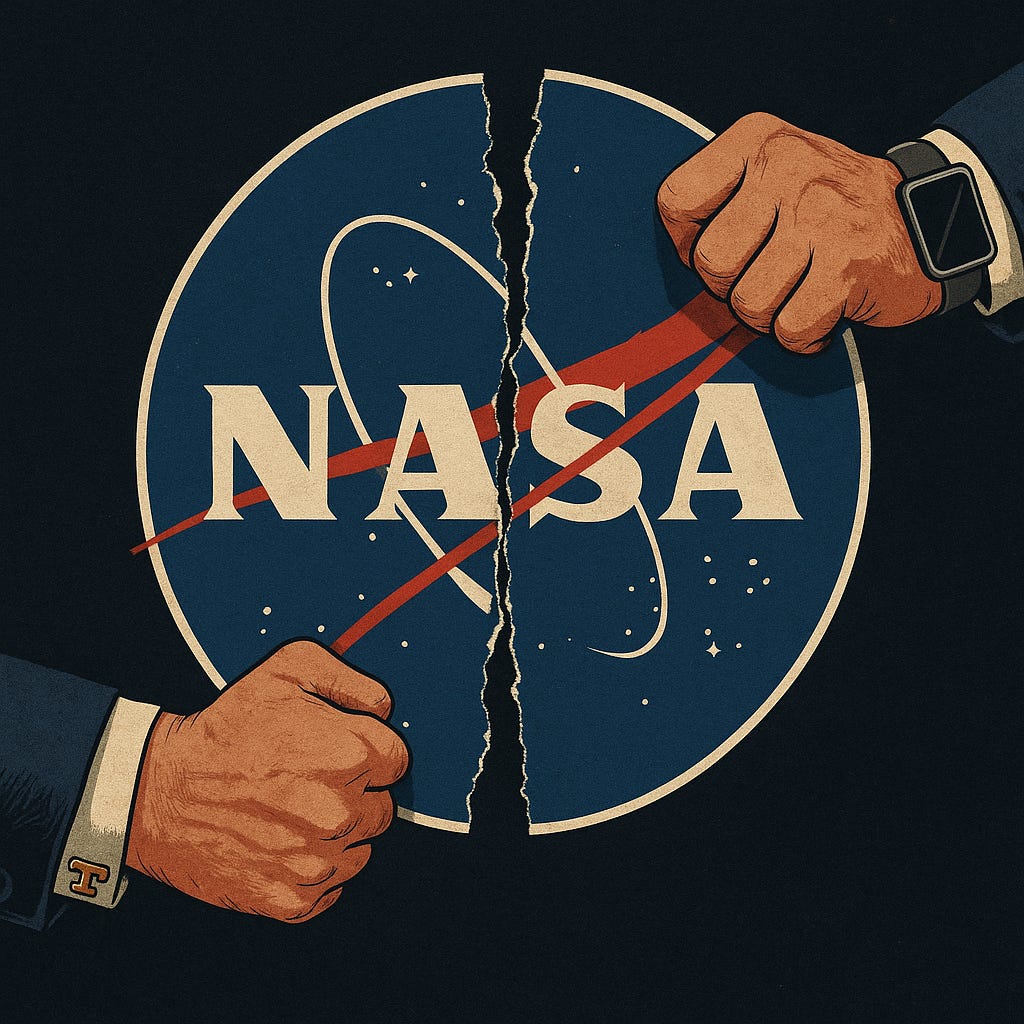
The headlines have been sensational: Trump threatens to strip Elon Musk’s SpaceX of government contracts. Musk fires back with cryptic warnings. NASA missions hang in the balance. What appears to be another media spectacle, two egos colliding in orbit, is in fact something far more perilous.
This isn’t just a fight over money or control. It’s the latest chapter in America’s slow abandonment of science as a public good. NASA, once the crown jewel of national pride, now finds itself trapped between private ambition and political sabotage.
There was a time when space united us. The moon landing wasn’t just a scientific triumph; it was a defining moment of American identity. We planted a flag not just on the lunar surface, but in the collective imagination of a nation. Space wasn’t partisan. It was patriotic. It was ours.
How soon we forget.
We just hit 15,000 subscribers—thank you!
Get exclusive access for just $1/week or $52 a year.
Get exclusive analysis and fearless reporting you won’t find in corporate media.
NASA’s Long Decline: A Legacy Undermined
NASA was once untouchable, a symbol of American ingenuity and global leadership. Over the past few decades, however, that legacy has been quietly eroded. Year after year, administration after administration, NASA’s budget has been chipped away, its ambitions have been narrowed, and its workforce has been downsized. Grand missions became delayed experiments. Science took a backseat to political theater.
This didn’t happen all at once. It happened through a thousand quiet cuts: the sidelining of climate research, the shelving of planetary science, the shifting of priorities from public exploration to private investment. As NASA was defunded, it was also rebranded as a partner, not a leader. Enter SpaceX.
To fill the void, the government began outsourcing. Yes, the results were remarkable: reusable rockets, cheaper launches, renewed interest. However, beneath the success was a deeper problem: a public institution becoming dependent on private infrastructure to function at all. NASA wasn’t failing. It was being starved.
Why NASA Still Matters (to Everyone)
For those who see space as a luxury America can’t afford, think again. NASA is not just about Mars missions or moon bases. It’s about keeping life on Earth safer, smarter, and more sustainable.
Satellites launched by NASA and related agencies monitor hurricanes, wildfires, rising sea levels, and carbon emissions, offering real-time data to farmers, firefighters, city planners, and emergency response teams. Medical research in zero gravity has advanced our understanding of diseases like osteoporosis, cancer, and Alzheimer’s. Technologies originally developed for space travel, like water filtration systems, scratch-resistant lenses, and even the memory foam in your mattress, have quietly made their way into everyday life.

NASA isn’t an escape plan. It’s a survival toolkit.
Yet, year after year, the agency is told to do more with less—less funding, fewer staff, limited public backing. We have grown so used to its quiet brilliance that we’ve forgotten just how much we rely on it until something breaks.
The Threat We Don’t See: Solar Storms and Systemic Fragility
Most people don’t think about the Sun unless it’s scorching or setting. However, solar storms—bursts of energy and radiation from the Sun—pose one of the greatest risks to our modern, hyperconnected world. In an era where nearly everything relies on satellites, networks, and GPS, a powerful solar flare could disrupt the systems we depend on in seconds.
Imagine waking up with no internet, no GPS, no access to your bank account, and no communication beyond a few scattered emergency channels if they’re even operational. Food supply chains grind to a halt. Power grids crash. Planes are grounded. And you can’t even find your way to the store without a signal.
It’s not science fiction. It’s happened before. The 1859 Carrington Event caused global telegraph outages when all we had were wires. Today, the consequences would be catastrophic.
NASA and NOAA continually track solar activity. When a solar storm erupts, we may have anywhere from a few hours to a day or more to prepare. That narrow window can mean the difference between precaution and catastrophe, enough time to ground flights, shield satellites, or power down critical infrastructure. However, that only works if we fund the science that provides us with those warnings in the first place.
We’ve reported on the cuts at NOAA and other agencies previously.


While Trump demands a “Golden Dome” in space, his administration is defunding the very science that could prevent a very real, very terrestrial collapse.
See our article about the Golden Dome here:

Privatization and Dependency: Lessons from Health and Defense
Space isn’t the first public domain to be handed over to private interests, and the pattern should alarm us.
In healthcare, decades of privatization have left Americans with the most expensive, unequal, and confusing system in the industrialized world. In national defense, unchecked contractor influence has fueled bloated budgets, endless wars, and a revolving door between government and industry. Now, we’re watching the same playbook unfold in space.
What began as a public-private partnership has morphed into dependence. NASA’s most essential missions now rely on rockets owned by a single billionaire. And when that billionaire threatens to pull the plug during a political feud, astronauts, research, and global cooperation all hang in the balance.
This isn’t innovation. It’s vulnerability.
We didn’t elect Elon Musk. We can’t hold him accountable. Yet somehow, he controls critical infrastructure once reserved for public institutions. We’ve created a situation where science is subject to ego, progress is subject to profit, and the public—once again—is expected to watch from the sidelines.
Previously, we have reported on budget cuts and space pollution here:


What Kind of Future Are We Building?
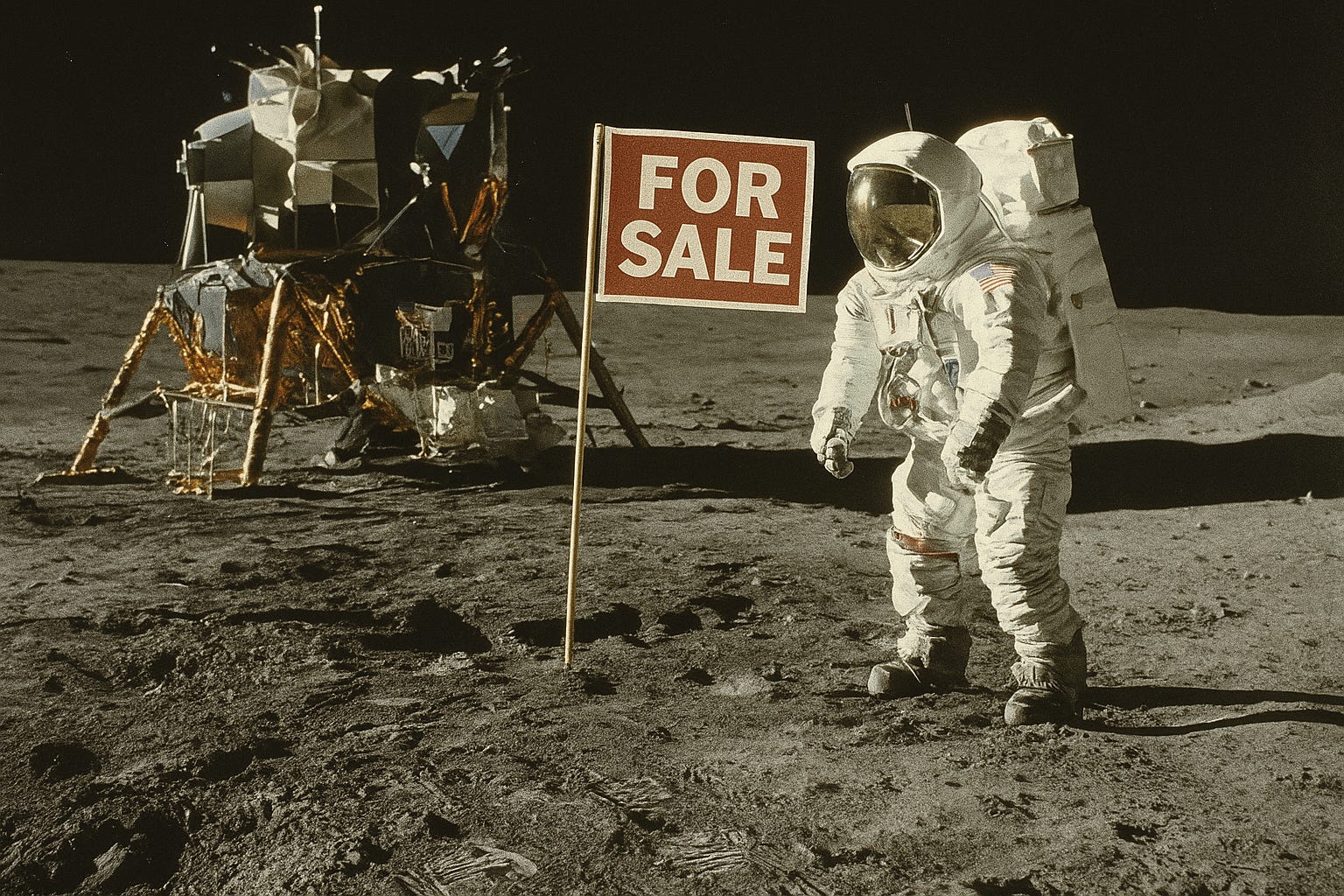
We are at a crossroads, not just in space, but in how we choose to invest in the future. Will science be something we share, or something we sell? Will exploration be driven by curiosity and collaboration, or controlled by capital and competition?
The truth is, NASA isn’t just a space agency. It’s one of the last bastions of public trust in a world increasingly shaped by disinformation, privatization, and political sabotage. To undermine it is to reject the very idea that truth should be a shared good.
International solidarity, climate resilience, medical breakthroughs, and technological equity could mark the next era of space exploration. Or it could be a gilded arena for billionaires and demagogues where knowledge is gated and access is monetized.
This isn’t about nostalgia for the Apollo era. It’s about recognizing that the challenges we face—rising seas, food insecurity, extreme weather, energy crises—require the kind of science, imagination, and investment that only public institutions like NASA can lead.
We don’t need a race to Mars while Earth burns. We need space research that helps us save Earth and prepares us for whatever comes next.
The Real Choice
This isn’t just about NASA. It’s about the broader war on science, on truth, on institutions, on the very idea that facts should guide policy. From climate denial to pandemic misinformation, we’ve seen what happens when science is starved, silenced, or spun for political convenience.
Trump’s attacks on NASA are only the latest front. The same budget that slashes space science guts climate research, undermines public health, and politicizes education. When science is treated as partisan, everyone loses, especially the most vulnerable.
We need to fund science, not just to launch missions, but to stabilize economies, combat diseases, protect our planet, and gain a deeper understanding of our place in the universe. That means rejecting the idea that science exists to serve politics or profit. It exists to serve people.
A healthy democracy doesn’t just tolerate science; it protects it. It champions institutions like NASA. It invests in discovery, values evidence, and dares to imagine a future beyond scarcity and fear.
We can have space for all, or space for sale. The choice is ours.
We just hit 15,000 subscribers—thank you!
Get exclusive access for just $1/week or $52 a year.
Get exclusive analysis and fearless reporting you won’t find in corporate media.
Bibliography:
National Oceanic and Atmospheric Administration, Space Weather Prediction Center. “Alerts, Watches and Warnings.” Accessed June 2025.
National Oceanic and Atmospheric Administration, Space Weather Prediction Center. “Coronal Mass Ejections.” Accessed June 2025.
National Oceanic and Atmospheric Administration, Space Weather Prediction Center. “GOES X‑ray Flux.” Accessed June 2025.
National Oceanic and Atmospheric Administration, Space Weather Prediction Center. “Space Weather Watches, Warnings and Alerts.” Accessed June 2025.
National Aeronautics and Space Administration. “NASA Spinoff 2021.” Accessed June 2025.
Mental Floss. “11 NASA Inventions We Use Every Day.” Published 2023.
Science.HOWSTUFFWORKS.com. “What NASA Technology Helps Keep You Warm?” January 2025.
D. Cordelli. “Privatization, Structural Dependence, and the Problem of Legitimacy.” Erasmus Journal for Philosophy and Economics 16, no. 2 (Winter 2023): 66–84.
“Impact of Privatization on Healthcare System: A Systematic Review.” PMC (PubMed Central), accessed June 2025.

Fascinating…I had no idea NASA contributed to so many important innovations. Thanks for the info.
Privatizing a government agency for profit. Sounds familiar.