


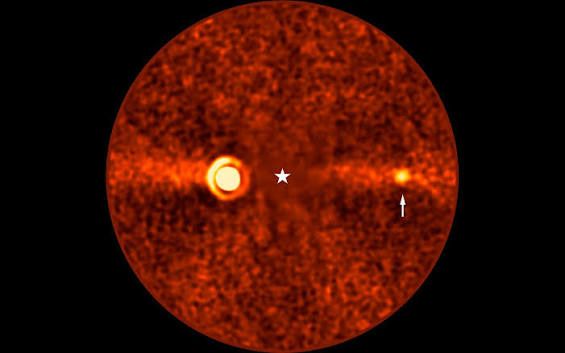
Astronomers have confirmed a faint new planet orbiting Beta Pictoris, a young star system about 63 light years from Earth, after the world spent years hidden in data and dust.
The planet, called Beta Pictoris d, is the third giant planet found in the system. NASA said the James Webb Space Telescope detected it by identifying chemical fingerprints in its atmosphere, while a separate team using the European Southern Observatory’s Very Large Telescope and archival observations independently confirmed the discovery.
AP reported that the planet is the dimmest ever directly imaged from Earth and that two research teams found it independently late last year using different telescopes. The planet is roughly Jupiter like, takes about 91 years to orbit its star, and was overshadowed by its brighter host star and two companion planets.
Subscribe free for daily political analysis they won’t broadcast. Join 110K+ readers →
The finding is more than another entry in the exoplanet catalog. NASA said Beta Pictoris d remained difficult to see because it lies within one of the brightest debris disks known. Webb’s spectroscopic method helped isolate molecular signatures from the planet’s atmosphere, including evidence used to confirm that the signal was not just dust or an image artifact.
That could matter for future planet hunting. NASA described Beta Pictoris d as the first directly imaged planet discovered primarily through moderate resolution spectroscopy, a method that could help astronomers find faint worlds in complicated star systems.
Online reaction has been strongest in space focused communities. On Reddit, users reacted to the image itself, the fact that multiple planets appear in the system, and the scale of imaging a world 63 light years away.
Scientists plan to keep studying Webb data to refine the planet’s temperature, atmosphere, and orbit.
Subscribe free for daily political analysis they won’t broadcast. Join 110K+ readers →