


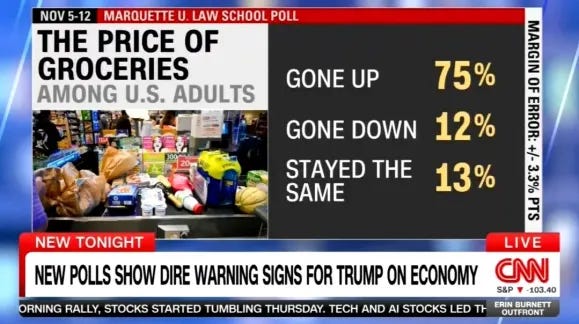
A new Marquette University Law School national poll finds that Americans overwhelmingly believe groceries cost more today than they did six months ago — and the number is striking.
According to the survey (Nov. 5–12, 2025), about:
75% say prices have gone up
13% say prices stayed the same
11–12% say prices have gone down
These are the same rounded figures that appeared in a recent CNN graphic, which simplified the poll’s five detailed response categories into three clear buckets (“up,” “same,” “down”) so they would total 100% on screen.
Who Feels It Most
Not everyone feels the rise equally. Marquette’s own breakdown shows:
66% of people living comfortably say groceries are up
76% of people just getting by say they’ve risen
85% of people struggling financially say they are paying more
That means the poorer you are, the worse the prices feel — and that perception gap is consistent across multiple Marquette surveys.
Politics Plays a Role Too
The poll also found big partisan differences in how people perceive the exact same grocery prices:
56% of Republicans say prices are up
82% of independents say they’re up
92% of Democrats say they’re up
This matches what economists have said for months: inflation isn’t just economic — it’s political. Voters’ views of the economy tend to match their politics.
The Approval Rating Angle
The same Marquette survey shows Donald Trump at 43% approval and 57% disapproval as he heads deeper into his second term.
And when voters were asked specifically about his handling of inflation and the cost of living, the numbers were even harsher:
28% approve
72% disapprove
That helps explain why CNN spotlighted the grocery-price spike during economic coverage. When three-quarters of Americans say groceries cost more — and when voters rate the president poorly on inflation — the issue becomes a political pressure point.
What This Means Going Forward
This is not the first Marquette poll to show rising grocery-price perception, and it likely won’t be the last. For more than a year, majorities in Marquette’s national and state surveys have said food prices feel higher than they were six months earlier.
As Congress prepares for another round of economic debates — and as the 2026 midterms quietly begin to take shape — grocery costs remain one of the most powerful forces shaping public mood.
Whether prices continue to rise or finally cool, voters have already made up their minds: something at the grocery store feels wrong, and they’re blaming Washington for it.