


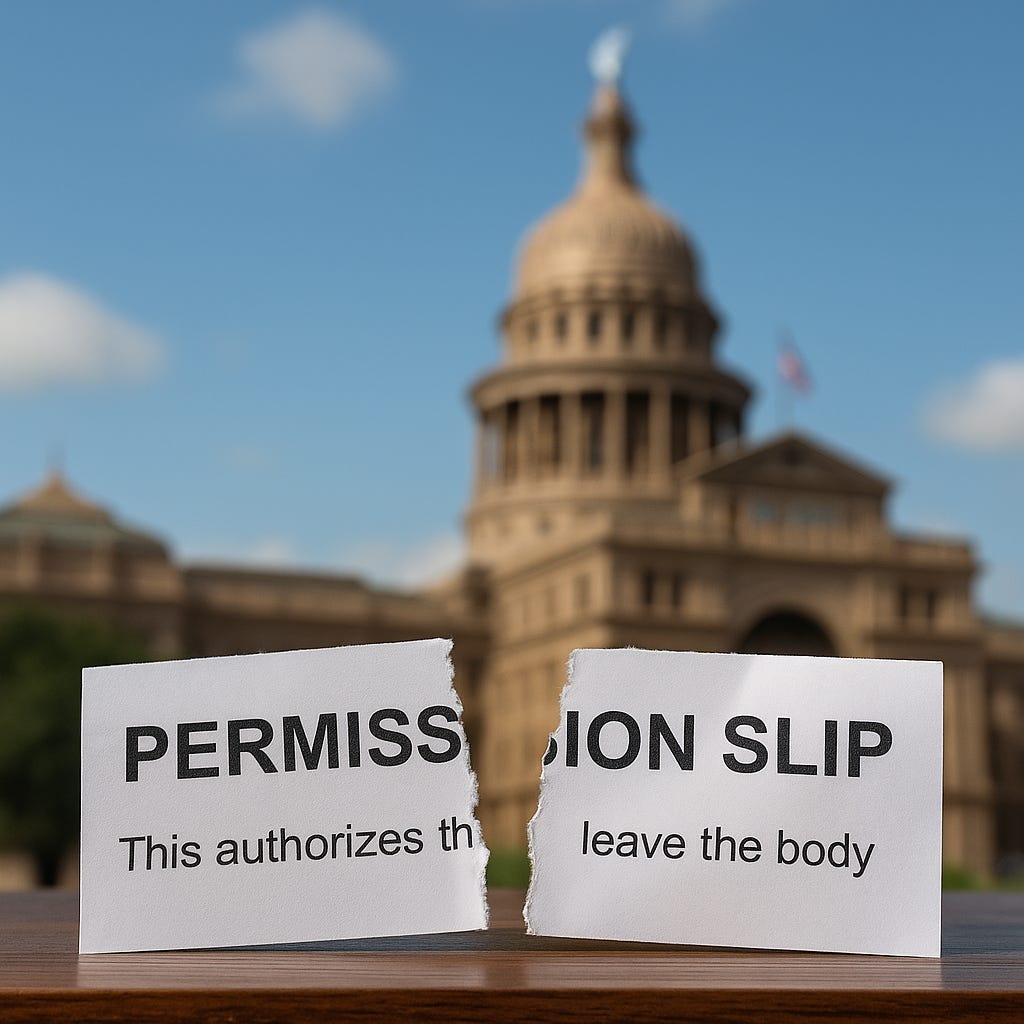
On the night of Monday, August 18, the Texas House chamber did not empty out with the final gavel. One lawmaker stayed behind. Representative Nicole Collier, who represents District 95 in east Fort Worth—a majority-minority district—refused to leave. She had declined to sign a permission slip required by House leadership, a document authorizing the Department of Public Safety to track her whereabouts and, if necessary, escort her back to the chamber to maintain quorum. The rule had been implemented to prevent Democratic lawmakers from breaking quorum by leaving the building, but in practice, it placed those who refused under informal confinement.
That single act, small in motion but monumental in meaning, was a rejection of both the physical constraints being imposed on her and the political power play behind them. The special session was supposed to be about flooding relief. But the first order of business was redistricting, specifically, a mid-decade rewrite of congressional maps that fractured minority representation in Fort Worth, Houston, El Paso, and San Antonio. Collier’s own district was among those carved apart.
By refusing to comply, she made a different kind of quorum. She showed up, she stayed, and she chose to be present not as a pawn but as a protest.
While her colleagues went home—some reluctantly, many silently—Collier spread out a blanket and made a bed on the cold House floor. She did not call a press conference. She did not livestream her defiance. She simply endured. Alone, that night, with the weight of principle pressing down harder than the lights above her, she became the conscience of a legislature that had lost its way.
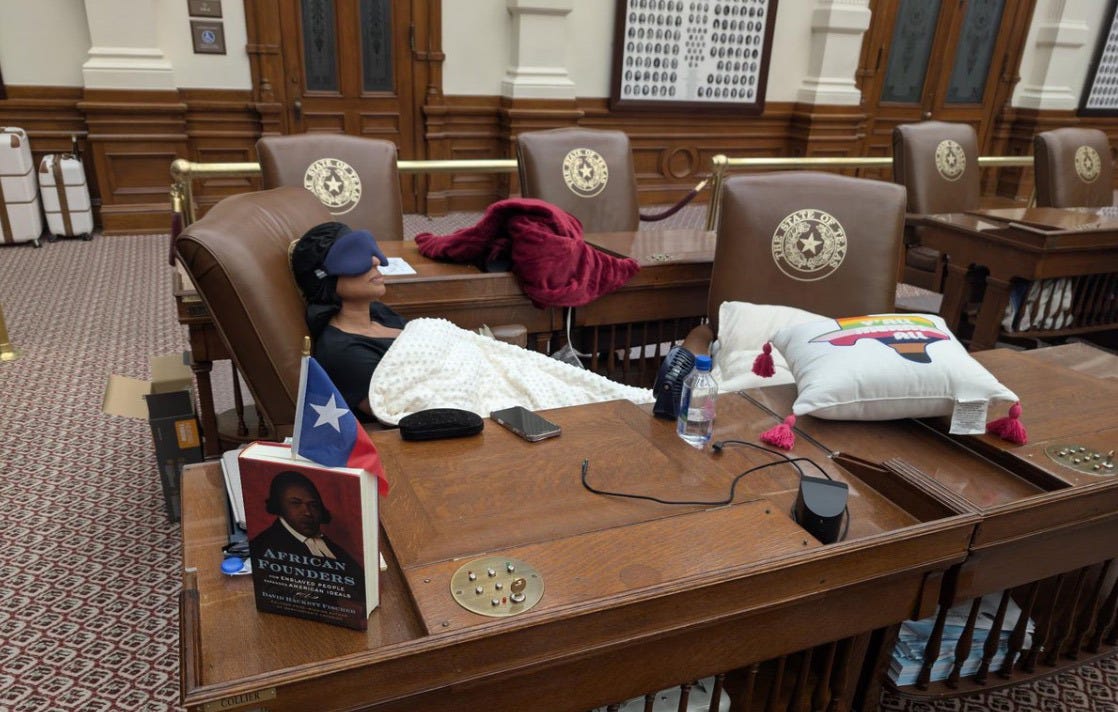
Via Representative Collier’s X post
Because democracy doesn’t defend itself, and neither does your sanity. Subscribe here to keep your eyes open and your sarcasm sharp.
The Swell: When Others Joined Her
The following night, Tuesday, August 19, Collier was no longer alone. One by one, six fellow Democrats joined her on the House floor, some with blankets, others with nothing but the same quiet resolve. Before bedding down for the night, they each tore up their own permission slips in a symbolic rejection of the surveillance they had initially accepted.
Among them were Representatives Gene Wu of Houston and Vince Perez of El Paso, both of whom represent heavily Latino districts that were also targeted in the redrawn maps. They had initially signed the slips, but by Tuesday, their presence alongside Collier was a gesture of solidarity and regret. Joining them were four women—Rhetta Bowers of the Dallas-Fort Worth suburbs, Mihaela Plesa of North Texas, Penny Morales Shaw of Houston, and Cassandra Garcia Hernandez of San Antonio. Each of their districts, like Collier’s, stood to lose political power under the new lines.
They did not arrive with cameras in tow. There was no press event or coordinated media rollout. But their decision to return to the floor after having previously complied was a meaningful escalation. If Monday night had been a statement of one woman’s defiance, Tuesday night became a demonstration of collective resistance.
Yet their numbers were still small. Out of a House Democratic caucus of over 60 members, only seven chose to sleep on the chamber floor. The message wasn’t just who stood up. It was how many didn’t.
The Mockery and Control
If Collier’s protest was dignified and restrained, the Republican response was anything but. Rather than engage with the substance of her dissent or the unprecedented nature of detaining lawmakers inside the Capitol, GOP members opted for mockery. One Republican likened the Democratic sit-in to “camping out for the new iPhone,” reducing a protest over political surveillance and racial disenfranchisement to little more than performative self-indulgence.
It was not just dismissive. It was pointed. The metaphor wasn’t chosen by accident. It feminized the act of protest, trivialized it, and cast it as a consumerist spectacle rather than civic defiance. The fact that a Black woman had taken the first stand, and that women and men of color had followed, only underscored the racial and gender dynamics behind the insult.
Behind the mockery was real power. The DPS escort rule remained in effect, even after redistricting had passed on Wednesday. House leadership gave no indication that lawmakers like Collier would be permitted to leave without consequence. In effect, she remained confined to the chamber, held in place not by bars, but by a refusal to release her from the architecture of compliance.
Collier, for her part, met the condescension with clarity. “This is not the way to govern,” she told reporters. “You don’t govern by force.”
She explained her decision plainly: “I will not agree to be in DPS custody.” And when asked about the possibility of indefinite confinement, she did not waver. “If I have to be detained in order to do my job, then so be it.”
This was not performance. It was resistance in its rawest form.
The Silence: Who Didn’t Show Up
Even as Collier’s stand drew quiet momentum from a few colleagues, the overwhelming response from the rest of the Democratic caucus was silence. More than fifty House Democrats stayed home, stayed quiet, or complied. Some, like Rep. James Talarico, who had once been hailed as a rising progressive voice in the party, signed the permission slip and left without public comment.
No one expected a mass walkout, but a unified refusal to sign? A coordinated decision to remain on the floor in protest of a party using state law enforcement to surveil elected officials? That would have sent a message. It could have reframed the session, or at the very least, drawn national attention to the constitutional implications of what was unfolding in Austin. Instead, one lawmaker acted alone until six more joined her, too late to change the outcome.
Collier, meanwhile, didn’t just stay. She sued.
On August 19, she filed a writ of habeas corpus with the Texas Supreme Court, asking the justices to rule on whether the DPS rule amounted to unlawful detention. The petition argued that lawmakers were being “held in physical custody” and subjected to “threatened or actual force” by executive order, simply for attempting to leave the Capitol building. The court has not yet ruled on the matter, but the message was unmistakable: if her colleagues would not stand with her, she would stand on the Constitution.
The contrast was stark. While Collier prepared a legal challenge to the state’s overreach, others packed their bags and went home.
The Emergency That Wasn’t
Governor Greg Abbott had called the second special session under the banner of public safety. Just months earlier, catastrophic flooding in the Hill Country had killed more than a hundred Texans, destroyed homes, and exposed the glaring failures in the state’s emergency response system. It was a moment tailor-made for meaningful reform: resilient infrastructure, flood alerts, emergency coordination.
Instead, the very first bill passed was a redrawn congressional map.
Of the eighteen items Abbott placed on the special session agenda, only seven had anything to do with disaster relief. The rest included a slate of ideologically charged legislation: a revived bathroom ban, restrictions on abortion pills, new limitations on hemp and THC products, and a renewed effort to muzzle local governments. Flooding might have triggered the session, but it was quickly relegated to the bottom of the pile. For Republican leadership, it was the cover story, not the crisis.
See our previous reporting here:

No bill to expand warning sirens was passed in the return to the chamber. No new funds were allocated to prevent the next Kerr County tragedy, where lives were lost in part because the county had declined federal disaster aid years earlier. The storm had already come and gone. So had the political urgency.
Once Democrats were confined to the chamber floor, the emergency had been forgotten.
The Power Grab: Redistricting Redux
In normal times, redistricting happens once a decade, following the U.S. Census. Texas had already completed that process in 2021. There was no legal requirement, no court order, no data-driven necessity to revisit the congressional map. But with Donald Trump urging allies to redraw districts before the 2026 midterms—and Republicans facing demographic erosion in urban centers—Governor Abbott made redistricting a top priority of the emergency session.
Once the legislature returned to the chamber, the new map was introduced, debated, and passed with remarkable speed. It added five new safe Republican seats and reshaped several districts where Democrats had gained ground in recent years. The result was a map engineered not to reflect voter will, but to override it.
Republicans currently win about 56 to 58 percent of the statewide vote, yet the new map gives them control of as many as 30 of the state’s 38 congressional districts, nearly 80 percent of the seats. It’s not a representative democracy. It’s representational inflation.
Collier’s district in Fort Worth was one of those that was split and diluted. So was Gene Wu’s in Houston and Vince Perez’s in El Paso. The four women who joined them on the House floor—representing the suburbs of Dallas, San Antonio, and Harris County—also serve communities being fractured or absorbed into more conservative districts. We don’t know what the new maps look like exactly, but it is easy to guess. Their protest was not hypothetical. It was a direct response to the theft of political power from their constituents.
Texas Republicans weren’t just rigging the game. They were changing the rules mid-play, with a map built to last a decade, passed under the cover of an emergency that wasn’t.
See our reporting on the redistricting efforts here:


Abbott’s Priorities: Culture Wars Over Climate
If redistricting was the first order of business in this so-called emergency session, culture-war legislation was not far behind. Many of these bills had already made appearances earlier in the year, debated, delayed, or blocked during the first special session. But this time, with quorum secure and public focus elsewhere, Governor Abbott’s ideological priorities began moving again with renewed speed.
A ban on consumable hemp products containing THC passed the Texas Senate in both sessions. In the first special session, it failed to advance in the House, blocked by procedural delays and the Democratic walkout. But in this second session, the Senate passed a fresh version—Senate Bill 6—on August 18 by a 22–8 vote. It now heads to the House, where it’s expected to fare better amid reduced dissent.
Bathroom legislation targeting transgender Texans followed a similar path. A so-called “bathroom bill” was reintroduced in the first special session but failed to gain traction. When it returned as Senate Bill 8 in the second, the Senate fast-tracked it, bypassing public notice requirements to accelerate hearings. It passed out of committee just a day after the session began.
Other ideological items—like restrictions on local governments' ability to lobby the state legislature—were also recycled between sessions and advanced again in the Senate. Meanwhile, abortion pill restrictions, framed as maternal health policy, remain stalled but still loom on the agenda.
By contrast, the legislation that should have defined the session—disaster preparedness—remains largely untouched. No significant funding has been allocated to flood mitigation. Siren systems, infrastructure repairs, and emergency coordination bills languish in committee.
The result is a session that looks less like a response to a natural disaster and more like an opportunity for political consolidation. Abbott, under increasing pressure from both Donald Trump and Elon Musk, has chosen to govern through distraction. With redistricting secured, and culture war victories stacking up, the real emergency—how Texas failed its people during the floods—has faded into the background.
The Disconnect: Texans Want Help, Not Headlines
The divide between what Texans need and what their government is delivering has never been more stark. In poll after poll, voters list the same priorities: affordable healthcare, infrastructure resilience, and emergency response. Even in the deeply polarized landscape of Texas politics, there’s a broad consensus that state leaders should play a major role in disaster preparedness.
A recent survey found that 70 percent of Americans, and nearly two-thirds of Republicans, expect the government to invest in flood warning systems and recovery planning. Another showed that only 26 percent of Texans consider bathroom legislation “very important.” Cannabis regulation, likewise, ranks far below economic and healthcare concerns. The message from the public is consistent: we want help, not headlines.
But Austin isn’t listening. While lawmakers spent hours debating THC thresholds and bathroom assignments, flood victims were left waiting. While redistricting maps were printed and passed in less than a week, no new emergency infrastructure was funded. And while legislative attention centered on ideological purity, nearly five million Texans remain uninsured, many of them children.
This isn’t just political negligence. It’s deliberate misdirection. The emergencies that bring lawmakers into session are never the emergencies that define their actions. Disasters are real, but culture wars are evergreen and easier to fundraise on.
It’s not hard to see why voters feel abandoned.
The Stand That Mattered
Nicole Collier didn’t stop the redistricting vote. The maps passed. The permission slips remained in effect. The surveillance rule stayed on the books. The culture-war bills continued their march through the Capitol.
But her protest cut through the noise. In a legislature that had gone numb to its own corruption, Collier brought clarity, first by standing alone, then by inspiring others to follow. She didn’t wait for permission. She didn’t hide behind party strategy. She refused, and then she stayed.
When she filed her habeas corpus petition, she wasn’t trying to make a scene. She was trying to make a point: that freedom of movement and conscience are not privileges handed down by the Speaker’s office or revoked at the governor’s whim. They are rights. No political party, no law enforcement agency, no “emergency session” gets to suspend them without resistance.
The six others who eventually joined her brought some power to that moment. But the moral weight still belongs to the first night, the night she stayed alone, on a thin blanket under bright lights, asserting her right to represent the people who sent her to Austin.
The tragedy isn’t that she stood alone. It’s that she had to.
Don’t let the bastards sneak anything past you. Subscribe and get your daily dose of rage and receipts delivered fresh, before the spin doctors can scrub it.
Sources:
“4 women arrested over supporting Texas Democrat's lock‑in Capitol protest” – San Antonio Express-News
“Rep. Nicole Collier camps out in House chamber in Democrats' last stand against GOP redistricting” – San Antonio Express-News
“Texas rep held in state Capitol seeks court order for her release” – Axios (Dallas)
“Democratic lawmaker defies GOP 'permission slip,' vows to remain in Texas House chamber” – Houston Chronicle
“Texas Democrat Rep. Nicole Collier sleeps in state House, calls herself 'political prisoner'…” – New York Post
“Texas House Rep. Nicole Collier locked in chamber Monday night after refusing to sign GOP 'permission slip’” – Austin American-Statesman
“Nicole Collier, Texas lawmaker who slept at statehouse, files lawsuit challenging police escorts” – Texas Tribune
“Gov. Abbott orders special session on Hill Country flooding, redistricting, THC and unfinished GOP priorities” – Texas Tribune
“Texas House Democrats join Rep. Nicole Collier in protest” – KVUE Local News
“Texas Senate fast tracks THC ban, flood prep and bathroom restrictions…” – Texas Tribune
“Texas House Democrats flee the state in bid to block GOP’s proposed congressional map” – Texas Tribune
“Abbott calls second special session as first round ends with Democrats still out of state” – Texas Tribune
PDF of Collier’s habeas corpus petition – Courthouse News
Editorial: “Texas is drowning— and lawmakers are playing politics” – Houston Chronicle
Editorial: “After years of negligence, Texas lawmakers must address flood threat” – San Antonio Express-News

When Texas created a legislature, it should have used manaquins. It would fit their delusion better.
James Talarico's compliance and absence of solidarity is the greatest disappointment.