


On the night of September 25, 2025, the U.S. Supreme Court quietly handed President Trump another win. With no oral arguments, no signed opinion, and no public explanation, the Court allowed the administration to freeze billions in foreign aid —funds that had already been approved by Congress and allocated to humanitarian partners worldwide.
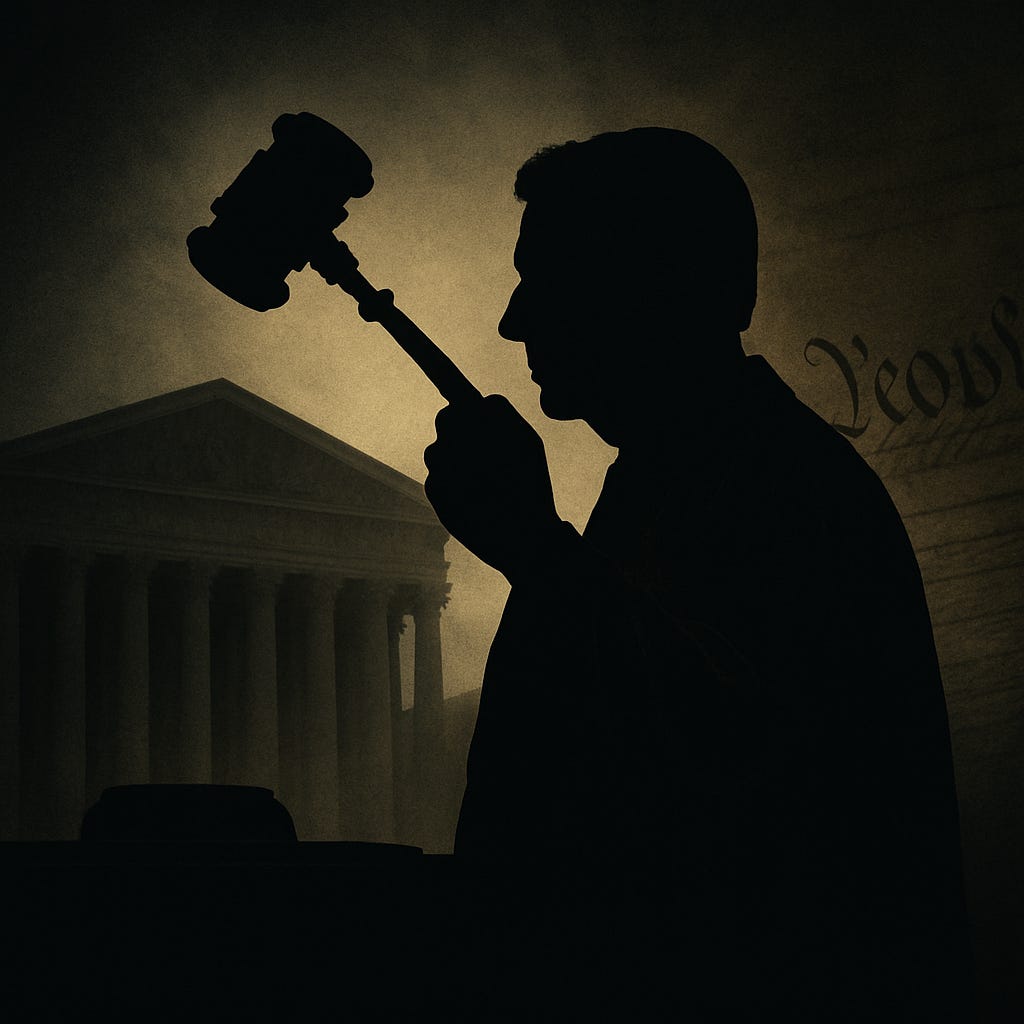
This wasn’t a traditional ruling. It came via what’s known as the “shadow docket”, a secretive backchannel of emergency orders issued with speed and almost no transparency. Originally designed for rare, time-sensitive procedural actions, the shadow docket has become Trump’s legal weapon of choice.
We just hit 20,000 subscribers, 1,000 articles, and 1,000 podcast episodes. To celebrate, paid subscriptions are 20% off for two weeks only. That’s just $64/year—less than $1.25 a week.
A Backdoor for Presidential Power
Since returning to office in January, the Trump administration has filed twenty-three emergency applications to the Supreme Court. The Court has sided with him in twenty-one. In the span of just nine months, Trump has used this obscure legal tool to fire independent regulators, sideline federal agencies, suspend aid, and fast-track layoffs. In each case, the Court’s intervention came quickly—sometimes within days—without the deliberation or reasoning Americans typically associate with the judiciary.
Unlike full Supreme Court opinions, these decisions don’t explain themselves. They often arrive unsigned, late at night, through a one-sentence order. And yet their impact is immediate. The president gets what he wants, and the law shifts—at least for a while—without a full airing of the facts or arguments.
Emergency Justice, Without Accountability
Shadow docket decisions were never intended to be the primary means by which this country resolves constitutional questions. They were meant for genuine emergencies—imminent executions, natural disasters, time-sensitive injunctions. But under Trump, they’ve become a go-to strategy for asserting control.
The decisions don’t set formal precedent, but that’s not the point. They let policy go into effect immediately. By the time a full case winds its way through the courts, the executive action is already in motion. In many cases, the original conflict becomes moot. What was supposed to be temporary becomes permanent simply because no one stopped it fast enough.
The Judiciary’s Slow Drift Into Executive Capture
Legal scholars refer to it as “executive capture”, when institutions designed to check power instead start serving it. That’s what’s happening now, in real time. The Supreme Court, by greenlighting Trump’s emergency requests without explanation, is no longer acting as a restraint. It’s acting as a collaborator.
The judiciary has become a power amplifier. Not through sweeping, landmark rulings that reshape doctrine, but through quiet, procedural nods that reshape reality. It is governance by judicial silence.
From the Pen to the Gavel: A Dangerous Symmetry
This pattern mirrors another trend that should be familiar by now: Trump’s reliance on executive orders to bypass Congress. What began decades ago as internal memos to manage federal agencies has become a primary tool of presidential policymaking. Immigration bans, regulatory repeals, and spending directives are now rolled out with little debate or delay.
The shadow docket is the judicial echo of that approach. One branch writes the order. Another clears the path. Together, they create a dual-track system for enacting power—fast, opaque, and largely unaccountable.
When Time Becomes the Battlefield
A full Supreme Court case can take months, even years. But a shadow docket decision can reshape policy overnight. That’s the real danger. Trump’s team understands the value of speed. They don’t have to win on the merits. They just need enough time to act before the courts catch up.
By the time legal challenges reach full review, agencies have been gutted. Funds have been cut. Laws have been enforced. Opponents are left trying to undo changes that have already taken root. Even if the final ruling reverses course, the damage will have been done.
Cracks in the Wall, But Not Enough
There are signs of resistance. Civil rights groups, advocacy organizations, and state attorneys general are increasingly challenging these emergency decisions more aggressively. They’re asking the Court to justify its actions, to slow down, to explain.
Some liberal justices—Elena Kagan most vocally—have warned that the Court is losing legitimacy by deciding major issues in the shadows. Members of Congress have introduced bills to force greater transparency and limit the use of emergency procedures in politically consequential cases.
But these efforts are slow. The machinery of oversight is grinding, and Trump’s strategy is moving much faster.
The Stakes Couldn’t Be Higher
The shadow docket was never part of the constitutional design. It evolved out of necessity, rather than a vision. But like executive orders, it’s now being used to sidestep the very democratic processes it was meant to complement.
If this trajectory holds, the courts won’t be a check on the presidency. They’ll be part of it. The more the public accepts these quiet, unexplained shifts in power, the more we concede that the law is no longer something we debate. It’s something that happens to us.
The Founders imagined a government of laws, not of men. But in today’s Washington, one man writes the order, a few justices nod, and the law changes—quietly, quickly, and without a word.
Stay Informed. Stay Loud.
Subscribe to The Coffman Chronicle for no-BS political analysis, action guides, and daily truth bombs you won’t get from corporate media.
Sources:
“US Supreme Court expands its ‘emergency’ docket — and Trump’s power too”, Reuters
“US Supreme Court lets Trump remove consumer product safety commissioners”, Reuters
“Supreme Court allows Trump officials to freeze billions in foreign aid”, The Washington Post
“Trump can slash Education Department’s civil rights staff, court rules”, Reuters
“Supreme Court lets Trump end legal protections for 500,000 migrants, exposing more to deportation”, AP News
“Judge rules Trump’s firing of FTC commissioner was illegal”, Reuters
“US judge orders Trump to reinstate fired product safety commissioners”, Reuters
“Supreme Court sides with Trump administration in battle over ability to remove agency commissioners”, SCOTUSblog

Pritzker should authorize the Purge. Chicago would be lit. Let them try to stop it in time. Blessed be Governor Pritzker and America, a Nation Reborn.
This is how empires fall.