


Every major poll tells the same story: the American public is disillusioned with both political parties. Approval ratings for Democrats and Republicans are in free fall. Faith in institutions is crumbling. Calls for a third party are louder than ever.
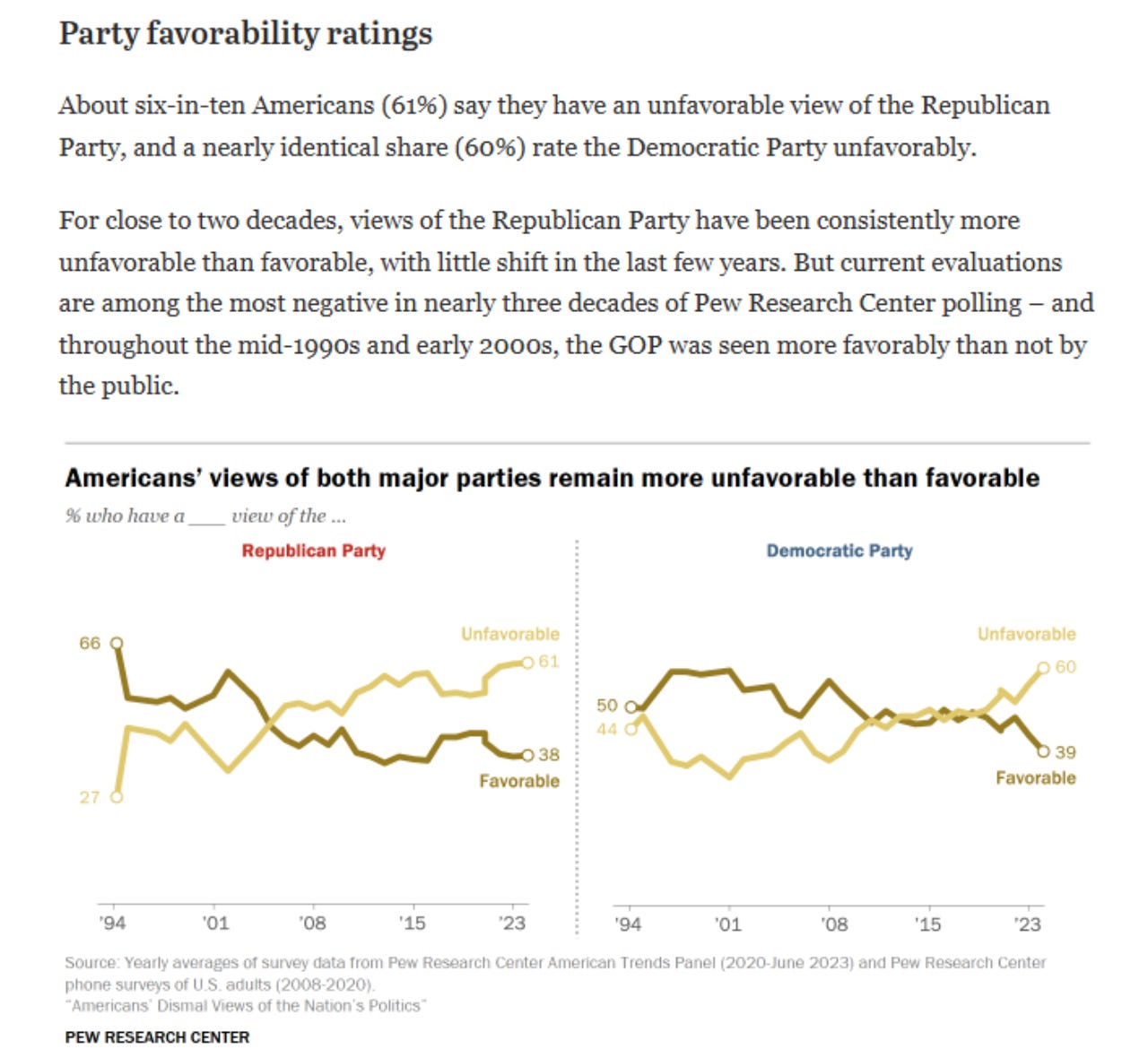
These aren’t just vibes. This is measurable, documented decline— and it’s been years in the making.
And yet, nothing seems to change.
Party leaders look at this growing dissatisfaction and somehow interpret it as a call for more of the same: more caution, moderation, and triangulation.
But that’s not what people are asking for. Not really.
They’re not asking for “centrism” in the sense that consultants and cable news panels define it. They’re asking for honesty. For action. For basic dignity in policymaking. For a political system that works for them, not just for donors, lobbyists, or legacy media narratives.
And the disconnect between what people say and what the political class hears? That gap is becoming unbridgeable.
We’ll examine how polling misreads, political tribalism, and generational disconnection are converging into a democracy-wide disconnect and consider where we might go from here.
Independent News. Just $1/Week.
We just hit 10,000 subscribers—thank you! We’re offering full access to The Coffman Chronicle for just $1 a week ($52/year) to celebrate.
Get exclusive analysis and fearless reporting you won’t find in corporate media.
Support truth. Stay informed.
The Polling Misread and the Myth of “Centrism”
Every few months, a new poll drops showing voters drifting away from both parties. Another report says Americans want the Democrats to be “more centrist.” And without fail, party leadership interprets this as a green light to water down their policies — to pull back from bold ideas and compromise before the fight begins.
But what if “more centrist” doesn’t mean “less ambitious” or “less progressive”?
What if it means something else entirely?
When pollsters ask Americans about specific policies, without party labels attached, a remarkably consistent trend emerges: people support what are traditionally considered progressive ideas.
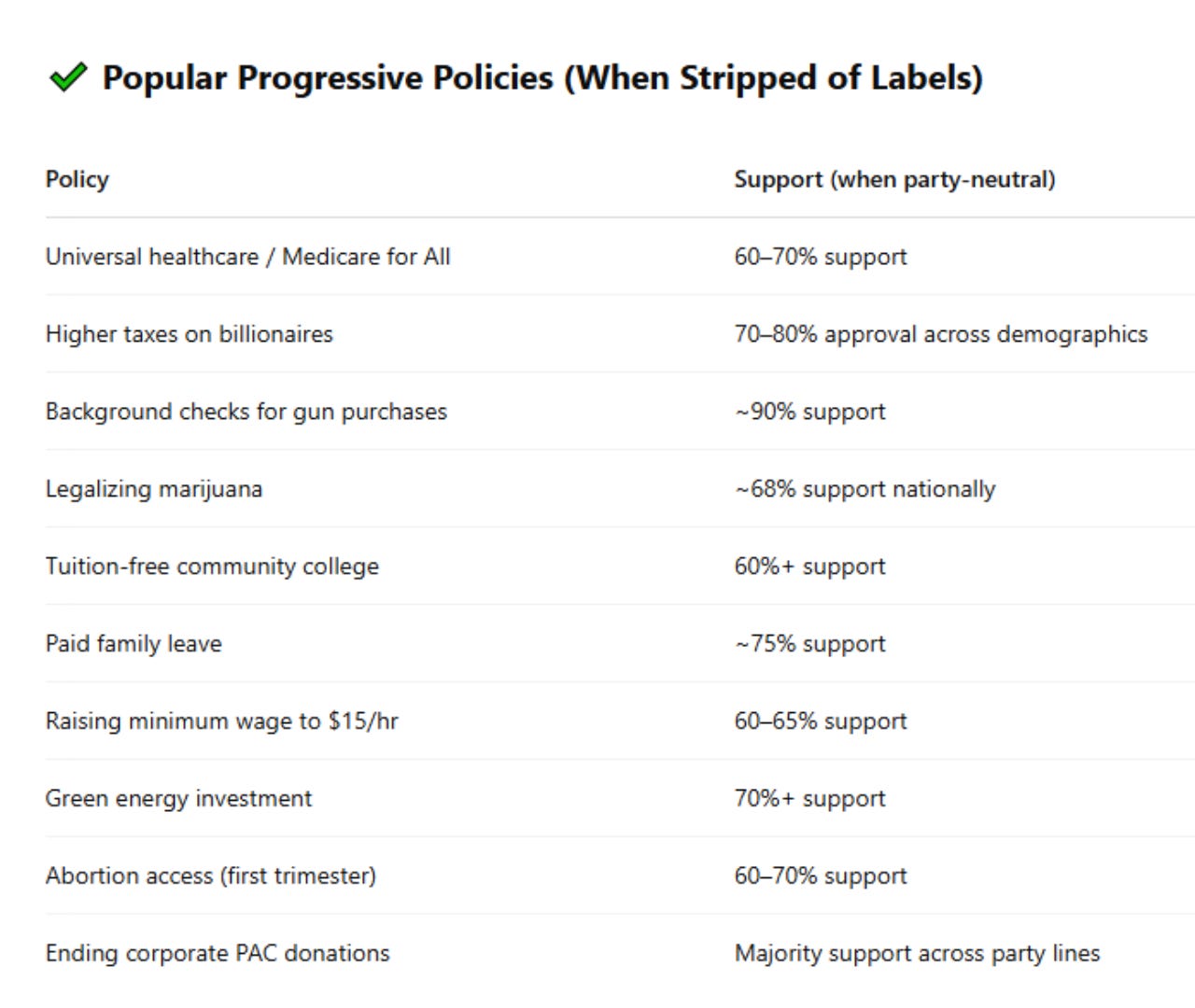
These aren’t fringe positions. They’re mainstream. In some cases, they’re overwhelmingly popular.
But instead of hearing that support, Democratic leadership hears a dog whistle: “Be more moderate.” They don’t realize—or perhaps don’t want to admit—that voters aren’t asking for caution. They’re asking for less corruption, more clarity, and actual results.
Words like ‘centrist’ and ‘progressive’ don’t just describe ideas; they trigger identities, fears, and assumptions. Until we ask what people mean when they use these words, we’re not really listening.
But it’s not just about misunderstanding preferences. It’s about misunderstanding pain, and the consequences are being exploited in real time.
Strategic Failure: What the GOP Built While Democrats Took the Bait
While Democrats have spent the last decade trying to refine their messaging, adjust to polls, and avoid backlash, Republicans have been playing an entirely different game. They haven’t tried to win more hearts; they’ve rewired the system to need fewer of them.
Gerrymandering, voter roll purges, judicial takeovers, book bans, and curriculum control are all part of a long-term, systemic plan to hold power without majority support.
See our previous reporting on the right’s attempts to undermine elections:
Note: This article is more than 45 days old and now lives in our archive. Consider becoming a paid subscriber to enjoy our full 450+ article archive, exclusive reporting, and occasional early access.

And yet, while all this has been happening, Democrats — instead of doubling down on material issues or reframing the narrative — have been pulled into culture war traps set by right-wing operatives.
Every week brings a new headline designed to provoke:
Bathrooms. Drag shows. CRT. Trans athletes.
Rather than standing up and saying, “We will not debate the basic humanity of our neighbors,” Democratic leaders often enter the arena as if it’s a legitimate ideological debate.
Many voters — especially younger and more progressive ones — aren't asking Democrats to win every cultural skirmish.
They’re asking them to have a spine. To draw moral lines. To say:“We don’t negotiate civil rights.”
“We don’t compromise on human dignity.”
“We don’t pretend hate is just ‘a difference of opinion.’”
And no place shows the cost of this strategic drift more than in the youngest voters, where a new kind of gendered divide is reshaping American politics.
The Youth Gender Divide — Alienation, Agency, and the Radicalization Gap
There’s a political chasm opening up in America’s youngest voting bloc, and it’s not just ideological—it’s gendered.
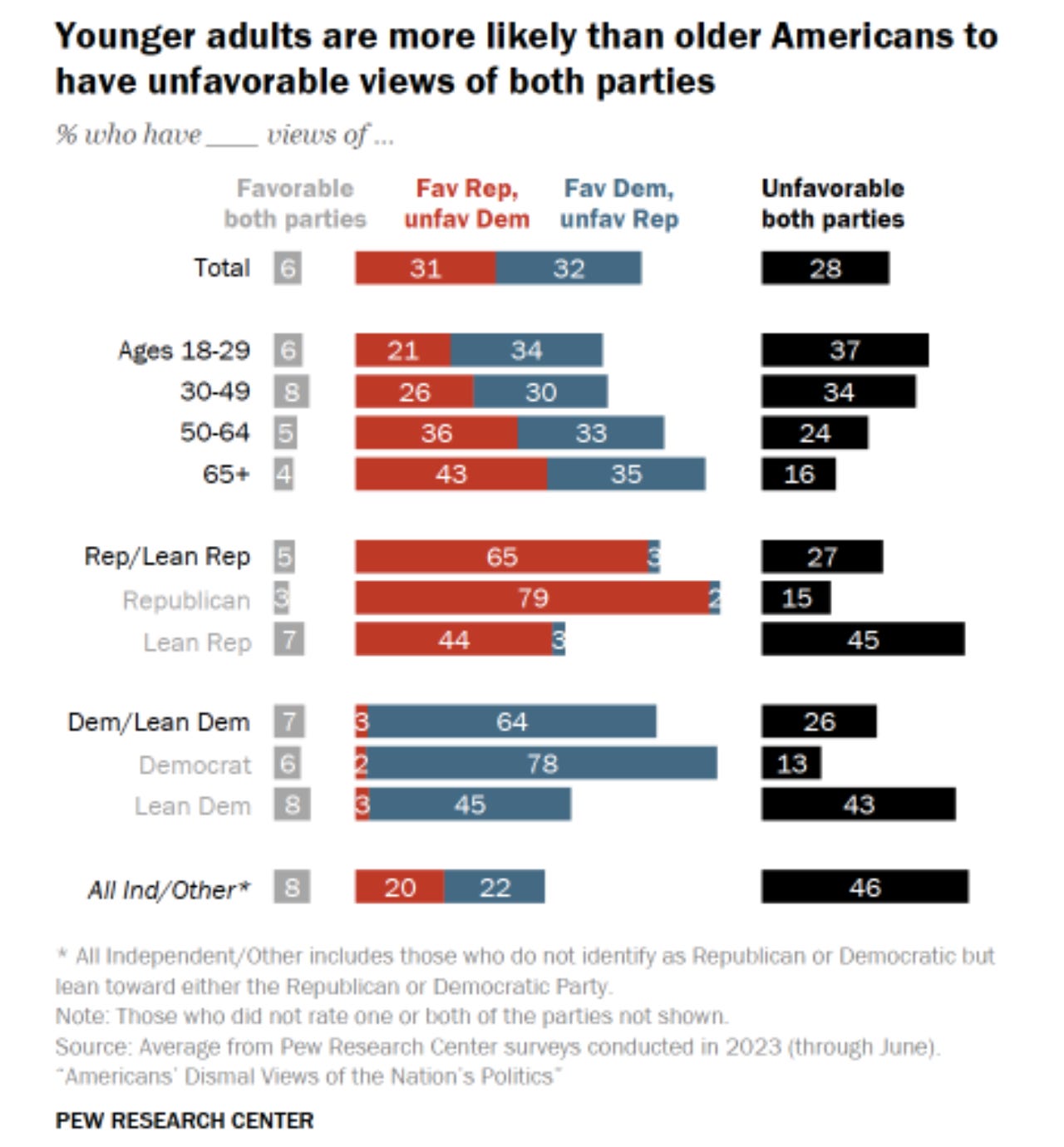
Young women are breaking hard toward Democrats, driven by reproductive rights, bodily autonomy, and the fallout from Roe. They’re not being offered fear. They’re being targeted by it.
Young men, meanwhile, are drifting toward the right — not always ideologically, but emotionally. Influencers like Charlie Kirk and Andrew Tate offer them not just opinions but identity, status, and belonging.
One group is being radicalized by a sense of lost status.
The other is being mobilized by a fight for survival.
And Democrats — instead of offering community, purpose, and courage — often offer polling-tested hesitation.
And when those emotional needs aren’t met with dignity and truth, disconnection turns into disengagement, or worse, into extremism.
The Feedback Loop of Disengagement and Extremism
Disillusionment isn’t just a byproduct of dysfunction — it’s becoming the system’s fuel.
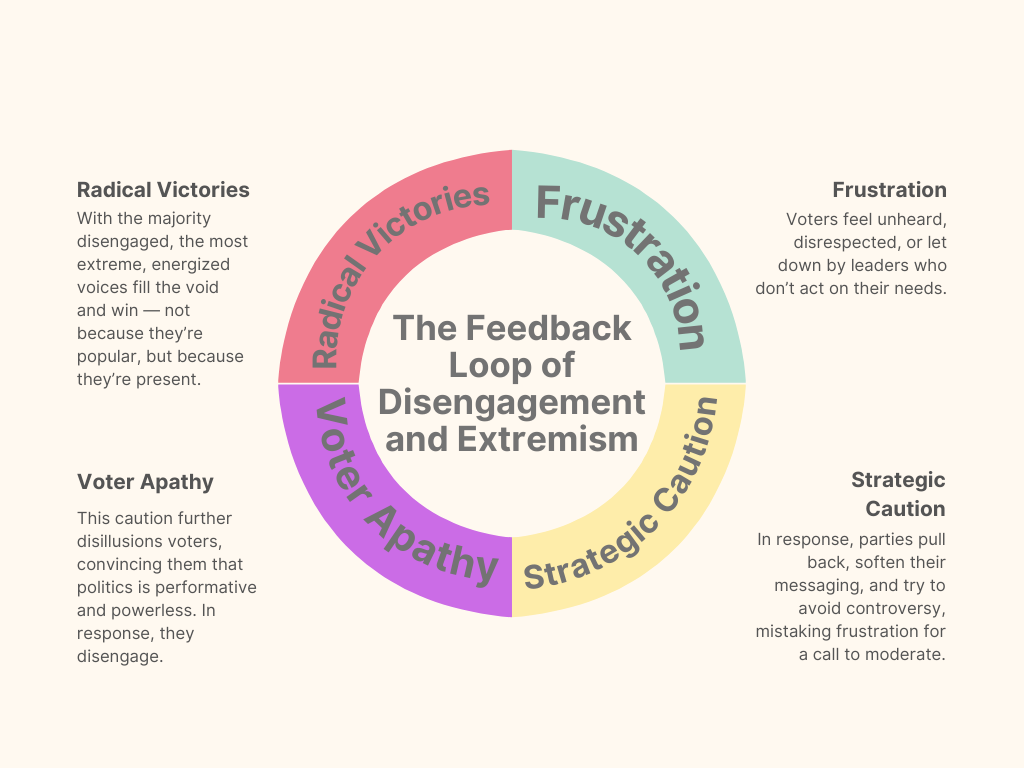
Here’s how the feedback loop works:
Voters get frustrated because they feel unheard.
In response, political parties retreat, playing it safe, moderating, and avoiding risk.
That retreat convinces voters nothing will change, so they disengage.
And that vacuum? It’s filled by the most extreme voices, who show up, win, and make the system worse.
Which brings us right back to more frustration.
Each step feeds the next. The louder the discontent, the quieter the response, and the more extreme the outcomes.
Where We Go From Here: Reconnection, Clarity, and a Politics That Listens
We won’t fix a decades-old fracture with one election or one better slogan. But we can start with courage, clarity, and better questions.
1. Vote Like a Builder, Not a Fan
We don’t need to love a candidate to vote for them. We need to know what they’ll fight for and whether they’ll listen when it matters. Tools like ISideWith or Ballotpedia can help you see who’s aligned with your values across a range of issues, not just one identity. Because politicians often say one thing while voting altogether differently in practice.
2. Listen Better. Ask Better. Poll Better.
Polling language shapes perception. Until we improve how we ask — and really listen — we’ll keep misinterpreting what voters are trying to say. Polls mean nothing when they force respondents into a corner with unclear or misunderstood language.
3. Get Money Out. Let Representation In.
We can’t have a politics that listens until we have one that isn’t bought. Campaign finance reform is foundational, not optional. SuperPacs, Citizens United, and all the rest must go before the only ones with a voice are the ultrawealthy.
4. Rebuild Civic Connection Especially Across Difference
We’re not divided just by party; we’re divided by proximity. The biggest threat to radicalization is exposure. College, public service, diverse workplaces — they break the script. The right knows this. That’s why they’re attacking it.
5. Stop Taking the Bait
Let the right play culture war theater. The left should offer dignity, policy, and moral clarity. Say what’s true, not what polls say is safe. Basic humanity is not up for debate.
6. Make Room for New Voices
One of the clearest demands from voters, especially younger ones, is that leadership should look and sound more like the people it serves. That means making space for younger leaders, working-class voices, activists, and people outside the traditional donor-politician pipeline.
It’s not just about age. It’s about perspective. It’s about leaders who understand the urgency of climate change because they’ll have to live through it. We need leaders who understand housing, debt, and healthcare not as policy points, but as lived realities.
If we want new outcomes, we need new inputs. And that starts with changing who holds the mic.
7. Don’t Just Wait for Better Candidates — Be One
Don't check out if you don’t see a candidate you believe in. Seek one out, support one, or become one. The system depends on more than just votes—it needs volunteers, organizers, challengers, and everyday people willing to step into the ring.
We can’t keep waiting for someone else to save democracy.
We are democracy.
There are local offices, school boards, and state seats where fresh voices can win, but only if we stop thinking politics is something that happens far away.
Final Thought: A Listening Politics Is a Living Politics
We don’t need perfect candidates. We need decent ones who fight for us.
We don’t need clever messaging. We need clarity.
We don’t need a new party. We need a new politics, one that listens.
And that starts not with the polls.
It starts with us.
We just hit 10,000 subscribers—thank you! We’re offering full access to The Coffman Chronicle for just $1 a week ($52/year) to celebrate.
Get exclusive analysis and fearless reporting you won’t find in corporate media.
Bibliography:
Pew Research Center. The Republican and Democratic Parties. September 19, 2023.
Pew Research Center. Age, Generational Cohorts and Party Identification. April 9, 2024.
Pew Research Center. Support for More Political Parties in the U.S. Is Higher Among Adults Under Age 50. October 19, 2023.
Pew Research Center. As Partisan Hostility Grows, Signs of Frustration With the Two-Party System. August 9, 2022.
Pew Research Center. Third-Party and Independent Candidates for President Often Fall Short of Early Polling Numbers. June 27, 2024.
Pew Research Center. Changing Partisan Coalitions in a Politically Divided Nation. April 9, 2024.
ISideWith. Political Quiz to Help You Find Your Political Match. Accessed April 19, 2025.
Ballotpedia. The Encyclopedia of American Politics. Accessed April 19, 2025.
They may turn into 4 parties .. we will see.
I absolutely agree with you, and I feel like I've been banging my head against a wall sending requests to the DNC and my Dem Senators for practical, visible action that they are changing course to show they care more for people than their corporate donors. Crickets. No action plans.
How can your analysis be applied?