


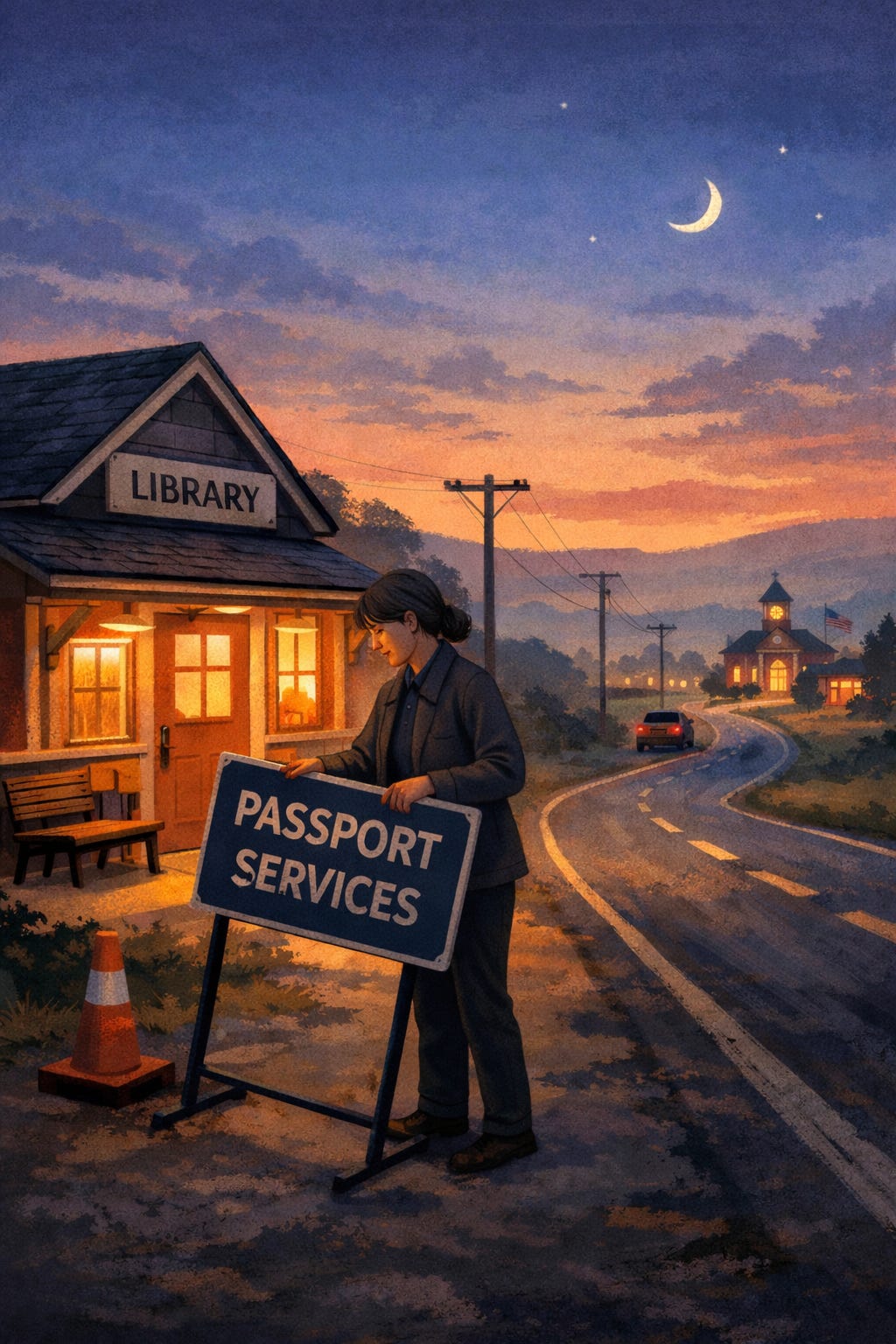
On February 13, 2026, a quiet but consequential change took effect. Nonprofit public libraries across the United States stopped accepting passport applications.
They did not stop because of fraud, or failed audits, or community complaints. They stopped because the U.S. State Department decided that 501(c)(3) public libraries are not “governmental” enough under a century-old law to be allowed to collect passport execution fees. The agency insists the impact is small, saying nonprofit libraries account for “less than 1%” of its more than 7,500 passport acceptance facilities and that “99% of Americans live within 20 miles” of a facility.
On paper, that sounds almost painless. On the ground, especially in rural and small-town America, it is anything but.
This Community Is Powered by You
What started as a small circle has grown into something much bigger, and it’s all because of readers like you.
Every time you forward this email, post it on socials, or bring someone new into the fold, you’re helping build one of the most passionate, independent political communities out there.
Want to keep the momentum going?
Share this newsletter with someone who should be part of this conversation.
Thank you for being here. It means everything.
A Fight That Started Months Before the Headlines
The national headlines about libraries and passports landed the week of February 13. The struggle started months earlier.
In late 2025, nonprofit public libraries began receiving cease-and-desist letters from the State Department advising that, as private nonprofit corporations, they “should never have been approved” as passport acceptance facilities and must stop accepting applications. Some libraries in New England and Pennsylvania quietly wound down passport services in the fall. Others continued operating while seeking clarification. All of them were told there would be a hard cutoff date in February.
In Pennsylvania, the state library association notified members that nonprofit libraries had been told February 13 would be their last day to act as passport acceptance facilities. The WPSU public radio report on the change noted that one small-town branch alone had become a regional passport hub, serving residents who would otherwise have to drive long distances to another county.
As these letters circulated, congressional offices started getting calls. Librarians had spent years training staff, passing federal inspections, and building high-demand services that were now at risk, not because of performance problems but because of a legal reinterpretation.
That is what prompted two members of Congress from Pennsylvania, Madeleine Dean and John Joyce, to introduce H.R. 6997, the Community Passport Services Access Act, on January 12, 2026. Their bill would amend the 1920 passport statute so that nonprofit public libraries can continue to serve as passport acceptance facilities and keep the standard $35 execution fee.
Two weeks later, Senator John Fetterman introduced the Senate companion bill, S. 3733, “to amend the Passport Act of June 4, 1920, to authorize certain public libraries to collect and retain a fee for the execution of a passport application.” In early February, he led a bipartisan, bicameral letter to Secretary of State Marco Rubio, urging the department to extend the existing program while Congress works on a permanent fix, warning that forcing libraries to stop in the meantime had placed them and their patrons “in an untenable position through no fault of their own.”
The extension has not been granted. The cutoff arrived anyway.
The “Less Than One Percent” Problem
From a distance, the State Department’s statistics are tidy. Fewer than one percent of 7,500 passport acceptance facilities are affected. 99% of Americans live within 20 miles of a facility. Those numbers are technically plausible and profoundly misleading.
The first issue is that not every courthouse, post office, clerk’s office, or municipal library is a passport acceptance facility. The 7,500-facility network includes only those locations the State Department has formally designated and trained. Many local post offices do not process passports. Many county clerks’ offices do not. Federal courthouses generally do not. Government-run libraries can participate, but many choose not to because of staffing and space constraints. The presence of a public building on a map does not guarantee that a passport service is available there.
The second issue is that “within twenty miles” is a very different proposition in a rural county than in a dense metro area. In a city or inner suburb, a twenty-mile radius can easily contain dozens of passport facilities with overlapping hours and appointment options. If one site closes, another is often a short bus or train ride away. In many rural regions, that twenty-mile distance translates into forty-five minutes or an hour of driving each way on two-lane roads, with no public transit, to reach a single facility that may only take passport applications on weekday mornings.
The third issue is capacity. The State Department’s statistics measure geographic proximity, not actual availability. A facility that offers passport appointments only from nine to three on weekdays, books out weeks in advance, or prioritizes in-county residents is “within twenty miles” in the most literal sense and functionally out of reach for many working families. Libraries, by contrast, have often been the only sites offering evening or weekend appointments and more flexible scheduling.
It is true that, counted at a national scale, nonprofit libraries make up a small fraction of the 7,500-facility network. It is also true that the service they provide is often uniquely accessible in the communities where they operate.
Why Libraries Started Doing Passports At All
To understand why this policy change stings, it helps to understand why public libraries got into the passport business in the first place.
Public Service Infrastructure, Not Just Books
For decades, public libraries have done far more than lend books. They are where people go to print tax forms, meet with volunteer tax preparers, fill out job applications, write résumés, apply for benefits, and get help navigating government paperwork. Accepting passport applications fit naturally into that mission. It is another instance of helping residents complete complicated federal forms in a familiar, free-to-enter public space.
In communities without a courthouse or a large post office, or where those offices keep strictly limited hours, the local library was often the only institution both accessible enough and trusted enough to fill the gap. In Connecticut, for example, Ridgefield Library, a nonprofit association library, began processing passports in 2014. By the time its service was scheduled to end on February 13, 2026, it had completed nearly 6,000 passport appointments and had recently passed a federal inspection with a perfect score.
Expanded Hours and Family-Friendly Access
Libraries also brought something else to the table: time. Many set up evening and Saturday passport hours specifically to accommodate people who cannot take time off from hourly jobs to stand in line at a courthouse on a Tuesday morning. Parents could schedule appointments after school or on weekends and combine them with a routine library visit. Staff were accustomed to working patiently with people who spoke limited English, who were unfamiliar with federal forms, or who lacked internet access at home.
When that service disappears from a library, the alternative is not just a different building. It is often a completely different set of constraints: limited weekday-only hours, a stricter appointment system, a less forgiving environment for families with children, and longer travel times.
Revenue That Required Real Investment
Passport services also became an important, if modest, revenue stream. Every first-time passport application processed at an acceptance facility includes a $35 execution fee that goes to the facility, not the State Department. For libraries that process thousands of applications a year, those fees can add up to tens of thousands of dollars that help pay staff and keep programs running.
That revenue, however, is not free money. To become passport acceptance facilities, libraries had to apply to the State Department, train staff, create secure procedures for handling sensitive documents and payments, and accept the burden of more frequent federal audits. Many adjusted staffing schedules or hired additional part-time workers to handle the demand. They did this in good faith reliance on the federal government’s repeated approvals and inspections.
The new interpretation tells them, effectively, that their years of compliance do not matter. What matters is their corporate form.
Why Pennsylvania Is at the Center of the Storm
The impact of that legal distinction is not evenly distributed. It falls hardest in states where “public library” does not automatically mean “municipal department.”
One of the clearest examples is Pennsylvania. According to reports on the issue, roughly 85% of public libraries in the state are organized as private nonprofit corporations rather than as arms of local government. That structure reflects decades of state policy that did not require municipalities to operate or fully fund libraries, pushing many communities to create independent 501(c)(3) organizations to keep basic services alive.
Those same nonprofit libraries are now being told they are “non-governmental organizations” for passport fee collection purposes. The Pennsylvania Library Association has said that more than twenty-six nonprofit public libraries in the state acted as passport acceptance facilities and together processed over 41,000 applications last year. By any reasonable standard, that is not a marginal service.
Many of those libraries are in rural or small-town areas. Juniata County Library, for example, has become the passport site not just for its own county but for residents of multiple neighboring counties who lack closer options. Its director told WPSU that losing passport services would be a serious blow both to access and to the library’s budget.
If there are, as the State Department suggests, fewer than a hundred nonprofit libraries nationwide that were actually serving as passport facilities, Pennsylvania’s twenty-six make up a striking share of them. That disproportionate impact helps explain why lawmakers from the state are so prominent in the legislative response. When 85% of a state’s public libraries are suddenly told they can never again participate in a federal program that was working, it is not an abstract administrative tweak. It is a direct hit to the institutions that have stepped in where local government failed.
The situation is similar, though on a smaller scale, in other states with large numbers of nonprofit or association libraries, such as Connecticut, New York, Maine, and Rhode Island. In each case, the policy does not just remove a service; it punishes the very governance model that has kept library doors open in underfunded communities.
The Legislative Fix on the Table
The bills now before Congress are short and narrowly targeted. S. 3733, in the Senate, and H.R. 6997, in the House, would amend the Passport Act of 1920 to make explicit that certain public libraries, including nonprofit 501(c)(3) libraries that serve the general public, may act as passport acceptance facilities and collect and retain the execution fee.
The American Library Association has endorsed both bills, noting that roughly 1,400 nonprofit public libraries—about 15% of all public libraries in the United States—fall into the “non-governmental” category the State Department is now excluding. The association warns that “dozens” of nonprofit libraries have already been forced to shut down their passport services and that more could follow if the law is not clarified.
In its public statements, the State Department has framed the decision as an unavoidable matter of legal compliance, saying federal regulations “clearly prohibit non-governmental organizations” from collecting the passport execution fee. The pending legislation effectively calls that bluff. If the problem is that the law does not speak clearly enough to modern library governance structures, Congress can, in theory, fix that with a sentence or two.
Until it does, nonprofit public libraries sit in a kind of constitutional uncanny valley: public enough to be treated as civic infrastructure when local governments need them to be, private enough to be excluded from a federal partnership they have already been carrying out successfully for years.
A Final Layer: Stricter Voting Rules and Harder-to-Reach Passports
There is one more policy development that, while separate, makes the passport decision harder to ignore.
Earlier this month, the United States House of Representatives narrowly passed the Safeguard American Voter Eligibility Act, or SAVE Act, a bill that would require voters to provide documentary proof of United States citizenship to register to vote in federal elections. The measure, introduced by Representative Chip Roy of Texas, would require registration officials to obtain documents such as a passport, birth certificate, naturalization certificate, or similar proof before adding someone to the rolls.
The SAVE Act does not specifically mandate a passport. A certified birth certificate would also satisfy the requirement. However, in practice, a valid passport is one of the few standardized, federally issued documents that unambiguously demonstrate citizenship and identity. For people whose birth certificates are hard to obtain—because they were born in another state, have undergone name changes, or are dealing with poor record-keeping—a passport can be the most straightforward way to comply.
That is where the interplay with library passport services becomes troubling. As one federal policy moves to narrow which documents “count” for voter registration, another federal policy is removing passport access from some of the most convenient and trusted locations in rural and small-town America. For residents in those areas, the path to meeting any new documentation requirement is no longer “stop by the library on a Thursday night.” It is “take time off work, find childcare, drive an hour to another county, pay $165 or more in fees and associated costs, and hope there is an appointment available.”
The fate of the SAVE Act in the United States Senate is uncertain. The passport decision is already a reality. Together, they point to a larger question: how much quiet friction—in miles, dollars, and hours away from work—is the country willing to place between people and both their public library and their ability to fully participate in civic life?
For now, one fact is clear. As of February 13, nonprofit public libraries that had become vital passport hubs in dozens of communities have been told to step aside. Whether that is a temporary detour or a permanent closing of a door depends on whether Congress chooses to reopen it.
If you found this useful and want to follow how policy decisions ripple down into everyday institutions like public libraries, schools, and local governments, you can subscribe to get future pieces straight in your inbox. The Coffman Chronicle writes about the quiet intersections of bureaucracy, democracy, and daily life—how abstract laws turn into very concrete barriers or lifelines in real communities. Hit subscribe if you want more reporting and analysis like this without the noise or the horse-race spin.
Sources:
State Department orders nonprofit libraries to stop processing passport applications — Susan Haigh, Associated Press via WHYY, February 13, 2026.
U.S. public libraries forced to end passport services. Can they get an extension? — Zac Thompson, Frommer’s, February 13, 2026.
ALA praises bill to protect passport acceptance services in nonprofit libraries — American Library Association, February 13, 2026.
Pennsylvania libraries hope legislation lets them continue offering U.S. passport services — Anne Danahy, WPSU / NPR, January 22, 2026.
Federal Enforcement Change Will End Library Passport Services — James V. Brown Library (Williamsport, PA), February 3, 2026.
Lawmakers urging federal government to allow nonprofit libraries to continue processing passports — McKenna Alexander, WGAL 8 (Lancaster, PA), updated February 11, 2026.
CT nonprofit libraries stopping passport service due to federal policy change — Kaitlin Keane, CT Insider / Ridgefield Press, February 10, 2026.
The Ridgefield Library will cease passport application acceptance service effective February 13, 2026 — Ridgefield Library, Noteworthy blog post, February 2026.
Dean, Joyce Introduce Bipartisan Bill to Restore Public Library Passport Services — Press release, Office of Rep. Madeleine Dean, January 12, 2026.
H.R.6997 – To amend the Passport Act of June 4, 1920 to authorize certain public libraries to collect and retain a fee for the execution of a passport application — Congress.gov, 119th Congress, introduced January 9, 2026.
S.3733 – A bill to amend the Passport Act of June 4, 1920 to authorize certain public libraries to collect and retain a fee for the execution of a passport application — Congress.gov, 119th Congress, introduced January 29, 2026.
Murphy, Blumenthal, Bicameral Colleagues Urge Extension Of Library Passport Acceptance Program — Press release, Office of Sen. Chris Murphy, February 10, 2026.
Letter to Sec. Rubio re: Passports at Libraries — Senators Fetterman, McCormick, Schumer, et al., February 6, 2026.
Fetterman Urges Rubio to Halt Library Passport Ban Amid Growing Backlash — Maryann Pugh, MyChesCo, February 10, 2026.
Passport Fees — U.S. Department of State, Travel.State.gov, updated 2025–2026.
Apply in Person – Adult Passport — U.S. Department of State, Travel.State.gov, updated 2025–2026.
United States Passport Fees – Accessible August 2025 — U.S. Department of State, August 2025.
Safeguard American Voter Eligibility Act — Wikipedia
When I worked for a city Library years ago, we offered this service several times a month. We would sometimes have over a dozen people waiting for us to open. This really is a shame.
Another of the t administration's "death by a thousand paper cuts." Congress, "Quick! a band-aid!"