


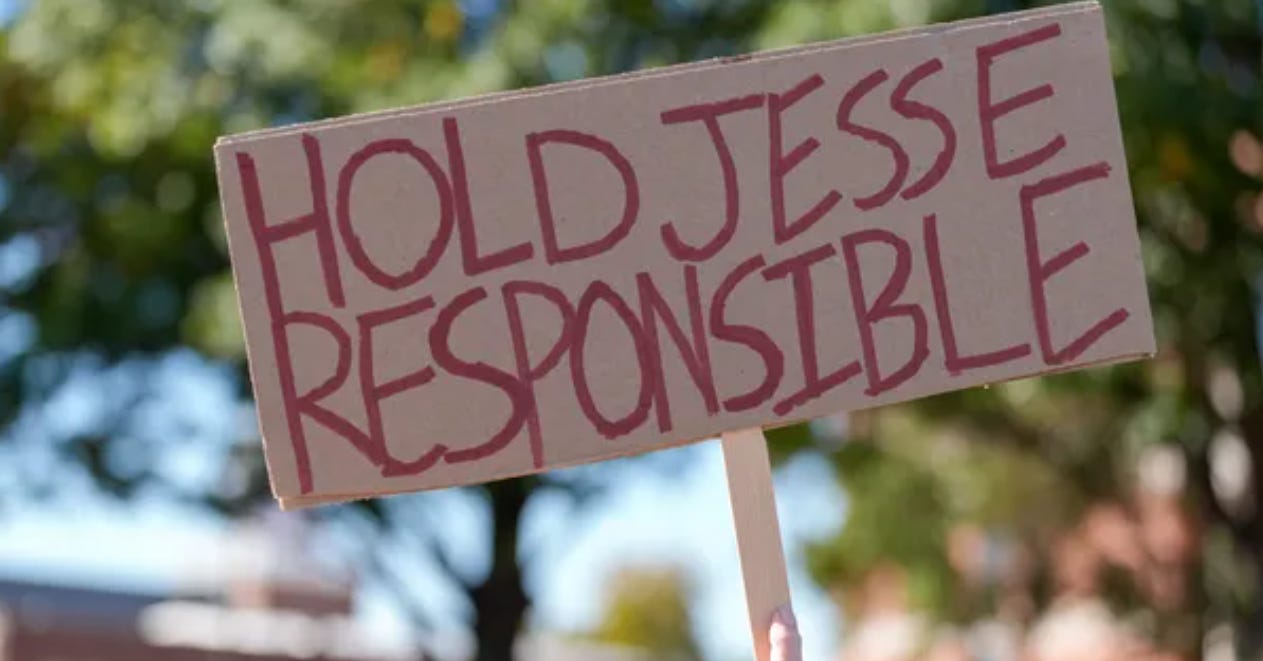
The Case That Stopped People Cold
Some stories don’t just enter the news cycle. They kick the damn door in. That’s what happened in Oklahoma when Judge Susan C. Worthington, a woman entrusted with the power to protect the vulnerable, handed Youthful Offender status to 18-year-old Jesse Mack Butler, who faced ten charges tied to the rape and sexual assault of two teenage girls.
With one ruling, Butler walked away with something his victims will never have again:
a clean slate.
No prison time. No felony record. No sex offender registry. Just a quiet path back to normal life, the same normal life he violently stole from two girls who will spend years trying to rebuild it.
And people didn’t just react. They erupted. Because we’ve seen this pattern before: the courts bending over backward to preserve a young man’s “bright future.”
However, this time, the outrage had a sharper edge. The judge was a woman.
That hit differently. Parents felt it in their gut. Survivors felt it like a fresh bruise. The question ricocheted across social media and kitchen tables alike: “If even a woman judge won’t stand up for girls who’ve been hurt, then who the hell will?”
This wasn’t just disbelief. It was betrayal, a betrayal that reveals something far more disturbing than one judge’s decision. Because the truth is bigger than her. The truth is heavier than her.
This is what it looks like when an institution built around protecting male offenders is so powerful, so deeply rooted, that even women who rise into its ranks end up enforcing its oldest, most harmful reflexes.
Gender didn’t save these girls. A generational worldview, fused with a male-designed judicial culture, steamrolled right over it.
That’s why this story matters, ot because one woman got it wrong, but because the system keeps getting it wrong, no matter who’s holding the gavel.
And that’s where we begin.
The System Doesn’t Change Just Because a Woman Sits Behind the Gavel
The easiest story to tell here would be the wrong one: that this happened because Judge Worthington is an outlier, a lone bad actor, a woman who somehow “should have known better.”
But that lets the real culprit off the hook, because what happened in this courtroom isn’t an anomaly but a product of the system itself.
Courts aren’t blank slates. They’re institutions soaked in decades of precedent, tradition, and prosecutorial norms, all built in an era when male perspectives defined everything from what counts as “real” violence to what a girl’s trauma is worth in the eyes of the law.
Women who enter that system don’t get to rewrite the rulebook. They inherit it.
They inherit the sentencing philosophies developed when sexual assault was called “misconduct.” They inherit plea-bargaining cultures that prioritize efficiency over accountability. They inherit legal language shaped around protecting the reputations and futures of young men long before women were allowed in the room at all.
So when a woman judge delivers a ruling that feels like a slap to victims everywhere, it isn’t because she woke up one morning and chose cruelty. It’s because the system she operates within was architected to give young male offenders the benefit of the doubt, and to treat girls’ pain as a regrettable footnote rather than a defining fact.
Judges, even female judges, don’t make decisions in a vacuum; they make them inside an ecosystem shaped by cultural norms that minimize sexual violence, legal frameworks written without survivors in mind, and institutional expectations that see rehabilitation for boys as more valuable than justice for girls.
That’s why this ruling looks so familiar. It is. It echoes the same blueprint we’ve seen in countless cases across the country: the instinct to protect the boy, not the girl.
The judge's gender didn’t change that blueprint. It simply exposed how deep it runs.
If the presence of a woman on the bench was enough to fix this system, we wouldn’t be writing this article. We’d be celebrating progress. Instead, we’re staring at the truth that makes people the most uncomfortable:
A system built to minimize sexual violence will continue minimizing it, even when a woman is the one holding the gavel.
The Generational Divide: Two Worlds, Two Realities
To understand rulings like this, you have to understand something that’s become almost taboo to say out loud. There is a massive generational divide in how sexual violence is perceived, processed, and punished.
For younger generations — teenagers, twenty-somethings, young parents — sexual violence is understood for what it is: a life-altering trauma, a breach of safety, a shattering of trust, and a violent crime with lifelong consequences.
For many older officials in the justice system, including judges who came of age in a totally different era, the framework is different. The vocabulary is different. The instincts are different.
They grew up in a world where:
sexual assault within a “relationship” wasn’t always viewed as assault,
girls were told to stay quiet to avoid shame,
boys’ futures mattered more than girls’ pain,
consent was assumed, not affirmed,
and trauma was something you were expected to overcome quickly, quietly, and without disrupting anyone’s life.
So when they see a teenage boy who hurt two girls, the first instinct — shaped by decades of cultural conditioning — is not to ask, “How do we protect the victims?”
It’s to ask, “Do we really want to ruin this boy’s life?”
That instinct didn’t come from malice. It came from a worldview that has simply not kept up with reality.
Judge Worthington didn’t invent this instinct. She inherited it, the same way thousands of judges, prosecutors, and court officers across the country did, an instinct born in a time before the word “consent” was mainstream, before survivors had language for what happened to them, before the justice system acknowledged trauma as more than a momentary inconvenience.
Younger generations reject that worldview outright. They understand digital grooming, coercion, peer pressure, and the psychological fallout victims live with. They don’t shrug off assault as “teen drama.” They don’t accept the idea that boys will be boys and girls will be fine.
However, in too many courtrooms, that outdated worldview still sits in the judge’s chair. This case exposed the collision of those two worlds: two girls living with trauma in 2025 and a judicial philosophy still operating, in many ways, from 1955.
This is why the public reaction wasn’t just outrage but exasperation and exhaustion. It was people finally saying what survivors have whispered for decades: “Why are we still fighting the same battles our mothers and grandmothers fought?”
If justice in America depends on which worldview a judge belongs to — the modern one that recognizes trauma or the old one that treats it like an inconvenience — then victims aren’t getting equal protection. They’re getting generational roulette.
And in this case, the roulette wheel spun exactly the way a broken system predicted it would.
Victims’ Trauma vs. Male “Potential” The Old Calculation
There’s a pattern that runs through cases like this, one so old and so familiar that survivors can recite it from memory. It’s the quiet, unspoken calculation many judges and prosecutors still make when a teenage boy stands accused of sexually assaulting a girl: What will this do to him? Not: What has this already done to her?
In courtroom after courtroom, state after state, that same equation plays out. The boy’s grades, his sports teams, his job prospects, his college plans — all become evidence of a future too bright to dim with accountability. Meanwhile, the girls he hurt become little more than collateral damage, wrapped in legal jargon and flattened into “victims” instead of people.
We saw it in the Stanford case, when Brock Turner’s father wrote that his son shouldn’t be punished so harshly for “20 minutes of action.” We saw it in Vermont, where a judge fretted that a teenage offender deserved a chance to “learn and grow” after a brutal sexual assault. We saw it in Florida, where prosecutors described a rape as “a complicated dating situation” to justify a lenient plea. And now we’re seeing it again in Oklahoma.
Different states. Different judges. Different victims. The same damn blueprint.
It’s the blueprint that treats girls’ trauma like a temporary detour, something they’ll push through with enough time and silence. It’s the blueprint that treats boys’ futures like fragile crystal, too precious to risk breaking, even when they’ve already shattered someone else’s life.
But trauma doesn’t evaporate when a judge signs a diversion agreement. There is no Youthful Offender program for the nightmares. There is no second chance for the trust those girls lost. There is no clean slate for the fear that now lives in their bodies.
These girls will carry the weight of what happened into every relationship, every future decision, every moment where the world suddenly feels unsafe, even in the middle of an ordinary day.
Meanwhile, the court worried about him missing out on his ordinary days.
And that’s the old calculation in its purest form: Her trauma is her burden. His potential is everyone’s priority.
Judge Worthington didn’t invent that calculation. She applied it exactly as the system taught her.
The result? The girls get a lifetime of managing wounds they never asked for. The boy gets a chance to pretend those wounds never happened. And the justice system calls that balance.
Why a Woman Judge Shocked People More and What That Reveals
The moment people realized the judge behind this ruling was a woman, the outrage took on a different tone — sharper, heavier, almost stunned. For many, the expectation was unspoken but deeply held: Surely a woman would understand what these girls went through. Surely a woman would see the danger in giving a teenage boy a free pass after ten counts of sexual assault. Surely a woman — if no one else — would stand between young victims and a system that has ignored them for generations.
That expectation wasn’t naïve. It was human.
Because when survivors look at the bench, they aren’t looking for perfection. They’re looking for someone who knows, someone who has lived in a world where girls learn early how vulnerable they are, someone who has seen the double standards, someone who understands the fear that lingers long after the moment has passed.
So yes, when the ruling came down from a woman, it hurt in a different way, not because women can’t make bad decisions — of course they can, but because it shattered a quiet hope people didn’t even realize they were holding.
Here’s the uncomfortable truth the system doesn’t want to admit: A woman can sit on the bench without having the girls on that bench in her line of sight.
It is not because she lacks empathy, but because empathy alone can’t override decades of institutional conditioning. Judges make decisions within the logic they were trained to trust. And too often, that logic still tells them that a teenage boy’s future is the most fragile thing in the courtroom.
Her gender didn’t outweigh the system’s instincts. It didn’t outweigh the generational worldview that minimizes sexual violence when the offender is young, known to the victims, or seen as “promising.” It didn’t outweigh a legal culture that normalizes plea deals designed to preserve the status quo.
If anything, her gender revealed just how powerful — and how universal — those instincts are.
What shocked people most wasn’t that a judge made this decision. It was that a woman judge did, and the result was no different than the rulings handed down by men in the hundreds of cases before this one.
The system swallowed gender whole and kept moving.
That’s the part that cuts the deepest. It means the fight for justice isn’t just against outdated men in old courtrooms. It’s against a worldview so entrenched that anyone can uphold it, even those you hoped would know better.
This case didn’t just challenge people’s trust in the judiciary. It challenged their trust in the idea that representation — on its own — is enough to fix systems built with bias at their core.
And when a woman judge hands down a ruling that mirrors the same old patterns, it forces a harder, more honest question: How deep does this bias run if even women, once inside the system, end up reinforcing it?
The Invisible Machine: Prosecutors, Plea Deals, and the Logic of Youthful Offender Culture
To understand how a case with ten sexual assault charges ended with no prison time and a clean record, you have to look beyond the judge and into the machinery behind the bench, the part of the justice system most people never see.
The courtroom is just the final stop. The real decisions happen long before anyone steps up to the microphone.
At the center of that machinery is a cultural reflex prosecutors have relied on for decades: plead it down, move it along, protect the stats, and avoid a trial at all costs.
Trials are risky, expensive. Trials can end careers if a jury doesn’t cooperate. Trials require victims — often teenagers — to relive trauma in front of strangers and cross-examinations designed to tear them apart.
So prosecutors lean on plea deals, judges lean on prosecutors, and victims often learn about the agreement only when it’s too late to stop it.
That’s how “Youthful Offender” status becomes the system’s favorite escape hatch. It looks good on paper: rehabilitation, second chances, fewer young people locked up. However, in practice, it’s increasingly used as a pressure valve, a way to resolve serious cases quietly, neatly, and without risking the mess of accountability.
And in sexual assault cases involving teenage girls, that valve gets turned far too often.
You could hear that logic creeping into the Oklahoma case when the district attorney framed the assaults as “complicated” because the victims and offender knew each other. That phrasing isn’t accidental. It’s a playbook move. When prosecutors want leniency, they call it “gray area.” When they want a conviction, they call it assault.
In this case, they chose leniency. Once prosecutors signal that they’re comfortable with a plea, most judges — male or female — follow suit. That’s not cowardice. It’s the culture. Judges trust the state. Judges trust the process. Judges assume that if a deal is on the table, it must reflect a careful weighing of evidence.
Yet too often, the plea reflects caseload pressure, not justice, reputation management, not accountability, institutional convenience, not the full weight of the harm done.
That’s how girls who were assaulted end up watching their cases evaporate into rehabilitation programs, sealed files, and promises that the boy who hurt them “deserves a chance.”
That’s how victims end up silenced, not by intimidation, but by procedure.
Judge Worthington’s ruling fits cleanly into that pattern. It wasn’t rogue or unprecedented. It was the system functioning exactly as designed: minimizing sexual violence when the offender is young, familiar, or deemed “redeemable.”
The machine doesn’t malfunction. It performs.
And in Oklahoma, it performed the way it has for decades — protecting the future of a young man who committed a serious crime, while treating the future of his victims as expendable.
That’s not justice. That’s maintenance. That’s keeping the machine running.
The Viral Outrage: When Social Media Becomes the Only Accountability Tool Left
If this case had stayed inside the courthouse, it likely would have disappeared the way so many cases like it do, sealed behind legal jargon, buried in youth diversion programs, swallowed by the quiet machinery of plea deals and paperwork.
But it didn’t stay hidden. It erupted.
One person, horrified by the ruling, posted the judge’s name and the case details on X. That single screenshot became a spark in dry brush, igniting a firestorm of anger, disbelief, and national attention.
In a matter of hours, what should have been a local courtroom footnote became a trending topic. People weren’t just sharing it. They were demanding to know how something like this could happen, how a woman judge could sign off on it, and why no institutional guardrails had stopped it.
Whether the tweet’s tone was appropriate is its own conversation, but what matters here is the truth it revealed: without that viral moment, the public would never have known.
That’s the state of justice in America right now — accountability by accident, not by oversight boards, judicial review, or transparency requirements, but by a stranger with a phone doing what the system refused to do: shine a light on a decision that profoundly failed two victims.
And that’s the part that should terrify anyone who cares about the rule of law. When the only mechanism for public accountability is a viral post, what does that say about the systems we’re supposed to trust?
Courts have always relied on opacity— proceedings tucked away, records sealed, plea deals negotiated in quiet hallways, victims told not to speak publicly, families left in the dark until the judge reads the sentence aloud.
But we don’t live in that world anymore.
Today, every courtroom is a potential front page — not because the courts choose transparency, but because the public forces it. Social media has become the emergency exit when the justice system locks its doors.
People weren’t outraged because the case went viral. The case went viral because people were outraged.
They recognized the pattern, the same old minimization of sexual violence, the same deferential treatment of young male offenders, the same institutional reflexes hiding behind the shield of “procedure.” And when an institution refuses to correct itself, the public will do it for them.
What happened in Oklahoma wasn’t a scandal because of social media. It was a scandal long before the first tweet. Social media just exposed it.
That exposure matters because it revealed a fundamental truth the justice system has spent decades trying to avoid: If people didn’t speak out, if the internet didn’t amplify their voices, predators would walk free, and the public would never know.
The court may not like that, but the victims needed it.
Without that viral outrage, this case would have joined the thousands of quiet failures the system expects no one to notice.
The Kitchen-Table Consequences, For Every Family Watching
Cases like this don’t just live in courtrooms or online threads. They land inside people’s homes. They sit with families at the kitchen table long after the headlines fade. Whether the legal system wants to admit it or not, this ruling didn’t just affect two victims. It sent a message to millions of girls, parents, and survivors across the country.
And the message was chillingly clear: If something happens to you, don’t count on the system to protect you. If something happens to your daughter, don’t assume the court will stand with her. If a boy with “potential” hurts her, the system may still see him as the real victim.
Parents felt this in their bones. They looked across their kitchen tables at daughters who are still growing into themselves, still figuring out trust and boundaries and safety, and wondered how they’re supposed to promise protection in a world where even a woman judge won’t deliver it.
Mothers recognized the sickening familiarity, the old warnings they grew up with resurfacing in real time: Don’t be alone with boys. Don’t drink too much. Don’t go to the bathroom alone. Don’t trust that the system will do right by you if something happens.
Fathers felt a different kind of dread — the helpless kind — knowing that they can teach their daughters strength and self-worth, but they cannot shield them from a legal culture that routinely undervalues their harm.
And survivors? They didn’t need anyone to explain this case to them. They’ve lived this outcome. They’ve walked out of courtrooms feeling invisible, minimized, or betrayed by people who were supposed to deliver justice.
This ruling confirmed a truth survivors have known for generations: the system is far more comfortable giving a second chance to a boy who hurts girls than giving justice to the girls who were injured.
That’s the kitchen-table impact, not abstract frustration, but fear— fear that the justice system isn’t a safety net at all, but a lottery, fear that accountability depends on the age of the offender, the worldview of the judge, and whether a prosecutor decides your trauma is “worth” pursuing.
And fear is powerful. Fear changes behavior. It shapes childhoods, adolescence, dating, trust, and confidence. Fear can redraw the boundaries of a girl’s life before she even understands what’s been taken from her.
We cannot ignore the message being sent to boys, either.
What does a ruling like this teach them? What does it teach the ones watching from afar? That sexual assault is a “mistake”? That the consequences are negotiable? That the courts will work overtime to protect their futures if they cross a line?
Rulings like this tell boys a different story than they tell girls: Boys get warnings. Girls get wounds. Boys get rehabilitation programs. Girls get trauma counselors. Boys walk out of court with a path forward. Girls walk out with a path they never wanted.
That’s the real-world impact. That’s the cultural cost.
That’s why families across America felt this ruling like an earthquake, because they recognized the tremor. It’s the same one their mothers felt, the same one their grandmothers felt, the same one survivors have been living with for decades.
This case didn’t just fail two young victims. It reminded an entire country that the system wasn’t built with girls in mind, and still hasn’t been rebuilt with them in mind.
A System That Won’t Fix Itself
Every part of this case — the plea deal, the Youthful Offender status, the generational worldview, the woman judge reinforcing an old male-designed script — points to the same brutal truth: This system is not broken, but working precisely the way it was built. It will keep working this way until we force it to change.
A system that consistently protects boys over girls is not malfunctioning but revealing its priorities. A system that hands second chances to offenders while handing lifetime scars to victims isn’t confused but consistent. A system that only becomes transparent when a tweet goes viral isn’t accountable, but hiding.
We keep asking individual judges to do what the system's architecture resists. We keep asking prosecutors to fight battles their incentives punish. We keep asking victims to trust a process that treats their pain as paperwork.
And nothing changes.
Why? Because the justice system doesn’t update itself. It doesn’t wake up one morning with a new conscience or a new algorithm. It doesn’t suddenly decide that girls’ trauma matters or that boys’ futures aren’t worth protecting at all costs.
It has to be dragged, pushed, confronted — loudly, relentlessly, publicly — until its reflexes are no longer tolerated and its old calculations become politically and culturally impossible to defend.
What happened in Oklahoma wasn’t a glitch. It was a warning, a neon sign flashing above a courthouse telling every parent and survivor in this country exactly what they’re up against.
Here’s the hardest part to swallow: If even a woman judge, in 2025, in the aftermath of #MeToo and a decade of cultural reckoning, still hands down a ruling that mirrors the same patriarchal instinct the system was built on, then we are nowhere near done.
Representation alone won’t save us. Gender alone won’t save us. Good intentions alone won’t save us.
We need structural change, not symbolic progress. We need transparency, not quiet plea deals. We need accountability for prosecutors and judges, not sealed files and diversion programs that vanish cases like smoke. We need sentencing standards that recognize trauma as real and irreversible, not guidelines that treat sexual assault like an unfortunate detour on a boy’s road to adulthood.
Most of all, we need a justice system that stops balancing a girl’s shattered sense of safety against a boy’s imagined potential, and finally sees those two things for what they are: Not equals. Not comparable. Not interchangeable. Not even in the same moral universe.
Until that changes, we aren’t talking about justice. We’re talking about maintenance, continuity, and the steady, predictable reproduction of harm wrapped in the language of law.
The people who benefit from that continuity are counting on the rest of us to get tired, quiet, and move on.
We’re not moving on, and we’re damn sure not tired.
The system won’t fix itself, so we will, with every article, every voice, every survivor who speaks out, every parent who refuses to accept this as normal, every person who refuses to let these cases disappear into the darkness the courts prefer.
Sunlight is pressure. Pressure creates change. This time, change won’t come from the bench but from the people watching it.
At the end of the day, this case didn’t just show us a woman judge reinforcing an old system. It showed us the truth that the system has never dared to say out loud. When a woman on the bench protects a boy who harmed girls, it proves the problem was never gender, but the institution that taught her to do it.
Support Independent Media And Help Us Keep Doing This Work
If you value journalism that refuses to look away, storytelling that names the systems failing our families, and reporting that legacy outlets won’t touch until it’s too late, then I’m asking you — directly — to support independent media.
The Coffman Chronicle isn’t backed by corporations or political campaigns. It’s fueled by readers who believe sunlight matters. It’s powered by people who refuse to let stories like this disappear into silence.
If you want more deep-dive investigations, more kitchen-table truth-telling, and more coverage that puts real people before institutions, consider becoming a paid subscriber today.
Independent voices only survive when the people they serve stand with them. If this work matters to you, help me keep the lights on and the pressure high.
Become a paid subscriber to The Coffman Chronicle, because legacy media won’t tell these stories, but we will.
Bibliography:
“Parents of Oklahoma Teen Sex Assault Victim Speak Out after Accused Attacker Avoids Prison.” ABC News, December 10, 2025.
“2023 Plea Bargain Task Force Report Urges Fairer, More Transparent System.” American Bar Association, February 22, 2023.
“Just Before Giving Stanford Rapist 6 Months, Judge Dealt Similar Case a Harsher Sentence.” Democracy Now!, June 9, 2016.
“After Brock Turner: Did the Stanford Sexual Assault Case Change Anything?” The Guardian, September 1, 2016.
“Outrage Mounts in Oklahoma over Plea Deal for Rapist: ‘That’s Sketchy as Hell’.” The Guardian, November 7, 2025.
“Guilty Pleas on the Rise, Criminal Trials on the Decline.” Innocence Project, July 8, 2018.
“Plea Bargains in Criminal Law Cases.” Justia, last modified October 18, 2025.
“Oklahoma Statutes § 10A-2-5-205 (2024) – Certification as Delinquent, Youthful Offender or Adult.” Justia, 2024.
“High School Baseball Star Who Pleaded No Contest to String of Rapes Walks Free – Sparking Outrage from Parents, Lawmakers.” New York Post, October 22, 2025.
“Fury Erupts after Accused Teen Sex Predator Dodges Prison; Families Swarm Courthouse Demanding Judge’s Head.” New York Post, November 6, 2025.
“Teen Facing Rape Charges Skips Prison Time; Deal Sparks Outcry in Stillwater.” The Oklahoman, October 24, 2025.
“Light Sentence for Stanford Rapist Sparks National Outrage.” PBS NewsHour, June 7, 2016.
“‘Love Shouldn’t Hurt’: Parents of Teen in Oklahoma Assault Case Break Their Silence after Judge Spared Her Ex from Prison.” People, December 10, 2025.
“In the Shadows: A Review of the Research on Plea Bargaining.” Vera Institute, 2022.
“Vermont Judge Sentences Convicted Child Rapist to 60-Day Sentence.” The Vermont Cynic, January 24, 2006.
Until men fear repercussions of all sexual assault, nothing will change. It is up to us to teach them the fear of repercussions. Rapists…..can’t live with ‘em, can’t kill them. Or can we?
T H I S is why I left Oklahoma decades ago--It's a toxic hellhole for girls and women in particular and all marginalized people. I've lived happily in Minnesota ever since. It's not perfect, but it's damn close.